


Looking for the real thing? Browse authenticated ancient rings, each piece one of one, individually authenticated, with documented provenance. For the background, see the guide to ancient jewelry.
Short answer and why a single age does not apply
The short answer is that there was no single pan-Hellenic age for girls to marry in ancient Greece, and the timing depends on the polis, social class and historical period; studies that aim to give a single figure typically mean a conditional range rather than a universal rule, and contemporary syntheses urge caution when turning literary or legal examples into population claims Oxford Research Encyclopedias article on marriage and the family and a general overview on Marriage in ancient Greece.
See provenance and restoration close-ups on @auroraantiqua
Explore curated dossiers and condition notes to see how dating and social context are presented for actual ancient rings.
Readers often point to Classical Athens as a commonly cited example where girls are frequently reported to marry in their mid-to-late teens, and to Sparta where standards and rituals produced later marriage ages in many accounts; these are useful starting points but not a universal pattern for the Greek world Metropolitan Museum of Art overview of marriage and family.
How historians estimate marriage age: sources and methods
Historians use three broad kinds of evidence to estimate marriage ages: literary and legal texts, epigraphy and funerary records, and the archaeological record. Each source class can point to practices or ideals, but none gives an unambiguous population average. Literary sources and legal speeches often describe norms or contested cases and therefore can be read carefully to indicate social expectations and elite practices Oxford Research Encyclopedias article on marriage and the family.
Epigraphic corpora collect inscriptions such as grave markers, dedications and legal texts; these are valuable because they are primary evidence and can sometimes include ages or familial indicators, but inscription datasets are biased toward particular social groups and male-commissioned texts, which complicates demographic inference Packard Humanities Institute epigraphic database.
Primary text collections and searchable editions are essential tools for cross-checking translations and context; projects that gather classical authors and inscriptions in searchable form allow scholars to test assumptions about terminology and to see how often certain age-related phrases appear in different genres Perseus Digital Library.
Classical Athens: what literary and legal sources suggest about mid-to-late teens
For Classical Athens much of the conventional phrasing about female marriage ages comes from legal speeches, dramatists and normative discussions that, when read together, point toward marriages commonly arranged in mid-to-late adolescence; many scholarly syntheses translate legal and narrative indicators into a working range often cited as roughly 14 to 17 for girls in certain social strata Metropolitan Museum of Art overview of marriage and family. See also Lives and Roles of Women in Classical Athens for further discussion.
Legal terminology and references in Athenian court speeches do not state a single statutory age that applied across all citizens, but they do allow historians to infer likely stages of life and marriageability by linking terms for maidenhood, guardianship and dowry arrangements to ages mentioned in context; such interpretive steps require careful philology and comparison across texts Oxford Research Encyclopedias article on marriage and the family.
There was no single age; marriage timing varied by polis, social class and period. Classical Athens often appears in sources as mid-to-late teens for some groups, Sparta shows later teenage patterns, and inscriptional and archaeological evidence are biased toward elites so averages for non-elite groups remain uncertain.
These Athenian sources should be treated as indicators of elite or legally contested cases more than straightforward demographic statistics, since surviving speeches and narrative texts mostly reflect the situations of families with legal visibility and the social weight to appear in the record Perseus Digital Library.
Sparta and other poleis: later ages and different rituals
Spartan girls are commonly described in scholarship as marrying later than Athenian girls, often in the later teenage years, within a set of social and ritual practices that emphasized different stages of female life and public visibility; comparative accounts highlight that Sparta's social structure and gendered rituals affected timing and the social meaning of marriage Cambridge University Press overview on Spartan women.
Beyond Sparta and Athens, many poleis had local laws, custom and dowry practices that produced divergent patterns; in some communities later adulthood or particular ritual prerequisites governed when formal marriage ties were established, so cross-polis comparisons must account for local legal frameworks and social roles Oxford Research Encyclopedias article on marriage and the family.

Social class, dowry and family strategy: why elites often married earlier
Elite families frequently arranged earlier unions for reasons such as alliance-building, securing lineage and managing inheritance, and those strategic pressures show up in legal texts and literary portrayals that focus on family negotiation and dowry settlements Oxford Research Encyclopedias article on marriage and the family.
Dowry practices could accelerate or delay marriage depending on economic circumstances and legal incentives; when a marriage consolidated property or political ties it could be arranged earlier, and conversely economic or demographic pressures could postpone formal unions, so dating of marriage must be read in connection with dowry and inheritance contexts Routledge's treatment of women in classical antiquity.

Because surviving funerary and legal records emphasize the choices and visibility of elite households, the ages commonly reported in syntheses should be read as reflecting those strata rather than all citizens; collectors who see an ornate ring with rich provenance might therefore be looking at material associated with higher-status social worlds rather than the daily life of less-documented groups Packard Humanities Institute epigraphic database. For related products see our rings collection.
Chronological shifts and regional variation: Archaic, Classical and Hellenistic trends
Comparative work shows that age norms shifted across centuries, with changes in political structures, property relations and cultural contact influencing when marriages were arranged; syntheses caution against collapsing Archaic, Classical and Hellenistic practices into a single number and instead recommend ranges that are tied to period and place Metropolitan Museum of Art overview of marriage and family.
In the Hellenistic period, broader Mediterranean contact and changing urbanism produced social transformations that could alter family strategy and the social timing of marriage; local variation remained important, so regional case studies are necessary to refine claims about average ages in any given century Oxford Research Encyclopedias article on marriage and the family.
Limits and biases in the data: what epigraphy and archaeology do and do not show
Epigraphy and archaeology are indispensable but uneven: inscriptional corpora and funerary markers are heavily weighted toward elite, male-sponsored texts and therefore cannot straightforwardly be extrapolated to represent whole populations, a limitation scholars explicitly note when reconstructing demographic pictures Packard Humanities Institute epigraphic database.
Archaeological finds such as rings, grave assemblages and domestic objects provide material context but rarely include direct age statements for owners; linking an object's date to an owner's age requires careful argumentation supported by provenance, associated inscriptions or reliable excavation records Perseus Digital Library.
Guide to inspecting inscription and primary text sources for marriage-age evidence
Use these resources to verify quoted ages and context
What this means when you look at an ancient Greek wedding band or ring
How dating and social context affect interpretation (ancient greek wedding bands)
When you see an ancient ring listed as a possible wedding band the object's date and iconography can suggest plausible social contexts but not the specific age of its wearer; a ring dated to the Classical period might be consistent with an owner who married in adolescence in some poleis, but that interpretation depends on social status, locale and the kind of ensemble the object was found with Metropolitan Museum of Art overview of marriage and family. See our ancient Greek rings collection for examples of typologies and condition notes.
Iconography such as certain intaglio motifs or inscriptions can suggest gendered use or social meanings, and condition notes that report wear consistent with long-term personal use may support an interpretation linking the object to life-cycle practices; still, linking an object directly to a wedding event or a specific age requires supporting documentation like inscriptions or secure provenance Oxford Research Encyclopedias article on marriage and the family.
How to read provenance, documentation and condition notes for age claims
Provenance can be decisive: documented collection history, verification letters or exhibition records that note findspot or associated inscriptions allow stronger inferences about social context than a bare typological date; when such documentation is absent, sellers and buyers should treat age-of-wear claims as informed suggestions rather than facts Oxford Research Encyclopedias article on marriage and the family.
Restoration and condition notes matter because modern repair or reassembly can obscure original features that might have helped confirm a funeral association or matching inscription; transparent restoration notes improve the interpretive value of a listing and help avoid misattributing later work to an ancient owner Packard Humanities Institute epigraphic database.
Suggested questions for sellers include asking for collection history, any documentation of findspot or associated inscriptions, details of conservation treatments and clear photographs of hallmarks or tool marks; such neutral requests help buyers assess how confidently a ring can be tied to a social context or a particular life-stage claim Oxford Research Encyclopedias article on marriage and the family. If you need to follow up with a seller, use the site's contact page to request collection history or provenance documentation.
Common mistakes and pitfalls when interpreting age claims
A frequent error is generalizing Athenian norms to all of Greece; treating a mid-to-late teen range from Athenian sources as a universal law ignores local law and custom and risks misreading objects from different polities Oxford Research Encyclopedias article on marriage and the family. For a comparative perspective on age at marriage in the ancient Mediterranean see The Age of Roman Girls at Marriage.
Another common pitfall is assuming that an inscriptional age or a commemorative formula equals the typical age at marriage for ordinary people; inscriptions reflect choices about what was remembered and who commissioned a text, and they therefore over-represent particular social perspectives Packard Humanities Institute epigraphic database.
Finally, collectors sometimes conflate the dating of an object with the age of its wearer: a ring dated to the fourth century BCE tells you when the object was made or used, not necessarily the age at which an individual wore it; contextual evidence is needed to make claims about wearer age plausible Perseus Digital Library.
Case studies: scenarios from Athens, Sparta and an inscriptional corpus
Hypothetical Athenian elite scenario: imagine an Athenian family arranging a marriage to cement a political alliance; an ornate ring with an intaglio and clear provenance to an elite burial might well belong to a woman whose marriage was arranged in her mid-to-late teens according to the kinds of legal and literary signals scholars rely on when they reconstruct Athenian patterns Metropolitan Museum of Art overview of marriage and family.
Contrasting Spartan example: in a Spartan context the same object type might imply different social pathways because Spartan ritual obligations, public female roles and social expectations often led scholars to reconstruct later average ages and distinct marital rites; a privately owned ring with Spartan ties therefore requires a different interpretive frame than one from Athens Cambridge University Press overview on Spartan women.
An inscriptional data point: a grave inscription that mentions a woman's marriage or familial role can be informative, but scholars read it alongside other local inscriptions and funerary patterns because a single inscription often reflects the commemorative choices of a family rather than a statistical average; large-scale inscriptional work is therefore necessary to move from anecdote to aggregate patterns Packard Humanities Institute epigraphic database.
Open questions and directions in contemporary scholarship
Important open questions include precise average ages for non-elite groups and systematic quantitative reconstructions based on regional inscription corpora; scholars in 2026 continue to emphasize variability and the need for careful, context-sensitive ranges rather than single-age claims Oxford Research Encyclopedias article on marriage and the family.
Methodological advances that could improve reconstructions include larger-scale digital analyses of inscriptional corpora, improved publication of excavation contexts and interdisciplinary combinations of demography, philology and material culture studies to triangulate social practices more robustly Packard Humanities Institute epigraphic database.
How to responsibly present age ranges in listings and educational content
Preferred language is conditional and specific: use phrases such as 'likely within the mid-to-late teens in certain Athenian elite contexts' or 'consistent with later teenage marriage in some Spartan accounts' rather than asserting a universal age; this matches the scholarly caution recommended in syntheses Oxford Research Encyclopedias article on marriage and the family.
Sample provenance phrasing: 'Dated to the Classical period; provenance: private collection with exhibition history; no associated inscriptions identified. Suggested social context: fits elite domestic assemblages where mid-to-late teen marriage is often reported in Athenian sources, but evidence is circumstantial.' Such phrasing clarifies what is documented and what is inferred.
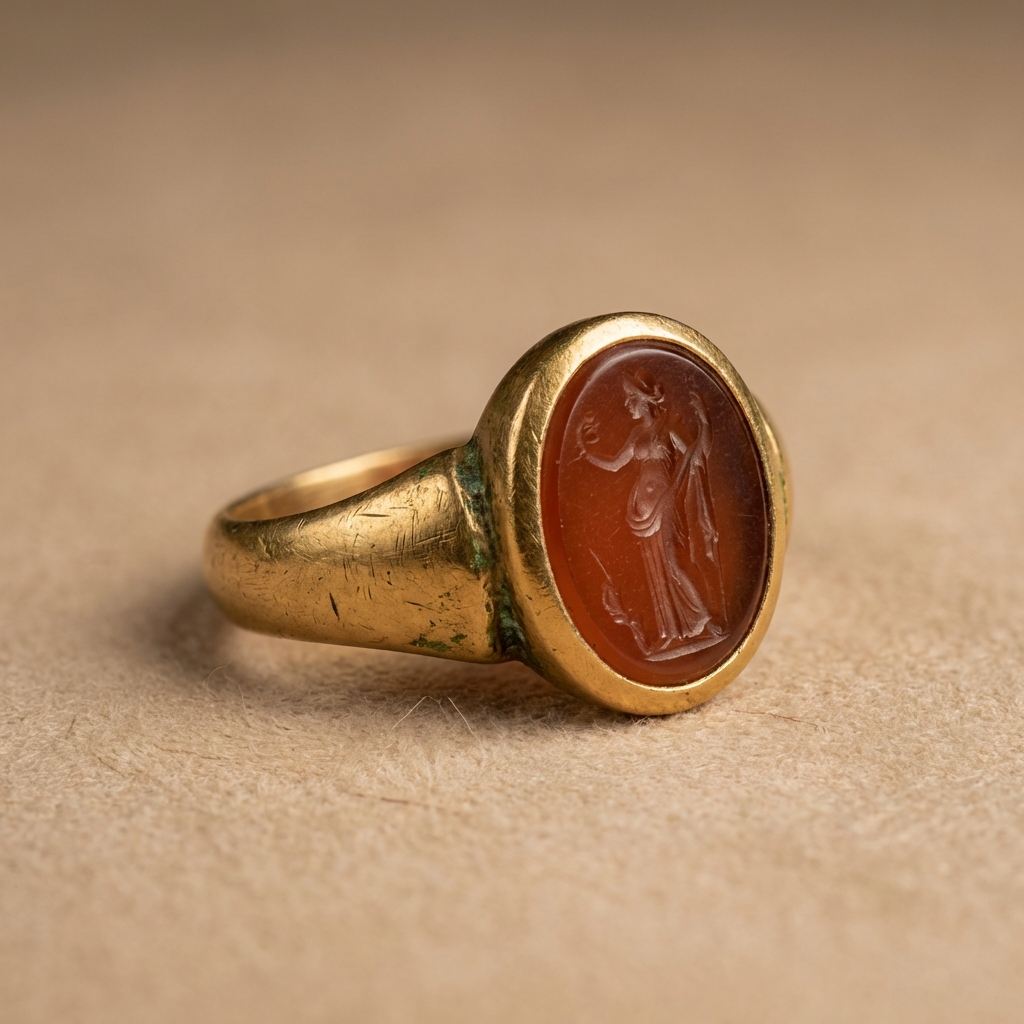
Keep restoration notes explicit and factual, for example: 'Stabilized fracture to bezel; original wire soldered to hoop; no modern refits to intaglio surface observed' rather than implying restoration affirms an object's social use, because conservation language helps readers judge interpretive weight.
Conclusion: what readers should take away about age and ancient Greek wedding bands
Key takeaway: age norms for girls' marriages in ancient Greece varied by polis, social class and historical period, and responsible summaries present conditional ranges tied to specific kinds of evidence rather than a single pan-Hellenic age Oxford Research Encyclopedias article on marriage and the family.
For collectors: prioritize clear provenance, transparent condition and restoration notes, and any associated inscriptions when assessing claims that a ring functioned as a wedding band for a wearer of a particular age; consult primary sources or specialists when listings make specific life-stage claims Packard Humanities Institute epigraphic database. Research and listings examples are available in our ancient Greek rings collection.
Athenian sources point to marriages often arranged in mid-to-late adolescence for some families, but this reflects particular legal and elite contexts rather than a uniform rule for all social groups.
Scholarship indicates Spartan girls often married somewhat later than many Athenian cases, but this pattern is tied to Spartan social roles and ritual practices and is not universal across all regions.
No, an object's date tells when it was made or used; determining the wearer's age requires inscriptions, secure provenance or contextual evidence and should be presented as a cautious inference.
More from Aurora Antiqua
References
- Trésor hellénistique trouvé à Délos en 1964, École française d'Athènes, via Persée
- "Sappho" Earring, Harvard Art Museums / Arthur M. Sackler Museum, Cambridge, Massachusetts
- boucle d'oreille, Louvre site des collections, Musée du Louvre, Département des Antiquités grecques
- Earring, Dumbarton Oaks Research Library and Collection, Trustees for Harvard University
- Pair of Earrings, Dumbarton Oaks Research Library and Collection
- Hellenistic Gold Eros Jewellery: Technique, style and chronology, BAR Publishing, Oxford, via Fulcrum
- Aulus Gellius, Attic Nights, Book X, LacusCurtius, Bill Thayer, University of Chicago (Loeb Classical Library edition)