


Looking for the real thing? Browse our Medieval ring collection, each piece one of one, individually authenticated, with documented provenance. For the background, see the guide to medieval jewelry.
What a medieval pendant is and why symbols matter
A medieval pendant is a small, portable ornament worn suspended from a cord or chain, often bearing a motif, inscription or reliquary compartment that communicates devotion, identity or protective purpose. Typical forms include pendant badges linked to pilgrimages, small reliquary pendants that could contain a relic or cloth fragment, and signet-mounted pendants that derive from seal imagery; each form can carry different expectations about original use and social context. In many cases an individual object described as a medieval pendant will need to be read through its motif, manufacturing technique, material and any available provenance to reach a cautious interpretation.
Symbols on pendants often worked at several levels at once: they could mark devotion, signal family or office, and serve an apotropaic function depending on date, region and wearer status. For a practical introduction to these layered readings, museum overviews provide helpful comparators for both form and function V&A's medieval jewellery overview.
a short how-to photograph tip for remote appraisal
natural light and multiple angles
Historical overview: how symbols shifted from roughly 500 to 1500 on medieval pendants
Across roughly c. 500 to 1500 CE the repertoire of motifs on wearable objects changed as Christianity became visually dominant and as social structures produced new visual needs. Early medieval pendants increasingly used Christian iconography as a primary communicative layer, while later medieval centuries saw the rise of heraldic and secular devices as badges and signets became more widespread. This broad chronological pattern is reflected in major museum galleries and object surveys British Museum medieval Europe gallery summaries.
Workshop practices and material availability also shaped which symbols were most common in any given era. Workshops reused efficient motifs and casting methods for popular jewellery, while more elaborate intaglio work or gold settings tend to survive in contexts associated with higher status. Use patterns therefore reflect both ideology and practical production choices, and dating benefits from combining stylistic reading with technical evidence.
Christian symbols commonly found on a medieval pendant
Crosses, Christograms and the Star of Bethlehem
Christian symbols are among the most frequently represented motifs on pendants and rings from the early to late Middle Ages. Plain crosses, cruciform devices, Christograms such as the chi-rho, and star motifs that can refer to nativity themes appear commonly and often indicate devotion or pilgrimage associations; museum catalogues offer many visual examples for comparison V&A's medieval jewellery overview.
To recognise these forms on a small object, note the overall composition and any intentional centerpoints, such as inset gems or engraved lines, which can signal a Christological intent rather than a simple geometric decoration. Pilgrim badges and pendants that link to particular shrines often carry additional signs such as place-names or saintly emblems that help identify the intended cult.
Saints attributes and pilgrimage marks
Pendants associated with pilgrimage frequently bear saints' attributes small, reproducible icons that help identify a saint and, by extension, the shrine associated with the journey. Books, keys, palm fronds or specific animals are typical attributes that, when paired with inscriptions or provenance notes, strengthen a devotional reading British Museum medieval Europe gallery summaries.
When an attribute is present but the object lacks secure provenance, compare the iconography and any inscription to museum object entries and published exemplars rather than assuming an immediate identification.
Protective amulets, inscriptions and talismans on medieval pendants
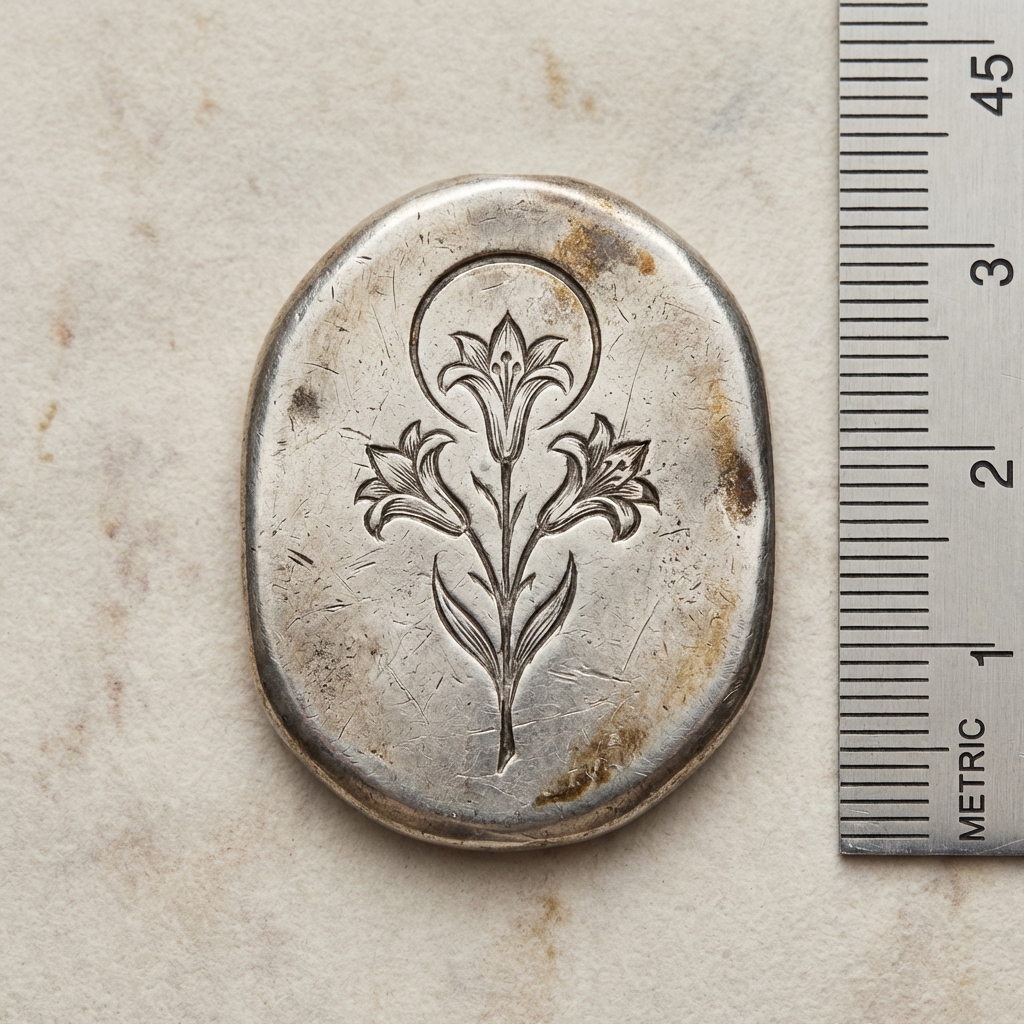
Protective amulets and inscribed talismans continued alongside explicitly Christian jewellery throughout the medieval period, including pendants bearing engraved invocations, saints' names or apotropaic symbols. These objects can function as devotional items and protective devices at the same time, and they are well attested in both museum collections and medieval textual sources Jaspar, Melchior, Bal…, ein Fingerring aus Kupfer (a copper finger ring), Lüneburger Stadtarchäologie.
To document an inscription on a pendant, photograph the detail with raking light, transcribe letter forms carefully, and compare the sequence to documented parallels; museum catalogues and object reports often record similar formulae and provide interpretive notes that are useful for reading medieval amulet meanings.
Heraldry and secular badges: identity, office and allegiance on medieval pendants
Heraldic devices and secular badges increase in prevalence from about the 12th century and often mark family, office or political allegiance on jewellery and badges. Signet-style devices and badges drawn from seal motifs became portable identifiers in both elite and non-elite contexts Encyclopaedia Britannica on heraldry.
These motifs can be informative about identity, but they require careful cross-checking against provenance and technique; later surface work or modern restorations can sometimes introduce heraldic imagery that is not original to the piece.
Common symbols include Christian motifs, saints' attributes, heraldic devices and natural motifs; collectors should read these in combination with material, technique and provenance and compare them to museum catalogues for confident interpretation.
When attempting to identify a family device on a pendant, ask for any documented collection history and compare the motif to dated seal impressions or museum-held signets rather than relying only on stylistic resemblance.
Natural motifs on a medieval pendant: animals, plants and hybrid creatures
Birds, beasts, foliage and hybrid creatures appear widely on medieval jewellery and can be read as decorative, symbolic or protective depending on context. These motifs were often part of a workshop repertoire, which led to regional groups of stylistically related designs Metropolitan Museum of Art overview on medieval jewellery. Examples include emblematic representations and specific subjects such as the V&A pelican pendant The Pelican in her Piety.
In many cases the same animal or vegetal motif can carry multiple associations: it may be a general ornament, a heraldic reference, or an apotropaic emblem depending on accompanying signs, inscriptions or find context. For identification, visual comparators in museum collections help separate local stylistic variants from broadly distributed decorative types.
See restorations and provenance details on Instagram
If you want a concise reference, download the identification checklist PDF to keep with object photos for remote comparisons.
Workshops frequently reused popular animal and plant forms because they were economical to cast or stamp. Recognising a regional treatment of an animal motif may require looking at proportions, line quality and repeat counts, which museum object notes often describe in detail.
Practical identification checklist for a medieval pendant
Collectors can use a short five-step checklist to assess a pendant before purchase: identify motif type, record manufacturing technique, note material and patina, transcribe any inscription, and verify provenance or documentation. Recording these points in order makes later comparison with museum catalogues clearer and more reliable British Museum medieval Europe gallery summaries.

For remote consultation, photograph the whole object from several angles with a metric scale and a clear close-up of the motif and any tool marks; these records are essential when consulting object reports and comparators in catalogues. Aurora Antiqua provides condition and documentation notes to accompany listings, which can help buyers understand restorations and provenance statements. For a concrete comparator see the V&A reliquary pendant entry Pendant | Unknown | V&A.
When using the checklist, assign a confidence level to each item to reflect gaps in provenance or technical description. Museum catalogues are useful comparators, but differences in conservation history and prior repairs can complicate straightforward matches.
Materials, techniques and what they tell us about dating a medieval pendant
Materials and techniques contribute important clues for dating and social reading. Intaglio gems and gold settings often indicate earlier or higher-status contexts, while cast bronze and silver are frequently associated with later and more popular production. These broad tendencies are discussed in museum object overviews and technical notes Metropolitan Museum of Art overview on medieval jewellery.

Key techniques to record include intaglio carving, casting marks, bezel construction, and traces of gilding or solder repairs. Restoration notes that describe stabilised areas or filled losses should be read carefully because they affect surface evidence used to read motifs and inscriptions.
Workshop styles, regional variants and attribution challenges for pendants
Regional stylistic variants are often visible in motif treatment, metalwork execution and gem cutting, and recognising these families can assist attributions to likely workshops or production zones. Comparative catalogues and object groups in museums provide useful reference points for these patterns V&A collection notes on regional motifs.
Attribution without find context or clear provenance remains probabilistic. Combining stylistic reading with technical evidence and documented comparators gives the strongest basis for assigning a probable workshop or region, but any conclusion should be framed as likely rather than certain.
Common misidentifications and typical errors when reading symbols on pendants
Frequent mistakes include assuming a motif is original when it may be a later addition, and overreading decorative motifs as having symbolic meaning without contextual support. Such errors are common in market descriptions and can be mitigated by careful attention to patina, tool marks and restoration notes British Museum advice on object identification.
Simple checks to avoid misidentification are to compare the patina across adjoining surfaces, inspect for inconsistent tool marks, and request any restoration records before accepting symbolic readings as original.
Care, preservation and reading restoration notes for collectors
Restoration and preservation notes typically record what has been stabilised, where repairs were carried out, and which surfaces were intentionally left untouched. Clear condition photos that show these areas help readers assess how surface evidence might have been altered by conservation choices V&A's medieval jewellery overview.
When restoration has altered decorative surfaces, it may obscure incised inscriptions or tool marks that are essential for reading symbols. Ask sellers for before-and-after documentation where possible, and prefer conservative conservation that records interventions in the object report.
How provenance and documentation change interpretation of a pendant
Types of provenance documentation that strengthen interpretation include collection history entries, prior ownership notes, and verification letters or object reports. Such documentation allows a reader to link an object to a find context or a dated collection, improving confidence in stylistic and iconographic readings V&A's notes on provenance.
When provenance is incomplete, treat attributions as tentative and use museum comparators to bracket probable dates and functions rather than asserting firm conclusions.
Practical examples: museum comparators and case studies of medieval pendants
Comparing a devotional pendant with a heraldic badge shows how material, technique and provenance combine to support different readings. A small leaded devotional pendant with a clearly incised cross and shrine inscription is likely linked to pilgrimage use, while a cast metal badge with a clear device and association in an object report is more plausibly a secular badge; museum object reports illustrate both trajectories British Museum object summaries and specific object entries such as the British Museum pendant H_1979-1103-1.
Another useful comparison contrasts a pendant bearing a hybrid beast rendered in a regional line style with a similar-appearing object in a dated museum collection; matching line quality and casting seams can indicate a common workshop practice and narrow probable date ranges.
Conclusion: reading meaning, context and next steps for collectors
Symbols on a medieval pendant are rarely singular in meaning. The most reliable readings combine motif, manufacturing technique, material and provenance, and treat attributions as probabilistic rather than definitive. Use the identification checklist, consult museum catalogues and request condition and provenance documentation to strengthen any interpretation British Museum medieval Europe gallery summaries.
Aurora Antiqua aims to provide condition notes, restoration descriptions and contextual text to help collectors make informed decisions without asserting absolute authenticity guarantees.
Look for clear devotional signs such as crosses, Christograms, saints' attributes or pilgrimage inscriptions; combine these with provenance and technique notes to increase confidence.
Yes, inscriptions narrow readings when transcribed and compared to documented parallels, but dating should also consider material, technique and find history.
Request condition photos, restoration notes, documented provenance and measurements, and ask for close-ups of inscriptions or tool marks.
More from Aurora Antiqua
References
- Ring, Victoria and Albert Museum, London
- Jaspar, Melchior, Bal…, ein Fingerring aus Kupfer (a copper finger ring), Lüneburger Stadtarchäologie
- anello, opera isolata, ambito Italia centrale (sec XV) anello ca, Istituto centrale per il catalogo e
- Devotional finger ring, London Museum (formerly Museum of London)
- Ring, Victoria and Albert Museum, London
- Trésor de Colmar : bague de mariage juive, POP, Ministere de la Culture, Plateforme ouverte du patrimoine POP
- Medieval gold signet ring, Collections Online, Amgueddfa Cymru, Museum Wales, Cardiff
- Reliquary Cross with the Arms of the Veltheim Family, Brunswick, c. 1300, Art Institute of Chicago
- Pendant, Victoria and Albert Museum
- The Pelican in her Piety, Victoria and Albert Museum