


Looking for the real thing? Browse our full ring collection, each piece one of one, individually authenticated, with documented provenance. For the background, see the guide to ancient jewelry.
What is a Pinchbeck locket? Definition and context
A Pinchbeck locket is best understood as a decorative locket made, or finished, in an imitation-gold alloy that was developed in London in the 18th century and used widely for affordable jewellery and small personal objects; the alloy and its use are described in specialist reference sources on historic metals Encyclopaedia Britannica.
In practical terms, a Pinchbeck locket typically presents a warm yellow tone similar to gold but, unlike gold, it is not a precious metal and is therefore seldom hallmarked; collectors therefore rely on physical characteristics and documentation rather than hallmarking to support attribution. For context, Pinchbeck pieces are generally dated to the late 1700s through the 19th century, which places them well after true medieval lockets in time and technique.
The short, practical reason this matters to collectors is that the alloy category affects how a piece is described, conserved and valued. Calling a piece a Pinchbeck locket signals a copper-rich brass-like material and an 18th to 19th century manufacturing context rather than a medieval date, which changes expected condition notes, likely repairs, and documentation priorities.
How a Pinchbeck locket differs from a medieval locket
Comparing a Pinchbeck locket with a medieval locket helps clarify dating and material expectations. A medieval locket normally predates 16th century workshop practices and often uses different base metals, simpler joining methods, and iconography linked to medieval devotional or secular motifs; a warm yellow modern-looking alloy commonly indicates a later date and should prompt further checks rather than immediate dating by style alone.
Behind-the-scenes on @auroraantiqua
Aurora Antiqua presents curated listings with clear condition notes and provenance-style information to help collectors compare materials and dating without assuming certainty.
Pinchbeck was developed in 18th century London as an imitation gold alloy and so any locket described as Pinchbeck should be treated as likely postmedieval, typically late 1700s onward, unless good documentation says otherwise Victoria and Albert Museum.
That said, visual similarity alone is not proof. Later brass reproductions and revival jewellery can mimic Pinchbeck tone, and some makers in the 19th century deliberately copied medieval forms. When style or motifs look older but the metal finish appears unusually bright and warm, proceed cautiously and seek further evidence.

History and composition of Pinchbeck
The alloy commonly called Pinchbeck is credited to London makers in the 18th century and has been discussed in museum and reference literature as a stable historical category of imitation gold Encyclopaedia Britannica.
Most period descriptions and later analyses characterise Pinchbeck as a copper-rich brass. Historical accounts often report a formulation described as roughly five parts copper to one part zinc, which is roughly 80 to 85 percent copper and 15 to 20 percent zinc; that mix produces the warm yellow tone associated with the alloy British Museum.
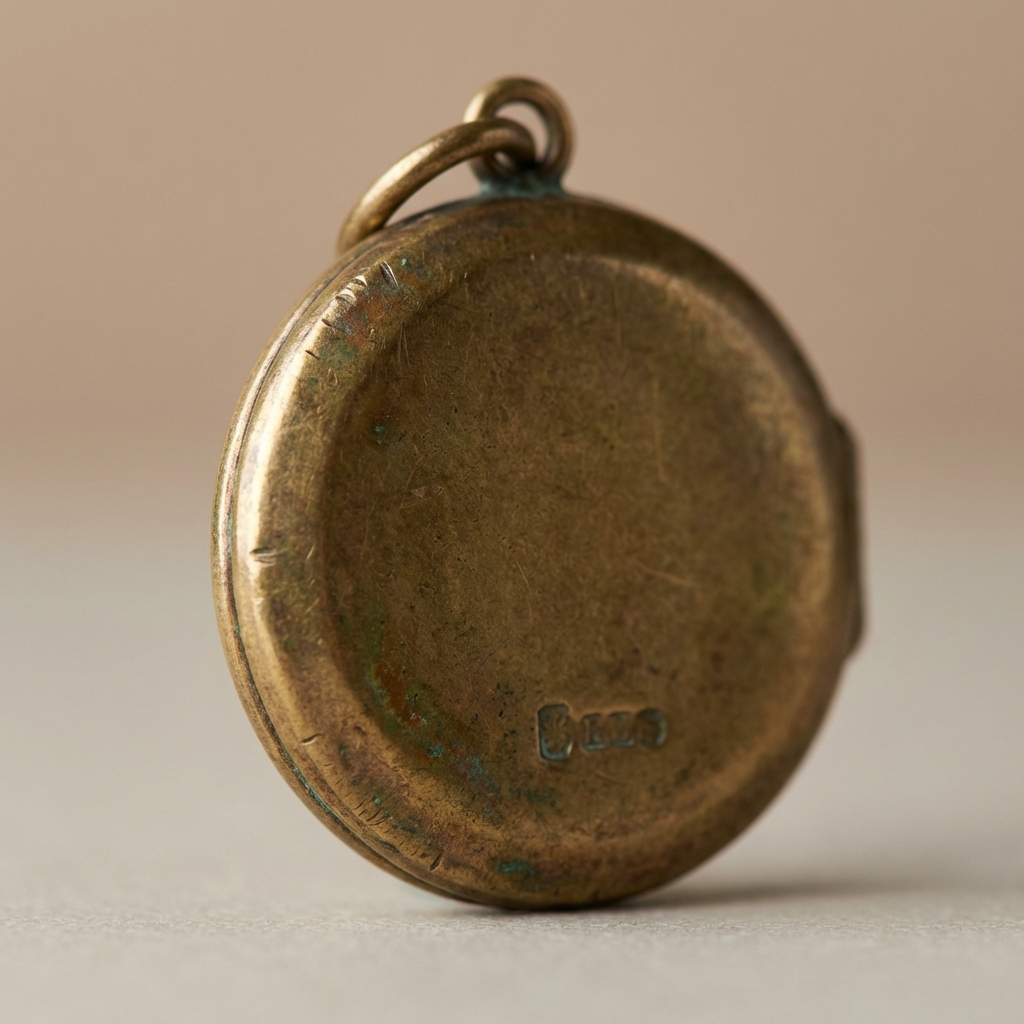
It is important to note that recipes and workshop practices could vary by maker and period, so the precise alloy for any individual locket may be uncertain without elemental analysis. For collectors this means the label Pinchbeck indicates a family of copper-rich brasses rather than a single, identical alloy recipe.
Visual cues: spotting a Pinchbeck locket
Practical visual cues for identifying a likely Pinchbeck locket include a warm yellow colour that may mellow with age, patina and surface wear consistent with use, and an absence of official precious-metal hallmarks; museums and object-care guides describe these indicators and their limits Victoria and Albert Museum.
Look closely at areas of repeated handling such as the hoop, rim and bezel where wear, rubbing or small losses of surface finish reveal underlying metal tones. A convincing age-appropriate patina, consistent wear on edges, and repair marks can support a later 18th or 19th century attribution when combined with other evidence.
Compare material and manufacturing cues, request close-up photographs of seams and the hoop, perform non destructive checks such as a magnet test, and seek handheld XRF or specialist analysis when price or provenance justify it.
Because Pinchbeck is not a precious metal, official hallmarking is generally absent; when maker names or provenance references appear in listing or collection notes they can help compensate for the lack of a hallmark, but such documentation should be assessed alongside physical evidence and any available testing Historic England.
Simple non destructive checks collectors can try at home
Collectors can perform a small set of careful, non destructive checks that may indicate Pinchbeck rather than proving it. Start with weight and heft comparison against similar-sized items; a brass-like alloy will feel denser than many late plastic or base-metal fakes but lighter than solid gold of the same size.
Use a small magnet to confirm nonferrous behaviour; Pinchbeck and most brasses are not magnetic, so a magnetic response usually signals a ferrous component or a modern assembly. Avoid forceful or invasive testing and document findings with close photographs and notes Conservation science notes.
Very cautious surface scratch checks can reveal underlying metal colour but carry risk of damage and should only be done by experienced hands or with seller permission. When available and appropriate, handheld XRF can give a quick elemental readout (see handheld XRF guides) that supports a copper-rich brass identification; reserve destructive sampling or aggressive probes for laboratory settings and consult a conservator if corrosion is present Conservation science notes.
When to seek lab analysis and professional tests
Handheld XRF and laboratory elemental analysis become valuable when price, rarity, provenance ambiguity or conservation concerns justify the cost; handheld XRF can identify a copper-rich brass surface consistent with Pinchbeck but has limits where surface enrichment, plating or heavy corrosion obscure bulk composition (see alloy analysis resources) Conservation science notes.

Request any existing lab reports or XRF readouts when negotiating a purchase. If results are absent and the object is of significant cost or provenance importance, ask the seller whether third-party testing can be arranged or whether a short examination by a recognised specialist is possible.
Conservation and caring for Pinchbeck lockets
Conservation guidance for Pinchbeck follows standard museum practices for copper alloys: avoid abrasive cleaning and strong polishes, control storage humidity, and stabilise active corrosion through a conservator rather than home treatments Museum Conservation Department guidance.
Simple safe storage includes clean, inert packing materials, low relative humidity and avoiding direct contact with acidic papers or some fabrics that can accelerate corrosion. If a locket shows active verdigris or powdering corrosion, stop handling and seek specialist assessment.

Document any restoration or repairs in condition notes and, where restoration has been performed, ask for clear records of materials and techniques used. Preservation-minded buyers should prefer reversible and minimal interventions and expect to see restoration notes in curated listings.
Authentication and valuation: decision criteria for buyers
Good authentication combines visual inspection, non destructive tests, photographic and microscopic documentation, provenance or maker attribution when present, and specialist or laboratory verification when warranted. This combined evidence approach helps separate confident attributions from plausible descriptions Victoria and Albert Museum.
simple decision aid to prioritise tests based on price and provenance
higher score indicates testing is justified
Valuation depends more on condition, rarity, and provenance than on alloy alone. A well documented Pinchbeck locket with clear provenance and careful restoration notes can be more desirable to a collector than a poorly documented gold-tone piece without history; conversely, unattributed pieces sell primarily on condition and visual appeal rather than alloy category.
Common mistakes and red flags when assessing lockets
One frequent error is overrelying on colour or shine alone to date or categorise a locket. A bright gold-like tone can come from modern brass finishing or heavy polishing that removes surface patina; assume colour is suggestive but never conclusive without other evidence Victoria and Albert Museum.
Other red flags include vague condition notes, missing photos of critical areas such as the hoop and bezel, claims of hallmarks for nonprecious alloys, and pressure sales language that discourages third-party inspection. These should prompt caution and a request for more documentation or return terms.
To mitigate risk, ask for close photographs, microscope images of seams and joins, and any provenance or maker details. If a seller cannot provide basic documentation or clear images, treat the listing as higher risk and consider asking for a short inspection before committing.
Practical examples and scenarios collectors may encounter
Scenario one: a well documented Pinchbeck locket offered with a clear chain of custody, photographs of the interior and exterior, and a brief conservator note. In this case, the buyer should prioritise checking any XRF or lab notes and confirm what restoration if any was performed; strong provenance reduces the immediate need for further invasive testing Victoria and Albert Museum.
Scenario two: a visually convincing warm yellow locket with no documentation. Here, the practical steps are to request high-resolution images of the hoop, bezel and any maker marks, perform safe non destructive checks such as a magnet test, and, where the price justifies it, arrange a handheld XRF or specialist inspection before purchase (see what XRF can and cannot analyze) Conservation science notes.
Scenario three: a modern brass reproduction sold as antique. Look for tool marks inconsistent with historic workshop methods, very even new surface finishing, absence of patina in expected areas, and sellers unwilling to disclose restoration or permit inspection. These signs warrant returning to the seller for clarity or walking away.
Buying checklist and closing summary
Buyer checklist: request clear condition notes and any provenance, ask for close-up photos of hoop, bezel and seams, perform safe home checks (weight comparison, magnet test), document findings with photos, and consider handheld XRF or lab analysis when price, rarity or uncertainty justify it Conservation science notes.
Prioritise condition notes, documented provenance and conservator input for any active corrosion or restoration. Remember that Pinchbeck denotes an 18th century imitation-gold alloy category rather than a guarantee of a specific recipe for any single locket; confident attribution usually relies on combined evidence from visual inspection, documentation and testing Encyclopaedia Britannica.
By using cautious, conservator-informed steps and clear documentation, collectors can make informed decisions about acquiring lockets described as Pinchbeck and avoid common pitfalls when visual attractiveness masks later reproduction or undisclosed repairs.
Pinchbeck lockets are generally dated to the late 18th century through the 19th century; precise dating for any piece should combine stylistic evidence with documentation or analysis.
Colour alone is not definitive; a warm yellow tone suggests a copper-rich brass but should be verified with non destructive tests and documentation before accepting the attribution.
Avoid abrasive cleaning and strong polishes; use gentle dusting and seek a conservator for active corrosion or uncertain restorations.
More from Aurora Antiqua
References
- Hallmarking Guidance Notes: practical guidance in relation to the Hallmarking Act 1973, the UK Assay Offices
- Hallmarking Act 1973, The National Archives / legislation.gov.uk, UK
- 16 CFR 23.3, Misrepresentation as to gold content, Federal Trade Commission, eCFR
- Gesetz über den Feingehalt der Gold- und Silberwaren (FeinGehG, German law on gold and silver fineness), Bundesministerium der Justiz
- Hallmarking, The Assay Office Birmingham
- Investigating Ancient “Bronzes”, J. Paul Getty Museum and Getty Conservation Institute, Los Angeles
- Portable XRF for paintings and metals authentication, npj Heritage Science (Springer Nature), DOI
- Conserve O Gram 10/2: Caring For Silver And Copper Alloy Objects, National Park Service, US Department