


Looking for the real thing? Browse authenticated ancient rings, each piece one of one, individually authenticated, with documented provenance. For the background, see the guide to ancient jewelry.
Quick answer and definition: what we mean by an "ancient Claddagh ring"
The shortest, evidence-based answer is that the oldest reliably datable surviving Claddagh rings are placed in the 17th to 18th centuries, based on museum catalogue work and specialist Galway sources, so collectors should treat claims of markedly earlier dates with caution Claddagh Rings, National Museum of Ireland, Dublin.
By "ancient Claddagh ring" for the purposes of this article we mean a surviving ring that carries documentary or material evidence allowing a secure early date assignment, such as hallmarks, contemporary accession records, or reliably published provenance; that practical definition is what collectors most often need when evaluating an early-date claim.

Different audiences use "oldest" in different ways. Some mean the earliest surviving example that can be demonstrated in a public collection or catalogue, while others mean the earliest securely excavated or scientifically tested instance; in published and museum work the first meaning is the norm because many private pieces lack excavated contexts.
Dating techniques that underpin the short answer include assay and maker hallmarks for post-1700 silver, detailed provenance and accession notes in museum catalogues, stylistic comparison with dated examples, and, where necessary, material analysis; together these methods form the evidentiary basis for placing the earliest surviving Claddagh rings in the 17th to 18th centuries Claddagh Ring Museum.
How museums and assay records help date early Claddagh rings
Hallmarks and assay marks
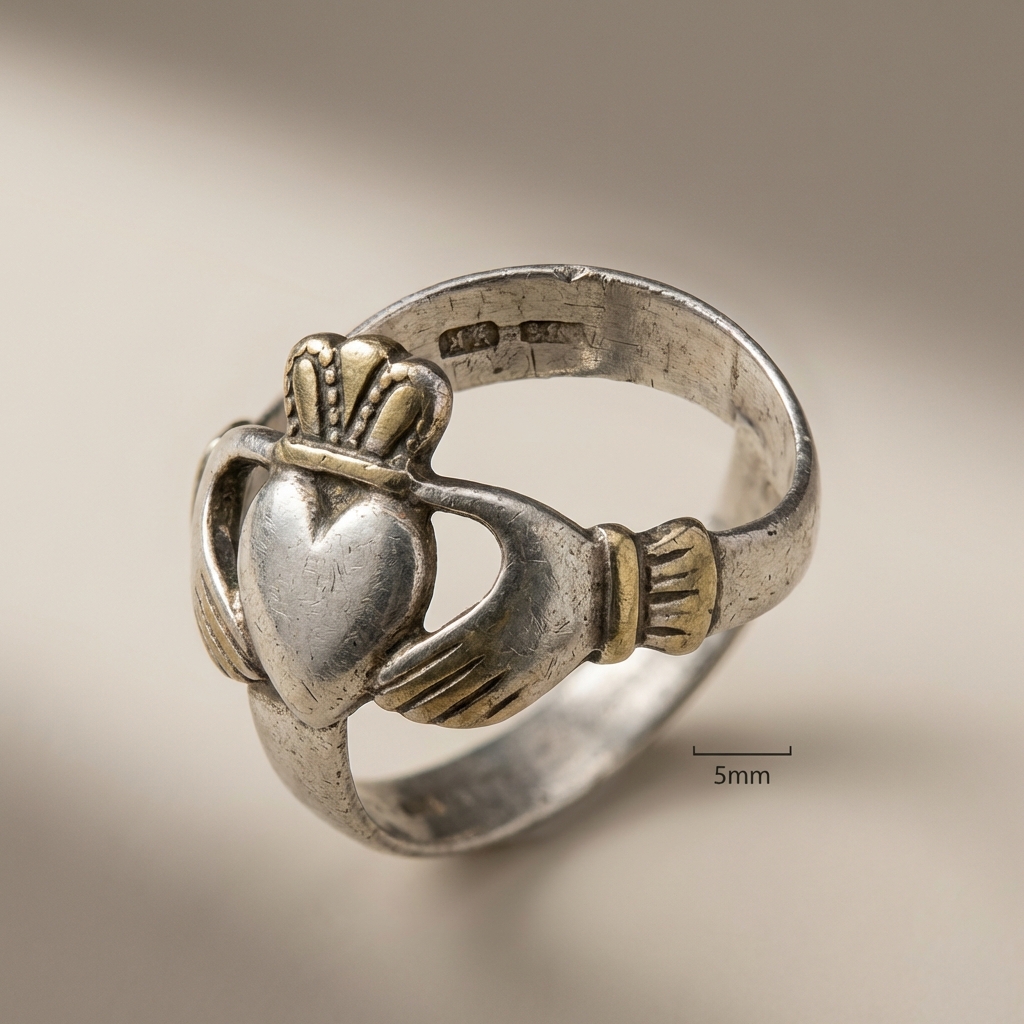
For silver Claddagh rings made after about 1700, assay-office hallmarks and maker's marks are the primary legal and scientific tools for dating and attribution, because assay systems record date letters and maker identities that can be checked against official registers The History of The Assay Office, The Company of Goldsmiths of Dublin, The Assay Office (Dublin Castle).
When a clear hallmark is present and correctly interpreted, it provides a secure terminus for dating a piece in a way that stylistic comparison alone cannot match; this is why buyers and curators place heavy weight on hallmark transcripts when they are available.
Provenance in museum catalogues
Museum accession notes, sale catalogue records, and collection histories often supply the decisive evidence when hallmarks are absent or ambiguous, because they can establish a continuous chain of custody or an early documented presence in a collection Galway City Museum.
Catalogues and published collection entries typically list accession numbers, donor or vendor names, and any recorded prior ownership; those elements make it possible to compare a private piece to museum comparanda with more confidence than stylistic description alone.
Stylistic comparison and dating
Where stamps and documentary records are lacking, curators use careful stylistic comparison with dated museum examples as a supporting line of evidence, focusing on motif treatment, proportions, and manufacturing traces that are consistent with period workshops Claddagh Rings, National Museum of Ireland, Dublin.
Stylistic evidence is valuable but must be used cautiously, because similar formal elements appear across different workshops and decades; this is why museums combine stylistic reading with provenance and hallmark data when assigning 17th or 18th century dates.
The Richard Joyce origin story - popular narrative versus scholarly view
The familiar public story names Richard Joyce, a Galway goldsmith, as the maker of the first Claddagh ring and remains influential in many local and popular accounts, appearing in reference works and visitor literature Encyclopaedia Britannica and in wider coverage such as a National Geographic feature National Geographic.
Scholarly reassessments treat the Joyce narrative as a mixture of verifiable events and later folklore, noting that while Joyce may have been a maker associated with the motif in Galway lore, the claim that he alone invented the design is not supported as a single-source fact in the primary documentation Irish Antiquity.
The oldest reliably datable surviving Claddagh rings are placed in the 17th to 18th centuries, based on museum catalogues, provenance records, and hallmark evidence; claims of markedly earlier dates require new, verifiable primary data.
As a collector, it is useful to read the Joyce story as contextual and cultural history rather than as definitive proof of an object's date or maker; the narrative can inform provenance research but does not replace hallmark and provenance documents.
When museum and catalogue evidence are available, they typically provide firmer dating than origin legends; for private pieces without such documentation, the Joyce story can be part of the background that prompts further enquiry rather than the sole basis for acceptance.
Why earlier origins remain an open question
Lack of securely excavated pre-17th examples
Reviewed museum and specialist sources do not show any securely excavated Claddagh ring with an unambiguous pre-17th-century archaeological context, so claims of a medieval Claddagh form remain unproven in the published record Claddagh Rings, National Museum of Ireland, Dublin.
The absence of securely provenanced pre-17th finds means that, from a strictly archaeological standpoint, the earlier-origin hypothesis requires new, verifiable primary data before the picture can change.
Potential European antecedents
Some scholars note that formal elements similar to the Claddagh motif appear in a range of European ring types and that design influences can travel between workshops, but direct lines of descent from specific continental types to the Claddagh motif remain debated and under-published. Comparative material appears in several medieval and post-medieval catalogues and collections, and readers may find related items in our medieval crusader rings collection Medieval Crusader Rings.
Clarifying earlier origins would therefore require published provenanced finds or comparative metallurgical studies that demonstrate continuity of form and technique prior to the documented 17th century examples Irish Antiquity.
What new evidence would change the picture
The kind of primary data that would convincingly push the earliest date earlier includes a securely excavated Claddagh-type ring with full archaeological context and publication, a metallurgical report tying technique or alloy to an earlier period, or archival documents that explicitly describe the motif before the late 17th century Claddagh Ring Museum.
Until such data appear in the published record, the cautious reading of current sources is that earlier origins are possible but not yet demonstrated with the level of provenance or scientific testing required by museums.
Checklist for collectors: how to assess an 'ancient' Claddagh ring
1) Request high-resolution images showing the bezel, shoulders, interior, and any marks, plus full measurements and metal description; clear photos are the starting point for any assessment.
2) Ask the seller for hallmark and assay transcripts or close-ups of stamps, and have those transcripts checked against assay registers when possible; hallmarks are decisive for post-1700 silver Hallmark Identification, The Company of Goldsmiths of Dublin, The Assay Office (Dublin Castle).
3) Request provenance documentation: collection history, sale catalogues, accession numbers, and any verification or letters from prior owners; documented collection chains often make the difference between a speculative and a supportable early-date claim Galway City Museum.
4) Review restoration and condition notes to understand what was stabilized or repaired; later repairs can obscure punches and makers' marks and change the assessment of originality.
5) When an early date is critical to value or historical interest, consider independent material testing or a specialist report to check alloy composition or surface stratigraphy; these tests can provide physical evidence where documents are lacking Hallmarking Process, The Company of Goldsmiths of Dublin, The Assay Office (Dublin Castle).
Need provenance details or hallmark transcripts?
Consult available documentation carefully and ask sellers for full provenance and condition notes; Aurora Antiqua presents items with clear context and welcomes questions about provenance before purchase.
Use the checklist above as a minimum due diligence routine: absence of clear hallmarks or provenance should make early-date claims provisional until independently verified or supported by accession records. You can also consult our rings collection for example items and context rings collection.
Common mistakes and red flags to avoid
Over-reliance on origin legends is a frequent error; stories about named individuals or colourful local lore can be valuable context but do not substitute for hallmark transcripts or accession records Encyclopaedia Britannica.
Misreading hallmarks is another common problem: faint, incomplete, or altered stamps can be mistaken for early marks, and restorations sometimes remove or obscure punches, so professional verification of stamps is important.
Confusing stylistic similarity with secure dating is a further trap; a motif that resembles a museum example is not proof of the same age unless supported by independent documentation or testing Claddagh Ring Museum.
Other red flags include vague or inconsistent provenance statements, lack of specific accession references, and sellers who decline independent inspection or testing; these patterns warrant caution.
Museum examples and what their records show (how to compare with a private piece)
Public collections such as the National Museum of Ireland and the Galway City Museum hold early Claddagh examples that cataloguers place in the 17th and 18th centuries, and their online or published entries typically record accession numbers, donor information, and any hallmarks noted at the time of cataloguing Richard Joyce and the oldest known Claddagh ring, Galway City Museum. Local reporting on significant objects has also been published Oldest Claddagh Ring Returns to Galway.
When comparing a private ring to museum entries, check motif details, measurements, metal type, and whether the museum item carries a recorded hallmark or accession citation; matching several elements strengthens a comparative argument more than motif resemblance alone Galway City Museum.
Quick steps to compare a private ring with museum entries
Use museum catalogue entries as benchmarks
Use museum catalogue citations as benchmarks when requesting provenance from a seller: a credible comparison will identify which catalogue entry is being referenced and give specific grounds for similarity rather than general claims.
If a seller claims a pre-17th-century Claddagh ring: responsible next steps include documents to request such as high-resolution images, hallmark transcripts, sale or accession records, restoration notes, and any independent verification letters; assembling these elements is the first step in evidence-based assessment Galway City Museum.
Seek specialist reports when the documentation is incomplete or the claim has significant provenance implications; metallurgical testing and independent assay transcripts can reveal alloy recipes or surface characteristics consistent with a proposed period Hallmarking Process, The Company of Goldsmiths of Dublin, The Assay Office (Dublin Castle).
Deciding whether to buy or pass depends on the strength of the assembled evidence: accept an early-date claim only when clear documentation or independent testing supports it; otherwise treat the date as provisional and priced accordingly.
Conclusion: what 'the oldest Claddagh ring' means for collectors
The weight of museum catalogue and specialist evidence places the oldest surviving Claddagh rings in the 17th to 18th centuries, and that conclusion is the working baseline for collectors seeking to identify genuinely early examples Claddagh Ring Museum. See additional coverage and discussion in national reporting Ireland.
The Richard Joyce origin story remains an important part of the motif's cultural history but should be read as narrative context rather than documentary proof of a single inventor; collectors should prioritize hallmarks, provenance, and independent testing when early dates matter Irish Antiquity.
Follow the buyer checklist: request images, hallmark transcripts, provenance documentation, and consider independent testing for critical attributions; contextualised collecting leads to better informed, more satisfying acquisitions.
Museum catalogues and specialist Galway sources place the oldest reliably datable surviving Claddagh rings in the 17th to 18th centuries, based on provenance, stylistic comparison, and hallmarks where present.
Treat such claims cautiously and request hallmark transcripts, provenance records, and independent testing if the early date is important, because current published sources do not show securely excavated pre-17th Claddagh rings.
High-resolution images of marks, hallmark or assay transcripts, accession or sale records, and restoration notes are the most useful documents; independent metallurgical reports can help when documentary evidence is lacking.
More from Aurora Antiqua
References
- Claddagh Rings, National Museum of Ireland, Dublin
- Richard Joyce and the oldest known Claddagh ring, Galway City Museum
- The King of Claddagh · Mainistir Phádraig Naofa · Bailiúchán na Scol, Dúchas.ie, National Folklore Collection
- The History of The Assay Office, The Company of Goldsmiths of Dublin, The Assay Office (Dublin Castle)
- Hallmark Identification, The Company of Goldsmiths of Dublin, The Assay Office (Dublin Castle)
- Hallmarking Process, The Company of Goldsmiths of Dublin, The Assay Office (Dublin Castle)
- Publication 561 (12/2025), Determining the Value of Donated Property, Internal Revenue Service (IRS), USA
- Research report: export licensing and provenance, GOV.UK, Department for Culture, Media and Sport (DCMS)
- galwaycitymuseum.ie
- Client Challenge, JSTOR