


Looking for the real thing? Browse genuine crusader rings for sale, each piece one of one, individually authenticated, with documented provenance. For the background, see the guide to medieval jewelry.
What is an ancient Celtic ring? Definition and context
What counts as Celtic ring
An ancient celtic ring is best understood as a historic or archaeological ring that shows Celtic or Insular artistic influence and that is treated as an antiquity in collecting and museum contexts. These pieces range from simple bronze hoops to rings with inscribed or cast knotwork and can be dated only by archaeological context or stylistic comparison, so dating is typically presented as an estimate tied to available documentation and condition notes. For collectors the working emphasis is on visual features, recording, and collection history rather than modern style labels.
See restoration and provenance on @auroraantiqua
If you would like to see curated examples with clear condition notes and provenance context, Aurora Antiqua presents selected pieces with restoration and collection history for study and comparison.
Periods and geographic spread often overlap with Insular art traditions that circulated in the islands and Atlantic fringe of early medieval Europe, and later Celtic-influenced motifs continued to appear in revived and vernacular work. Museums frame such rings as part of a broader material culture, so a ring described as Celtic usually points to design features and comparative dating rather than a single origin story. For a concise museum overview of Celtic art and its contexts, see the British Museum exhibition notes below.
Key collecting terms to note are knotwork, patina, bezel, and collection history. Sellers and curators typically pair a catalog entry with a short condition statement and an estimated date range to set expectations for buyers and researchers.
Knotwork and motif meaning: how museums interpret Celtic designs
Interlace, continuity, and ambiguity
Museums and many scholars read Celtic knotwork as interlace patterns that can indicate continuity, interconnection, or decorative complexity rather than a single, fixed symbolic meaning, and this interpretive caution is important when assessing an ancient celtic ring in a collection context British Museum exhibition overview.
That interpretive stance means a motif on a ring might reflect workshop taste, a decorative tradition, or a broadly shared visual language rather than a specific ‘‘amulet formula.’’ When cataloging or describing a motif, curators often use conditional language such as can indicate or often interpreted as to avoid overstating a single meaning.
Iconography versus literal meanings
Iconographic study can help suggest likely associations for certain motifs, but a single ring rarely carries enough contextual evidence to fix an exact social or ritual meaning. For buyers, that uncertainty argues for humility when assigning symbolic claims to a single object: treat motif interpretations as plausible readings rather than certainties.
Claddagh rings and Irish wearing traditions
How the Claddagh communicates relationship status
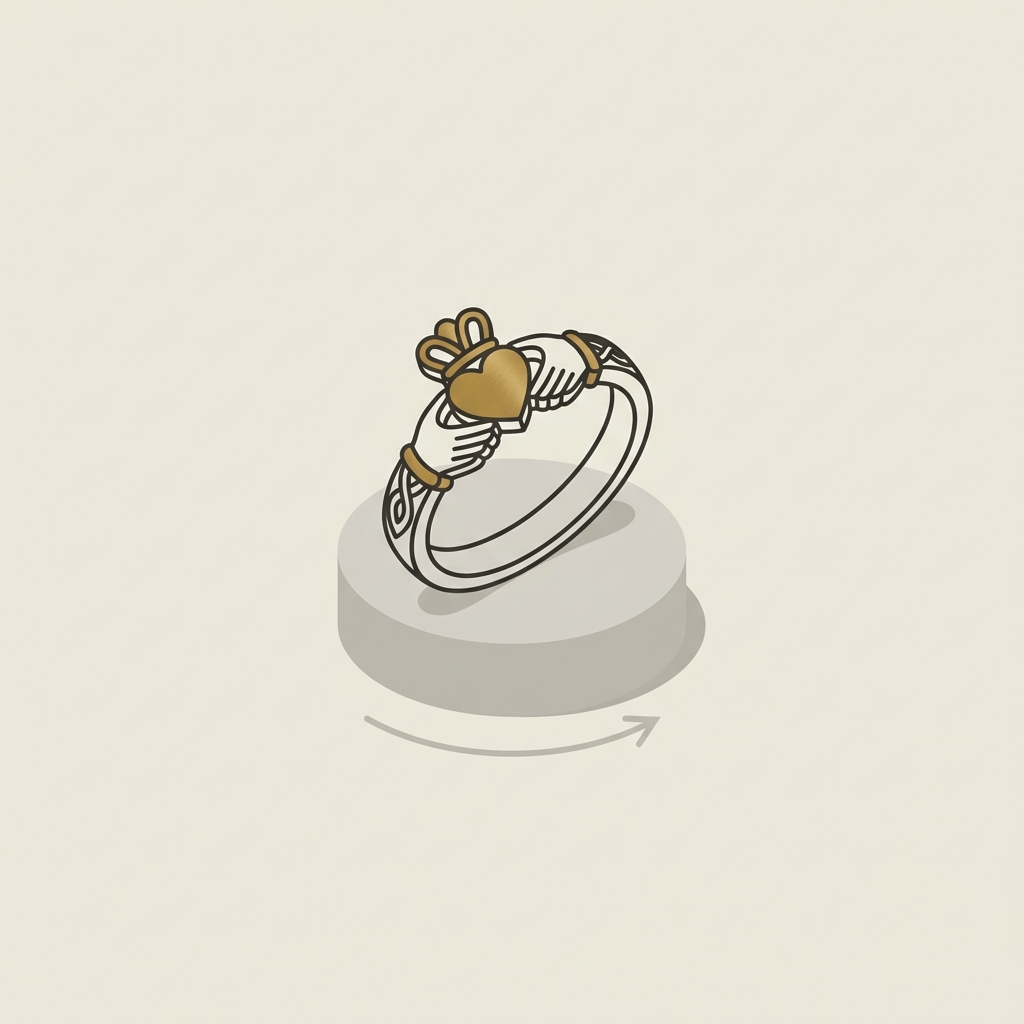
The Claddagh ring remains the clearest example of a Celtic-associated wearing tradition: museum documentation and cultural institutions describe the convention of wearing the ring on the right hand with the heart pointing outward when single, and turning it inward or moving it to the left ring finger to indicate engagement or marriage Galway City Museum.
For more on wearing conventions see practical Claddagh guidance and historical summaries such as the overview at Ireland.com.
Use documented traditions like the Claddagh for relationship signalling when appropriate, but for other knotwork rings prioritise fit, comfort, and clear provenance; choose orientation based on the signal you want and the ring's stability.
Regional and modern variations exist, and contemporary practice can differ by family, community, or personal preference. The National Museum of Ireland and other institutions record both the widely known convention and the fact that not every wearer follows it strictly National Museum of Ireland collection notes.
Because the Claddagh tradition is relatively well documented, it is often used as a clear example when explaining how ring orientation can communicate relationship status; still, the Claddagh is a particular type of ring and its rules do not automatically apply to other knotwork or Celtic-influenced rings.
Historical range: finger choice, function, and period differences
Signet and amulet functions
Across medieval and early modern Europe, finger choice and ring function varied: signet rings, used to seal documents, were commonly worn on fingers chosen for practical access, while amulets or decorative personal rings might occupy different positions, so there is no single historical rule that applies to all Celtic or medieval rings Scholarly overview of medieval rings.
This variability means that many modern wearing conventions are a blend of historic practice, local custom, and later revival fashions. For a collector this underlines the practical point: finger choice in the present can honor multiple strands of usage without needing to reproduce a single historic prescription. See Aurora Antiqua's related collection for Celtic pieces Celtic rings collection.
Decorative and personal uses
Decorative rings might emphasize bezel visibility and comfort, while rings with seals or intaglios prioritized ease of access for stamping. When evaluating an ancient celtic ring, note the likely original function recorded in catalog notes and consider whether you intend to wear the piece as a decorative object, a signaling ring, or a handled artifact for occasional use.
Modern conventions: which hand and which way to orient a Celtic ring
Practical cultural signals
Modern advice on which hand to wear a Celtic-style ring combines cultural signals, such as the Claddagh orientation for relationship signalling, with practical considerations like dominant hand and motif visibility Guidance on which hand to wear rings.
For many wearers the choice is pragmatic: if you use your hands for detailed tasks, you might wear a meaningful ring on the non-dominant hand to reduce risk of damage. If you want the motif to be visible in conversation, orient the bezel and choose a finger that displays the design clearly when your hand is at rest.

Personal and regional preference strongly influence orientation: some choose the left ring finger to signal partnership, while others follow family or local cues. The important practical rule is to pick a hand and orientation that communicates what you intend while keeping the ring safe in daily life.
Comfort and daily wear considerations
Orientation also matters for comfort. A projecting bezel or raised shoulder can catch on clothing if the ring is worn on a finger used frequently for gripping or pulling; in such cases, moving the ring to a less active finger limits wear to the metal and preserves any patina or surface detail.
Fit first: measuring, sizing, and testing an ancient ring
How to measure for ring size

Accurate sizing is a first-order concern for anyone planning to wear an antiquity. Measure finger size at a stable temperature, avoid measuring right after exercise or a hot bath, and allow slight clearance for normal daily swelling so the ring is comfortable across the day; these are standard best practices recommended by gemological authorities GIA ring sizing guide.
Test the ring on the intended finger before committing to frequent wear. If a ring is documented as requiring restoration or has an unstable bezel, plan to wear it only occasionally or consult a conservator before extended use.
a quick sizing and fit checklist for an ancient ring
allow slight clearance for daily swelling
Testing bezel orientation and comfort
Try different orientations during a short wear trial: rotate the bezel to check for rubbing against adjacent fingers, test reach when you grip objects, and check for catches on clothing. If any orientation causes discomfort or threatens the ring structure, prefer occasional wear or seek a conservator's recommendation before resizing.
Practical wearing tips: daily life, work, and layering with other rings
Activity-based advice
Avoid wearing an ancient ring during heavy manual work where it might be struck, bent, or exposed to chemicals. Even a well-stabilised metal ring can have thin areas or repairs that are vulnerable to stress, so remove it for gardening, heavy lifting, or tasks with solvents or detergents.
If you plan to wear a ring daily, rotate its orientation occasionally to distribute wear and reduce pressure on any single arc of the hoop; this simple habit can extend the life of patina and slow uneven abrasion.
Pairing with modern rings
When pairing an ancient celtic ring with modern bands, prioritise comfort: place modern, snug wedding bands where they will stabilise the ancient ring if that helps fit, or wear the antiquity on a different finger to avoid friction between metals. Check for catches at the shoulders and bezel where textiles can snag and accelerate wear.
Buying checklist: what to check on listings for an ancient Celtic ring
Condition and restoration notes
When assessing listings, prioritise clear condition notes that describe what was stabilised, repaired, or left untouched; trustworthy entries describe visible corrosion, repaired breaks, and any added solder in straightforward language, and they note which images show the repaired areas GIA guidance paired with seller condition best practices.
Ask for close photos of the bezel, shoulders, and interior hoop, and request measurements and weight. A transparent listing allows you to assess whether the piece is suitable for wear or should remain a museum-style object in a collection. See related ring listings on Aurora Antiqua's rings collection rings collection.
Provenance and documentation
Prioritise any provenance statements, collection history notes, or verification letters included in the listing. Documentation does not equal absolute proof of origin, but when present it helps you evaluate how the piece has been handled, traded, and recorded by previous owners or institutions. Sellers that include clear provenance language and restoration notes make it easier to make an informed decision.
How to read restoration, preservation, and provenance statements
What restoration notes should say
Good restoration notes state which elements were stabilised, whether any soldering or replacement parts were used, and whether any conservation work changed the appearance. They should make clear what remains original and what has been altered so that a buyer understands the object's condition and likely conservational needs GIA ring care and labeling advice.
When a listing is vague about repairs or uses market language like restored without details, follow up with direct questions about what was done and request images focused on the repair areas.
Assessing provenance strength
Provenance is strongest when it includes collection history, dates of previous ownership, and any third-party verification letters. Phrase your inquiries to the seller calmly and precisely: ask for the chain of custody and supporting documents rather than broad claims. Treat provenance as evidence to weigh, not as an absolute guarantee of origin. For additional historical context see our Q&A on the history of Celtic rings what is the history of Celtic rings.
Common mistakes and pitfalls when wearing or buying Celtic rings
Misreading motif meaning
One common mistake is assuming a single, fixed meaning for knot motifs; museum practice treats many interlace designs as stylistic and open to interpretation, so avoid overconfident symbolic claims when writing or buying a ring.
Another frequent error is undervaluing condition notes: buyers sometimes focus on visual appeal without confirming restoration details, which can lead to surprise costs for conservation or reveal that a ring is unsuitable for regular wear.
Ignoring condition and repair history
Improper resizing or aggressive cleaning are risky. If a seller notes previous soldering or unstable joints, do not assume a straightforward resizing is safe; consult a conservator and request detailed images before authorising any intrusive work.
Practical examples and scenarios: pick the right finger and orientation
Example 1: Claddagh worn to signal relationship status
Scenario: you own a Claddagh-style ring and want to use it as a relationship signal. Follow the museum-documented convention where appropriate: wear the ring on the right hand with the heart outward if you prefer to signal single status, and move it or turn the heart inward or to the left ring finger to indicate engagement or marriage, following the practice recorded by Irish cultural institutions National Museum of Ireland.
Bear in mind that this is a culturally specific convention and may not be recognised in every context, so when communicating with others consider whether your community expects the same signals.
Example 2: Wearing for comfort at work
Scenario: you work with your hands and want to wear an ancient ring occasionally. Prioritise comfort by choosing a less active finger or the non-dominant hand, test bezel orientation for catches, and reserve the piece for low-risk situations. If the ring has thin points or visible repairs, confine wear to brief social use and rely on documentation and condition notes to decide whether everyday wear is appropriate.
These small practical choices help balance the desire to wear wearable history with the need to protect fragile materials and documented repairs.
Care, storage, and simple preservation steps for ancient rings
Short term care
Avoid abrasive cleaning and household chemicals that can alter surface patina; gently lift surface dirt with a soft brush and consult a conservator before using any solvents. For short-term storage use padded boxes or cloth pouches in a stable, cool, dry environment to limit humidity changes that stress metal and corrosion products GIA care guidance.
Label storage with basic documentation: listing reference, reported provenance, and a short condition note so future handling is informed by the object's recorded history.
When to seek professional conservation
If a ring shows active corrosion, loose parts, or old invasive repairs, seek a qualified conservator before any attempt at cleaning or resizing. A conservator can advise on reversible stabilisation and on whether cosmetic restoration is appropriate given the piece's documented history.
Conclusion: deciding which way you personally should wear an ancient Celtic ring
Weighing symbolism, comfort, and documentation
Decide by weighing three points: clarity of documentation, fit and comfort, and the signal you want to send. The Claddagh provides a clear wearing convention for relationship signalling, but other knotwork rings typically leave more room for personal choice and practical adaptation.
Prioritise fit, readable condition notes, and conservative restoration records when you intend regular wear; if documentation or condition suggests fragility, prefer occasional wear and professional conservation guidance.
Final checklist
Checklist to take from this guide: verify condition and restoration notes, request provenance documentation, measure and test fit at stable temperature, test bezel orientation for comfort and snagging, and consult a conservator for any intrusive work. These steps help you choose where and how to wear an ancient celtic ring with care and confidence.
It depends on condition and restoration history. If the ring is stable and documented as suitable for wear, occasional daily use can be acceptable; if repairs or thin sections are noted, limit wear and consult a conservator.
No. Museums and scholars commonly treat knotwork as interlace motifs that often indicate continuity or connection rather than a single fixed symbolic meaning.
Measure your finger at a stable temperature, allow slight clearance for daily swelling, and perform a short wear trial to check bezel orientation and comfort before wearing the ring regularly.
More from Aurora Antiqua
References
- Gimmel Ring, Victoria and Albert Museum, London
- Aulus Gellius, Attic Nights, Book X, LacusCurtius, Bill Thayer, University of Chicago (Loeb Classical Library edition)
- Pliny the Elder, The Natural History, BOOK XXXIII, Perseus Digital Library, Tufts University (edition Bostock)
- Ring, The Cleveland Museum of Art
- Hallmarking Act 1973, UK Government, legislation.gov.uk (The National Archives)
- Silver and plate, Icon, The Institute of Conservation (UK)
- Archaeological materials, Icon, The Institute of Conservation (UK)
- Evaluation of a two rubber band technique for finger ring removal, PMC, Annals of the Royal College of Surgeons
- Client Challenge, JSTOR