


Looking for the real thing? Browse genuine ancient rings for sale, each piece one of one, individually authenticated, with documented provenance. For the background, see the guide to ancient jewelry.
What is an ancient Claddagh ring? Definition and context
Basic description: hands, heart, crown
The Claddagh design, recognised for two hands holding a crowned heart, is classically described in reference works and museum summaries as a vernacular Gaelic symbol for friendship, love and loyalty rather than a formal liturgical emblem, a point emphasised in museum overviews and encyclopaedic entries Encyclopaedia Britannica and Ireland Magazine.
For collectors the phrase ancient claddagh ring typically marks an older, historic example as opposed to a modern reproduction; that distinction matters because wear, patina, and documented ownership help place a ring in time and use. When writers and curators use the term ancient claddagh ring they usually mean a ring with verifiable age indicators or collection history rather than a newly made piece described in antique style National Museum of Ireland collection notes.
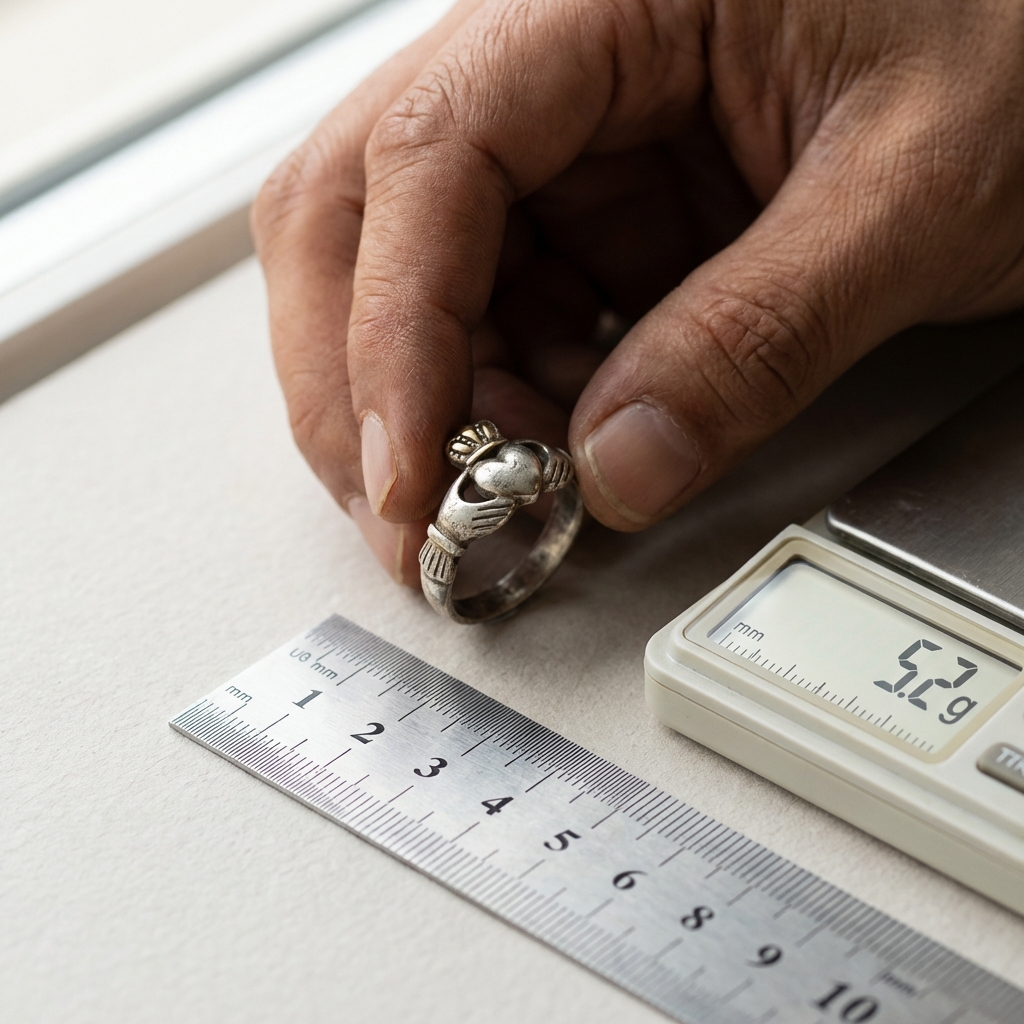
Guide on what to photograph and measure for a listing
Include a scale in every photo
How the term ancient applies to Claddagh rings
Sellers and researchers use a range of evidence to claim an item is an ancient Claddagh ring. That evidence can include visible patina, consistent wear, hallmarks where present, and chain of custody in collection notes. None of these features alone proves a religious function, but together they can help establish a ring's age and provenance when tied to documentation National Museum of Ireland collection notes.
Collectors should note that museums and major reference works situate the motif in the Claddagh community near Galway as a cultural origin, which frames the design as local Gaelic folk-symbolism rather than an institutional church emblem Encyclopaedia Britannica.
Origins, legend and the Richard Joyce story
The Richard Joyce narrative and why historians treat it cautiously
A widely told account links the Claddagh design to a 17th century Galway goldsmith named Richard Joyce, but historians treat that narrative as partly legendary because documentary evidence is incomplete and the earliest attestations are not always continuous or clear; local histories and cultural reporting note those evidential gaps Galway City Museum overview and coverage in the New York Times.
When researchers examine the Richard Joyce story they look for probate entries, apprenticeship rolls, and early market records that might corroborate an individual maker. Those documentary sources can strengthen a maker attribution, but in the case of Richard Joyce the surviving records do not provide an unambiguous chain of proof and so the account remains a plausible origin story rather than settled fact Irish Times analysis.
How local tradition and documentary gaps shape origin stories
Local tradition is important for cultural context but it can become entangled with romanticised narratives that shop copy and later retellings propagate. Curators therefore treat folk histories as starting points for research rather than as standalone proof. To move from story to evidence, scholars look for surviving physical examples tied to dated records or early collection notes specialist overview in a journal of Irish studies.
Tracing the motif's early appearances also requires careful comparison of ring types and regional manufacture styles because stylistic continuity is not the same as continuous documented use. That methodological caution is why accounts of origins often remain provisional and why collectors should expect conditional language in reliable descriptions Galway City Museum overview.
How the Claddagh has been used in Irish life and Catholic communities
Cultural adoption versus institutional religious meaning
The Claddagh ring is commonly used by Irish Catholic wearers in weddings, engagements and daily life, especially in communities where local customs and Catholic practice overlap; this modern usage reflects cultural adoption rather than exclusive ecclesiastical origin, a point made in cultural overviews that document practice without assigning liturgical status CatholicIreland.net explanation.
Does cultural use equal religious origin?
No. The Claddagh motif is a Gaelic folk symbol used widely in Irish culture and often adopted by Catholic communities, but a specific ring is only reasonably described as Catholic in origin when supported by clear provenance or documentary ties to a Catholic individual or institution.
Many families present Claddagh rings at marriage or as tokens of familial loyalty, and those uses have become part of Catholic community practice in places such as Galway and the wider Irish diaspora. That social adoption explains why a ring may be strongly associated with Catholic life without indicating that the motif was created for or by the church National Museum of Ireland collection notes.
Histories and museum accounts place the motif firmly in local Gaelic dress and custom, which helps explain how the Claddagh moved from village token to broader national symbol rather than a specifically liturgical device Encyclopaedia Britannica.
Modern uses: weddings, engagement and community identity
In contemporary practice a Claddagh ring's orientation on the finger can signal relationship status and the ring often appears in engagement or wedding contexts. Those conventions are social rules, not church doctrines, and they vary by family or region. Observers looking at a modern ceremony should therefore treat the ring as cultural jewellery used within religious communities rather than as an instrument of official Catholic ritual CatholicIreland.net explanation. For further discussion see our Q and A on whether the Claddagh ring is Catholic here.
Where a collector finds a claim that an antique Claddagh ring was specifically owned by a cleric or used in a religious office, look for documentary support such as parish records or documented ownership rather than assuming a religious function from the motif alone National Museum of Ireland collection notes.
How scholars and museums evaluate claims about religious origin
What counts as evidence: provenance, documentation, and collection history
Museum curators and historians treat provenance and collection history as decisive when assessing claims that an object has institutional religious associations. Strong documentary evidence can include accession notes, verified ownership letters, or parish records that tie a named person and time to the object Galway City Museum overview and related resources such as the museum teacher resource PDF.
Stylistic motifs alone rarely prove institutional religious association because motifs circulate widely through folk practice and conventional jewellery making; museums therefore prioritize paperwork that traces a ring from one owner or collection to another over purely stylistic comparisons National Museum of Ireland collection notes.
Common research methods used by curators and historians
Researchers typically combine physical inspection, comparison with dated examples, archival searches for probate or sale records, and examination of museum accession files. When several independent documentary strands align, the claim for a particular historical usage is stronger; absent that alignment, attributions that a ring is "Catholic" in origin remain speculative specialist overview in a journal of Irish studies.
Collectors can ask sellers for specific types of documentation that museums find persuasive, such as early auction catalog entries, prior collection labels, or correspondence that references the object in a dated context Galway City Museum overview.
Decision checklist for collectors: is this ancient Claddagh ring a Catholic piece?
Specific questions to ask of a listing or seller
To judge whether a listing justifies calling an item a Catholic piece, request clear provenance documentation, including any prior ownership records, museum receipts, or parish entries that name a holder; without such records a claim of Catholic origin should be treated as unproven Galway City Museum overview.
See provenance checks and behind the scenes on @auroraantiqua
If you have documents or images you want reviewed, consider downloading a checklist or contacting a specialist for a condition and provenance read before purchase.
Ask for detailed condition notes and restoration notes that explain what was stabilised or repaired, because alterations can remove or obscure features relevant to dating and use. Insist on clear photos of hallmarks, inscriptions, and the inner band and compare them with known examples when possible National Museum of Ireland collection notes.
Weigh documentation: a provenance letter or museum accession note typically carries more weight than a verbal family tradition repeated without supporting evidence. Where documentation exists, examine whether it directly links the ring to a named person known to have a religious office or role Galway City Museum overview.
How to weigh documentation versus stylistic traits
Stylistic traits can suggest a likely date range or workshop influence but cannot prove institutional religious use. Use documentation as the primary guide and stylistic analysis as supporting evidence; when both align the claim becomes substantially stronger specialist overview in a journal of Irish studies.
When no strong provenance exists, treat attributions of ecclesiastical origin as possible but unproven and make purchase decisions with that uncertainty in mind, prioritising transparent seller documentation and condition notes National Museum of Ireland collection notes. For relevant items in our catalog see the rings collection here.
Typical mistakes and Stolperfallen when reading Claddagh provenance
Misreading folklore as documentation
A common error is to accept romanticised origin stories or seller copy as evidence. Folklore can inform context but it is not a substitute for dated paperwork; this mistake regularly leads buyers to assume a religious provenance that is not documented Irish Times analysis.
Confusing cultural practice with institutional origin is another frequent pitfall: because Claddagh rings appear often in Catholic weddings, some descriptions leap from cultural association to claims of church commission, an inference that requires documentary proof to stand National Museum of Ireland collection notes.
Confusing cultural practice with institutional origin
Incomplete restoration notes or omitted accession history can create false confidence. If a listing lacks clear restoration documentation, ask what work was done and when, since modern interventions can change the ring's apparent date or remove evidence such as hallmarks specialist overview in a journal of Irish studies.
Red flags include vague provenance dates, unverifiable family stories, missing photos of key details, and seller assertions that rely solely on traditional narratives rather than primary documents Irish Times analysis.
Practical examples: reading listing notes for an ancient Claddagh ring
Example A: a well-documented antique listing
Scenario A: a listing includes an accession note from a known collection, dated photographs showing consistent wear, and a prior auction catalogue entry naming the object. In that case the documentation supports historical claims and a link to specific ownership or a museum catalogue strengthens a claim that the ring has an established history rather than an origin story alone Galway City Museum overview.
Example B: a listing that relies on legend alone
Scenario B: a listing repeats the Richard Joyce narrative without accompanying paperwork, and images show a polished, modern looking band with no clear hallmarks or accession marks. Treat the religious origin claim as speculative and request clearer provenance before accepting the seller's narrative Irish Times analysis.

Before purchase always ask the seller for high resolution photos of inscriptions and the inner band, and request a written statement of any restoration. Those requests are reasonable and help you apply the checklist above when deciding how much weight to give a religious association claim National Museum of Ireland collection notes.
Responsible buying and final takeaways
Summary judgement: what 'Catholic' usually means for collectors
In summary, the Claddagh motif is best understood as Gaelic folk-symbolism that has been widely adopted in Catholic communities, especially for wedding and engagement practice. That frequent cultural use does not equate to a liturgical origin; to claim a specific ring is a Catholic piece requires evidence beyond motif alone Encyclopaedia Britannica.
Aurora Antiqua presents curated descriptions with condition notes and provenance context to help buyers evaluate such claims and encourages requesting documentation where available rather than relying on legend or seller narrative. You can also browse related items in our Celtic rings collection here.
Next steps: verification, ask for documents, and preservation tips
Before you buy an ancient claddagh ring, request provenance letters, any prior museum or auction references, clear condition and restoration notes, and matching photos of hallmarks or inscriptions. If those items are missing treat religious-origin claims as possible but unproven and consider getting an expert opinion tied to the specific documentation you can obtain Galway City Museum overview. For further reading and community answers see our Q and A post.
Preservation tips: store the ring in a stable environment, keep condition notes with purchase records, and document any conservation work. Transparent documentation preserves the object's story and helps future researchers and collectors assess its historical use specialist overview in a journal of Irish studies.
No. The Claddagh motif is documented as Gaelic folk-symbolism for friendship, love and loyalty; its common use in Catholic communities reflects cultural adoption rather than a liturgical origin.
Strong evidence includes dated provenance letters, parish records that name the object or owner, museum accession notes, or verified auction records tying the specific ring to a person or place.
Treat the Richard Joyce story as a plausible origin tale but not definitive proof; ask for supporting archival or collection records before accepting the attribution.
More from Aurora Antiqua
References
- Claddagh Rings, National Museum of Ireland, Dublin
- Richard Joyce and the oldest known Claddagh ring, Galway City Museum
- The King of Claddagh · Mainistir Phádraig Naofa · Bailiúchán na Scol, Dúchas.ie, National Folklore Collection
- The History of The Assay Office, The Company of Goldsmiths of Dublin, The Assay Office (Dublin Castle)
- Hallmark Identification, The Company of Goldsmiths of Dublin, The Assay Office (Dublin Castle)
- Hallmarking Act, 1981, Electronic Irish Statute Book, Office of the Attorney General, Ireland
- Getty Provenance Index, J. Paul Getty Trust, Getty Research Institute, Los Angeles
- William Wytlesey's ring, Victoria and Albert Museum, London
- galwaycitymuseum.ie
- galwaycitymuseum.ie