


Looking for the real thing? Browse genuine crusader rings for sale, each piece one of one, individually authenticated, with documented provenance. For the background, see the guide to ancient jewelry.
What an ancient viking arm ring is and why its motifs matter
An ancient viking arm ring is a metal bracelet or arm band made in the Viking Age, broadly the 8th to 11th centuries CE, that often carries decorative motifs, maker marks and regional styles; collectors and historians describe these objects as small portable artefacts that show workshop and regional variation. The phrase ancient viking arm ring is commonly used by collectors and in museum descriptions to signal age, form and the kinds of motifs that may appear on the piece.
Typical physical features include a twisted hoop or solid band, a decorated bezel, and patterns that may be geometric, animal interlace, or short runic inscriptions. These visual motifs matter because they often point to a workshop tradition, a geographic area, or a chronological phase within the Viking Age, and understanding that context helps explain what a motif likely meant when it was made British Museum.
Quick symbol check workflow using watchdog and museum sources
Use these sources to compare a single motif
When motifs from an ancient ring are adapted into modern tattoos, wearers are translating a visual language across centuries. That translation can be straightforward for purely decorative bands, but it becomes more complex when a motif is or includes runic or symbolic elements, because those elements can carry layered meanings today.
For readers thinking about a tattoo that references an ancient ring, expect variability: the same pattern may be described differently by different museums, and dating is often an estimate based on style and find context rather than a precise year.
Why some Norse symbols are socially and politically sensitive
Historic symbols do not always retain only their original meanings; in the modern era some Norse motifs have been adopted by political movements, and that adoption creates a contemporary layer of meaning separate from archaeological context. Researchers have documented patterns of appropriation that show how modern groups can change the public reception of a symbol Institute for Strategic Dialogue.
Watchdog organisations and civil-society analysts maintain lists and guides that identify symbols which have been repeatedly used by extremist groups. These lists do not erase a symbol's history, but they do record how motifs are read in some present-day settings, which is important to consider before getting a visible tattoo.
Specific Norse motifs often flagged by watchdogs to avoid
Some symbols have been explicitly identified by watchdogs as frequently co-opted by extremist groups. Two of the most commonly cited examples are the Othala or Odal rune and the valknut; these items appear on watchdog pages that explain how the signs have been used in modern extremist contexts ADL Othala rune.
Watch behind-the-scenes finds and provenance notes on @auroraantiqua
Save or print this article as a quick reference before you consult a tattoo artist or historian; a short checklist later in this guide helps you vet a motif step by step.
The valknut is another motif discussed by monitoring groups, and readers who see it in design work should be aware of the contemporary associations watchdog pages describe ADL Valknut and a regional ADL entry Valknot. Appearance alone may not indicate intent, but visible use of a flagged symbol can carry modern connotations that affect how others interpret the wearer.
When evaluating a design, look at form and context. A knot device or a runic shape that resembles a flagged sign may be harmless in many settings, but because these symbols have recorded modern uses, many experts advise caution and suggest checking current watchdog guidance before inking.
How museums and scholars explain runes and Norse iconography
Scholars and museum collections emphasise the diversity of meanings and regional styles within Viking Age iconography, noting that identical motifs can appear in different areas and times with different associations. For specific motif entries and descriptive context, museum resources remain a primary reference British Museum.
Runes, animal interlace and decorative bands can be local workshop signatures, fashionable ornament, or inscriptions carrying personal messages. Because of this variety, a motif that looks familiar may not have a single, fixed meaning across the Viking Age, and provenance, find context and dating all help refine interpretation.
How extremist groups have appropriated Viking imagery in recent years

Research by specialists in contemporary extremism shows a patterned appropriation of Norse symbols by far-right groups, a trend documented across multiple reports and case studies that trace how imagery has been re-purposed for modern identity signalling Institute for Strategic Dialogue.
Civil-society analyses add that appropriation has continued into the early 2020s and that the public meaning of an image can change when a symbol is repeatedly used with political intent SPLC analysis. For those adapting historic motifs, this means that a visually authentic design may still be read through the lens of recent uses.
Legal, workplace and travel risks of visible Norse tattoos
Visible tattoos that include symbols identified by hate-monitoring organisations can create problems in work and travel settings, because employers and institutions may treat politically charged symbols as part of dress code or conduct considerations. Practical guidance for employees and employers stresses treating such symbols carefully to avoid workplace conflict Acas guidance.
There are documented cases and advice notes that suggest visible associations can affect job prospects or create awkwardness in public spaces. The exact risk depends on country, sector and employer policy, so a person considering a visible forearm or hand tattoo should check local rules and discuss potential implications ahead of time.
A short pre-tattoo checklist for vetting an ancient Norse motif
Step 1, vet the symbol against watchdog lists. Compare the motif you plan to use with current lists maintained by monitoring organisations to see whether it appears among symbols flagged for extremist appropriation ADL Othala rune or in the ADL Hate Symbols Database Hate Symbols Database.
Step 2, research historical meaning. Consult museum entries and scholarly summaries to learn whether the motif is decorative, a maker mark or an inscription, and use those sources to form a provenance-style note for your design British Museum.
Yes, some Norse symbols have been co-opted by extremist groups and carry modern connotations; vet symbols against watchdog lists, consult museum sources for historical context, and consider alternative designs to reduce social and workplace risk.
Step 3, consider workplace and travel. Review local employer guidance and public-space codes to assess whether a visible tattoo could pose a risk or conflict in your everyday context Acas guidance.
Step 4, choose safer alternatives or commission an original design. If a motif appears on a watchdog list or remains ambiguous after research, opt for archaeological ornament bands, animal art style motifs without runic elements, or a bespoke design created with a knowledgeable artist and documented sources Institute for Strategic Dialogue.
Safer motif alternatives and design approaches
Safer options include decorative ornament bands and animal interlace that do not incorporate runes or known hate-linked signs. Museum examples of ornament and interlace show patterns that can be adapted as tattoos while avoiding overt symbolic elements British Museum.
Commissioning an original design based on Norse aesthetic vocabulary is another practical route. Ask the artist to document sources and to avoid direct copies of runic shapes that monitoring groups have associated with extremist use Institute for Strategic Dialogue.
Working with tattoo artists and historians: practical steps
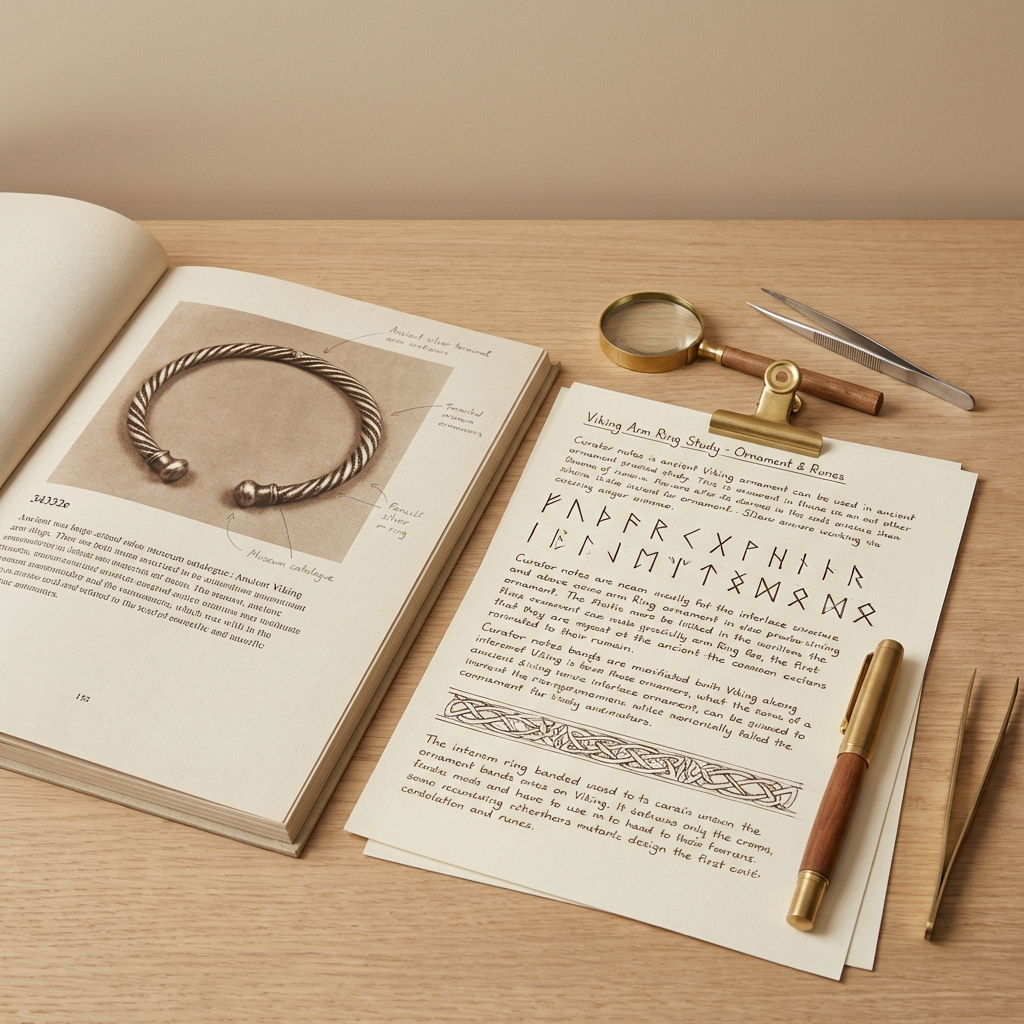
When you brief an artist, include the sources you consulted, a note of what to avoid, and a short provenance-style justification for the motif. Providing museum links or image references helps the artist understand period detail and limits the chance of accidental inclusion of a flagged sign British Museum. For more general questions you can point artists to our blog for examples of provenance notes.
If a motif is ambiguous, consider a short expert check from a historian or curator. A focused question about dating, regional style or whether a sign has known modern associations can often be answered quickly and will help you document the design intent.
Common mistakes and misconceptions to avoid
A frequent error is assuming that historical origin alone makes a motif safe. Because some symbols have been re-purposed in recent decades, historical appearance does not always remove modern political associations Institute for Strategic Dialogue.
Another common mistake is copying images from social media or ambiguous sources without checking watchdog lists or museum entries. Small stylistic changes do not reliably change public perception, and an altered rune or knot can still be read as a flagged symbol ADL Othala rune.
Practical scenarios: sample decisions for visible and hidden tattoos
Scenario A, visible forearm tattoo: if you plan a forearm motif, follow the checklist steps and verify that the design does not appear on monitoring lists and that your employer accepts visible symbols; many workplaces have flexible rules, but you should confirm in advance Acas guidance.
Scenario B, a sleeve combining runes and decorative bands: combining flagged runes with neutral ornament increases the chance a viewer will read the political sign first. If a runic shape appears, it can dominate perception even when set among decorative elements Institute for Strategic Dialogue.
Scenario C, commissioning an arm ring inspired design: when commissioning a design that mimics an arm ring, document the sources, ask the artist to avoid flagged runes, and keep a short provenance note explaining the motive and sources for the pattern British Museum.
How to document and record your design choices
Create a short provenance-style note for your tattoo that lists the motif name, the image source, the artist, and the intended meaning. Saving screenshots of museum entries and any expert correspondence will make that record clear and defensible if questions arise later British Museum.
Keep source images, curator comments, and a brief designer note with the final art file. Avoid asserting absolute authenticity for a historical meaning and instead describe what the sources suggest about period, region and typical use ADL Othala rune.
Final takeaway and next steps before you book an appointment
The essential steps are straightforward: vet a symbol against watchdog lists, check museum and scholarly resources for historical context, consider workplace and travel implications, and choose safe alternatives or document an original design. Following this checklist reduces the risk of unintentional extremist association ADL Othala rune.
For a calm curation perspective on motifs and provenance-style notes, Aurora Antiqua aims to present context and condition notes for wearable artifacts so buyers and designers can make informed choices. Re-check watchdog pages and local workplace guidance before you book an appointment.
Yes. Even historically accurate motifs can have modern associations if extremist groups have repeatedly adopted the same symbol, so check watchdog lists and museum context before inking.
Choose decorative ornament bands, animal interlace without runes, or commission an original design inspired by Norse styles while avoiding runic shapes linked to extremist use.
Compare the motif to established watchdog lists and consult museum entries or a brief expert check from a historian to clarify historic meaning and modern usage.
More from Aurora Antiqua
References
- Viking Art Styles in the East Midlands: Borre · Vikings in the East Midlands
- Runer og runemagi, vikingernes skriftsprog, Nationalmuseet, Copenhagen
- New runic translation reveals community ownership of the Galloway Hoard, National Museums Scotland
- Silver Arm-Ring (NLM-1B89B2) · Vikings in the East Midlands, Centre for the Study
- The World’s Largest Viking Treasure, Historiska museet / Statens historiska museer, Stockholm
- List of symbols designated by the ADL as hate symbols, Wikipedia