


Looking for the real thing? Browse our Medieval ring collection, each piece one of one, individually authenticated, with documented provenance. For the background, see the guide to medieval jewelry.
Quick answer and why the question matters
Short answer: there was no single universal age. Written sources such as saga literature and medieval Icelandic law record betrothals often in the early to mid teens, commonly around ages 12 to 15, while many accounts and demographic indicators suggest consummation and first childbirth typically fell in the mid-to-late teens or into the early twenties, depending on status and locality, and archaeological evidence supports a range rather than a single fixed age Women in the Viking Age. demographic indicators
This matters because popular summaries that give a single number obscure important variation across regions and social groups, and because collectors and readers who encounter objects called wedding rings should understand the interpretive steps behind that label.
Follow @auroraantiqua for finds, context and conservation notes
Sign up for our newsletter to receive contextual notes and curated pieces

For historians, the question intersects legal history, demography and material culture; for collectors it affects how we read provenance and typology when a listing calls an object a wedding or betrothal ring.
Concise summary
In short: betrothals in some texts are recorded in the early-to-mid teens, consummation and first childbirth often occur later, and material culture like rings is an interpretive clue rather than proof of marital age or practice Women in Old Norse Society.
Why accurate age estimates matter for history and collecting
Accurate, cautious phrasing helps researchers avoid treating narrative or legal examples as population statistics, and it helps collectors ask for the right documentation when assessing claims about an object’s use or date Rings and exchange in Viking-Age Scandinavia.
What kinds of sources historians use and their limits
Literary sources: sagas and law codes
Sagas and law codes are central to our understanding because they record legal categories, social norms and narrative episodes, but they are not equivalent to population registers; they reflect literary conventions, legal ideals and the concerns of their compilers Gr\u0000E1g\u0000E1s (selections and translation).
Archaeological and osteological data
Osteology and grave assemblages provide complementary evidence about age-at-death and patterns of fertility, yet translating skeletal age estimates into precise ages at first marriage or childbirth is difficult because of sample sizes, dating precision and the challenge of linking particular grave goods to life events Vikings: people and society.
Museum catalogues and object studies
Museum catalogues and object-focused studies help identify forms and contexts for jewellery and gift-exchange, but objects alone rarely prove a specific social practice without supporting documentation or comparative typology Rings and exchange in Viking-Age Scandinavia.
What the sagas and Icelandic law texts record
Betrothal versus marriage in legal language
Medieval Icelandic law collections, such as Gr\u0000E1g\u0000E1s, draw a clear legal distinction between betrothal and the later acts associated with marriage, and they record cases implying betrothals that took place in early adolescence in some communities Gr\u0000E1g\u0000E1s (selections and translation).
Evidence supports ranges: betrothal is often reported in early-to-mid teens in some sources, while consummation and first childbirth commonly occurred in the mid-to-late teens or early twenties depending on status and locality.
Examples cited in sagas and law collections
Narrative sources often mention ages around the early teens when describing arranged betrothals, while other stories and legal provisions imply a later consummation or separate household arrangements; historians read these texts as evidence about norms and legal practice rather than as direct demographic counts Women in Old Norse Society.
How historians read these cases
Scholars treat saga and law examples carefully, using them to identify social norms, legal expectations and the language used to describe betrothal, always noting regional variation and the literary contexts that shaped how age and consent are reported Viking Age \u0000Vlaw and Society overview.
What archaeology and osteology add to the picture
Grave assemblages and demographic estimates
Skeletal age estimates and associated grave goods indicate diversity in life courses and in the timing of childbearing, supporting the view that age at first marriage and childbirth varied rather than adhered to a single norm; demographic reconstructions therefore present ranges and probabilities rather than a fixed number Vikings: people and society.
Limits of dating and sample size
Many osteological datasets remain limited in size and subject to dating uncertainties, and the archaeological association between a ring or bead and a woman in a grave does not, by itself, prove that the object marked a marriage or betrothal event Rings and exchange in Viking-Age Scandinavia.
Regional patterns from burial evidence
Comparisons show some regional differences consistent with variations in the saga and legal record: for example, Icelandic textual evidence is strong and particular to its social context while continental burial patterns can reflect other local norms and practices Women in the Viking Age.
Material culture of betrothal and weddings: rings and exchange objects
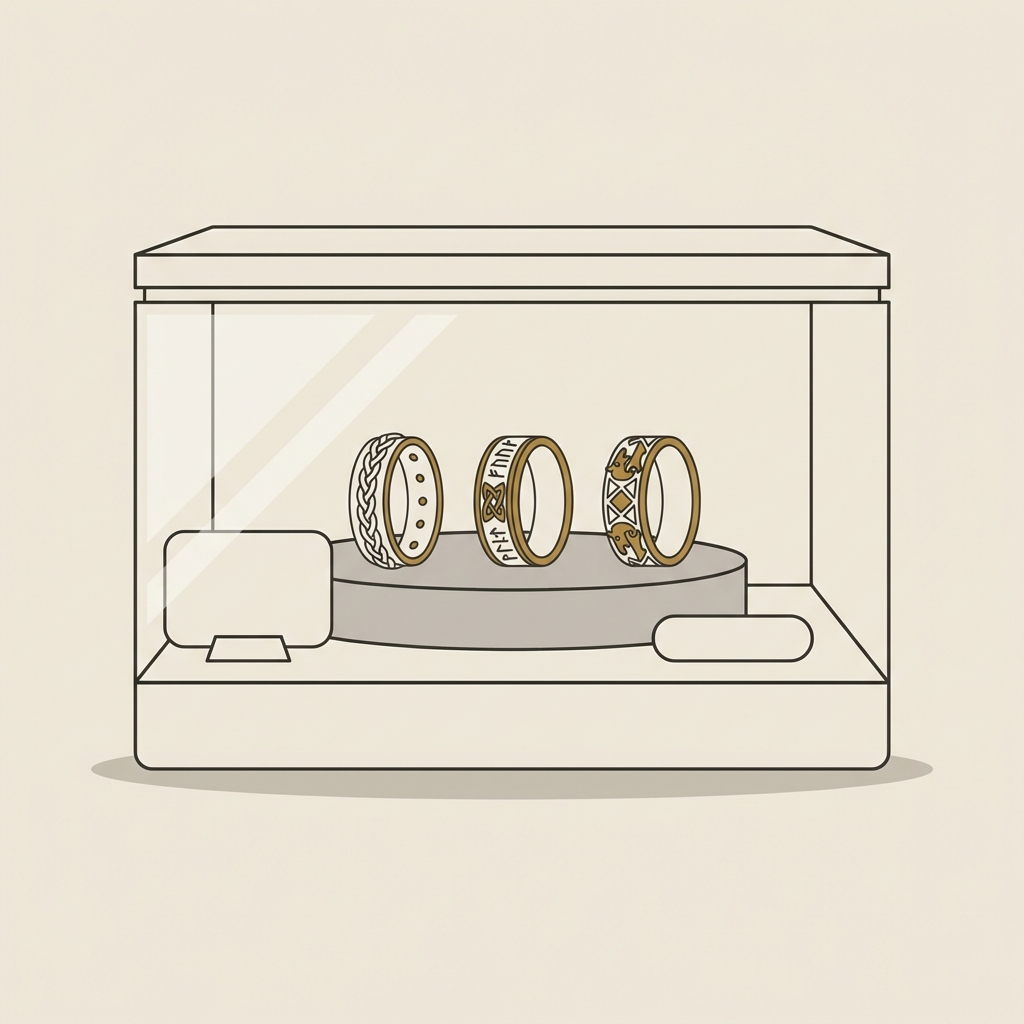
Common ring types and what museums say, ancient viking wedding rings
Museum catalogues commonly discuss rings, arm-rings and other wearable gifts in the context of exchange and alliance, but they emphasize that forms and symbolism vary with region and date, and that typology must be tied to comparative material and documentation Rings and exchange in Viking-Age Scandinavia.
Other wearable items and exchange gifts
Arm-rings, brooches and bead sets appear alongside rings in many collections and are often part of broader gift economies; curators caution that single object types rarely equal a single social function without context Vikings: people and society.

How objects are used in historical interpretation
Museums and researchers use typology, wear patterns and find context to argue that some objects functioned within exchange tied to marriage, but they also stress provenance and conservation records to avoid over-interpreting isolated finds Rings and exchange in Viking-Age Scandinavia.
How age-at-marriage varied by status, location and period
Elite and wealthy households versus peasant households
Elite households often arranged marriages with an emphasis on alliances and property, so timing and the social meaning of betrothal could differ from the practices of lower-status households; legal and narrative sources sometimes reflect those elite strategies Women in Old Norse Society.
Icelandic patterns compared to continental Scandinavia
Icelandic saga and law texts provide detailed language about betrothal that may reflect local norms, while continental burial evidence and material culture point to variation in practice across the broader Scandinavian world Gr\u0000E1g\u0000E1s (selections and translation).
Changes over the Viking Age and early medieval period
Scholars emphasize temporal change and regional diversity, so statements about a single average age for the whole period risk obscuring how household strategies and legal frameworks evolved across centuries Women in the Viking Age.
Stages: betrothal, marriage ceremony, and first childbirth
Legal and social meaning of betrothal
Betrothal functioned as a distinct legal and social act in many sources, creating obligations and expectations that were separate from the later consummation or household transfer; texts record the separate status of betrothal in contract terms and dispute cases Gr\u0000E1g\u0000E1s (selections and translation).
Timing between betrothal and consummation
Evidence suggests betrothal could occur in the early teens while consummation and first childbirth more commonly followed in the mid-to-late teens or early twenties; household strategy, kinship negotiations and local custom influenced the interval Women in the Viking Age.
A short checklist to record provenance and condition when assessing a ring
Use this when preparing questions for a seller
Patterns of first childbirth in sources
Saga narratives and demographic reconstructions align in showing a spread of ages at first childbirth, reinforcing that social, economic and regional factors shaped when households began reproduction after the legal acts connected to marriage Women in Old Norse Society. demographic reconstructions
Dating, terminology and reading reports carefully
How to read a museum or sale description
Careful descriptions use qualifying language such as described as, appears to be, or estimated dating to indicate uncertainty; responsible listings include condition notes and provenance that explain why a particular typology is suggested Rings and exchange in Viking-Age Scandinavia.
Terms that indicate uncertainty
Look for phrases that explicitly flag estimation and avoid listings that use certainty language without supporting documentation; such cautious phrasing is common in museum catalogues and scholarly work Vikings: people and society.
When to ask for further documentation
If provenance or conservation reports are missing, request high-resolution photos, condition and restoration notes, and any comparative references the seller uses to justify dating or function Rings and exchange in Viking-Age Scandinavia.
How to assess an alleged wedding ring as a collector
Checklist: documentation and condition
Prioritise provenance history, clear condition notes, restoration details, high-quality imagery, and measurements; these elements let you compare the item with museum catalogues and published typologies rather than relying on a single label Rings and exchange in Viking-Age Scandinavia.
Questions to ask the seller
Ask for a collection history, conservation or restoration reports, test data if available, and comparable references from museum catalogues; a reliable listing will provide specific documentation rather than broad claims Vikings: people and society.
When to consult an expert
Consult a specialist or conservator when provenance is vague or when the object’s condition raises questions; experts can help with typology comparisons and with assessing whether wear is consistent with long use or modern intervention Rings and exchange in Viking-Age Scandinavia.
Common mistakes, myths and over-claims to avoid
Misreading literary sources as literal demographic facts
A common mistake is to treat saga anecdotes and legal examples as statistical facts; historians avoid equating literary mentions with population averages and instead combine sources to outline ranges and social patterns Gr\u0000E1g\u0000E1s (selections and translation).
Assuming object type equals function
Assuming every simple ring is a wedding ring is risky because similar forms served multiple roles in different places and periods; context, wear and provenance matter more than typology alone Rings and exchange in Viking-Age Scandinavia.
Overconfident dating and provenance claims
Watch for listings that omit restoration notes or use absolute dating language without documentation; responsible curators and sellers give context, provenance and condition information to support attributions Vikings: people and society.
Practical examples and scenarios
Reading a sale listing: red flags and good signs
A strong listing explains collection history, provides condition and restoration notes, and cites comparable museum entries; a weak listing uses vague language and lacks images of critical details such as joins and patina Rings and exchange in Viking-Age Scandinavia.
Comparing two museum catalogue entries
Comparative catalogues are useful because they show form variation, documented provenances and conservation notes that illustrate how curators attribute objects to contexts such as exchange or personal adornment Vikings: people and society.
A hypothetical collector's decision flow
Start with the checklist: provenance, photos, condition notes; if any of these are missing, pause and request documentation, then consult an expert for typology comparison before making a commitment Rings and exchange in Viking-Age Scandinavia.
Buying checklist and next steps for collectors
Immediate red flags and must-have documentation
Immediate red flags include vague provenance, no conservation notes, and photos that hide key angles; must-have documentation includes collection history, condition and restoration notes, and clear, measurable descriptions Rings and exchange in Viking-Age Scandinavia.
Questions to ask and records to keep
Keep a record of all communications, images and any reports you receive, and ask sellers for references to comparable museum items if they use typology to justify a date or function Vikings: people and society.
Preservation and display considerations
For wearable antiquities, avoid routine cleaning with household chemicals, store items with stable humidity and temperature, and consult a conservator for any active restoration; conservation records are also helpful when re-selling or lending to institutions Rings and exchange in Viking-Age Scandinavia.
Conclusion and further reading
Summary of the cautious, evidence-based answer
Evidence from law codes, sagas and osteology supports ranges and social patterns rather than a single universal age for marriage in the Viking world; betrothal is often reported in the early-to-mid teens in some texts while consummation and first childbirth commonly occur later, and collectors should treat object labels as interpretive claims backed by typology and provenance Women in the Viking Age.
Key references and museum resources to consult
Consult the works and museum pages cited throughout this article for fuller treatments of legal texts, osteological methods and typology comparisons; these sources illustrate the caution scholars bring to dating and social claims Viking Age resources at the National Museum.
How Aurora Antiqua frames pieces for collectors
Aurora Antiqua presents curated ancient rings with condition notes, provenance references and clear historical context to help collectors judge attributions, and we describe restoration and conservation work when present without implying certainty beyond the documentation provided Rings and exchange in Viking-Age Scandinavia.
Medieval Icelandic law texts record betrothal as a distinct legal act and include examples that imply betrothals in early adolescence, but scholars treat these as legal and social evidence rather than clear demographic averages.
No. Similar ring forms served many functions; provenance, condition and comparative typology are needed before attributing a ring to betrothal or wedding use.
Request detailed provenance or collection history, high-resolution photos, condition and restoration notes, measurements, and any references to comparable museum catalogues or specialist reports.
More from Aurora Antiqua
References
- Internet History Sourcebooks: Medieval Sourcebook, Internet Medieval Sourcebook, Fordham University, New York
- Ring, Victoria and Albert Museum, London
- Ring, Victoria and Albert Museum, London
- The silver hoards of the Vikings, Nationalmuseet / National Museum of Denmark
- Viking silver arm-rings discovered on the shores of Clew Bay, Co. Mayo, National Museum of Ireland
- Red Lists Database, International Council of Museums (ICOM)
- New Acquisitions of Archaeological Material and Works of Ancient Art, Association of Art Museum Directors (AAMD)
- Historical knowledge, National Museum of Denmark, Copenhagen
- Product Details, Cornell University Press, cornellpress.cornell.edu
- par.nsf.gov