


Looking for the real thing? Browse authentic Byzantine rings, each piece one of one, individually authenticated, with documented provenance. For the background, see the guide to medieval jewelry.
Quick answer and scope: ancient greek wedding rings in Orthodox practice
Short answer for couples, ancient greek wedding rings
Short answer: Greek Orthodox couples commonly exchange rings as a canonical sign of betrothal and mutual consent, yet the crowning, the stefana, is the primary sacramental moment that confers the marriage in Orthodox theology.
This distinction is important for couples planning a wedding: the ring exchange is a visible pledge and part of many parish customs, but the sacramental focus rests on the crowns and the accompanying prayers and Eucharist. For a concise liturgical overview that explains the place of rings within the sacraments, see the Orthodox Church in America's explanation of marriage as a sacrament Orthodox Church in America marriage guide.
Yes. Greek Orthodox couples commonly exchange rings as a public sign of betrothal and consent, but the crowning remains the principal sacramental act; antique rings can be used when clergy approve and when clear provenance and condition notes are provided.
What this article covers and what it does not
This article reviews the common practice across Greek parishes, the historical background linking rings to Byzantine and Christian visual culture, practical timing options for the ceremony, and how to use antique rings responsibly during a service. It does not attempt to adjudicate questions of authenticity for specific artifacts, nor does it replace parish instructions from the officiating priest.
Where the article cites liturgical or pastoral guidance, it uses parish-facing resources and well-known liturgical commentary to keep statements grounded in the sources noted below.

What wedding rings mean in Orthodox liturgy and history
Theological emphasis: crowning and sacramental core
Within Orthodox liturgical teaching, the crowning and the associated blessings, often followed by the Eucharist, carry the central theological weight of marriage, while rings act as a canonical sign of mutual consent and the public pledge that precedes or accompanies the rite; pastoral guides and liturgical descriptions consistently separate the visible pledge from the sacrament proper Greek Orthodox Archdiocese of America sacrament overview.
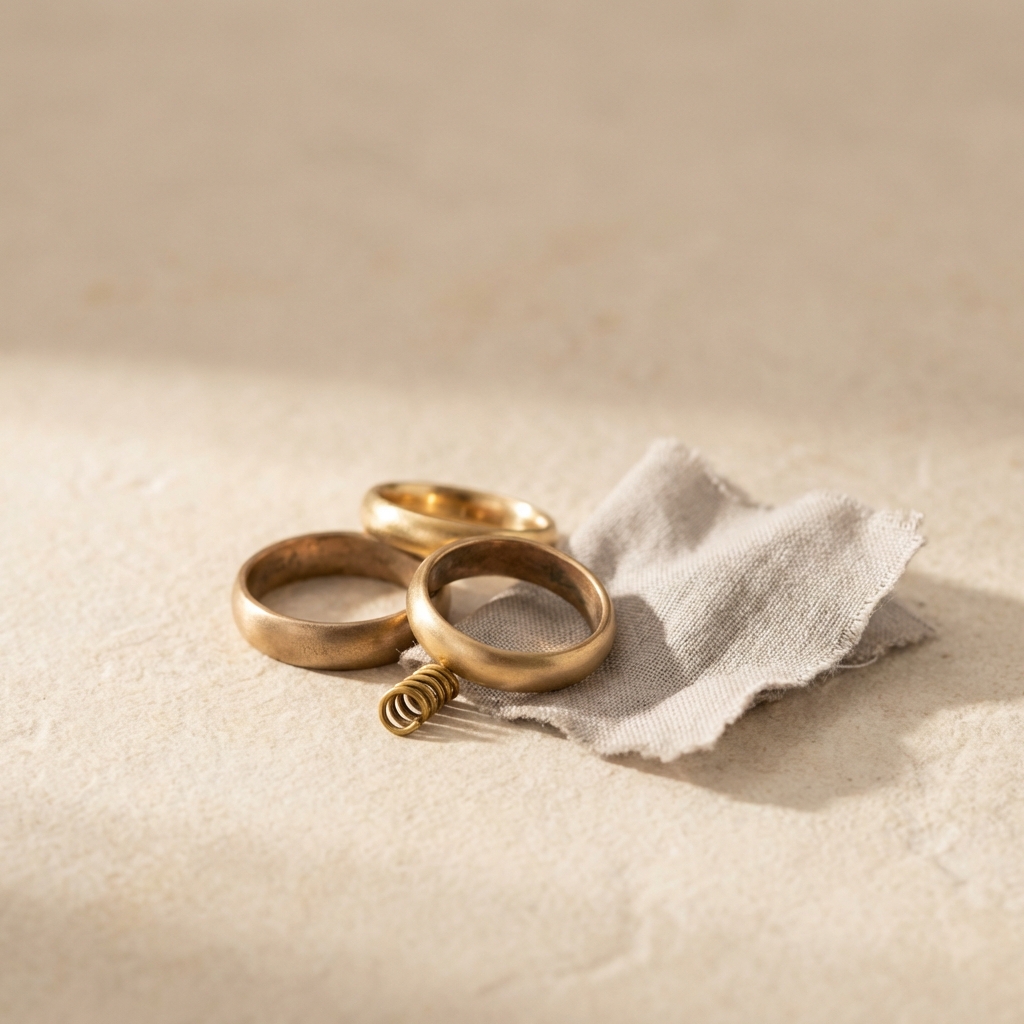
Describing the theological focus in practical terms helps avoid confusion: when a priest speaks of the crowning and the Eucharist, that is the moment Orthodox theology treats as binding in a sacramental sense, whereas a ring exchange is a recognized and meaningful ritual sign of consent and intent.
Historical and Byzantine visual context for rings
Rings sit within a long Christian and Byzantine visual culture where marriage symbols include rings, crowns, and iconography that underline mutual commitment and household formation; liturgical commentators and historians place rings alongside crowns as part of the broader symbolic vocabulary without making archaeological claims about specific objects Ancient Faith Ministries discussion of the crowning. For a practical lay overview of modern wedding order and customs see an overview of a Greek Orthodox wedding.
For collectors or history-minded readers, this means the aesthetic or historical form of an ancient ring can convey cultural meaning, but its liturgical function is determined by local custom and clerical instruction rather than by the object alone.
Timing and regional variations: when are ancient greek wedding rings exchanged?
Greek practice rings at the start or betrothal portion
In many Greek practice contexts, notably parishes aligned with the Church of Greece and in Greek diaspora communities, rings are exchanged at the start of the wedding service or during a betrothal portion that precedes the crowning; liturgical descriptions used in Greek practice reflect this ordering as a common approach Greek Orthodox Archdiocese of America sacrament overview. For parish-level wedding guidelines see wedding guidelines.
Couples should understand that this timing underscores the rings' role as a public pledge and that the crowning follows as the distinct sacramental action.
Other Orthodox traditions and local parish differences
Other jurisdictions within Orthodoxy, and individual parishes, may place the ring exchange at a different point in the rite or handle engagement blessings separately; Pemptousia and other pastoral resources emphasize the persistence of regional and parish variation and recommend confirming local custom with the officiating priest Pemptousia overview of Orthodox wedding customs.
Because practices vary by jurisdiction, it is routine for couples to be asked by their priest whether they expect rings to be exchanged at the outset or handled in another way, and the officiating priest will give the authoritative direction for that parish.
Choosing a ring for the service: materials, style and using antiques
Traditional choices why simple gold bands are common
Practical liturgical guidance and common parish practice tend to favor simple gold bands for clarity during the ceremony; plain gold rings are easy to handle, photograph well, and avoid distracting from the crowns and prayers, a preference reflected in pastoral writing and liturgical notes Ancient Faith Ministries on wedding customs.
That said, many couples choose rings with Byzantine motifs or culturally meaningful designs for personal or heritage reasons, and such choices are often acceptable when they do not interfere with the ceremonial flow.
Using Byzantine motifs or antique rings documentation and condition notes
If you plan to use an antique ring in the service, bring clear provenance and condition information so the officiating priest can consider handling and ceremonial placement; pastoral guidance on preparatory steps emphasises consulting the priest and preparing documentation ahead of time Orthodox Church in America marriage guide.

From a collector standpoint, Aurora Antiqua recommends clear photos, notes about restoration or stabilization, and measurements so clergy can see how the piece will perform in the ceremony; these are standard condition notes used when presenting an antiquity for consideration.
Practical ceremony steps and advice for couples using antique rings
Checklist for the rehearsal and the service
Start early: consult the officiating priest well before the rehearsal, present any documentation for an antique ring, and confirm which part of the service will include the exchange so readers know who will hold or present each item during the rites Orthodox Church in America guidance on marriage preparation. For additional parish ceremony explanation see a wedding ceremony explanation.
Ensure the ring photographs and measures clearly, and if it has visible repairs or stabilization, provide a short restoration note so the clergy and the couple handling it know its fragility and any handling limits.
Prepare your antique ring for the service
Check with your priest early and bring clear photos and condition notes for any antique ring so the clergy can advise on handling during the ceremony.
How to present provenance and condition notes to clergy
When showing documentation to a priest, be concise: provide clear provenance statements, high-resolution photos from several angles, and a brief restoration note describing what was stabilized or repaired. Pastoral sources advise practical clarity rather than long scholarly essays when presenting an object for use in worship Greek Orthodox Archdiocese of America liturgical guidance.
If a ring is fragile or unusually heavy, ask the priest whether it should be handled by a designated person during the ritual or mounted temporarily on a simpler band for the service; this is a practical step that preserves both the artifact and the ceremony.
Common mistakes and etiquette when choosing or using ancient greek wedding rings
Misunderstanding the sacramental role of rings
A frequent mistake is treating the ring exchange as the sacrament itself rather than a canonical sign that typically accompanies or precedes the crowning; authoritative summaries of sacramental theology underline that crowning and Eucharist are central while rings function as pledge tokens St Vladimir's Seminary Press discussion of sacraments.
Framing rings properly as symbolic consent helps couples avoid confusion about the order of the service and ensures they follow parish guidance during the ceremony.
Practical pitfalls with antique pieces
Common practical problems include unclear provenance, excessive fragility, or undocumented restorations that could make handling risky during a service; parish guidance and pastoral notes recommend clear restoration and condition statements before the rehearsal Pemptousia on wedding customs.
Etiquette: always defer to parish custom and your officiating priest for the order and handling of rings and crowns, and avoid insisting on a particular sequence if it conflicts with liturgical direction.
Short scenarios and examples: how couples have used antique rings in services
Example 1 Greek parish with rings at start and simple band
Scenario: a couple in a Greek parish agreed with their priest to exchange simple gold bands at the start of the service, followed by the crowning and the Eucharist; the priest explained that the rings signaled consent while the crowns completed the sacrament, a common ordering in Greek practice Greek Orthodox Archdiocese of America sacrament overview.
Checklist after scenario: consult the priest, prepare plain bands for clarity in the ritual, and rehearse the handoff so those carrying crowns and rings know their roles.
rehearsal checklist for rings and crowns
use this to brief clergy and attendants
Example 2 Diaspora parish with local variation and antique heirloom
Scenario: in a diaspora parish with mixed traditions, a couple wished to use an heirloom Byzantine-style ring. They showed provenance and a short restoration note to the priest at a pre-wedding meeting and the priest approved use on the condition that a designated attendant carry it during the exchange to reduce handling risk; this demonstrates the practical parish-level negotiation many couples encounter Pemptousia on parish variations.
Checklist after scenario: bring documentation, ask about a temporary mount if the ring is fragile, and name an attendant responsible for safe handling during the exchange.
Conclusion quick checklist and further reading
One-paragraph recap
Recap: ancient greek wedding rings commonly serve as the visible pledge of consent in Greek Orthodox practice, while the crowning and Eucharist contain the primary sacramental significance; couples should consult their priest early, prepare documentation when using antiques, and prefer liturgically simple choices when practical Orthodox Church in America marriage guide.

For authoritative parish instructions consult your local priest and the liturgical resources of your jurisdiction; for background reading the Greek Orthodox Archdiocese, Orthodox Church in America, and established liturgical commentaries provide solid, parish-focused material that clarifies the role of rings relative to the crowns and the Eucharist Ancient Faith Ministries on the crowning.
No. Rings are a canonical sign of betrothal and consent; the crowning and the Eucharist carry the primary sacramental significance in Orthodox marriage.
Often yes, but you should consult your priest early, provide clear provenance and condition notes, and follow any handling guidance the clergy give during the rehearsal.
Yes. Timing and placement vary by jurisdiction and parish custom, so confirm the order and any expectations with the officiating priest.
More from Aurora Antiqua
References
- Ring, Dumbarton Oaks Research Library and Collection, Trustees for Harvard University
- The techniques of Byzantine gold jewelry, Paul and Alexandra Canellopoulos Museum, Athens
- Archaeological materials, Icon, The Institute of Conservation (UK)
- E.C.C.O. Professional Guidelines (II): Code of Ethics, European Confederation of Conservator-Restorers'
- NPS Museum Handbook, Part I, Appendix O: Curatorial Care of Metal Objects, National Park Service, US Department
- Evaluation of a two rubber band technique for finger ring removal, PMC, Annals of the Royal College of Surgeons
- Hallmarking Act 1973, UK Government, legislation.gov.uk (The National Archives)