


Looking for the real thing? Browse authentic Byzantine rings, each piece one of one, individually authenticated, with documented provenance. For the background, see the guide to medieval jewelry.
Quick answer: Why ancient greek wedding bands are usually worn on the right hand
The short explanation is liturgical and cultural. In Greek Orthodox practice the ring exchange takes place in the Services of Betrothal and Crowning, and the rite commonly places the wedding ring on the right ring finger as a ceremonial convention rather than as a uniform civil rule, so right-hand wearing is best read as a religious cultural norm in many communities. GOARCH marriage resource
That placement draws on the right hand’s meaning within Orthodox ritual, where the right side is often associated with blessing, oath and honour, making the right ring finger a natural locus for a visible sign of the marriage vow. This is a pattern that is typical rather than absolute, and variations occur by place and personal choice. OCA sacraments overview
Follow @auroraantiqua for provenance and behind-the-scenes details
Explore curated listings that include clear provenance and condition notes to understand how wearing customs relate to a ring’s history.
How to use this article: read the quick answer and then follow the historical and practical sections that explain ceremony, symbolism and cataloguing approaches. If you are a collector or seller, the sections on evaluation and catalog-style notes give direct phrasing you can use when presenting an ancient ring.
For readers seeking a quick practical takeaway, treat right-hand wearing as the default cultural meaning within Greek Orthodoxy but allow for regional variation and personal decisions about which hand is used after civil registration or in diaspora settings.

How the Greek Orthodox ceremony treats ancient greek wedding bands: Betrothal and Crowning
The ceremony gives the ring its immediate liturgical role. In most Greek Orthodox rites the ring is blessed and exchanged during the Service of Betrothal and receives further liturgical recognition during the Service of Crowning; these moments are when the ring functions visibly as a sign of betrothal and sacramental unity. Ceremonial texts and pastoral guides describe the placing of the ring on the right ring finger as part of the rite rather than as a separate civil act. GOARCH marriage resource
The wording used by priests at these services often frames the ring as a blessing and a pledge, and the sequence of blessing, exchange and crowning ties the object to sacramental language. Where civil and liturgical steps differ, couples sometimes adapt by wearing the ring on the left only after civil registration or by using two rings for different social contexts. OCA sacraments overview
document provenance and visible condition of a ring
use clear photos and measured units
When describing a historic ring in a catalog or a collection record, connect the ceremonial note to the object. State that the ring is consistent with being used in a betrothal or crowning context when appropriate, but frame that as a probable cultural usage rather than conclusive evidence of how the specific object was worn in life.
Symbolism: Why the right hand matters in Orthodox liturgy
Within Orthodox liturgical language the right hand regularly signifies blessing, oath-taking and honour; the Scriptures and the Church’s ritual tradition repeatedly use the right side as the place of favour and authority. This symbolic geography makes the right ring finger a meaningful place to receive an object that stands for a promise made before God and the community. Church of Greece liturgical resource
Because the rings are exchanged during the Services of Betrothal and Crowning and the right hand has traditional liturgical associations with blessing, oath and honour, making the right ring finger a conventional place to receive a visible sacramental token.
Translating that symbolic meaning into the material life of a ring, the object becomes both sign and witness. A ring placed on the right hand in the context of a liturgy is a visible marker of blessing and public commitment, so catalog entries and descriptions that mention right-hand wearing should present it as part of the ceremonial meaning rather than as a legal fact.
Historical background: Byzantine practice and the continuity of right-hand wearing for rings
Material culture and iconography from the Byzantine world show rings used in marriage contexts and often depicted on the right hand, which supports a continuity of practice in many Eastern-Christian communities. Museum overviews of Byzantine jewellery underline rings as markers of unity and concord in marriage rituals, though dating and attribution should be given as estimates tied to provenance. British Museum Byzantine jewellery overview

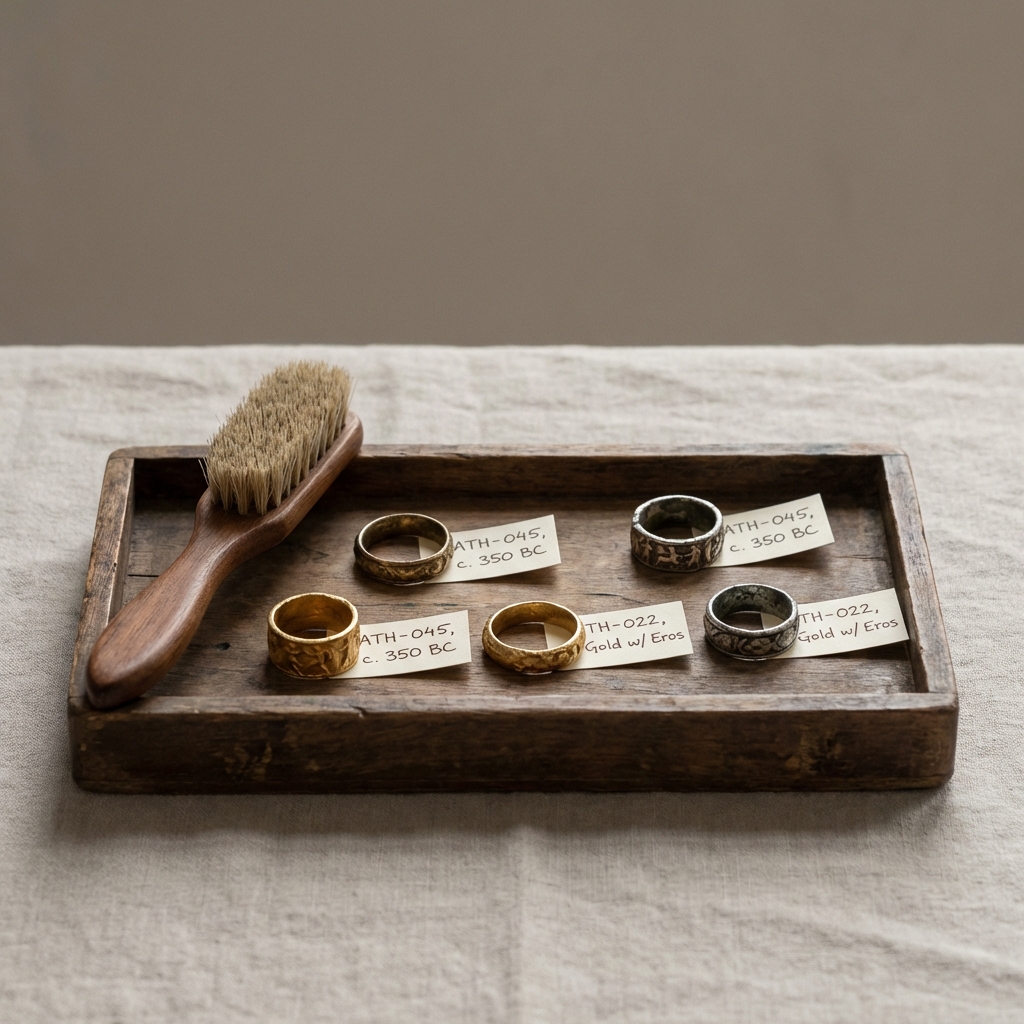
For collectors this Byzantine background matters because it situates right-hand wearing in a long-lived symbolic environment: objects that functioned as marriage rings in the Byzantine era were part of a ritual vocabulary where the right hand carried distinct semantic weight. At the same time, material evidence rarely records personal practice with absolute clarity, so any claim that a single ring was worn on a specific hand during its life should be hedged and explained with provenance and context.
When presenting a ring with a potential Byzantine association, include the relevant collection history, condition notes and any available dating rationale so readers can see how the wearing-side interpretation fits the broader evidence. Byzantine rings
Regional and modern variation in wearing side: what collectors should expect
Regional patterns remain visible in 2026. In Greece, Cyprus and many Eastern European Orthodox communities right-hand wearing is the norm after the liturgical exchange, while diaspora communities influenced by Western practice sometimes shift rings to the left or use local civil markers to decide which hand to display the band on. This reflects how living tradition adapts to local legal and social expectations. BBC explainer on Orthodox customs
For a collector, that means provenance statements should note likely regional practice when it is relevant to an object. If an object’s collection history or its findspot places it in a Greek or Cypriot context, stating that right-hand wearing was typical there is appropriate, provided the statement remains conditional and tied to cited sources.
In diaspora situations the wearing side can change for pragmatic reasons: civil registration practices, fashion, or dual-religious family practices can result in a ring initially placed on the right being later worn on the left. Catalog notes that record such changes are useful for future researchers and buyers who want to track an object’s social life in the modern period.
A practical framework for collectors and sellers: evaluating ancient greek wedding bands for context

Catalog copy should avoid overreaching. Use conditional phrasing such as appears to be or likely from when dating is visual rather than laboratory-confirmed, and explicitly list what has been tested or documented. Restoration notes should be precise about what was stabilised or repaired and what was left untouched so buyers understand which parts of the ring are original and which reflect later intervention.
For presentation, include a short paragraph that links the object to wearing customs: for example, say that right-hand wearing is typical in Greek Orthodox liturgy and that this ring’s style and period make such usage plausible. Follow that sentence with the provenance and condition details so readers can assess how persuasive the connection is for themselves.
Aurora Antiqua’s role in this process is to provide clear context and documentation language that collectors can rely on for informed decisions, while avoiding absolute claims about provenance unless independent verification is provided.
Dating, attribution and how to interpret wearing context on a specific ring
Physical markers that help with dating include patina, wear patterns on the hoop and bezel, tooling marks consistent with workshop methods of particular periods, and intaglio carving styles when present. These features can suggest probable workshops or broad date ranges, but should be presented as estimates unless corroborated by secure provenance or scientific testing. British Museum Byzantine jewellery overview
Provenance beats visual guesswork when available. A ring with a solid collection history and paperwork that traces it to a known find or earlier catalogue entry carries more weight for attribution than one dated only by style. Where documentation is lacking, combine careful technical description with conservative dating language and invite further study or testing rather than making firm claims.
Regarding wearing side, physical evidence can be circumstantial. Deformation consistent with a finger size or asymmetric wear on a bezel may suggest habitual use, but they do not conclusively record which hand was used in a ritual context. Treat wearing-side interpretation as culturally informed inference and make the limits of that inference explicit in catalog text.
Common mistakes, misreadings and care when handling ancient greek wedding bands
Several recurring errors appear in descriptions and listings. Writers sometimes assert certainty about provenance without documentation, claim legal or canonical rules where the practice is merely cultural, or describe restored areas as original. These misstatements can mislead collectors and should be avoided by using precise condition and restoration notes. GOARCH marriage resource
Another common mistake is to treat wearing side as proof of origin. While right-hand wearing is characteristic of many Greek Orthodox settings, it should not be used alone to date or attribute a ring. Always pair such statements with measurable or documentary evidence and present them as probable, not definitive.
On care and handling: avoid abrasive cleaning, do not attempt home electrochemical treatments, and stabilise active corrosion with a conservator’s advice. Photographic records before and after any intervention are essential. Where a ring has loose elements or active deterioration, recommend professional conservation rather than amateur repairs.
Short examples and catalog-style case notes for sellers
Byzantine silver ring example, catalog style: "Circa 9th to 11th century, Byzantine silver band with intaglio motif, hoop and bezel with wear consistent with age. Provenance: former private collection, collection history documented to 1970s. Condition notes: stable patina, no modern solder on bezel, small crack on inner hoop stabilized. Wearing context: right-hand wedding usage in Greek Orthodox liturgy is plausible given typology and period, stated as probable rather than certain." Cite relevant historical overviews where available. British Museum Byzantine jewellery overview
Medieval intaglio example, catalog style: "Medieval intaglio band, likely 12th to 14th century, carnelian intaglio reset within later bezel, provenance partial and under review. Condition notes: intaglio mobility noted, recommended conservation prior to wear. Wearing side: regional practice varies; note that right-hand placement is documented in many Eastern Christian rites but avoid definitive claims without collection history." Encyclopaedia Britannica entry on wedding ring
Modern diaspora example, catalog style: "Late 20th century orthodox-worn band, modern alloy, wearer reported moving ring to left after civil registration in a Western country. Condition notes: light polishing and modern repair on hoop. Wearing context: example illustrates how diaspora practice can shift hand placement after liturgical exchange; include owner statement in provenance."
Key takeaways for readers and a respectful closing note
Bulleted phrasing to use in catalogs or conversations: right-hand wearing is a liturgical and cultural convention in many Greek Orthodox contexts; present such statements as probable and link them to period and provenance when possible; avoid asserting legal or absolute rules about wearing side. Encyclopaedia Britannica entry on wedding ring
Final note: prioritize transparent provenance, precise condition and restoration notes, and cautious language when connecting an object to liturgical practice. These steps help collectors and readers understand where wearing-side interpretations are well supported and where they remain interpretive.
No. Right-hand wearing is common in many Greek Orthodox communities due to liturgical convention, but regional differences and personal or civil practices can lead some couples to wear rings on the left after the ceremony.
No. Wearing side alone is circumstantial. Use provenance, condition notes and stylistic or scientific evidence to support dating or cultural attribution.
State right-hand usage as probable when supported by period or provenance, use conditional language, and include provenance, measurements and clear restoration notes for transparency.
More from Aurora Antiqua
References
- Ring, Dumbarton Oaks Research Library and Collection, Trustees for Harvard University
- Octagonal Pendant, The Cleveland Museum of Art, Ohio
- Necklace with Pendants, The Cleveland Museum of Art, Ohio
- Gold earring, Museum of Byzantine Culture Thessaloniki
- Protection in Life and Death: Pendant Crosses from the Cemetery of Apollo Klarios at Sagalassos, Cambridge University Press
- The techniques of Byzantine gold jewelry, Paul and Alexandra Canellopoulos Museum, Athens
- Gimmel Ring, Victoria and Albert Museum, London
- Internet History Sourcebooks: Medieval Sourcebook, Internet Medieval Sourcebook, Fordham University, New York