


Looking for the real thing? Browse genuine crusader rings for sale, each piece one of one, individually authenticated, with documented provenance. For the background, see the guide to medieval jewelry.
What is a medieval cross necklace? Definition and historical context
Terminology: cross pendant, medallion, pilgrim badge, medieval cross necklace
A medieval cross necklace refers broadly to a small, personal pendant bearing a cross motif that was carried or worn for devotion, protection or identification between roughly the 10th and 15th centuries, and the term helps distinguish these pendants from larger liturgical fittings and reliquaries; this usage follows museum descriptions of medieval jewellery and devotional objects Victoria and Albert Museum article on medieval jewellery.
These objects can function in several ways in their original contexts: as a personal devotional emblem, a pilgrim badge showing a journey, an amulet with protective associations or a small liturgical pendant attached to vestments, and in many cases modern scholars note uncertainty in exact original function for specific pieces without clear documentation Journal article on crosses and personal devotion.

Regional styles vary: Byzantine or Eastern examples often show distinct iconographic conventions and manufacturing approaches compared with Western Latin forms, while materials and scale - frequently small bronze or silver mounts - help identify these pendants across collections Metropolitan Museum of Art overview of jewelry in the Middle Ages.
Who wore them: clergy, pilgrims, laypeople
Wearing a cross pendant was common across social groups, but the intended audience and use could differ: clergy used crosses in defined ritual and dress contexts, pilgrims carried badges and tokens to mark journeys, and laypeople may have worn crosses privately for devotion or protection Journal article on crosses and personal devotion.
When reading a listing or museum label, watch for language that names the likely function - pilgrim badge, devotional pendant, or liturgical attachment - and remember that some attributions remain tentative without further documentation Getty Research Institute guidance on provenance.

Materials, manufacturing and condition: what medieval cross necklaces were made of
Common metals and finishes: bronze, silver, occasional gilding
Many medieval cross pendants are cast in bronze or silver and sometimes show traces of gilding or inlay; museums emphasize these small cast forms as typical for personal devotional objects of the period Metropolitan Museum of Art overview of jewelry in the Middle Ages. Evolution of cross necklace designs provides additional context on changing styles.
Size tends to be modest - often small enough to fit comfortably on a neck chain - and attachment points are usually simple loops or small hoops that show wear consistent with long use, so condition notes should call out loop repairs or added suspension rings when present Metropolitan Museum of Art overview of jewelry in the Middle Ages.

Typical size, attachment points and wear patterns
Look for expected signs of age such as even surface wear, patina typical of bronze or silver and compressed detail on high points; these visual cues differ from modern tooling marks and fresh solder lines that can indicate recent repair or reproduction Metropolitan Museum of Art overview of jewelry in the Middle Ages.
Condition and restoration notes materially affect how an item can be worn: a well-documented stabilising repair that is disclosed in a listing is different from an intrusive modern restoration that replaces original material, and trustworthy listings will describe what was stabilised or left untouched Getty Research Institute guidance on provenance and documentation.
How restorations and conservation affect appearance
Conservation practice seeks to stabilise fragile areas and avoid aggressive cleaning that removes historic surfaces, so an item that retains patina but has discreet mechanical stabilisation is often preferable for collectors who want wearable history Metropolitan Museum of Art overview of jewelry in the Middle Ages.
When a listing includes restoration notes, check whether repairs are described clearly and whether any replaced parts are identified; transparent statements help users judge if the piece is suitable for occasional wear or better left for display Getty Research Institute guidance on provenance and documentation.
Historical rules and ecclesiastical guidelines about wearing crosses
Clerical dress codes and limitations on ornament
Historically, formal ecclesiastical regulations more often shaped clergy dress and ornamentation than lay private devotion; church canons and local regulations sometimes set limits on what clergy could wear and how crosses were displayed in liturgical contexts Oxford Journals article on clerical dress. See also Collar (order) for related ceremonial neck-wear traditions.
Rank and office could influence whether a cross was worn visibly or kept as part of vestments, and these internal rules often varied between dioceses and over time, so a single medieval rule does not cover every context Oxford Journals article on clerical dress.
There are no single universal rules, but historical church practice, modern denominational etiquette, conservation guidance and legal provenance obligations together form a practical framework for deciding when and how to wear a medieval cross necklace.
For laypeople, local custom and social norms frequently guided display rather than a universal ecclesiastical law, and what was acceptable in one town or region could differ from another Journal article on crosses and personal devotion.
Lay practice and local custom differences
Because laywear often depended on regional habits, identifying the probable audience for a pendant requires attention to both iconography and find-context when available, and cautious wording when labels attribute social use without corroborating documentation Getty Research Institute guidance on provenance and documentation.
Iconography and symbolic details sometimes signal intended audiences - for example a pilgrim badge motif tied to a known shrine - but many pieces lack that clarity and should be presented as probable rather than certain in attribution Journal article on crosses and personal devotion.
Modern etiquette: practical guidance for wearing a medieval cross necklace today
Respecting denominational meanings and liturgical settings
Match the symbol to its denominational context when possible and avoid using a historically specific emblem in a way that could confuse or unintentionally offend; keeping presentation modest in formal liturgical settings is a practical and respectful approach supported by historical practice and modern recommendations Oxford Journals article on clerical dress.
If provenance or inscription indicates a particular rite or region, consider whether wearing the piece in a different denominational setting could be sensitive and opt for a quieter display in those contexts Getty Research Institute guidance on provenance and documentation.
Choosing modest display for formal services
For formal or liturgical services, prefer a modest presentation - small scale, subdued chain and simple positioning close to the body - rather than a large or highly visible mounting that might read as theatrical or out of keeping with the setting Oxford Journals article on clerical dress.
When the historical context of a cross is uncertain, modesty in display reduces the risk of misrepresenting a piece and shows deference to communities for whom the emblem remains a living symbol Getty Research Institute guidance on provenance and documentation.
Places and situations to avoid wearing an ancient sacred object
Avoid wearing an ancient cross necklace into settings where it can be damaged or disrespected, such as during wet or high-impact activities, crowded or rough environments, or places where ceremonial practices might clash with the object's original association Metropolitan Museum of Art overview of jewelry in the Middle Ages.
Conservation advice supports this etiquette: limiting exposure to moisture, chemicals and abrasive contact preserves patina and prevents further loss, which aligns collector care with respectful use Metropolitan Museum of Art overview of jewelry in the Middle Ages.
Buying, provenance and legal-ethical rules before you wear a medieval cross necklace
Why provenance matters: chain-of-ownership and documentation
Provenance research and museum-standard documentation such as catalogue records, prior collection history and expert reports materially increase confidence in an item's attribution, condition and suitability for wear or display Getty Research Institute guidance on provenance and documentation.
When a seller provides clear collection history and condition notes, buyers can better weigh whether a piece should be worn or kept for display, and this transparency is central to responsible collecting Getty Research Institute guidance on provenance and documentation.
Legal frameworks: the 1970 UNESCO Convention and import/export concerns
The 1970 UNESCO Convention sets widely recognised principles against illicit trade in cultural property and buyers should avoid objects lacking clear legal export documentation or a credible ownership chain that predates the convention where relevant UNESCO text of the 1970 Convention.
Practical checks include asking for export permits, previous sale records and any expert reports that support legal ownership; in the absence of such documentation, defer wearing or transferring an item until provenance questions are resolved UNESCO text of the 1970 Convention.
A short provenance-check checklist for potential buyers
Use as a first filter before further inquiries
Good provenance documentation to request includes prior collection history with dates and sources, expert reports naming the specialist and their basis for attribution, and any export or customs permits that accompany the object's movement across borders Getty Research Institute guidance on provenance and documentation.
Absent reliable provenance, a piece may carry legal and ethical risks that extend beyond personal use; asking for clear documentation is not merely bureaucratic but helps protect both buyer and cultural heritage UNESCO text of the 1970 Convention.
Caring, conservation and everyday handling of a medieval cross necklace
Basic handling rules to preserve patina and structure
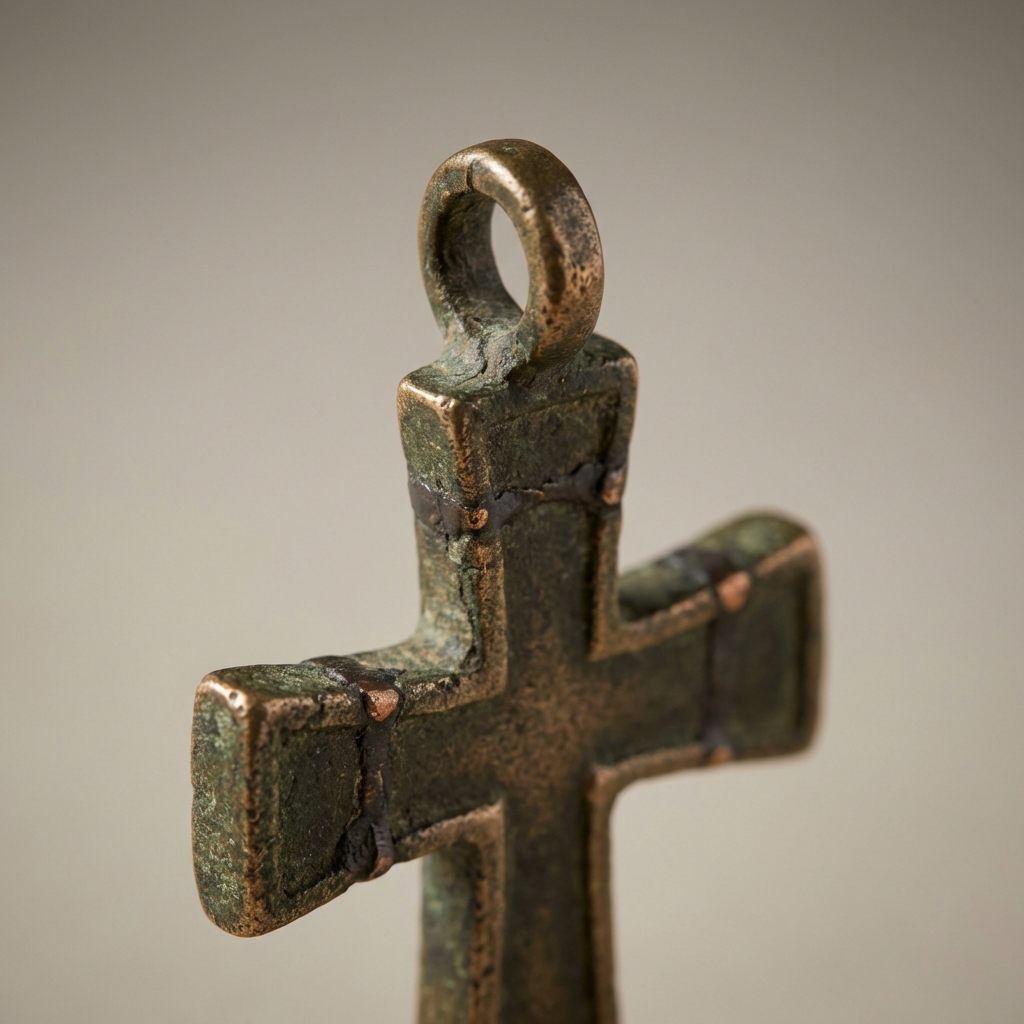
Handle a medieval cross necklace minimally and with clean, dry hands or gloves when practical; exposure to oils, sweat and moisture accelerates corrosion and can change surface chemistry in bronze and silver objects Metropolitan Museum of Art overview of jewelry in the Middle Ages.
Avoid abrasive cleaning and household polishes that remove patina; conservators generally recommend stabilising fragile areas rather than aggressive surface treatments that erase historical evidence Metropolitan Museum of Art overview of jewelry in the Middle Ages.
When to consult a conservator and what to ask
Consult a professional conservator if the loop is fragile, if previous repairs appear unstable or if corrosion threatens structural integrity; ask for written condition, a clear list of past restorations and recommended minimal-intervention steps Getty Research Institute guidance on provenance and documentation.
A conservator report should describe methods used, materials introduced and any limits on future wear recommended to prevent repeat intervention or loss of original material Getty Research Institute guidance on provenance and documentation.
Storage, display and wearing tips that minimise damage
Store a pendant in a stable, low-humidity environment on a padded support that prevents abrasion and reduces movement; when worn, choose a secure, lightweight chain and avoid sleeping, swimming or rigorous activity while wearing the pendant Metropolitan Museum of Art overview of jewelry in the Middle Ages.
Photograph condition before regular wear and keep those images with the documentation folder so any change can be compared against the baseline record provided at purchase Getty Research Institute guidance on provenance and documentation.
Common mistakes, myths and buyer pitfalls about medieval cross necklaces
One frequent mistake is assuming modern repairs or reproductions are original; visual signs like fresh solder, inconsistent patina or modern clasp types can indicate intrusive work that should be disclosed by a seller Metropolitan Museum of Art overview of jewelry in the Middle Ages.
See provenance, restorations and fresh finds on Instagram
Before deciding to wear a piece, consult condition notes and provenance checklists to confirm that repairs, export documentation and collection history are recorded and clear.
Another common pitfall is asserting precise dating or original function without supporting documentation; avoid confident statements about a pendant's date or role unless backed by expert reports or solid provenance Journal article on crosses and personal devotion.
Neglecting the 1970 UNESCO Convention and import/export documentation is a serious risk; buyers should not rely on verbal assurances alone when provenance is absent or incomplete UNESCO text of the 1970 Convention.
Examples and scenarios: wearing a medieval cross necklace in everyday life and special occasions
Scenario 1: wearing a small medieval cross as a modest everyday pendant
If you have a well-documented small pendant with clear condition notes and a stable suspension loop, wearing it sparingly in everyday, low-impact situations can be appropriate; photograph the piece beforehand and avoid contact sports or wet conditions Metropolitan Museum of Art overview of jewelry in the Middle Ages.
When provenance is partial or absent, prefer display over regular wear and use conservative mounting choices, such as a low-tensile chain and a secure loop protector, until documentation questions are resolved Getty Research Institute guidance on provenance and documentation.
Scenario 2: wearing an historic cross to a religious service
For attendance at a religious service, select modest presentation and consider whether the piece's original denominational associations align with the service's context; if provenance or iconography points to a different rite, choose a subtler display or reserve the object for non-liturgical occasions Oxford Journals article on clerical dress.
When in doubt about denominational meaning, consult knowledgeable colleagues or the seller's documentation rather than treating the pendant as a purely decorative item in a sacred setting Getty Research Institute guidance on provenance and documentation.
Scenario 3: displaying a pendant at home or in a collection
Display a medieval cross necklace in a secure, low-light, low-humidity case with a padded mount and minimal handling, and keep accompanying documentation accessible for viewers and future researchers Getty Research Institute guidance on provenance and documentation.
When a piece lacks full documentation, label it transparently as such and avoid firm claims about date, function or origin; this honest practice helps maintain scholarly standards and protects you legally and ethically UNESCO text of the 1970 Convention.
Quick checklist to decide whether to wear, display or seek more documentation: prioritise clear provenance, readable condition notes, stable suspension loops, and a conservator recommendation for any structural concerns Getty Research Institute guidance on provenance and documentation.
You can wear one occasionally if it has clear provenance, stable suspension and conservative conservation advice, but avoid daily exposure to moisture, sports or abrasive contact and photograph condition first.
Request prior collection history, expert reports, condition and restoration notes, and any export or customs permits; these records increase confidence in lawful and ethical ownership.
Avoid abrasive cleaners and household polishes; consult a conservator for any active corrosion and follow minimal-intervention guidance to preserve patina and surface evidence.
More from Aurora Antiqua
References
- Silver and plate, Icon, The Institute of Conservation (UK)
- How to Care For Your Jewellery: The Ultimate Guide by the National Association
- Archaeological materials, Icon, The Institute of Conservation (UK)
- Contact dermatitis, NHS, NHS (National Health Service, England)
- Pectoral Cross, Cleveland Museum of Art
- Object ID, International Council of Museums
- Research report: export licensing and provenance, GOV.UK, Department for Culture, Media and Sport (DCMS)
- About us, International Association of Dealers in Ancient Art