


Looking for the real thing? Browse genuine Greek rings for sale, each piece one of one, individually authenticated, with documented provenance. For the background, see the guide to buying ancient artifacts.
ancient greek rings: a short answer and why it matters
Short answer, supported by museum evidence, is that people in ancient Greece wore rings across many centuries and social settings, from the Archaic into the Hellenistic era and beyond. Examples preserved in major collections show plain hoops, engraved signets and gem-set bezels used in everyday and elite contexts, which helps us see rings as both personal ornament and functional tools for sealing documents and carrying meaning Metropolitan Museum of Art timeline on Greek and Roman jewellery. See our Q and A on ancient rings for a short FAQ style discussion.
That single fact matters for collectors because it frames how we read form, wear and documentation when assessing an object. A ring’s material, bezel type and recorded history combine to support or weaken an attribution and therefore should guide buying decisions rather than visual appeal alone.
Yes. Archaeological and museum evidence shows that ancient Greek populations wore rings from at least the Archaic period through the Hellenistic era. Rings functioned as personal ornament, administrative signets, amulets and markers of status, with materials and typology providing key clues for dating and social interpretation.
In the paragraphs that follow we use museum catalogues, collection essays and a curated shop listing as comparative evidence, explaining both what is well established and where uncertainty remains. Where helpful, the discussion points to the kinds of catalogue or shop entry details that strengthen confidence in a listing.
What we mean by 'ancient Greek rings' - definition and historical context
When this guide says ancient ring it refers to small wearable metal bands and mounted rings produced in the Greek world and related areas from roughly the Archaic period through the Hellenistic era, and sometimes continuing in Roman-period contexts where Greek styles persist. Dating is presented as an estimate and tied to typology, material and documented provenance rather than a single definitive test British Museum collection overview of Greek jewellery
Typical materials recorded in museum catalogues are bronze, silver and gold. The basic typologies counted here include plain bands or hoops, signet or intaglio rings with engraved gems, and bezel-mounted rings with decorative motifs. These categories help collectors understand likely functions and possible origins without overclaiming precision.
Materials and common types of ancient Greek rings
Bronze, silver and gold are the dominant materials in museum collections and each carries different implications for dating and social use. Bronze hoops are common in broad social strata, while silver and gold examples often appear with finer decoration or gemstones in burial and excavation contexts. The material record helps set realistic expectations when assessing a ring’s likely origin Ashmolean Museum overview of Greek jewellery
Quick material ID prompts for initial assessment
Use as a first visual check not a definitive test
Signet and intaglio rings, often set with carnelian or other engraved gemstones, become especially prominent in Hellenistic and later contexts; these rings were practical as seals and also served as personal ornament, so the presence of an engraved gem is informative about potential use and social role. See the Getty Museum catalogue of gems for a catalogue approach to gems and rings Getty Museum catalogue and comparative references in the literature American Journal of Archaeology special issue on gems
Plain hoop rings and simple bands are recorded across social strata and periods. Larger engraved bezels, more elaborate gem settings and finely cut intaglios generally occur in contexts associated with higher status or administrative use, which is why typology is a central part of initial assessment.
Chronology and regional variation: Archaic to Hellenistic and beyond
Basic forms such as plain bands and simple decorative rings appear early on in the Archaic and Classical periods, with relatively straightforward casting and finishing techniques. Over time, especially in the Hellenistic period, there is a clear rise in use of finely engraved gems and more complex mounts, reflecting changing fashions and workshop practices Metropolitan Museum of Art timeline on Greek and Roman jewellery
Regional differences are pronounced. Workshops in major Hellenistic centres produced a high volume of engraved gems and graduated settings, while provincial contexts sometimes combined local motifs with broadly Hellenistic shapes. For these reasons, readers should avoid assuming a single feature maps directly to a single date without corroborating evidence.
Social functions: seals, amulets, ornament and markers of status
Rings served multiple social roles. Signet use for sealing wax or clay documents is well attested and larger signet rings are frequently associated with administrative or elite male contexts, although women also wore signets in some cases and ornamented rings appear in female burials Metropolitan Museum of Art timeline on Greek and Roman jewellery

Amuletic uses are visible in iconography and motif choices, where protective images or symbolic animals are repeated on bezels and intaglios. Because meaning can shift by region and era, the same motif may serve as a protective emblem in one context and as a mark of identity in another.
Burial finds and literary references indicate both men and women used rings, but the contexts differ. Administrative documentation and larger signets point toward elite or civic roles, while decorative rings in graves often reflect personal adornment and identity in life and death Journal of Hellenic Studies survey on rings and signets
How museums and collections document rings: provenance, cataloguing and condition notes
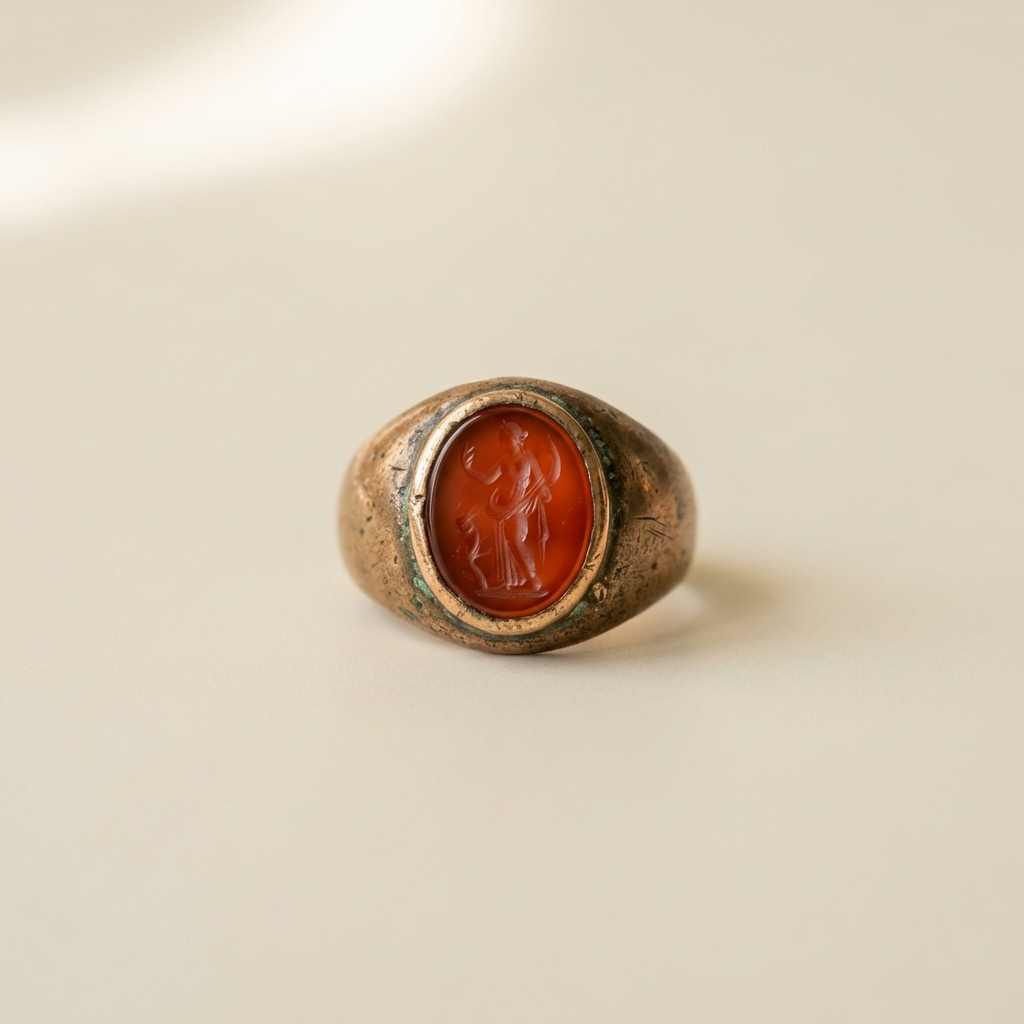
Museum and collection entries typically include material, typology, a dating estimate, and condition notes describing patina, corrosion and any restoration. Provenance or collection history is often recorded as prior ownership notes or accession information, and these elements together strengthen attribution when present British Museum collection overview of Greek jewellery
Cataloguing practices aim to be transparent about uncertainty; entries commonly state an estimated date range and reference comparable typologies or published exemplars. For buyers, a professional catalogue entry is useful as a model for what to request from a dealer listing.
How to identify an ancient Greek ring: typology, manufacture and patina
Start with clear photos and measurements, and then assess casting seams, tool marks from engraving, and the character of any patina. Casting and engraving techniques, when described or visible in photos, help differentiate period-appropriate manufacture from modern reproduction methods Aurora Antiqua product listing for Chimaron
Use the checklist before you buy
Use the practical checklist in the buying section to compare photos, measurements and condition notes; a stepwise check can help spot inconsistencies before you contact a seller.
Patina consistent with burial often shows stable surface colour and corrosion patterns that match the metal type. Beware surface treatments that mimic age; careful examination of edges, casting seams and the underside of bezels gives clues about natural burial wear versus artificial aging. When in doubt, request specialist reports.
Restoration notes should be specific. Terms like stabilised, repaired or conserved tell you whether a piece has been stabilised to prevent further damage, has undergone repair to rejoin broken parts, or has been conserved with minimal intervention to preserve original material. These descriptions help set expectations for display, care and potential further conservation work.
Practical buying checklist for collectors
Photo and measurement checklist: require multiple angles with scale, close-ups of the bezel, inner band and any hallmarks, and a clear size or millimetre measurement. Ask for images under consistent lighting to assess surface texture and patina. For examples of comparable items see our Ancient Greek Rings collection for shop examples.
Documentation and provenance checklist: request collection history, prior ownership notes, and any accompanying condition or conservation reports. Listings that summarize known provenance and restoration steps give stronger grounds for evaluation than those that omit these details British Museum collection overview of Greek jewellery
Condition and restoration checklist: confirm whether the item has been stabilised, repaired or left untouched, and ask what materials and adhesives were used if repairs were made. Red flags include vague restoration language, missing provenance, or a suspension of seller responsibility for prior treatment.
Decision criteria: condition, documentation and restoration notes explained
Weigh condition and documentation together. Good documentation can compensate for visible condition issues when it establishes a clear provenance, and conversely, excellent condition with no provenance requires cautious inquiry. Ask which carries more weight for you as a buyer and communicate that to the seller.
Common restoration treatments include cleaning to remove corrosive salts, stabilisation to prevent further deterioration, and discrete repairs to reattach fragments. Clear restoration notes should describe what was done and who performed it, which helps you assess ongoing care needs and conservation ethics.
Consult a specialist when a listing claims an important provenance without third party corroboration, when motifs or attributions appear contentious, or before making a high value purchase based on style alone. A specialist report can include metallurgical or gem analysis that goes beyond visual assessment.
Typical mistakes and red flags when assessing rings
An overreliance on visual appeal leads many buyers to accept surface cues without documentary backing. Attractive patina can be artificially induced, so always pair visual inspection with provenance and condition notes before concluding authenticity Aurora Antiqua product listing for Chimaron
Misreading patina or corrosion is common; natural burial patina often follows edges and recesses predictably, while artificial treatments may appear uniform or mask casting seams. Assuming a precise date or workshop without testing or specialist input is another frequent mistake to avoid.
Case studies: museum examples and a curated shop listing
Major collections provide well-documented exemplars. The Metropolitan Museum and the British Museum feature catalogued rings that illustrate plain bands, intaglios and gem-set bezels, and these entries show the level of typological and condition detail collectors should look for Metropolitan Museum of Art timeline on Greek and Roman jewellery and a recent review of engraved gems CAARE review
The Aurora Antiqua listing used here is presented as an illustrative example of a curated shop entry that provides description, estimated date, condition notes and provenance-style references where available. Use it as a model for the kinds of questions to ask rather than as a definitive standard Chimaron product listing

Comparing museum catalogues with detailed shop listings helps buyers see where documentation aligns and where gaps remain. Museum entries often cite exhibition or acquisition history, while well-curated shop listings that mirror this transparency are more useful for serious collectors.
Conservation, care and what restoration notes mean for ownership
Basic do-no-harm care for ancient metal rings includes keeping items dry, avoiding abrasive cleaning and storing them in a stable environment with moderate humidity. If a gem is present, handle with care and consult a conservator for cleaning instructions suited to the stone and mount.

Phraseology in conservation language matters. Stabilised generally means the piece has been treated to prevent active corrosion, repaired indicates structural work to mend breaks, and conserved suggests minimal intervention aimed at long term preservation. When restoration notes are vague, seek clarification before purchase.
Avoid further intervention unless recommended by a qualified conservator. Amateur cleaning or aggressive polishing can remove original surface evidence and reduce both historical interest and collector value.
Where scholarship is still unclear: open questions and responsible uncertainty
Workshop attributions for many Hellenistic engraved gems remain an open research area, and scholars caution that stylistic similarities do not always map to a single workshop or city. New analyses and publications continue to refine our understanding of production networks Hellenistic Engraved Gems volume and related literature AJA special issue on gems
Interpretation of provincial motifs also requires care, since local meanings can diverge from metropolitan usages. The limits of visual identification mean that many attributions should be treated as best estimates until new testing or documentation appears.
Conclusion: practical takeaways for history-minded buyers
Three practical steps before purchase: check material and typology against catalogue exemplars, demand clear provenance and condition notes, and request specialist input for high value or contentious attributions. These steps reduce risk and increase confidence when collecting ancient objects Metropolitan Museum of Art timeline on Greek and Roman jewellery
Aurora Antiqua frames its listings to provide condition notes and provenance-style references where available, and aims to help buyers compare shop information with museum catalogues. Use the checklist above and consult recent scholarship for deeper study. Browse our Ancient Greek Rings collection for related listings and examples.
Look for congruent evidence across typology, material, patina and provenance. Clear photos showing casting seams and tool marks, plus documented provenance or specialist reports, give the strongest practical support for an attribution.
Not necessarily; transparent restoration notes that specify what was stabilised or repaired and who carried out the work are normal. Avoid purchases where restoration language is vague or absent for otherwise important pieces.
No. Motifs can be helpful clues but are not definitive without contextual evidence and, where possible, specialist analysis. Many motif attributions remain estimates until new research is published.
More from Aurora Antiqua
References
- Ganymede jewelry (Gold, rock crystal, emerald), Greek, Hellenistic, ca, The Metropolitan Museum of Art, New York
- boucle d'oreille, Louvre site des collections, Musée du Louvre, Département des Antiquités grecques
- Aegean and Cypro-Aegean Non-Sphragistic Decorated Gold Finger Rings, American Journal of Archaeology
- Aulus Gellius, Attic Nights, Book X, LacusCurtius, Bill Thayer, University of Chicago (Loeb Classical Library edition)
- "Sappho" Earring, Harvard Art Museums / Arthur M. Sackler Museum, Cambridge, Massachusetts
- About us, International Association of Dealers in Ancient Art
- Publication 561 (12/2025), Determining the Value of Donated Property, Internal Revenue Service (IRS), USA
- Bronze disease, Conservation Wiki, AIC Wiki, American Institute for Conservation
- Kavousi IIC: The Late Minoan IIIC Settlement at Vronda, American Journal of Archaeology
- Client Challenge, JSTOR