


Looking for the real thing? Browse our Greek ring collection, each piece one of one, individually authenticated, with documented provenance. For the background, see the guide to ancient jewelry.
Quick overview: ancient Greek wedding rings in context
Ancient greek wedding rings appear both in the archaeological record and in visual culture, and they are plausibly connected to betrothal or marital display rather than functioning as a single, universal legal token. Archaeological studies and typologies of rings and intaglios summarize finds across Greek contexts and support this dual presence, which makes rings a useful starting point when thinking about wedding accoutrement in the ancient world Archaeology Magazine summary of ring studies (see GIA on the origin of wedding rings).
Rings survive well compared with many organic materials, so bronze, silver and gold examples often reach museums and private collections with enough form left to study. Visual evidence from funerary art and vase-painting shows rings as part of bridal display and hand gestures associated with marriage scenes, but direct legal descriptions tying a single ring type to a formal betrothal are limited in surviving texts Encyclopaedia Britannica overview of marriage in ancient Greece.
Bridal dress in classical and later Greek contexts was built from three principal garments, typically the peplos, the chiton and the himation, with regional and chronological variation visible across vase-paintings and museum collections. These garments could be arranged, folded and fastened in different ways to produce varied silhouettes for ceremony and daily wear, and the same basic pieces are repeatedly visible in iconography and surviving catalogue descriptions Metropolitan Museum of Art overview of dress in the ancient Greek world.
Textiles used for weddings were typically linen or wool, and colour or embroidered decoration is often inferred rather than preserved in full. Pigment traces on textile fragments and literary references provide hints about colour choices, but most reconstructions of hue depend on comparative study and cautious inference rather than direct evidence from intact, dyed bridal garments Greek and Roman textiles and dress studies.
@auroraantiqua: behind the scenes with Jakob on ancient rings and provenance
Sign up for a short newsletter to receive curated picks and condition summaries if you want to follow responsible listings without pressure.
Accessories form a central part of the bridal image in iconography. Stephane diadems, hair-pins, necklaces and rings are consistently paired with bridal hairstyles in Attic red-figure and white-ground scenes, creating a repeatable visual language for ceremonial looks. When reading these images it helps to keep in mind that accessories can signal regional fashions, social rank or ritual role rather than a strict, pan-Hellenic wedding costume Beazley Archive wedding scenes and accessory motifs.
Core bridal garments: peplos, chiton, himation
The peplos, a large rectangle of fabric folded and secured at the shoulder, is often associated with earlier Archaic representations, while the chiton appears more prominently in classical and Hellenistic depictions. The himation, a cloak or wrap, could be worn over either and provided an outer layer that varied by fold and drape. Museum catalogues and vase-painting comparisons are the primary sources for identifying which garment appears in a given depiction, and these sources are essential when reconstructing a wedding ensemble for a specific time and place Metropolitan Museum of Art dress catalogue.

Symbolic accessories: diadems, necklaces, hair-pins
Stephane diadems and other head ornaments recur in bridal scenes and funerary representations, often framing elaborate hairstyles that emphasize the ceremonial role of the wearer. Necklaces and hair-pins appear alongside rings, forming a coherent set of display objects in vase-paintings and tomb art. These accessories help place rings within a broader system of bridal equipment rather than treating rings as isolated tokens Beazley Archive visual evidence.
Types of rings, materials and typical features
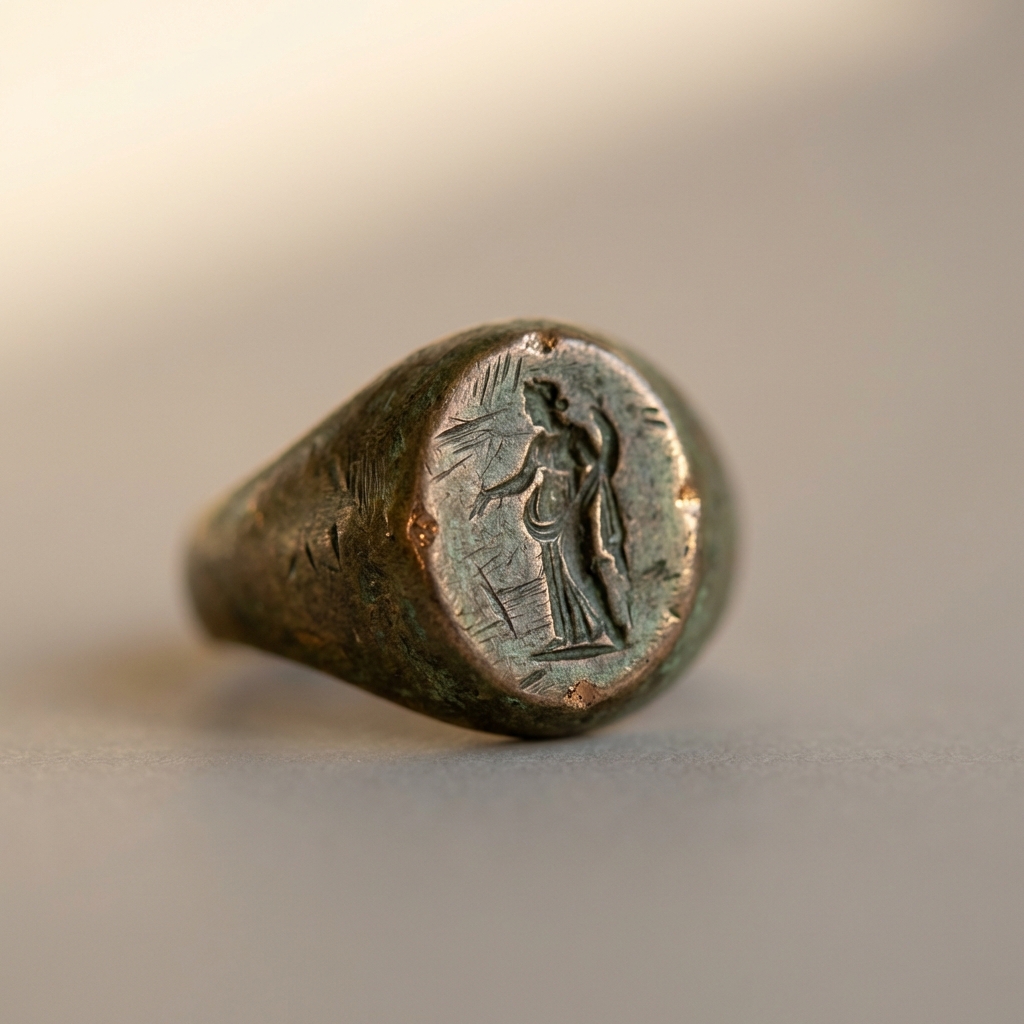
In Greek contexts ring materials typically include bronze, silver and gold, with examples sometimes bearing intaglios or inset gemstones such as carnelian or agate where the technology and wealth of the owner permitted. Archaeological surveys and typology studies document these common metals and the range of decorative approaches, which collectors will encounter frequently in catalogues and museum collections Archaeology Magazine summary of ring finds and intaglio studies (see Christie's guide to engraved gems).

Intaglios, when present, can be particularly diagnostic because carved motifs and cutting style vary by period and region. A gemstone intaglio set in a bezel shows different wear and setting techniques than a cast bronze signet ring, and the presence of a stone can affect how a ring was used, from personal display to sealing. When assessing any ring for attribution or dating, documented comparanda from museum catalogues and published finds are a central support for confident identification Archaeology Magazine ring typologies (see Getty Museum resource on ancient gems).
Common metals and gemstones
Bronze rings are common in domestic and funerary contexts because bronze was widely used and survives in large numbers; they can show corrosion patterns and repairs that are typical for age. Silver and gold rings are less numerous but often better preserved in terms of shape. Gemstones such as carnelian and agate appear in intaglios, but stone identification in listing descriptions should be treated as informed observation unless confirmed by materials analysis Archaeology Magazine discussion of materials.
Intaglios, bezels and decorative motifs
Look for bezel shape, pontil or joining marks, and the form of any intaglio carving. Recut intaglios, modern settings, or added mounts are common interventions in the market, so careful examination of photos and condition notes helps spot non-original alterations. Museum comparanda and published typologies provide the pattern language for recognizing authentic carving styles and bezel construction methods Metropolitan Museum typologies of jewelry.
How rings and bridal accessories appear in visual sources
Attic red-figure and white-ground vase-paintings provide some of the clearest visual evidence for bridal hairstyles and accessories in the classical period. These scenes often show stephane diadems, arranged hair, and jewelry in a ceremonial context, and they let us see how rings fit into a larger display language for wedding scenes Beazley Archive wedding scenes in vase-painting.
Rings appear in both material finds and visual sources as elements of bridal display, and buyers should focus on provenance, condition and conservators' notes, supported by comparanda from museum catalogues when evaluating an ancient ring.
Vase-paintings should be read with caution because they are stylized images produced for specific audiences and uses. Rings and other jewelry may be exaggerated, simplified or conventionalized to signal role rather than to record exact appearance. Combining iconographic evidence with actual finds from graves and domestic contexts gives a more balanced picture than relying on imagery alone Archaeology Magazine ring studies and find contexts.
Funerary representations add another layer of evidence because grave goods and tomb paintings sometimes replicate the accessories shown on vases, creating cross-checks between imagery and material culture. When an iconographic scene and a set of grave finds align, the combined evidence strengthens interpretations about wedding dress and accessory use in a particular place or period Metropolitan Museum dress and grave comparanda.
Provenance, documentation and best practice for identification
For collectors the central rule is that reliable identification rests on provenance documentation, condition and restoration notes, and materials analysis where available. A well-documented object will include collection history, previous ownership notes, and any reports from laboratories or experts who examined materials and construction; these elements together materially increase confidence in attribution British Museum conservation and documentation guidance.
Provenance information can take many forms, from an old collection label and sale catalogue citation to a verification letter from a recognized specialist. The value of such documentation is not only monetary, it is evidentiary. When documentation is absent or vague, buyers should treat descriptive claims with caution and seek additional comparanda from museum catalogues or published typologies Metropolitan Museum catalogues for comparanda.
Materials analysis is increasingly accessible and can confirm metal composition or gem identification, which helps separate ancient objects from modern forgeries that mimic motifs. Where a listing includes scientific reporting, that reporting should be read alongside restoration notes to understand what was tested and what remains uncertain British Museum guidelines on materials analysis and conservation.
How to read condition, repairs and conservation notes
Condition notes should describe what is original, what was stabilized, and what was restored. Terms such as stabilized, consolidated or conserved indicate work done to prevent further deterioration, while repairs or replaced parts should be explicitly listed and described so buyers can assess the degree of intervention British Museum conservation terminology.

Reversible conservation is a key principle: conservators aim to use methods and materials that can be undone without harming the original object, and restoration notes should make clear what would be lost if work were reversed. Clear photos, including detail shots of joins and interior hoop areas, support reading these notes and spotting repairs that are not original British Museum conservation practice overview.
Be especially attentive to modern additions such as re-polishing, soldered fills, or new mounted stones. These interventions can alter appearance and market description, so a transparent listing will explain these points and ideally show pre- and post-restoration images when available. When restoration language is vague, insist on clarifying details from the seller or a conservator Archaeology Magazine notes on modern interventions.
Wedding attire beyond rings: crowns, hairstyles and textiles
Stephane diadems and the carefully arranged hairstyles they framed are among the most visible elements of bridal iconography in Attic vase-paintings, providing a reliable motif for identifying ceremonial images. These crowns appear in multiple media and are often illustrated with clear ornamentation that helps categorize different diadem types across periods Beazley Archive diadem examples.
Compare images and typologies across museum catalogues and vase archives
Use museum photo IDs for accurate comparanda
Textiles for weddings were usually linen or wool and colours are inferred from pigment traces and literary references rather than surviving dyed garments. Regional differences and the passage of time mean that a single colour palette cannot be assumed for all bridal wear, so every assignment of hue or weave should be framed as informed interpretation based on textile studies and artefact traces Greek and Roman textiles and dress studies.
Patina and wear on metal accessories can also help place them in ensemble context because an object used in daily wear will show different marks than one produced for burial or display. Combining textile inference, hairstyle study and accessory typology leads to more nuanced reconstructions of bridal appearance than relying on any single category of evidence Metropolitan Museum dress and accessory comparisons.
Decision checklist for buyers: what to ask and what to expect
Before committing to a purchase, request these items as a minimum: a clear provenance record or collection history, detailed condition and restoration notes, high-resolution photographs showing joins and the interior hoop, and comparanda or catalogue references that place the piece relative to museum examples. These elements together give a baseline for further inquiry and reduce the likelihood of misattribution British Museum recommendations on documentation.
Spotting red flags: absence of provenance, vague restoration language, or generic motif descriptions without comparanda. If a listing claims a dramatic historical function for a ring without supporting documentation, that is a reason to request more detail or to seek a second opinion from a conservator or trusted specialist Archaeology Magazine notes on problematic listings.
Consider asking for scientific testing where possible, such as XRF for metal composition or gem identification reports. While not every seller can provide lab reports, the willingness to supply or discuss such tests is itself a useful indicator of responsible practice and of a seller's transparency British Museum guidance on materials testing.
Common mistakes and pitfalls when identifying ancient rings
An overreliance on motif alone is a frequent error. Many modern reproductions copy classical motifs, which means similar imagery does not by itself prove antiquity. Provenance and condition notes are decisive where motif comparison leaves ambiguity, and typological dating should be supported by find context or materials analysis where possible Archaeology Magazine observations on motif reuse.
Ignoring restoration and provenance gaps creates risk. Listings that omit restoration details or provide only a short, unclear provenance statement should be treated with skepticism. Ask for catalog comparanda and, if available, verification letters or collection inventories that corroborate the object's history British Museum conservation and provenance guidance.
Dating by style alone is tentative. Styles migrate and are copied over long periods, so stylistic dating is best used as a working hypothesis rather than a final determination. Whenever possible, confirm stylistic impressions with archaeological reports or museum catalogue references Metropolitan Museum advice on stylistic dating.
Practical examples and short case studies
Museum comparanda provide a straightforward case study: when a bronze ring with a simple bezel is comparable in form and dimensions to a published museum example and the seller can show a provenance trail linking the piece to a collection, the combined evidence supports a moderate level of confidence in dating and function. Archaeological reports that include find context are particularly helpful because they supply the secure association that stylistic comparison alone cannot provide Archaeology Magazine case reports and finds.
A well-documented listing example is one that pairs clear photography with a written collection history, restoration notes that explain stabilizations and any replacements, and references to similar catalogue entries in museum collections. Such a listing allows a buyer to triangulate the object's likely origin, evaluate condition, and decide whether independent testing is warranted British Museum guidance on responsible listings.
Next steps for readers: request documentation, compare the object to museum catalogues and published typologies, and consider a materials test for significant purchases. For collectors who want curated options, Aurora Antiqua presents curated ancient rings with condition notes and provenance references to help buyers evaluate pieces in a context-aware way. See our rings collection for a broader catalogue of related pieces.
Rings from Greek contexts are commonly made of bronze, silver or gold, and may include carved intaglios or set stones; specific stone identification usually requires testing or specialist description.
Vase-paintings show rings in wedding scenes and provide strong visual clues, but they are stylized and should be combined with archaeological finds and provenance to understand actual use.
Request a clear provenance history, detailed condition and restoration notes, high-resolution photos of joins and interior hoop, and any available materials analysis or catalogue comparanda.
More from Aurora Antiqua
References
- Gold openwork hairnet with medallion, Greek Ptolemaic, Hellenistic, ca, The Metropolitan Museum of Art, New York
- Pediment-shaped gold diadem, Greek, Hellenistic, ca. 330 to 300 BCE, Acc. 06.1217.1, The Metropolitan Museum of Art, New York
- Pair of Earrings, Dumbarton Oaks Research Library and Collection
- boucle d'oreille, Louvre site des collections, Musée du Louvre, Département des Antiquités grecques
- couronne, Louvre site des collections, Musée du Louvre, Département des Antiquités grecques
- "Sappho" Earring, Harvard Art Museums / Arthur M. Sackler Museum, Cambridge, Massachusetts
- Aulus Gellius, Attic Nights, Book X, LacusCurtius, Bill Thayer, University of Chicago (Loeb Classical Library edition)
- beazley.ox.ac.uk
- Ancient Gems and Finger Rings: Catalogue of the Collections, The Getty