


Looking for the real thing? Browse our Ancient Roman ring collection, each piece one of one, individually authenticated, with documented provenance. For a Roman signet ring in particular, see our signet rings, which also include Byzantine and medieval pieces, and our intaglio rings. For the background, see the guide to Roman jewelry.
signet ring ancient: definition and Roman context
A signet ring ancient, as used here, refers to a finger ring that carries a carved surface meant to leave an impression in a soft medium or to display a carved design as a personal emblem. In Roman contexts the carved face is typically an intaglio, a design cut into a hardstone or gem so that pressing wax or soft clay against it produces a raised seal impression; intaglio is the technical term often used in museum catalogues for these engraved stones.
Archaeological and museum collections document that Romans used signet and intaglio rings from the Republican through the Late Imperial periods for both sealing and visible display. Major public collections catalogue a wide range of examples that illustrate long chronological use and functional variety, from formal gold intaglio rings to simpler metal seal rings used in everyday administration British Museum collection overview.
The functions of these rings included creating a secure impression to close documents or goods and serving as a personal identifier or statement of identity. Over time and across regions, the balance between sealing utility and visible ornament shifted, so a ring found as grave-goods in one region may emphasise display while a utilitarian seal-ring from a workshop context emphasises administrative use.
Who wore a signet ring ancient in Roman society: social range and uses
Signet rings in Roman society appear in a broad social range, from high-status gold intaglio rings associated with elite portraiture to common bronze or copper-alloy seal rings used in daily transactions. The archaeological record and museum surveys show examples attributable to very different economic and social contexts, which suggests use by both elites and people engaged in practical administration The Met finger rings overview.
In practice, gold examples with finely carved hardstone portraits or deity scenes often communicate personal identity, family connections or status; by contrast, simpler bronze seal rings frequently appear in contexts consistent with business, household administration or local offices. Portraiture and funerary contexts sometimes make social associations visible, while documentary traces and administrative finds point to practical sealing functions.
See restoration details and provenance insights on @auroraantiqua
Explore documented pieces and condition notes to see how form, material and provenance combine when assessing ancient rings.
Beyond sealing and status, some rings carried imagery with protective or amuletic meanings, a use that overlaps with personal identity. Iconography that reads as protective in one find context can be social or emblematic in another, so interpretation tends to combine visual, archaeological and documentary evidence rather than rely on iconography alone.
Materials and technique: how Roman signet rings were made and carved
Roman signet rings were made in a range of metals and fitted with hardstones carved as intaglios. Gold, silver and bronze are common for the hoop and setting, while carnelian, jasper, agate and other hardstones are frequent choices for carved faces. Museum technical notes and collection catalogues emphasise this material variety when describing typical ring construction and mounting methods The Met finger rings overview.
Intaglio carving is the process of incising a design into a hardstone so that the reversed impression produces a raised image. Craftspeople used small drills, abrasive powders and fine engraving tools to cut hardstones; surviving tool marks, drilling traces and the style of cutting are among the visual clues conservators and catalogue entries record when assessing an object.
Yes, Romans commonly wore signet and intaglio rings across social classes; identifying an authentic example combines visual examination of bezel and intaglio style, wear patterns, clear provenance and, when available, scientific or conservation reports.
Conservators also note how bezels were formed and how stones were set: bezel shape, solder lines and signs of resizing or repair offer information about how a ring was used and altered over time. Technical conservation reports and museum entries often record these observations as part of condition and restoration notes, which collectors should consult when available bague, Louvre site des collections, Musee du Louvre, Departement des Antiquites grecques, etrusques et romaines.
Iconography on signet ring ancient examples: motifs and meanings
Iconography on Roman signet rings ranges from personalised portraiture and family emblems to divinities, animals and symbolic motifs. Portraits can indicate a named individual or ancestor, while divinities and mythological scenes may signal piety, aspirational identity or protective intent; the choice of motif often depends on the owner’s purpose and local visual traditions Journal of Roman Studies.
Animals and symbolic devices are common on smaller or utilitarian seals and can function as shorthand for identity, workshop marks or office insignia. Interpreting these images requires comparative study: a motif that reads as administrative in one region may have religious resonance in another, and historians rely on corpus studies and museum parallels to build context for individual readings.
Dating and typologies: how experts attribute Roman signet rings
Confident dating of a signet ring ancient typically depends on find context and comparative catalogue evidence rather than on ring form alone. Securely dated excavations, hoard contexts or labelled museum acquisitions provide the strongest chronological anchors, and corpus studies and museum catalogues form the typological frameworks specialists use when attributing rings British Museum collection overview.
Typologies group rings by material, iconography, mounting style and cutting technique, which helps narrow date ranges when direct context is absent. However, form alone can be misleading because styles persist and workshops re-used older motifs; as a result, many attributions remain best described as comparative and probabilistic rather than absolute.

When provenance and catalogue parallels are limited, specialist input from published corpus studies or museum catalogues is often necessary to refine dates and attributions. Cambridge corpus work and larger museum catalogues remain essential references for comparative dating and typology research A Corpus of Roman Engraved Gemstones from British Sites, University of Michigan Press / BAR Publishing.
Identifying an authentic signet ring ancient: practical checks for buyers
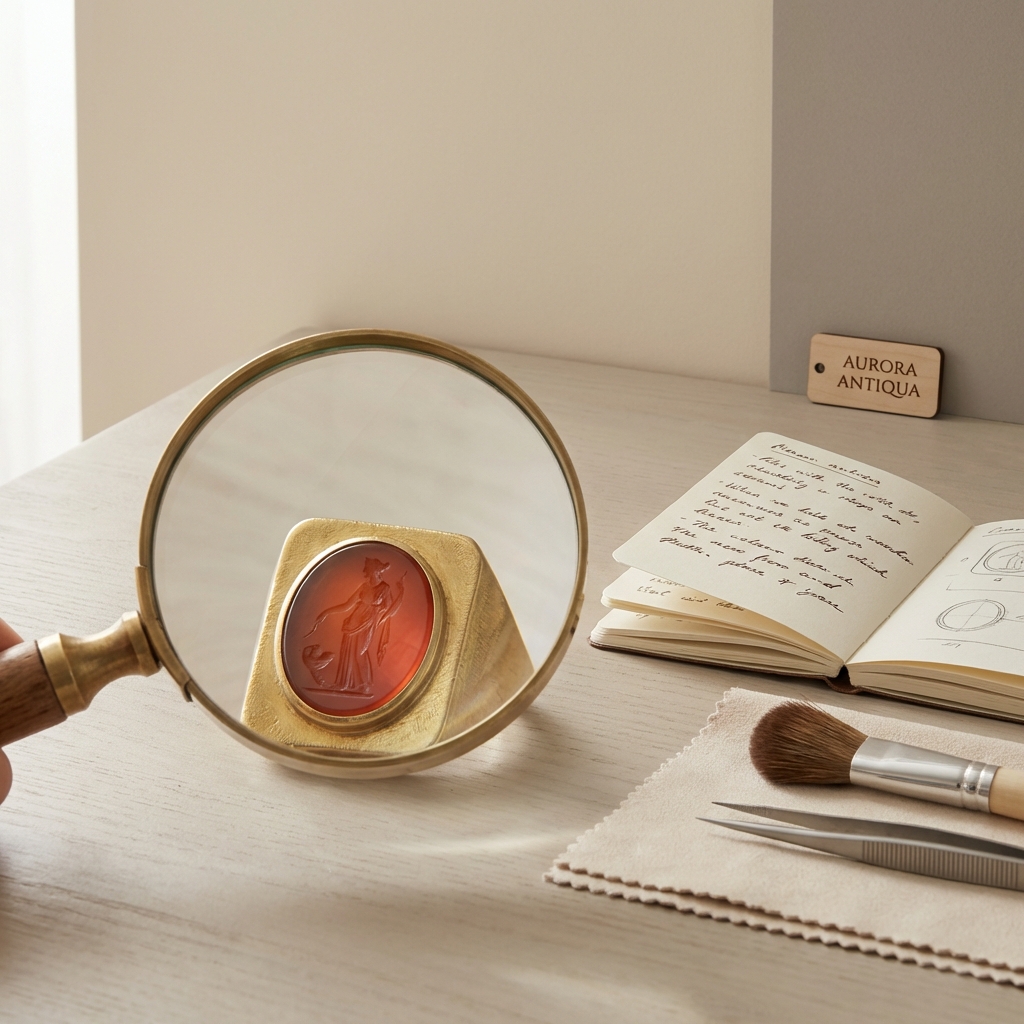
Before considering a purchase, use a structured visual checklist to evaluate an offered signet ring ancient. Start with close photographs or, ideally, in-hand inspection: check the bezel and the way the stone sits, look for consistent wear patterns on the hoop and shoulders, and inspect the intaglio under magnification for tool marks or abrasive cutting signs. These visual cues are often recorded in museum condition notes and technical descriptions when objects are published Amnon Rosenfeld, Michael Dvorachek, Shua Amorai-Stark, Elsevier, Journal of Archaeological Science.
Ask the seller for detailed provenance information and any available documentation such as collection history, prior ownership notes or verification letters. Clear documentation that links the object to a published catalogue entry or a known collection history strengthens the case for accepted attribution, while gaps in provenance merit caution. When present, independent third-party reports or laboratory analyses add another layer of evidence for materials and later treatments.
Scientific analyses conservators and researchers use include portable X-ray fluorescence for metal composition and microscopic imaging for surface features; condition and restoration notes commonly describe stabilisation or cleaning that affect appearance. Bear in mind that not every ring will have laboratory testing, and absence of a test does not by itself determine authenticity; rather, tests should be seen as one element within a wider evidential picture British Museum conservation notes.
Provenance, market issues and why documentation matters for a signet ring ancient
Market provenance statements vary in quality and detail, so it is important to verify claims rather than accept them at face value. Descriptions that simply say an item is "from a private collection" are less informative than ones that supply collection history, prior exhibition or catalogue citations. Scholars note that wider publication of finds and transparent documentation would improve regional chronologies and buyer confidence The Past Polluted: A Pigovian Approach to the Black Market in Antiquities, International Journal of Cultural.
When assessing a listing, prioritise documented provenance, clear condition notes and any restoration or conservation statements. Sellers who provide restoration notes describing what was stabilised or left untouched help buyers understand the object’s state and likely life history. If documentation is thin, ask for more detail or consider seeking specialist advice before purchasing.
one practical research step to verify provenance
Start with public catalogue entries
Unresolved market issues remain, including inconsistent provenance language and under-published regional finds. For this reason, collectors interested in signet ring ancient material should treat each object on its own evidence and prefer pieces accompanied by clear collection history and documentation.
Common mistakes and pitfalls when assessing signet ring ancient authenticity
A common error is overreliance on style alone. Because motifs and cutting styles can persist across decades or be reproduced, a visual match to a published type does not guarantee contemporaneity or original context. Corpus comparisons are valuable, but they are most powerful when combined with documented find context or chain-of-custody information Fund des Monats August 2019 (Find of the Month), Landesamt für Denkmalpflege und Archäologie Sachsen-Anhalt.
Another frequent pitfall is ignoring restoration and post-excavation history. Repairs, modern re-mounting or aggressive cleaning can change the surface and obscure original tool marks. Trust restoration notes and condition statements from sellers or museum entries, and when in doubt, request imaging and conservation reports to clarify what was done and when British Museum conservation notes.
Finally, avoid assuming a ring’s meaning solely from its imagery without considering archaeological and historical context. Imagery can be ambiguous and meanings shift across regions and periods, so interpretations that omit comparative or catalogue references are provisional at best.
Practical museum examples: studying signet ring ancient items in collections
Public museum catalogues are invaluable for studying real-world examples: collection entries show how institutions describe material, dating, iconography and conservation history. The British Museum and The Met both host accessible overviews and object entries that illustrate the diversity of Roman rings and seal usage across periods and regions British Museum collection overview.
The Met’s finger ring surveys and the Ashmolean’s technical notes on intaglios demonstrate how catalogues combine typology, material description and imagery to support attributions. Consulting these published entries helps buyers judge whether an offered ring has credible parallels or whether it sits outside well-published types The Met finger rings overview.
Conclusion and practical takeaways about the signet ring ancient
In sum, Romans did wear signet rings across social classes, in a variety of metals and with a wide range of carved intaglio motifs; the archaeological and museum record supports their multifunctional role in sealing, identity and display. Museum catalogues and corpus studies are the best starting points for understanding typology and context, while find context remains the strongest single factor for confident dating British Museum collection overview.
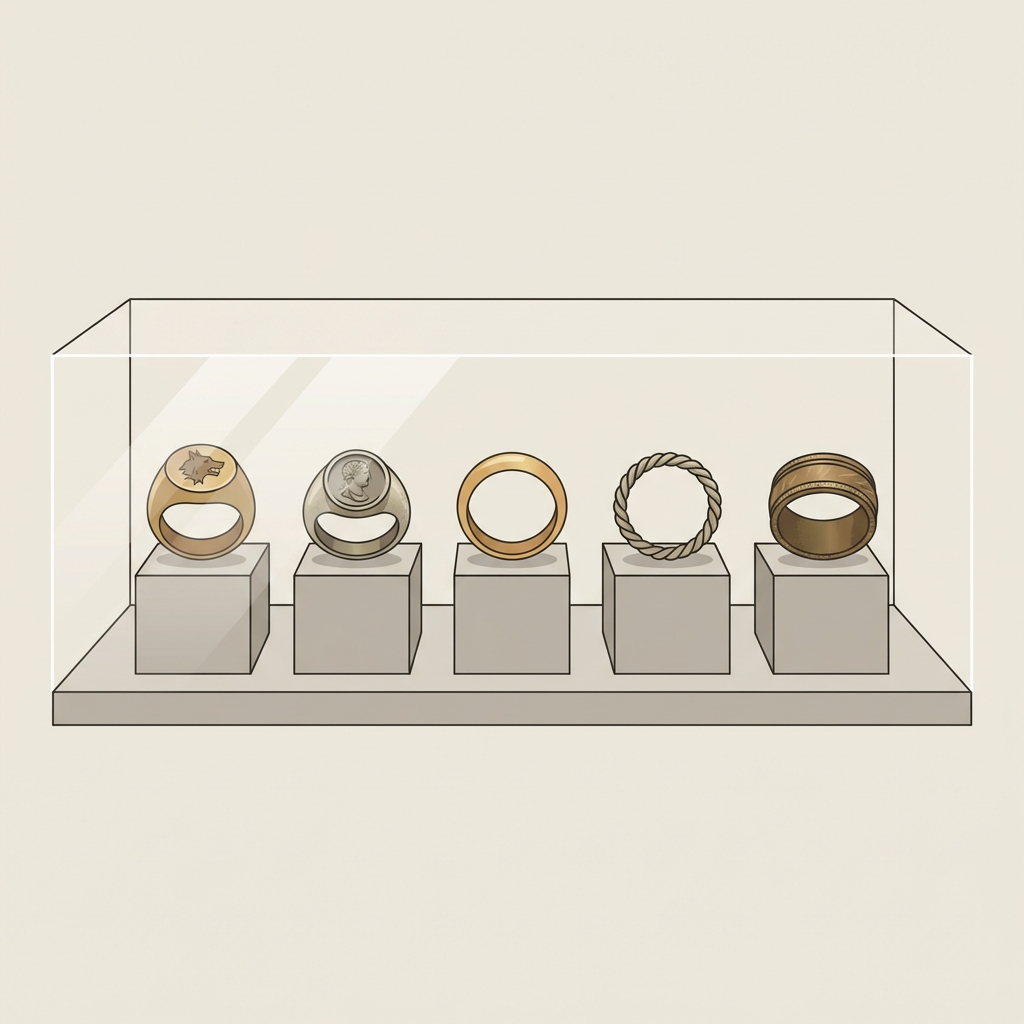
For collectors and curious buyers the takeaway is practical: use a visual checklist, prioritise clear provenance and condition notes, and seek specialist input when context or documentation is limited. Treat each object on its evidential merits and use public museum catalogues as comparative resources to refine judgments about attribution and age.
Romans used signet and intaglio rings both to make impressions for sealing documents or goods and as personal or status objects; use varied by region and period.
Common materials include gold, silver and bronze for the hoop, and hardstones such as carnelian, jasper and agate carved as intaglios, often described in museum catalogues.
Clear collection history, prior ownership notes, condition and restoration notes, and any third-party or laboratory reports are most helpful for assessing an offered piece.
Browse the Aurora Antiqua catalogue
Every piece is independently identified, dated, and documented. Shipped insured from Belgium with DHL Express, free within the EU.
More from Aurora Antiqua
References
- Art & Architecture Thesaurus Full Record Display (Getty Research)
- A Corpus of Roman Engraved Gemstones from British Sites, University of Michigan Press / BAR Publishing
- Uncovering Roman Carlisle 2024 autumn excavation announced, Cumberland Council
- Fund des Monats August 2019 (Find of the Month), Landesamt für Denkmalpflege und Archäologie Sachsen-Anhalt
- intaglio (gemma incisa) Mercurio stante, 100 dC, 299 dC, Istituto Centrale per il Catalogo e la Documentazione
- Amnon Rosenfeld, Michael Dvorachek, Shua Amorai-Stark, Elsevier, Journal of Archaeological Science
- bague, Louvre site des collections, Musee du Louvre, Departement des Antiquites grecques, etrusques et romaines
- Gemstones from Roman Britain: Recorded in the Portable Antiquities Scheme, University Debrecen, Hungary
- The Past Polluted: A Pigovian Approach to the Black Market in Antiquities, International Journal of Cultural
From Aurora Antiqua
We sell authenticated ancient & medieval pieces, each individually examined before listing and backed by a Lifetime Authenticity Guarantee. One of a kind, sold once, never reproduced.
Browse Ancient Roman Rings →