


Looking for the real thing? Browse genuine carved intaglio rings, each piece one of one, individually authenticated, with documented provenance. For the background, see the guide to Roman jewelry.
What is a Roman intaglio? Definition and historical context
roman intaglio ring, Meaning and primary uses in Roman society
An intaglio is an engraved gemstone used as a seal and as wearable jewelry, often set into a ring so impressions could be made in wax or clay.
Many public overviews and museum catalogues present intaglios as a continuous practice from the late Republic into the Imperial periods, with examples displayed to illustrate changing styles and uses; the Metropolitan Museum provides a useful general introduction to engraved gems and rings that summarizes this long chronological span Metropolitan Museum of Art overview on gems.
In Roman society an intaglio could serve as a signet for sealing letters or documents, a personal emblem worn to signal identity or status, and sometimes as a small portable display of belief or affiliation; catalogue studies and social histories link these uses to everyday administrative and social practice Journal of Roman Archaeology review of engraved gems.
Collectors and scholars therefore treat images and inscriptions on intaglios as both decorative and functional, using them to infer social context while noting that motif alone rarely provides a complete picture without additional evidence Gemstones from Roman Britain: Recorded in the Portable Antiquities Scheme, University Debrecen, Hungary.
Materials and mounting: what roman intaglio rings are made of
Common gemstones for Roman intaglios include carnelian, agate, onyx and jasper; each stone has characteristic color and translucency that collectors can use as a first clue to identification Metropolitan Museum of Art overview on gems.
These stones were typically set in metal mounts of gold, silver or bronze, and bezel style varies with period and function; museum collection entries describe how bezel thickness, hoop form and shoulder treatment help situate a piece in a chronological framework British Museum introduction to engraved gems.
Stone type affects appearance and wear: carnelian often shows a warm orange-red color and may take a high polish, while agate and jasper present banding or granular texture; the choice of setting metal affects how a ring oxidizes and where corrosion or abrasion typically appears, so clear condition notes matter for buyers and conservators Getty Conservation Institute guidance on gemstone care.
See behind the scenes on Instagram
Browse curated ancient rings with clear condition notes and documentation at Aurora Antiqua to see examples of how materials and mounts are described in listings.
When assessing a listing note whether the seller records restoration or stabilization work and whether measurements and photos include the bezel and underside of the gemstone; these details influence both identification and safe handling recommendations Getty Conservation Institute guidance on documentation and care.
Common motifs and iconography on roman intaglios
Frequent motifs on Roman intaglios include deities, portrait busts, animals and mythological scenes, and these themes appear across museum collections as typical iconographic choices for personal seals and display British Museum introduction to engraved gem motifs.
Iconography can suggest social meaning: a deity or heroic scene may express personal devotion or cultural affiliation, while portrait busts can indicate family identity or membership of an administrative class; such readings are conditional and stronger when combined with other evidence Journal of Roman Archaeology on signet ring motifs and context.
A short photo and motif checklist for assessing iconography and cutting style
Use for consistent comparison
Simple motif assessment begins with clear, well lit photos that show the field of the engraving at life size or with a scale; a checklist helps collect the same items for every ring, improving comparability across listings and catalogues British Museum guidance on recording engraved gems.
How roman intaglios were made: cutting styles and workshop clues
Cutting styles range from low relief, where designs are shallow and often linear, to higher relief where modelling creates stronger three dimensionality; these differences can reflect workshop practice and changing preferences across time Getty Museum Acquires Collection of Ancient Engraved Gems, J. Paul Getty Museum, Los Angeles.
Tool marks such as drill traces, facet shapes, and small reworking scars are useful microscopic clues; conservation imaging and microscopy reports from museum labs outline how such features are recorded and interpreted when attribution is attempted Fitzwilliam Museum conservation report on imaging and recent imaging studies Identification and mapping of ancient pigments in a Roman study.
Dating relies on a combination of motif, cutting style, bezel and mount construction, and documentation; scientific imaging can strengthen assessments but many attributions remain estimates without secure provenance.
When evaluating photos, look for consistent facet cuts near the edge of the field, unexpected fresh tool marks that might indicate modern recutting, and whether the stone surface shows wear consistent with prolonged contact against metal or skin Oxford Research Encyclopedia notes on technical clues.
Bezel and mount construction also record workshop choices: thin, closely set bezels may indicate later repairs, while integrated hoop and shoulder work suggests an original setting; specialists weigh these structural clues alongside stylistic evidence when building an attribution Journal of Roman Archaeology on mount and workshop attribution.
A practical framework for identifying and dating a roman intaglio ring
Start with a clear visual documentation checklist: high resolution photos from multiple angles, precise measurements of stone and ring size, and explicit condition notes describing chips, abrasions and any repairs Metropolitan Museum of Art guidance on photographic and descriptive documentation. For examples of available items see our rings collection.

Combine iconography, cutting technique and mount style: a deity shown in a high relief cut set in a thick gold bezel will lead to a different date estimate than a shallow, linear engraving set in a plain bronze hoop; layered evidence gives a more reliable estimate than any trait alone Journal of Roman Archaeology on combining traits for attribution.
Check provenance and documentation: findspot data, previous collection history, or third party reports increase confidence; absence of secure findspot information is a common limitation for market items and should temper firm dating statements Journal of Roman Archaeology on provenance and market limitations. Before committing to a purchase you can also consult related listings in the Aurora Antiqua Ancient Roman rings collection.

Scientific testing and imaging: what it can and cannot reveal
Non destructive techniques commonly used include microscopy for surface and tool mark study, spectroscopy for basic mineral identification, and X ray fluorescence for elemental data on metal mounts; these methods complement stylistic assessment when available Hallmarking, The Assay Office Birmingham. Raman microscopy and XRF are widely used in material studies Raman microscopy and XRF analysis.
Microscopy can reveal fresh tool marks and polishing consistent with recent recutting, while spectroscopy and XRF can help confirm whether a gem matches expected composition for carnelian or jasper; such testing materially increases confidence in material identification but is not universally accessible for market items A. M. Caggiani u. a., Corroborating the autoptic identification, Wiley, Journal of Raman Spectroscopy and analytical methods for revealing hidden details are described in the literature Analytical and mathematical methods for revealing hidden details.
Request reports when practical, and be aware that access, cost and seller willingness all limit routine testing; when a seller cannot provide any non destructive test data, treat attribution as conditional and weigh other documentation more heavily Fitzwilliam Museum discussion of access and limitations.
Condition, restoration and conservation: care guidance for collectors
Good condition notes should record visible chips, fills, stabilized fractures and any adhesives or modern solder used in repairs; transparent restoration notes reduce uncertainty for buyers and inform conservation needs Getty Conservation Institute guidance on documentation.
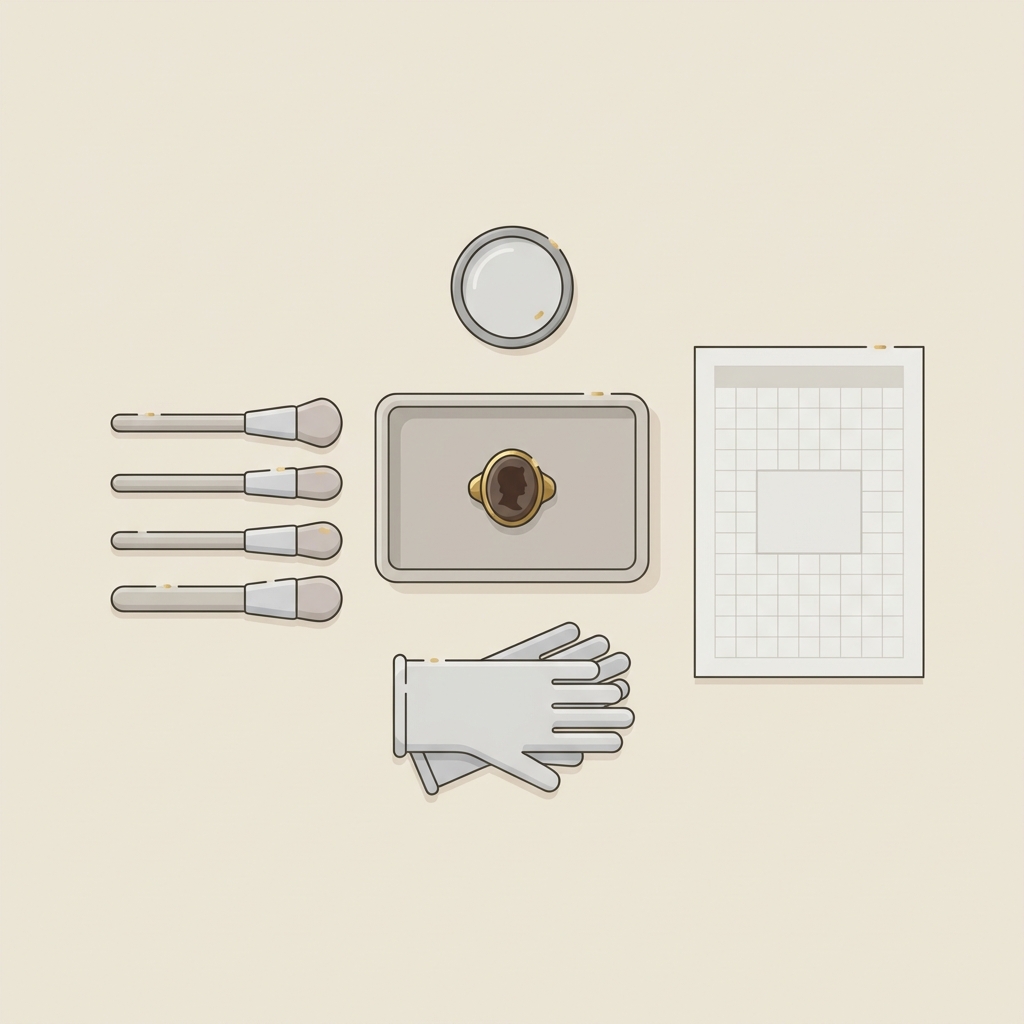
Consult a conservation professional when you detect uncertain repairs, composite mounts or loose settings; a conservator can provide a condition report and recommend reversible, minimal interventions that preserve the object and its documentary value E.C.C.O. Professional Guidelines (II): Code of Ethics, European Confederation of Conservator-Restorers'.
Common mistakes, forgeries and pitfalls collectors should avoid
A frequent error is overreliance on motif or gemstone alone to establish date or authenticity; stylistic features can be copied and gemstones can be recut or repolished, so motif should be weighed with technique and mount evidence Oxford Research Encyclopedia caution on single trait reliance.
Modern recutting, composite mounts and undocumented restoration are recurring risks in market pieces; imaging and microscopy can detect many of these alterations but are not infallible and may not be available for every object offered for sale Bague : satyre jouant de la double flûte devant une statue, Musee du Louvre, Paris, Departement des Objets d'art.
Always treat vague provenance claims with caution, and seek documentation such as previous collection history or export paperwork where possible; many market items lack secure findspot data, which limits high confidence dating Journal of Roman Archaeology on provenance gaps.
How to buy a roman intaglio ring: questions to ask and decision criteria
Before committing to a purchase request high quality images at life size or with scale, measurements of the stone and ring, clear condition and restoration notes, and any supporting provenance documents or prior collection references Metropolitan Museum of Art guidance on seller documentation. You can also compare documentation standards with items listed in our Ancient Roman rings collection.
Balance stylistic evidence, condition and any available test reports: a well documented provenance and imaging report increases confidence, while lack of documentation suggests prudence and possibly seeking a third party opinion for higher value items Journal of Roman Archaeology on weighing evidence.
Use a short pre purchase checklist: request scaled photos, ask about any conservation work, verify measurements, and ask whether the seller can provide or arrange non destructive testing; red flags include evasive answers about repairs, inconsistent photos, and no condition notes Getty Conservation Institute on buyer checks.
Summary: responsible collecting of roman intaglio rings
Roman intaglios are engraved gemstones that served as seals and personal jewelry from the late Republic into the Imperial periods; museum catalogues remain the primary public references for examples and comparative study Metropolitan Museum of Art overview on gems and our blog discusses the appeal of these pieces The timeless appeal of Roman jewelry.
Identification is strongest when iconography, cutting technique and mount style are combined with provenance and any available scientific testing; motif or material alone rarely settles attribution without corroborating evidence intaglio (gemma incisa) Mercurio stante, 100 dC, 299 dC, Istituto Centrale per il Catalogo e la Documentazione.
Keep clear condition and restoration notes, seek third party reports for uncertain or high value pieces, and store and handle intaglios according to conservation best practice to preserve their documentary and physical value Getty Conservation Institute care recommendations.
Look for characteristic color and translucency for stones like carnelian, agate, jasper and onyx, ask the seller for clear photos and gem identification notes, and request non destructive tests when available.
Request explicit restoration and stabilization notes describing any adhesives, fills, soldering, or recent reworking, and ask for before and after images if available.
Seek a professional assessment if a stone is loose, if repairs appear undocumented, or when planning any cleaning or display that could stress fragile mounts.
More from Aurora Antiqua
References
- Art & Architecture Thesaurus Full Record Display (Getty Research)
- Gemstones from Roman Britain: Recorded in the Portable Antiquities Scheme, University Debrecen, Hungary
- Getty Museum Acquires Collection of Ancient Engraved Gems, J. Paul Getty Museum, Los Angeles
- A. M. Caggiani u. a., Corroborating the autoptic identification, Wiley, Journal of Raman Spectroscopy
- Hallmarking, The Assay Office Birmingham
- About us, International Association of Dealers in Ancient Art
- E.C.C.O. Professional Guidelines (II): Code of Ethics, European Confederation of Conservator-Restorers'
- Bague : satyre jouant de la double flûte devant une statue, Musee du Louvre, Paris, Departement des Objets d'art
- intaglio (gemma incisa) Mercurio stante, 100 dC, 299 dC, Istituto Centrale per il Catalogo e la Documentazione