


Looking for the real thing? Browse genuine carved intaglio rings, each piece one of one, individually authenticated, with documented provenance. For the background, see the guide to Roman jewelry.
Quick overview: which gemstones appear in Roman jewellery and why
Timeframe and typical contexts
The Roman world used a consistent palette of stones from the late Republic through the early Imperial centuries and into late antiquity; choices combined visual effect, symbolic value and practical function such as sealing with intaglios. For collectors interested in roman empire jewelry, understanding the broad pattern of use helps separate decorative trends from functional uses like signet rings.
Major museum essays and reference overviews support a timeframe from the 1st century BCE through the 3rd century CE for many intaglio and signet ring types, and show continuity of specific materials across domestic jewellery and high-status display pieces Oxford Research Encyclopedia of Classics.
A short list of the most common stones
Below is a short list naming the stones readers will encounter and a one-line note on typical use: carnelian and other chalcedonies, favoured for carved intaglios and seals; garnet, common in cloisonn e9-style inlay and beads; amethyst, used for rings and necklaces with colour and symbolic associations; emerald and other green stones, appearing in elite jewellery as a status colour; onyx and banded chalcedony, for cameo and contrasting intaglio work; natural pearls, as luxury necklace and diadem components.
quick inspection checklist for photos and magnification
Use natural light and a ruler for scale
The list above reflects both aesthetic and functional reasons for material choice: sealing and intaglio carving for chalcedony varieties, resilient small stones for inlay work, and visually striking colours for display. Museum catalogues and object studies form the evidence base for these typical uses Metropolitan Museum of Art Heilbrunn Timeline.
The social and symbolic role of gemstones in the Roman world
Status, display and personal identity
Gemstones often marked social rank and personal display, with pearls and green stones especially associated with elite adornment in literary and archaeological sources. The presence of pearls in high-status necklaces and diadems is well attested and repeatedly noted in collection summaries and essays Smithsonian Magazine summary.
Colour choices could convey identity and affiliation in private and public contexts; owning a set of matching garnets or a carved carnelian intaglio could signal taste, access to trade networks, or office. These social meanings often sit alongside purely practical uses, so a single object can be both functional and emblematic.
Symbolic associations and sealing practices
Carnelian and other chalcedonies were commonly used for signet rings and seals because their fine-grained structure accepts detailed engraving and resists wear when used for sealing wax; many catalogues pair discussion of intaglio style with physical description to justify attributions Oxford Research Encyclopedia of Classics.
Amethyst carried inherited Hellenistic associations that persisted in Roman contexts, and stones could be chosen for colour symbolism as well as technical suitability for carving or setting. Use of stones for sealing often determined both material and form.
Detailed look at the main gemstones: carnelian, garnet, amethyst, emerald and pearls
Carnelian and chalcedonies: intaglios and signet rings
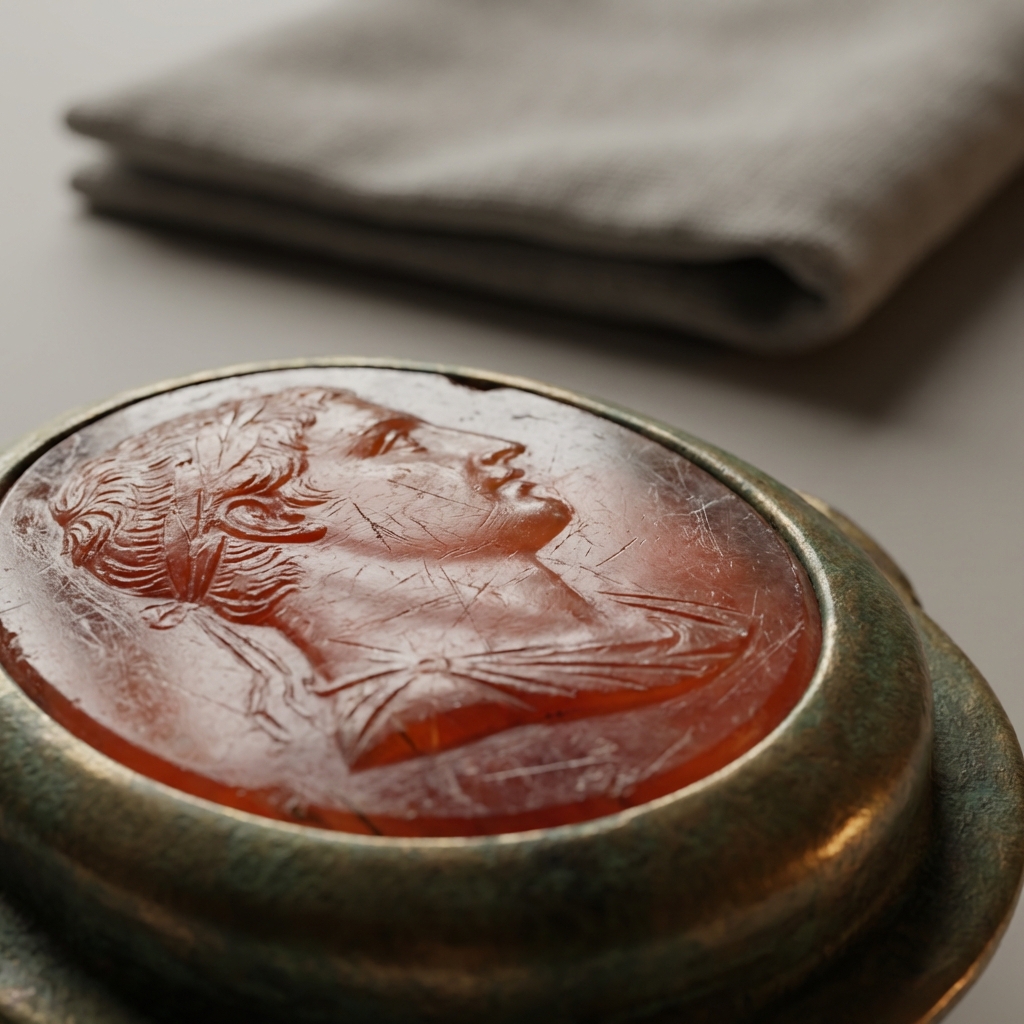
Carnelian and related chalcedony types were principal materials for Roman intaglios and signet rings, used for carved portraits, deity types and sealing devices from roughly the late Republic into the early Imperial centuries. This role for carnelian is a consistent point in object studies and reference essays Metropolitan Museum of Art Heilbrunn Timeline. An Ancient Art gallery example.
Collectors can look for certain visual clues in photos: well executed intaglios show crisp tool strokes in the recessed carving, subtle drill marks where holes were formed, and wear consistent with use on the flat face rather than on the edge. Published catalogues often describe carving technique and wear patterns when attributing a piece. See also the Art Institute case study Roman Intaglio of Mars.
The Roman world commonly used carnelian for intaglios, garnet for inlays and beads, amethyst and emerald for colour and status, and natural pearls for luxury pieces; collectors should prioritise provenance, clear photos showing tool marks and intaglio detail, restoration notes and gemmological reports when available.
Garnet: cloisonn e9 inlays, beads and varieties
Garnet appears widely across Roman jewellery in inlay work, beads and integrated cloisonn e9-style settings, and was used in both small personal items and larger display objects. The British Museum and analytical studies document common manufacturing approaches and the range of garnet types found in Roman contexts British Museum collection overview.
Because garnets were often cut as small cabochons or beads, identification cues include matching colours across a set of inlays, heat or drilling traces on bead holes, and a consistent red to deep red range in photographs. More technical studies use trace-element analysis to attempt sourcing, though many garnet provenances remain debated.

Amethyst, emeralds and pearls: colour, status and trade
Amethyst is commonly found in Roman rings and necklaces and carried Hellenistic and Roman symbolic associations that made it desirable for personal ornaments; gemmological reviews and museum catalogues include amethyst among commonly used stones in elite and middling jewellery Gemmological Institute review.
Emeralds and other green stones appear in elite contexts and are tied to long-distance trade routes into the empire; recent work on gemstones and trade highlights both eastern Mediterranean sources and farther networks, while noting limits to precise provenancing Gemmological Institute review.
Natural pearls are repeatedly attested in literary and archaeological sources as luxury items used in necklaces and diadems, and they feature in museum displays that document high-status use Smithsonian Magazine summary.
How gemstones were worked and set: intaglio carving, mounting and inlay techniques
Intaglio carving styles and drill marks
Intaglio carving techniques leave visible traces collectors can learn to spot: directional tool marks in recessed areas, tiny drill holes from perforation work, and slightly flattened zones where seals were used on soft wax. Conservation and catalog descriptions frequently call out these features when assessing authenticity and function Journal of Archaeological Science Reports. See further discussion in the Corinium Museum essay Intaglios in the Roman World.
Variation in carving style can help with rough dating: different workshops and periods favour specific line qualities and portrait conventions, so comparing a candidate intaglio to published typologies in museum essays is a practical step.
Cabochon, faceted and cloisonn e9 settings
Roman mounts included cabochon settings for smooth stones, early faceting or cleaning on harder gems, and cloisonn e9-style inlays where garnets were set into tiny compartments of gold or base metal. Visual cues include glue or solder traces in inlaid work and consistent wear on bezel edges that indicate long-term use British Museum collection overview.
Conservators note that differences in mounting style affect how a gem sits in photos: cabochons often appear rounded above the bezel, while inlaid garnets sit flush with metal cells. These differences are commonly documented in conservation notes and can guide visual assessment.
What conservators record in restoration notes
Conservation reports typically record stabilisation, repaired elements and areas left untouched so future readers know what was altered. Notes may detail cleaning methods, adhesives used and any modern additions, and these are valuable for judging how interventions altered appearance Journal of Archaeological Science Reports.
For collectors, clear restoration notes reduce uncertainty: a statement that a ring was stabilised at the hoop, or that a stone was reset in a later period, helps separate original manufacture from later interventions.
Gemstone sources and trade routes across the Roman world
Local Mediterranean sources and regional workshops
The Roman gem supply combined local Mediterranean deposits, for example Egyptian and Anatolian sources, with regional workshops that produced finished beads and intaglios. Scholarly reviews emphasise a mixed supply chain and regional processing centers within the empire Gemmological Institute review.

Long-distance imports: India, Africa and beyond
Certain materials reached the Roman world via long-distance trade: Indian and African sources are implicated for some pearls and exotic gemstones, and recent gemmological reviews discuss trace-element approaches that improve our understanding while noting remaining uncertainties Gemmological Institute review.
It is important to treat specific sourcing claims as provisional in many cases; while trace-element studies can cluster likely origins, fine-grained provenancing for many garnet varieties and some emeralds still remains an open research question in the literature.
Identification cues collectors should prioritise
Photographic evidence and intaglio detail
When assessing listings, request and inspect high-resolution close-ups of intaglio faces, profile shots showing bezel and shoulders, and macro images of drill marks or bead perforations. Published guidance recommends these visual cues as first-line evidence for intaglio and bead identification Oxford Research Encyclopedia of Classics.
Be cautious when images are cropped or lack scale; a clear ruler or known object for scale is essential for judging size and potential later re-cutting of stones.
Condition, patina and restoration notes
Look for wear consistent with age: softened high points on intaglios, even patina on metal surfaces near bezels, and conservation notes describing stabilisation or repairs. Condition notes and restoration records often accompany museum catalogues and trusted listings and can materially affect confidence in an attribution Journal of Archaeological Science Reports.
Absence of restoration details is not proof of originality, so ask sellers for conservator reports or before and after images when a listing mentions repair work.
Provenance, documentation and lab reports
Prioritise clear provenance or collection history, verification letters and published documentation when available; these elements greatly increase confidence compared with an undocumented listing. Scholarly guidance places provenance and documented history at the top of the evidence hierarchy for collectors Oxford Research Encyclopedia of Classics.
Laboratory gem reports are the technical standard when available and can show whether a gem is natural, treated, or a composite; their absence means visual and documentary cues must be weighted more carefully.
Documentation and testing: what lab reports and provenance can tell you
Types of documentation to request
Ask for collection history, prior ownership notes, any verification letters and conservator reports. These documents contextualise an item and indicate whether it has been studied or published, which materially affects confidence in a purchase Oxford Research Encyclopedia of Classics.
When lab testing exists, request full reports rather than summaries so you can see the methods used and the limits of the conclusions. Reports that document methods, instruments and comparanda are more useful than unsupported assertions.
See curated ancient rings and documentation on Instagram
If a listing includes clear condition notes and provenance records, consider it a stronger candidate for purchase and ask the seller for any available conservator or gemmological reports.
How to read a gemmological or conservation report
Gemmological reports typically state whether a stone is natural or treated and describe optical and chemical tests used; they can rarely give conclusive geographic provenancing for many stones but are valuable for basic identification. Recent reviews explain what common tests can and cannot show for ancient gems Gemmological Institute review.
Conservation reports focus on what was stabilised or altered and list materials used in restoration. Read them to understand whether a bezel was replaced, a stone was reset, or adhesives were applied, because these interventions change how the object should be interpreted.
Common misidentifications and other pitfalls for buyers
Re-cut or re-set stones and how they confuse attribution
Many stones were re-cut or re-set in later periods, and this can obscure original carving styles or create misleading combinations of gem and mount; analytical studies note this as a frequent complication for attributions Journal of Archaeological Science Reports.
Photographs showing the profile and underside of a stone can reveal later re-cutting or modern bezel additions, so insist on such views when a listing is ambiguous.
Modern composites and mislabelled materials
Composites and glass imitations can resemble ancient gems in photographs; look for bubbles, unusual translucency and surfaces that reflect unlike natural materials. Analytical papers and museum conservation notes document these risks and the tests used to distinguish materials.
When a listing lacks detailed images or mentions only vague material labels, treat the attribution cautiously until further documentation or testing is available.
Listing photography and measurement errors
Poor photography and missing measurements are common problems. A lack of scale or inconsistent lighting makes it harder to judge a stone's cut and wear. Collectors should request a millimetre measurement, a profile image and a clear close-up of any intaglio face.
In practice, good photographic evidence plus credible provenance can offset the lack of immediate lab testing, but the absence of both is a strong reason to pause.
Conservation, restoration notes and what they mean for appearance
Typical conservation terms and their meanings
Common phrases include stabilised, repaired and left untouched. Stabilised often means structural support was added to prevent breakage, repaired indicates active intervention to mend a break, and left untouched means conservators chose not to intervene; these distinctions show up in conservation records and can affect visual expectations for wear and patina Journal of Archaeological Science Reports.
Ask sellers for conservator names or short reports when restoration is mentioned so you can understand the methods and materials used in any intervention.
How restoration affects patina and structural stability
Restoration can alter patina appearance near joins and bezels and may change how a metal and stone meet visually. It can stabilise a fragile hoop but may leave visible joins; these outcomes are legitimate conservation choices but do not imply enhanced value by themselves.
Transparent restoration notes and before and after images help assess whether interventions were minimal or extensive, and whether they preserve the object's character as an antiquity.
Practical walkthroughs: reading a listing and judging a photograph
Photo checklist: angles, scale and detail
Use a simple photo checklist when reviewing listings: front close-up of the intaglio, profile of the setting, underside of the stone, full object for scale and a ruler or coin for reference. This approach is recommended by reference essays as a baseline for visual assessment Oxford Research Encyclopedia of Classics.
If images omit these views, request them before proceeding; missing angles hide re-cutting, modern repair or compositing.
Interpreting measurements and condition notes
Compare stated millimetre measurements to the visual scale in photos; small differences matter for rings versus beads. Condition notes that list specific interventions or provide conservator details increase confidence compared with vague statements like good condition.
Example: a ring described as stabilised at the hoop plus a clear conservator note and profile photos showing the repair is easier to assess than a ring listed as good condition without images or documentation.
Decision checklist for buyers: what to ask and how to prioritise evidence
Prioritising provenance and testing
Rank evidence when evaluating a listing: first provenance and collection history, second clear photographic evidence showing intaglio details and mounting, third restoration and condition notes, and fourth lab tests when available. This order follows scholarly guidance on attribution strength Oxford Research Encyclopedia of Classics.
Accepting a missing lab test can be reasonable if provenance is strong and photos show consistent tool marks, but weigh that decision against the price and your tolerance for uncertainty.
When to accept restorations or incomplete documentation
Accept restorations when they are documented, minimal and carried out by a named conservator, and when they do not obscure original features. Incomplete documentation can be acceptable if the seller supplies clear photos, a credible collecting history and transparent restoration notes.
When key questions remain, request a third-party report or decline until further documentation is provided.
Quick glossary: terms collectors will meet in listings
Intaglio: a carved, recessed design used for seals and signet rings
Patina: the surface changes on metal from age and environment
Provenance: documented ownership history or collection background
Bezel: the metal rim that holds a stone in place
Restoration notes: short descriptions of any repairs or conservation work performed
Conclusion: how to proceed carefully as a collector of Roman empire jewellery
Key takeaways
The most common gemstones in Roman jewellery were carnelian for intaglios, garnet for inlays and beads, amethyst and green stones for colour and status, and natural pearls for luxury display. These patterns are grounded in museum catalogues and scholarly essays that combine object study with trade analysis Metropolitan Museum of Art Heilbrunn Timeline.
Documentation, condition notes and gemmological reports are the strongest supports for confident collecting; when those are missing, clear photographic evidence and credible provenance history can partially compensate.
Practical next steps
When evaluating listings, follow the decision checklist above, request conservator or lab reports where possible, and prioritise sellers who present clear condition notes and collection history. Curated sellers can add value by sharing restoration notes and provenance documentation without promising certainty about every attribution.
Collecting ancient pieces is often a balance between appreciation for wearable history and careful evidence-based assessment, so proceed with patience and informed questions.
Carnelian and other chalcedonies were common for intaglios, garnet for inlays and beads, with amethyst, emeralds and natural pearls appearing in higher-status jewellery.
Look for tool marks and drill traces in close-up images, wear consistent with use on the seal face, clear provenance, and any available conservator or gemmological reports.
Request lab reports when the price or attribution hinges on the gem type, when provenance is incomplete, or when photos are inconclusive about treatments or composites.
More from Aurora Antiqua
References
- Quartz, Handbook of Mineralogy, Mineral Data Publishing / Mineralogical Society of America, USA
- Similarities and differences among selected gemmological varieties, Mineralogical Society of Great Britain
- Study on the effect of heat treatment on amethyst color and the cause, Springer Nature
- Nomenclature of the garnet supergroup (American Mineralogist 98, 2013), Mineralogical Society of America
- Getty Museum Acquires Collection of Ancient Engraved Gems, J. Paul Getty Museum, Los Angeles
- Gemma Augustea, Kunsthistorisches Museum Wien, Antikensammlung
- Carnelian ring stone with Asclepius, the god of medicine, Acc. 81.6.94, The Metropolitan Museum of Art
- Une intaille magique au Musée d'Arles (Bouches-du-Rhône), Persée, Revue archeologique de Narbonnaise
- Amnon Rosenfeld, Michael Dvorachek, Shua Amorai-Stark, Elsevier, Journal of Archaeological Science