


Looking for the real thing? Browse genuine carved intaglio rings, each piece one of one, individually authenticated, with documented provenance. For the background, see the guide to Roman jewelry.
What is a roman intaglio ring? Definition and context
A roman intaglio ring is an ancient ring with an engraved gemstone set into a metal hoop, typically cut in intaglio so the carved design sits below the gemstone surface and could function as a seal. This contrasts with a cameo, where the design is raised and carved in relief rather than incised. The distinction and basic definitions used by curators and collection catalogues help collectors recognise whether a small engraved gem was intended as a working seal or primarily as ornament; for a concise museum definition see The Met collection entry.
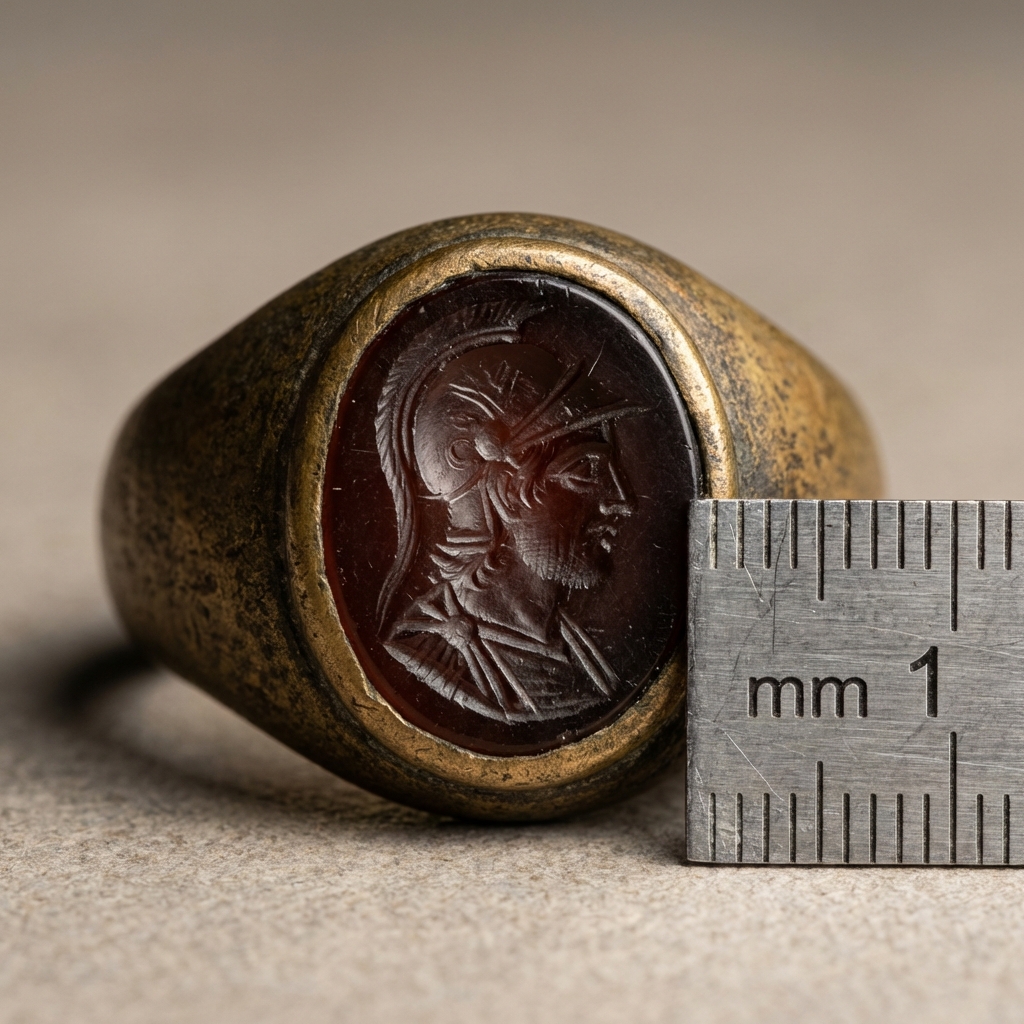
Common materials for Roman-period intaglios include carnelian, agate, chalcedony and occasionally semi-precious stones mounted in silver, bronze or gold bezels. Metal settings range from simple hoops to more elaborate shoulders and bezels, and the gemstone surface often shows wear consistent with repeated handling and use. For identification, look for a recessed cut that reads correctly when pressed into a soft medium, a natural patina on the metal, and surface wear on the stone that aligns with the ring s overall age and use.
Condition notes and any available provenance or documentation are central to whether a specific object is treated as a collectible rather than an undifferentiated antiquity. Measurements, clear multi-angle photographs and concise condition statements that record chips, visible repairs or areas of recutting make a ring far easier to assess and compare with published museum examples.
Definition: intaglio versus cameo and seal function
In plain terms, intaglio describes an incised design cut into a gemstone, intended to create a positive impression when used as a seal, while cameo describes a raised design carved in layers. Understanding which technique is used helps separate functional signet rings from decorative pieces and guides both dating and market expectations.
Typical materials, settings and periods
Carnelian and agate are among the most common gem materials encountered in Roman intaglios, often set in silver or bronze hoops in the early Imperial centuries. Many museum catalogues group examples by material and cutting style, which makes them useful comparators for collectors seeking likely period attributions and workshop characteristics.
Why collectors value intaglios: wear, patina and narrative
Collectors frequently look for wear consistent with age, a stable patina on the metal and a clear story of provenance or prior cataloguing. A well-documented ring with coherent condition notes and collection history typically attracts greater interest than an otherwise similar example without documentation. For a discussion of intaglio appeal see our blog post.
How experts identify and date roman intaglio rings
Experts use a combination of visual comparison with museum catalogues and scientific, non-destructive testing to form a date and attribution. Museum and major collection entries remain the primary comparative standards for stylistic and motif matches, and they are the first port of call when attempting to place an engraved gem in time and context, especially for motifs with broad publication histories; consult The Met collection for examples and notes on typology.
Non-destructive methods have become more widely used in recent years to support stylistic assessments. Portable XRF can help confirm the composition of metal mounts and, in some cases, provide elemental clues about the stone, while high-magnification microscopy and specialised imaging reveal cutting traces, tool marks and modern intervention more clearly than the naked eye. For a technical overview of how portable XRF and microscopy are applied to engraved gems see the Heritage Science article.
Each method has strengths and limits. Stylistic comparison can suggest a likely chronological range when a motif and cutting style match well documented museum comparanda, but published catalogues have regional and workshop coverage gaps that can leave some attributions open. Scientific data can support or challenge a stylistic reading, for example by showing that a bezel alloy or a modern recut is inconsistent with an early date, yet scientific results rarely give a single definitive year and are best read alongside curatorial comparanda.
Document and verify before you list or insure
Document your ring with clear photos and measurements, and consider requesting non-destructive testing or a written expert report if dating or provenance is unclear.
Museum comparanda and motif matching
Matching a motif to published museum examples is a practical first step for narrowing dates and possible workshop attributions. Online museum catalogues often include dated comparanda and curatorial notes that explain cutting style and iconographic context, which can be used to form an initial attribution hypothesis.
When using comparanda, compare composition, iconography and cutting technique rather than relying on a single similar subject; a single questionable match can mislead unless other visual cues align.
Scientific non-destructive testing: portable XRF, microscopy and imaging
Portable XRF can quickly identify elemental composition of a metal mount, which helps verify whether a bezel s alloy is consistent with an assigned period, while microscopy and reflected-light imaging reveal striations, re-cutting and modern tool marks that are invisible at low magnification. These tests are particularly useful where provenance is incomplete or when restoration is suspected.
Bear in mind that not every test provides a conclusive answer on date; rather, each technique adds a layer of evidence. Combining a microscopy report with a catalogue comparison creates a stronger, more defensible attribution than either approach alone.
Weighing stylistic indicators against scientific results
Curators and conservators typically treat stylistic and scientific evidence as complementary. A clear motif match in a curated collection raises confidence in a stylistic attribution, while anomalous scientific results prompt closer scrutiny or specialist consultation. Understand that a conflict between style and science does not automatically invalidate a piece; it indicates the need for further study, additional tests or independent expert opinion.
A practical appraisal checklist for owners
Before selling, insuring or buying, follow a concise documentation routine. Start by recording accurate measurements of the hoop diameter and gemstone dimensions, then make high-resolution photographs of the bezel, shoulders and underside of the gem from multiple angles. Include a note on how the ring was measured and whether the stone yields a readable impression when pressed into a soft medium.
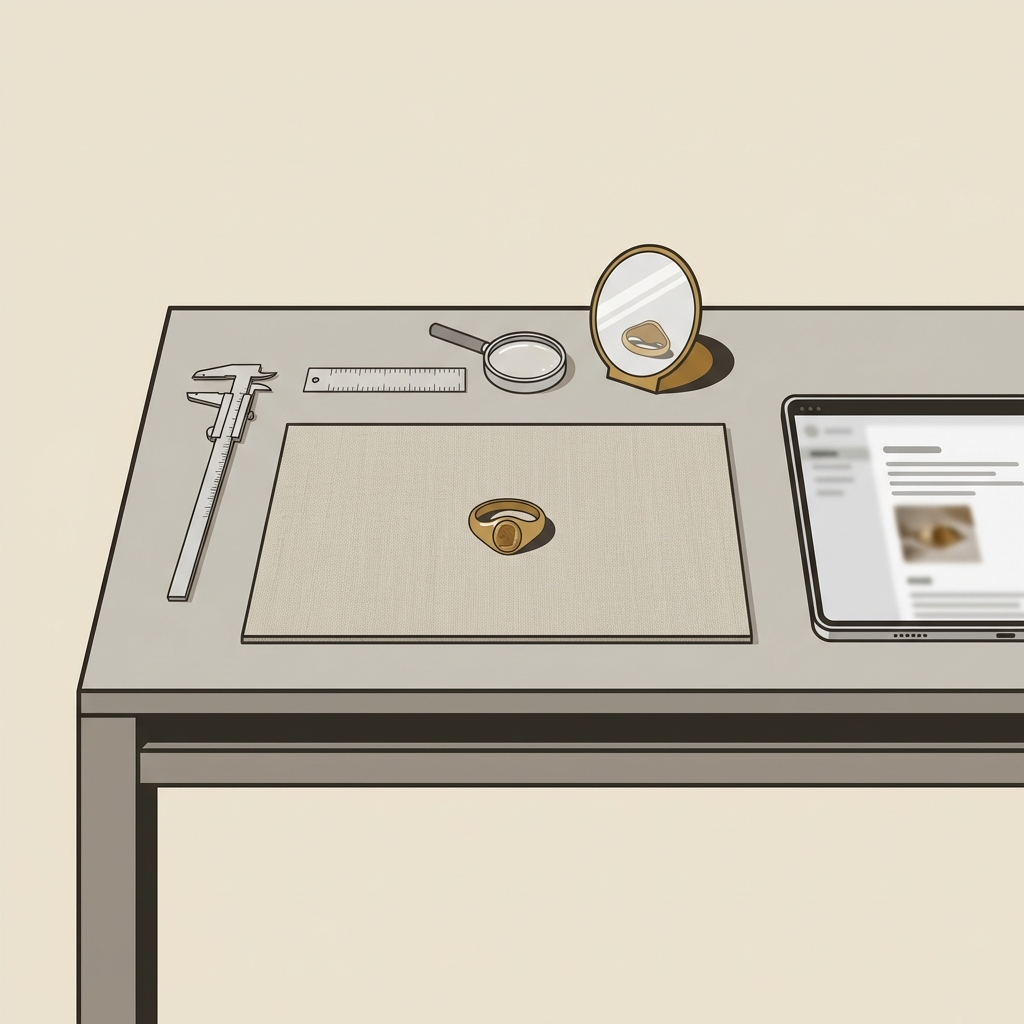
Clear condition notes are essential. Describe chips, hairline fractures, areas of abrasion, visible repairs or modern solder joints, and whether the stone shows signs of re-cutting. When restoration is present, specify what was done and whether the repair was stabilising, cosmetic or reversible. Good condition statements materially aid comparanda searches and expert reports.
Check motif and style against museum catalogues before assuming a precise date or attribution, using published examples as comparanda to test your preliminary view. If comparanda are lacking or the piece shows unusual features, request non-destructive analysis and a written expert report before listing the item or agreeing a sale.
When to escalate: if you find evidence of modern tool marks, an unexpected alloy in the mount, or inconsistent patina, seek a conservation report and consider imaging or microscopy. For material identification and to detect modern recutting, portable XRF and microscopy are the most commonly recommended first-line tests.
Record measurements, clear photos and condition notes
Measurements and photos function as the permanent record for any later valuation. Include a scale in images, and record where chips or old repairs are located. Documenting the ring s condition clearly reduces later disputes and helps valuers compare the piece with museum examples.
Check motif and style against museum catalogues and published comparanda
Use curated online catalogues to find comparable motifs and cutting styles. Museum entries often provide dating ranges and curatorial commentary that explain why a particular motif is associated with an era or workshop, which makes them more reliable than an unannotated image in a general listing.
It is wise to capture links or citation details to the specific comparanda you relied upon as part of your documentation package.
When to request non-destructive analysis and a written expert report
Request non-destructive testing when provenance is thin, when the piece looks atypical for its alleged period, or when a sale or insurance valuation justifies the cost. A focused portable XRF scan and microscopy report, paired with a short written expert opinion, usually provide the necessary evidence for most commercial and insurance contexts.
Condition and restoration: what affects value
Surface integrity, patina and the clarity of the intaglio cut are among the most significant condition factors that influence value. An original, intact cut and a stable, natural patina often command higher interest than a stone that has been heavily recut or polished, because original surfaces preserve ancient tool marks and provide stronger evidence of age and function.
Visible repairs, recuts and restorations should always be disclosed and described in detail. Imaging and microscopy are practical tools for detecting modern interventions, and disclosure of restoration work allows buyers and valuers to assess how the repair affects stability and visual character.
They can be, depending chiefly on material, condition and provenance; combining museum comparanda, non-destructive analysis and clear documentation gives the most reliable basis for valuation.
Whether a ring functioned as a working seal or signet can change collecting interest. Rings with evidence that they produced legible impressions are sometimes more sought after, because the impression links the object to a historical use rather than to purely decorative intent.
Patina, surface integrity and clarity of the intaglio cut
Patina on metal and weathering on stones often provide visual consistency with age. A coherent combination of patina, wear patterns and an intact cut increases confidence that a piece has not been heavily altered, which typically improves market interest.
Detecting and disclosing repairs, recuts and restorations
Microscopy and imaging reveal modern abrasions and recutting lines that can be missed in casual inspection. When a repair or recut is identified, recording the technique and materials used in the restoration notes is important for buyers and insurers to understand how the alteration affects condition and stability.
How functionality as a seal or signet changes collecting interest
When a ring can be demonstrated to have worked as a seal, by producing a clear impression or by matching carved subjects to historical seal use, it may attract collectors who prioritise functional objects and documentary association. Still, the presence of a working seal is one factor among several that influence value.
Provenance and documentation: why collection history matters
Provenance takes several forms: prior cataloguing in a reputable collection or publication, a documented ownership history, and verification letters from recognised experts. Each of these elements increases buyer confidence by providing a chain of custody that can be compared with published comparanda and institutional records.
Market evidence shows that clear provenance and prior publication materially increase confidence and often improve auction outcomes, because buyers can verify that the piece has been handled and evaluated by other professionals or institutions. For market context and discussion of provenance effects see the Artprice market report.
Before buying or listing, request any available catalogue references, photographs from previous owners, and written expert letters that accompany the piece. If such documentation is absent, plan for scientific testing and a contemporary expert report to support any valuation or sale proposition.
Types of provenance: cataloguing, prior ownership, verification letters
Cataloguing in a museum or publication provides a durable reference point, while a clear chain of prior ownership and dated photographs help establish continuity. Verification letters from recognised specialists add interpretive authority but are most useful when paired with test results and photographic documentation.
How provenance influences auction confidence and outcomes
Provenance that links a ring to an established collection or to printed catalogues reduces buyer uncertainty and can widen the pool of willing bidders. Conversely, missing provenance raises the need for conservatory testing and independent reports before major sales.
What documentation to request before buying or listing
Ask for condition notes, restoration history, cataloguing citations and any prior laboratory or imaging reports. If none exist, plan for a targeted portable XRF scan and microscopy images to be completed by a qualified conservator or laboratory prior to sale.
Market prices and what to expect for a roman intaglio ring
Price ranges for intaglio rings vary widely depending on material, condition and documentation. Recent market reports and auction archives show notable dispersion: modest later copies or poor-condition intaglios can sell for a few hundred dollars, common Roman silver examples often fetch mid-hundreds to low thousands, and well-provenanced gold or carnelian intaglios may reach higher, sometimes five-figure sums in specialist sales; for a sampling of auction results consult the Christie s auction archive.

Condition, intact original cut, natural patina and transparent provenance are the primary levers that move an object within these ranges. Two similar rings, identical in motif, can appear in markedly different price brackets when one has clear documentation and the other lacks verifiable history.
Use auction archives and market reports to form realistic expectations, but treat comparable sales as illustrative rather than determinative; see our ancient Roman rings collection.
Typical price ranges by material and condition
As a rule of thumb, later copies and heavily restored items tend to sit at the lower end of market ranges, while well-documented silver or bronze examples in good condition populate the mid-range, and gold or high-quality carnelian intaglios with strong provenance can achieve the highest prices. Exact results vary by sale context and documentation.
How auction archives and market reports inform expectations
Consulting recent market reports and auction records helps set a realistic condition-adjusted range for an item. Market reports summarise trends and highlight the kinds of pieces that attract sustained interest, while auction archives provide concrete sale outcomes for closely comparable objects.
When a piece may reach higher price bands
A piece is most likely to reach higher price bands when it combines an intact original cut, minimal invasive restoration, and verifiable provenance or prior publication. Distinctive iconography with a strong museum comparandum can also attract specialist buyers and push a sale into a higher bracket.
Common misidentifications and appraisal pitfalls
Common errors include mistaking modern recuts or later copies for original Roman work, and relying solely on stylistic judgement when databases lack comparative depth. Microscopy and imaging are the primary tools for detecting modern alterations that are not obvious in photographs.
Over-reliance on a single visual match without corroborating scientific tests or provenance can produce misattributions. Because published database coverage is incomplete for some regions and workshops, stylistic dating alone can be ambiguous and should be treated as provisional pending additional evidence.
Undisclosed restoration or gaps in provenance are frequent causes of value disagreements. When documentation is incomplete, insist on a written expert report and targeted non-destructive analysis before concluding a sale or insurance valuation.
Later recuts, modern reproductions and lookalikes
Recuts and modern reproductions can closely imitate historic cutting techniques but typically leave microscopic tool marks and abrasion patterns that differ from ancient techniques. High-magnification imaging and specialist comparison are usually sufficient to detect such differences.
Over-reliance on stylistic dating without testing
Stylistic comparison is valuable but not definitive; it should be paired with scientific checks when provenance is weak or when a piece shows atypical features. Written expert opinions based on combined evidence are more defensible than a judgement based solely on visual similarity.
Undisclosed restoration and provenance gaps
Undisclosed restoration complicates valuation and can materially reduce buyer confidence. Insist on full disclosure and, where appropriate, request images or reports of the conservation work to gauge how intrusive or reversible the treatment was.
Reading motifs: using museum comparanda to narrow dating
Museum comparanda help narrow possible dating by matching motifs, composition and cutting style to published examples. Search online catalogues for similar subjects and study the curatorial notes that explain why a given motif is associated with a particular era.
Ask for portable XRF and microscopy reports when provenance is limited
Request conservator-supplied images when possible
Practical cues to compare include the composition of the scene, the depth and angle of the incision, and the way the cutter handled secondary details such as hair, drapery or animal anatomy. These small visual signals often indicate a period or workshop style more reliably than subject matter alone.
When museum comparanda are not definitive, or when a motif appears across a wide date range, consult a specialist for workshop or regional attribution. A short expert opinion that cites comparable museum entries and any scientific data you have collected will usually resolve most open questions.
Common Roman motifs and their typical chronological ranges
Certain motifs are recurrent in Roman intaglios, including mythological figures, animals, and symbols associated with personal names or professions. Museum catalogues typically list such motifs with broad chronological ranges, which helps narrow possibilities even when exact dating is not possible.
How to search and compare motif examples in museum databases
Use keyword and subject searches in curated online catalogues, then compare cutting technique, composition and scale. Save or cite the specific catalogue entries you use so you can present those comparanda in any later valuation or sale listing.
When to consult a specialist for workshop or regional attribution
Consult a specialist when an attribution affects price materially or when the motif and cutting style do not match well documented museum examples. Specialists can often identify workshop habits or regional techniques not obvious to non-specialists and can recommend specific tests to close evidentiary gaps.
Practical scenarios: selling, buying, and insuring an intaglio ring
Preparing a ring for sale begins with documentation. For auction or private sale, compile measurements, condition notes, high-resolution photographs and any existing provenance records. If the item lacks documentation or presents an atypical appearance, obtain a short written expert report and targeted non-destructive analysis to support the listing. See our rings collection for examples.
For buyers inspecting online listings, request clear photographs from multiple angles, precise condition and restoration notes, and any available provenance documentation. Ask whether portable XRF or microscopy has been performed and request copies of any reports or images made during testing.
Insuring a documented antique ring typically requires a written valuation that references condition notes, comparanda and any scientific testing. Insurers expect transparent documentation, and a contemporary expert report helps justify replacement values and speeds claim processing should a loss occur.
Preparing a ring for auction or private sale
Gather comparanda, a concise condition statement and any previous cataloguing references. If the ring will be offered in an institutional sale or specialist sale, consider obtaining a short expert report that summarises evidence and references comparable museum entries.
Checklist for buyers inspecting online listings
Ask for dimensions, weight, close-up images with scale, restoration notes, and the provenance file. When provenance is missing or ambiguous, request targeted non-destructive tests or a current expert opinion before purchase.
Steps to insure a documented antique ring
Obtain a professional valuation that cites condition, comparanda and any laboratory analysis. Keep all documentation accessible and update the valuation if you undertake further testing or conservation work.
Conclusion: are intaglios worth anything? A practical takeaway
In short, whether an intaglio is worth anything depends on material, condition and provenance. Museum comparanda, scientific analysis and clear documentation together provide the most reliable basis for valuation in 2026, and each component affects market confidence in measurable ways.
Immediate next steps for owners are straightforward: document measurements and photos, compare motifs with museum catalogues, and request non-destructive testing and a written expert report when provenance is thin or when the condition is ambiguous. Taken together, these steps help convert an undifferentiated object into a documented collectible and improve the clarity of any subsequent valuation.
Start by comparing the motif and cutting style with museum catalogues, record measurements and high-resolution images, and request non-destructive analysis and a written expert opinion if provenance or dating remain uncertain.
Not always, but portable XRF and microscopy are recommended when provenance is limited or when the piece shows signs of recutting, repair or atypical materials.
Repairs do not automatically remove value, but undisclosed or invasive restoration typically lowers market confidence and should be clearly described in condition and restoration notes.
More from Aurora Antiqua
References
- Art & Architecture Thesaurus Full Record Display (Getty Research)
- A Corpus of Roman Engraved Gemstones from British Sites, University of Michigan Press / BAR Publishing
- Gemstones from Roman Britain: Recorded in the Portable Antiquities Scheme, University Debrecen, Hungary
- Uncovering Roman Carlisle 2024 autumn excavation announced, Cumberland Council
- A. M. Caggiani u. a., Corroborating the autoptic identification, Wiley, Journal of Raman Spectroscopy
- Amnon Rosenfeld, Michael Dvorachek, Shua Amorai-Stark, Elsevier, Journal of Archaeological Science
- Bague : satyre jouant de la double flûte devant une statue, Musee du Louvre, Paris, Departement des Objets d'art
- Publication 561 (12/2025), Determining the Value of Donated Property, Internal Revenue Service (IRS), USA
- Auction Terminology, Christie's
- PubMed Central