


Looking for the real thing? Browse our intaglio ring collection, each piece one of one, individually authenticated, with documented provenance. For the background, see the guide to Roman jewelry.
What does intaglio mean and where the word comes from
In technical art history an intaglio is an image cut below the plane of a gemstone or surface, an incised design meant to leave a negative impression when pressed into wax or soft material. This definition, used widely in museums and catalogues, draws the key contrast with cameo carving, where the image stands in relief above the surface; both terms remain standard in curatorial practice and object descriptions Metropolitan Museum engraved gems overview.
The English word intaglio is ultimately taken from Italian intagliare, literally to cut into, and entered art-technical usage through Italian and early modern European craft vocabulary; etymology references trace this origin and show why the Italian term persists in scholarly and museum language Online Etymology Dictionary entry for intaglio.
The term remains useful because it describes both a technique and an object type: an incised gem set to register seals, carry imagery, or be worn. That duality explains why curators and conservators still prefer the single-word technical term intaglio in labels and condition reports Encyclopaedia Britannica intaglio article.
a short research starting point for tracing terms and object records
Begin with museum glossaries and etymology pages
Etymology: Italian intagliare and the English term
A concise etymology helps collectors understand why intaglio is the standard term for incised gems in scholarship and sales descriptions. The Italian verb intagliare, meaning to cut into, explains the literal use and why English adopted the borrowing to describe the technique and finished object Online Etymology Dictionary entry for intaglio.
Difference between intaglio and cameo
In practice the difference matters for identification: intaglio images sit below the plane to create an impression, while cameo images are raised in relief and often exploit layered stones; the contrast is explicit in museum descriptions and useful when reading catalogues or listing text Encyclopaedia Britannica intaglio article.
How intaglio gems were made and what materials were used
Roman intaglio makers selected hard semiprecious stones such as carnelian, agate, jasper and other chalcedonies because their toughness and fine grain take a crisp incised line and hold detail well when used for sealing Metropolitan Museum engraved gems overview and the RISD Museum intaglio record RISD Museum intaglio record.
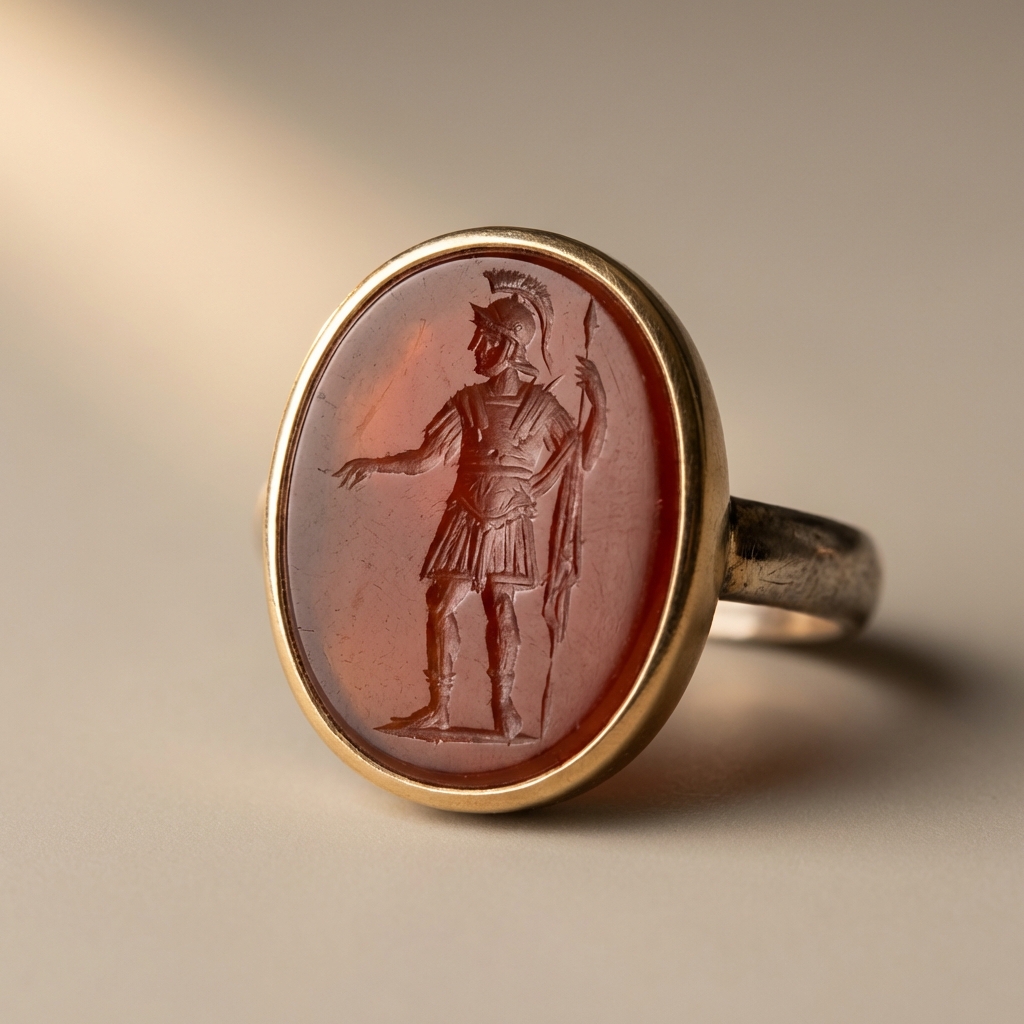
Carving technique involved abrasion and drilling rather than a single edged cut, so tool marks, the way lines end, and the depth of carving relate to the material properties; these technical features are part of how conservators and scholars evaluate an intaglio's method and likely date British Museum engraved gems collection entry.
Glass and other less common materials also appear in the archaeological record, sometimes used as cost-effective or locally produced alternatives to true stones; catalogues and find reports note these exceptions because they affect how a gem was worn and how the image responds to polishing and wear Metropolitan Museum engraved gems overview.
Roman intaglio rings, motifs and why some are called soldier intaglios
Many Roman intaglio rings bear martial imagery: deities like Mars and personified Victory, cavalry, horses, weapons and military standards are frequent themes in museum collections and find reports, and such motifs have often led sellers and cataloguers to describe pieces as related to soldiers British Museum engraved gems collection entry.
These martial motifs can function on several levels at once: an image of a horse or standard may signal group membership, evoke protection in battle, or simply reflect a fashionable motif; motifs therefore can indicate but do not alone prove that a wearer was a soldier Portable Antiquities Scheme engraved gem records.
Because intaglio comes from Italian intagliare, meaning to cut into, the term denotes an incised image below the plane of a gem; collectors should read soldier attributions cautiously, weighing motif against provenance, condition notes, and, when necessary, technical testing.
roman soldier intaglio ring meaning
When encountering the phrase roman soldier intaglio ring meaning in a listing, it is useful to read it as shorthand for a ring with martial iconography rather than a literal occupational certificate; careful phrasing in labels helps keep interpretations honest and useful for collectors Encyclopaedia Britannica intaglio article.
Interpreters rely on context to strengthen or weaken a soldier attribution: a ring found in a fort or with accompanying military items provides stronger grounds for that reading than a motif alone does Portable Antiquities Scheme engraved gem records.
Dual function: signet, amulet, and social signal
Intaglio gems served a practical sealing function in the Roman world, used to impress a seal into wax or clay and authenticate documents or packages; this sealing role is well documented in museum overviews and is central to how intaglios are described in catalogue entries Metropolitan Museum engraved gems overview.
Alongside sealing, imagery could carry symbolic or protective intent: military figures, deities, and certain animals operate as amuletic devices or identity markers, so an intaglio's motif can be meaningful without proving the wearer’s job or rank British Museum engraved gems collection entry.
How to visually inspect a Roman carnelian intaglio: step-by-step checks
Start with material and translucency: carnelian typically shows a warm orange to red-brown colour and a degree of translucency, and those visual traits are useful initial cues for roman carnelian intaglio identification when reviewing photos or handling an object in person Metropolitan Museum engraved gems overview and the Getty Museum publication Getty Museum publication.
Next check carving depth and line quality: intentional incised cutting produces controlled depth and tool flow, while modern recuts often leave fresher edges or inconsistent line ends; conservators describe these technical signs as part of a visual identification workflow A. M. Caggiani u. a., Corroborating the autoptic identification, Wiley, Journal of Raman Spectroscopy.
See condition and provenance up close on @auroraantiqua
Save or download this inspection checklist to compare photographs and condition notes when evaluating a listing
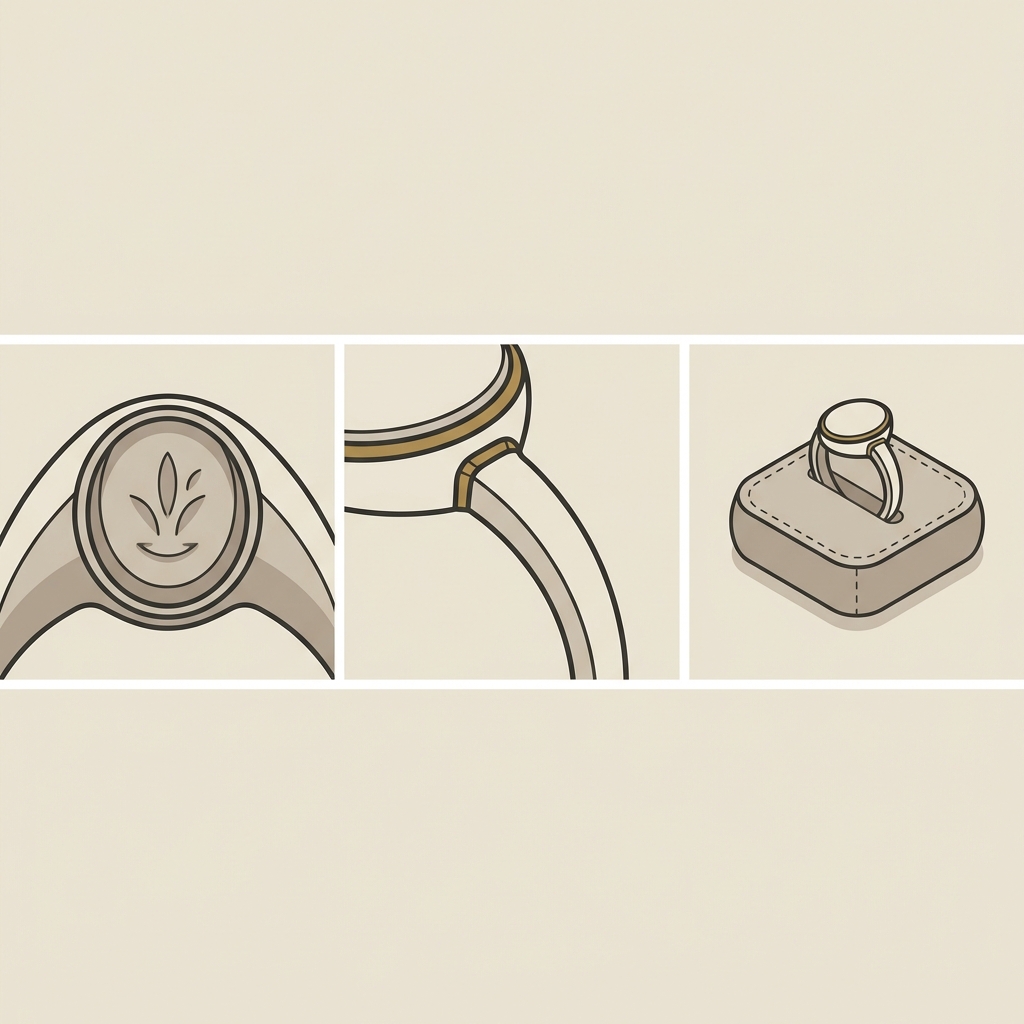
Inspect bezel and hoop joins and look for wear consistent with long use: smoothing where the band meets a bezel, rounded edges on the hoop, and surface patina often signal age-related wear, though they are not infallible on their own and should be considered alongside documentation Fitzwilliam Museum conservation guidance.
Conservation and restoration notes collectors should look for
Condition and restoration notes typically disclose stabilization, repairs to the hoop or bezel, reattachment of a stone, or areas left unrestored; clear statements of those interventions help a buyer understand how the object will appear and how previous work affects visual cues Fitzwilliam Museum conservation guidance.
Restoration can alter apparent tool marks and polishing so that recutting is harder to spot from photographs; conservators advise that precise language about polishing, fillings, or re-set stones is more useful than vague terms such as restored without detail Encyclopaedia Britannica intaglio article.
When restoration notes are unclear, ask for targeted views: photographs of the bezel underside, the hoop join, and macro images of the carving can reveal whether joins were modernly soldered or a stone shows signs of recent reshaping Bague : satyre jouant de la double flûte devant une statue, Musee du Louvre, Paris, Departement des Objets d'art.
Provenance and documentation: reading claims that a ring belonged to a soldier
Provenance statements vary from solid collection histories and verification letters to vague attributions; typed or documented collection history entries and references to findspots carry more weight than narrative claims without documents, and scholars encourage asking for documentary support where possible Portable Antiquities Scheme engraved gem records.
Provenance strengthens interpretations but rarely proves a wearer’s occupation on its own; a ring's association with a military site, a documented group of finds, or contemporary records adds context that makes a soldier attribution more plausible British Museum engraved gems collection entry.

Aurora Antiqua lists curated ancient rings with condition notes, provenance commentary, and restoration statements to help collectors assess claims; when a listing suggests a military link, the documentation provided should be the basis for that interpretation rather than motif alone British Museum engraved gems collection entry. See our Ancient Roman Rings collection.
When motif does not equal profession: limits and decision criteria
A short decision framework helps avoid overreach when a catalogue calls a piece a soldiers ring: weigh motif, documented findspot or collection context, the completeness of the provenance chain, and physical evidence such as personalization or military wear; the combination of factors can move a claim from plausible to stronger or weaker Metropolitan Museum engraved gems overview.
Common missteps include treating a martial motif as definitive proof of occupation or relying on stylistic similarity alone; because workshops copied popular motifs and recutters sometimes emulate earlier styles, context and documentation must carry most of the evidential weight British Museum engraved gems collection entry.
Use cautious phrasing in labels: when the evidence is partial, describe the ring as having a martial motif or as a likely soldier association only when supported by provenance or contextual finds rather than by the motif alone Portable Antiquities Scheme engraved gem records.
Red flags and common pitfalls: spotting forgeries and recut stones
Visual signs that suggest modern work include tool marks inconsistent with ancient abrasion techniques, overly fresh edges on letters or lines, unnatural polishing and modern adhesives; conservation guidance warns that recutting can mimic ancient styles and mislead even experienced viewers Head of a Roman emperor, Victoria and Albert Museum, London.
Stylistic similarity can be misleading because later workshops copied classical motifs and modern recutters intentionally follow historic forms; where doubt exists, laboratory analysis such as toolmark microscopy or gem characterization is the objective next step to confirm or refute modern intervention Encyclopaedia Britannica intaglio article.
Practical next steps when you suspect a recut include requesting high-resolution detail photos, asking about prior testing, and seeking a third party technical report before making a purchase decision Fitzwilliam Museum conservation guidance.
Practical examples: reading real object descriptions from collections and finds
Case study style reading makes the principles concrete: a museum entry that lists a ring with clear findspot data, a dated collection accession, and photographically documented wear supports a stronger soldier association than a market listing that only references motif in the title; curated records illustrate how context changes interpretation British Museum engraved gems collection entry. See Christie's collecting guide.
Portable Antiquities records provide another kind of example where findspot notes and contextual description often accompany images; reading these records side by side with catalogue descriptions teaches collectors how to translate listing language into likely scenarios Portable Antiquities Scheme engraved gem records.
When you compare an anonymized market listing with a curated record, note what documentation is absent: lack of collection history, missing condition details, or no close-up photographs of joins are common gaps that should trigger further questions Metropolitan Museum engraved gems overview.
A buyer checklist: what to ask, what to expect in a listing
Ask for specific provenance details: collection history, previous sales or accession numbers, and any verification letters rather than a one-line claim about past ownership; clear provenance entries are the most immediate improvement over vague attributions Portable Antiquities Scheme engraved gem records. See our Q&A hub.
Request targeted photographs and exact condition wording: images of the bezel underside, hoop joins, and macro views of the carving will reveal restoration or recutting more reliably than a single catalogue view; insist on precise restoration notes that describe what was stabilized and what was left untouched Fitzwilliam Museum conservation guidance.
Red lines include evasive language on restoration, missing close-up detail, or provenance statements that cannot be supported on request; acceptable statements are dated collection entries, explicit condition notes, and references to technical reports when available Encyclopaedia Britannica intaglio article.
Care, wearing, and long-term preservation of intaglio rings
Everyday care for mounted carved stones favours gentle handling, avoiding harsh chemicals and abrasive cleaning, and storing pieces separately to prevent knocks; conservators typically recommend preservation-first approaches for artifacts described as ancient to avoid irreversible changes An Introduction to Gem Treatments, Gemological Institute of America (GIA).
Conservation choices affect whether a ring is suitable for regular wear: stabilizing a loose bezel may allow intermittent use, while heavy restoration or thin settings can make regular wear inadvisable; when in doubt consult a conservator before attempting repairs or cleaning Encyclopaedia Britannica intaglio article.
Long-term storage advice includes climate-stable boxes, inert padding, and accurate condition records to track any changes; good condition notes and photographs taken at purchase form the baseline for future care decisions Fitzwilliam Museum conservation guidance.
Summary: why it is called intaglio and how to read claims that it belonged to a Roman soldier
The word intaglio comes from Italian intagliare, to cut into, and in museum practice an intaglio is an image cut below the plane of a stone, a definition that helps separate incised gems from relief-carved cameos and guides how rings are described in catalogues Online Etymology Dictionary entry for intaglio.
For collectors, the careful path is to treat a martial motif as an important interpretive clue that can support a soldier attribution only when combined with findspot, provenance, condition notes, and, where needed, technical testing; cautious wording such as likely martial motif or possibly associated with military contexts keeps descriptions honest and useful for future research Metropolitan Museum engraved gems overview. Find more guides at Aurora Antiqua.
Intaglio denotes an image cut below the stone's plane to make an incised design, often used for sealing and worn as a ring; it differs from a cameo, which is carved in relief.
No. Martial motifs can indicate military association but do not prove occupation without supporting provenance or contextual evidence.
Request clear provenance, close-up photos of the bezel and hoop, detailed restoration notes, and any technical reports before accepting a soldier attribution.
More from Aurora Antiqua
References
- Art & Architecture Thesaurus Full Record Display (Getty Research)
- Fund des Monats August 2019 (Find of the Month), Landesamt für Denkmalpflege und Archäologie Sachsen-Anhalt
- Uncovering Roman Carlisle 2024 autumn excavation announced, Cumberland Council
- Martin Henig, The Veneration of Heroes in the Roman Army: The Evidence of Engraved Gemstones, Britannia 1 (1970), via JSTOR
- Ring, Victoria and Albert Museum, London
- A. M. Caggiani u. a., Corroborating the autoptic identification, Wiley, Journal of Raman Spectroscopy
- Head of a Roman emperor, Victoria and Albert Museum, London
- Bague : satyre jouant de la double flûte devant une statue, Musee du Louvre, Paris, Departement des Objets d'art
- An Introduction to Gem Treatments, Gemological Institute of America (GIA)
- Ancient Gems and Finger Rings: Catalogue of the Collections, The Getty