


Looking for the real thing? Browse our intaglio ring collection, each piece one of one, individually authenticated, with documented provenance. For the background, see the guide to Roman jewelry.
What is a roman intaglio ring? Definition and historical context
A roman intaglio ring is an ancient ring whose gemstone has been carved in intaglio, meaning the design is cut into the surface so that impressions made by pressing the stone into soft material produce a raised image. In many cases these rings served as personal seals, amulets or ornament; the carving, motif and how it was worn all contribute to how specialists judge its cultural role and, by extension, its market value. The term intaglio is distinct from later forms of gem engraving in technique and typical motifs, and collectors often look for signs that a piece was used as a seal rather than produced as a purely decorative gem.
Historically, intaglio gems used in Roman rings were most often hardstones such as carnelian, jasper and agate, valued for their durability and the way they accept finely incised detail. The choice of stone and how it was cut can signal workshop practice and relative quality, which are central to valuation because skilled lapidary work on hardstone is comparatively scarce and can preserve fine iconographic detail over centuries. For a fuller technical overview of materials and technique see the Metropolitan Museum of Art discussion of engraved gems and hardstone carving Metropolitan Museum of Art resource on engraved gems.
Dating and workshop attribution for roman intaglio ring examples are typically estimates based on style, iconography and comparative examples rather than absolute certainties. Attributions to a period, workshop or locale can affect market perception and pricing, but these attributions are usually presented as opinions grounded in cataloguing practice rather than definitive scientific facts. Wear consistent with age, such as softened edges, surface patina and localized abrasion on the hoop or bezel, is common and is often recorded in condition notes to help buyers understand how use and time have affected an object.
See provenance, restorations and fresh finds on @auroraantiqua
Browse curated listings with condition notes and historical context rather than pictures alone to form a clearer view of what a particular ancient ring offers.
Common motifs on roman intaglio ring gems include deities, animals, hunting scenes, portrait busts and symbolic devices. Iconography can help narrow a probable date or workshop and also adds to desirability when a motif is rare or well executed. When reading descriptions, look for specific terms such as bezel, hoop and iconography to understand how the gem sits within its ring mounting and what the carved scene represents.
Why materials and carving technique are primary price drivers
The material of the gemstone and the lapidary technique used to carve it are often the first factors that determine an intaglio's market position because both raw material quality and skilled engraving are scarce. Hardstones such as carnelian, jasper and agate accept fine incised work and resist surface wear, which helps preserve fine detail that specialists prize; this interplay of durable material and refined cutting is a central explanation for premiums attached to well executed pieces Metropolitan Museum of Art resource on engraved gems.
Tool marks, the precision of line work and the depth of the intaglio cut are all signals of lapidary skill. Collectors and specialists will often inspect magnified photographs for consistent carving rhythm and signs that the design was cut with the tools and techniques appropriate to the proposed period. In written descriptions these observations may appear as notes on lapidary technique or workshop attribution and can materially affect how comparable sales are chosen when assessing price.
Beyond the gem itself, the metal setting contributes to price. Gold mountings typically add materially to a ring's market value compared with silver or base metal settings because they represent additional intrinsic cost and often indicate a higher-status original owner or later upgrading. In many listings material identification is described cautiously as appears to be unless the seller provides metal testing or assay details.
Provenance refers to the documented ownership history of a piece, and continuous collection history or references to museum catalogues can materially increase buyer confidence and realised prices at auction. When an item can be linked to an established collection or has appeared in a reputable sale catalogue, competitive bidding is more likely because the perceived risk of forgery or later alteration is lower; auction archives and sale results are practical places to trace these histories Christie’s selected auction results.
Forms of provenance that commonly add premiums include museum collection references, well recorded former ownership in publication or sale catalogues, and long continuous private-collection histories documented by invoices or letters. Sellers who can supply photocopies or scans of catalogue entries, lettered ownership notes or collection inventory records provide buyers with documentation to cross check; these materials are often cited in lot descriptions to justify asking prices.
Intaglios can be expensive because high quality hardstone material, skilled lapidary work, documented provenance and conservative condition assessments reduce uncertainty for buyers; scientific authentication and saleroom visibility further support premiums.
When assessing provenance in a listing, look for specific catalogue citations, dates of sale or exhibition entries rather than vague statements of prior ownership. Transparent provenance statements reduce uncertainty for potential buyers and can materially alter how comparable sale prices should be adjusted when estimating an asking price.
Condition, restoration notes and grading: what collectors look for
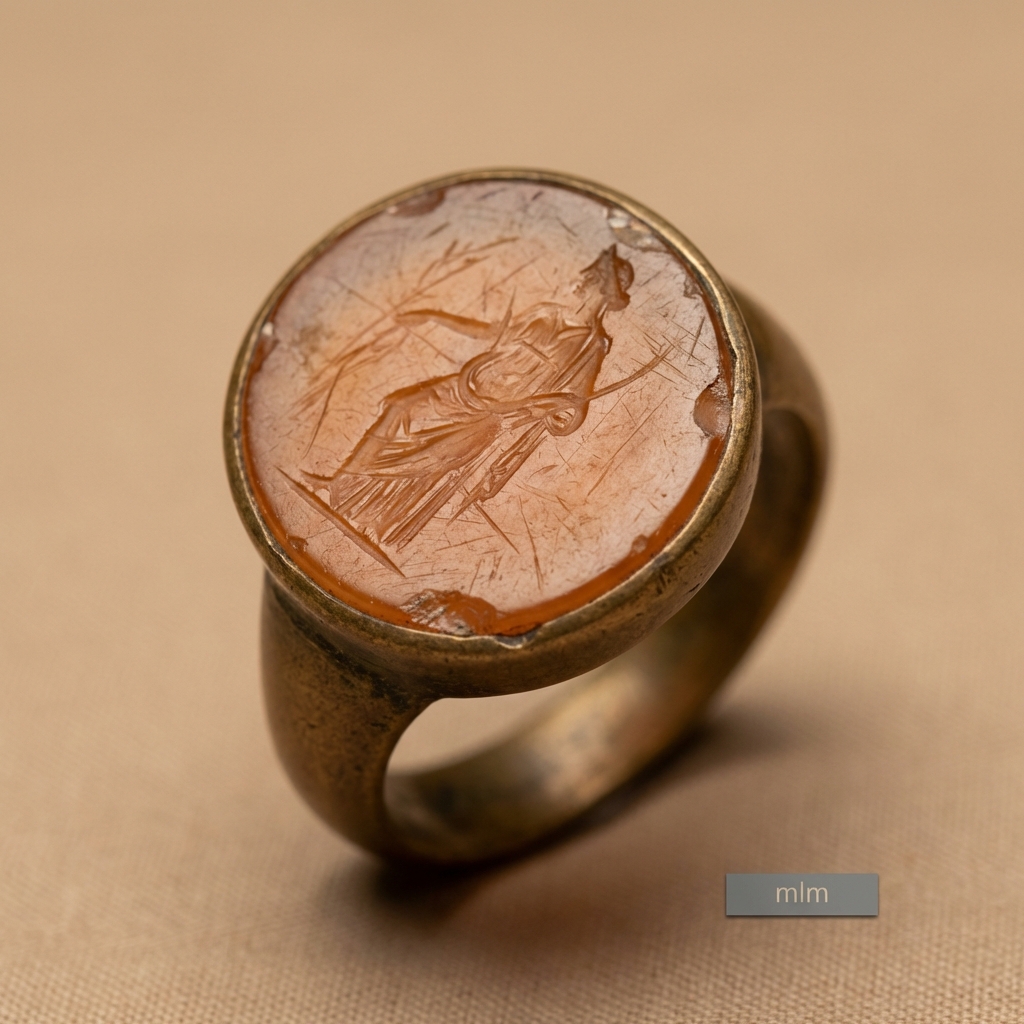
Condition notes are central to valuation because preserved patina, intact carving detail and honest descriptions of repairs or restorations help specialists grade desirability. Key features to examine include surface patina, chips or cracks in the stone, edge wear on the bezel, loss of carving detail and evidence of abrasive cleaning. The British Museum's collection care notes explain how condition and conservation observations inform collecting and conservation choices British Museum research on condition and conservation.
Restoration or stabilization measures range from minor stabilizing fills at the hoop to more substantial re-cutting or re-polishing of a gem. Transparent restoration notes that explain what was done and why allow buyers to judge whether the intervention is acceptable for an object they intend to wear or keep. Overcleaning can reduce market desirability by removing surface evidence of age and obscuring original tool marks that specialists use for attribution.
When reading condition descriptions, conservative phrasing such as appears to be, described as or likely indicates appropriate caution by sellers and curators. If a listing lacks clear condition notes or magnified photos showing areas of concern, request additional documentation before assuming the condition is satisfactory.
Authentication and scientific testing: when it pays to verify
Scientific authentication methods such as microscopy, spectroscopy and compositional analysis are increasingly used to confirm material and period and can reduce buyer risk; these techniques can be decisive for higher value lots where the cost of testing is justified by the potential price increase in market confidence A. M. Caggiani u. a., Corroborating the autoptic identification, Wiley, Journal of Raman Spectroscopy.
Microscopy can reveal tool marks and surface weathering consistent with age while spectroscopic and compositional tests can help confirm that a gem's mineralogy matches expected materials. Buyers should understand that these methods add time and cost and are not universally applied to lower value lots, but when available a technical report provides an additional layer of evidence that can support a higher asking price.

Requesting targeted analyses such as a short microscopy report or non destructive spectroscopy is a reasonable step when provenance is incomplete or when a piece is offered at a premium relative to comparable sales. Technical reports vary in scope, but a concise note that addresses material identification and observable surface features is often sufficient to reduce uncertainty for a buyer considering a higher priced lot.
Market signals: what auction results and specialist reports tell us
Recent sale archives and market summaries show wide price dispersion across intaglio rings, with many plain or unrestored examples realising in the low hundreds and more substantial, gold-mounted or well provenanced pieces achieving much higher totals. Market reports such as TEFAF's art market summaries provide context about demand and how specialist visibility affects segment performance TEFAF art market research.
Outlier sales typically share one or more of these features: exceptional provenance, an unusually fine example of lapidary work, or a high quality metal mounting. Those factors attract competitive bidding in major salerooms and can lift a lot well above typical realised prices. Conversely, lots with uncertain provenance or heavy restoration often realise below expectations because bidders price in additional risk.
How to assess asking price versus realised price for a roman intaglio ring
Begin by identifying comparable sales that match the listing in material, condition, mounting and provenance. Compare realised prices for these comparables, and then adjust for differences such as gold versus silver mounting, presence or absence of a museum catalogue reference, visible condition issues, and any technical reports supplied by the seller. Auction archives and sale catalogues are the most direct sources for comparable realised prices and can help ground a reasoned adjustment process. See specific comparable sales and price results from auction sites such as comparable sales.
Simple reasons a listing price may exceed recent realised prices include superior provenance not yet reflected in sale records, inclusion of a precious metal mounting, or the presence of an independent technical report. Conversely, lack of documentation, obvious restoration or limited saleroom visibility are common reasons a listing price may need to be discounted relative to auction evidence.
estimate a reasonable asking price by adjusting comparable sale prices
use conservative adjustments for uncertainty
Use the tool as a working worksheet rather than a definitive answer. Document your comparable sales and note the rationale for each adjustment to keep the assessment transparent when you communicate with sellers or agents.
Common buyer mistakes and red flags when shopping for intaglio rings
Frequent buyer errors include overvaluing marketing language, accepting blanket authenticity claims without supporting documentation, and ignoring condition and restoration disclosures. Vague provenance statements, such as unspecified decades of private ownership without catalogue citations, are a red flag and should prompt requests for documentation or a reduction in willingness to pay British Museum research on condition and conservation.
Another common mistake is assuming a stone identification from a single photograph. Sellers may describe a gem as carnelian or agate but without a test this remains an assertion; when material matters to price ask for a short technical comment or at least magnified images that show internal texture and surface features. If a listing mentions laboratory tests, request the report or a summary that explains the scope of analysis rather than accepting a brief statement of authenticity at face value.
Practical checklist for evaluating a listing or auction lot
Minimum items to request or verify include clear photos with scale and magnified detail shots, accurate measurements and weight where available, a clear note of metal type or assay, condition notes and any restoration notes, and explicit provenance statements or catalogue citations. These elements allow you to place the item against comparable sales more reliably Christie’s selected auction results.
Acceptable answers look like this: magnified photos that show original tool marks and wear consistent with age, a condition note describing any fills or stabilizations, and provenance entries with catalogue citations or dated invoices. Concerning answers include missing or heavily retouched photos, evasive statements about restoration, or provenance described only as prior private ownership without dates or documentation.

Typical price ranges and realistic expectations for intaglio rings
Market evidence indicates broad bands rather than neat tiers. Many plain or unrestored intaglio rings sell in the low hundreds, while well executed gems mounted in precious metal and with strong provenance can reach multiple thousands or higher. The overlap occurs because combinations of material, condition and documentation produce many intermediate valuations rather than a single uniform market price Christie’s selected auction results.
Rather than relying on headline bands, use comparable auction results and the checklist above to assess whether an asking price is reasonable for a specific piece. A listing near the top of a band can be justified by museum references, technical reports or exceptional lapidary quality, while the absence of those features generally argues for a more conservative offer.
Case studies: recent auction examples and what made them sell high or low
One class of high realisation examples includes gems with continuous collection history and an associated catalogue reference; these attract competitive bidders because the provenance reduces uncertainty about authenticity and prior alteration. Sale catalogues and archived lot notes often explain the provenance and any technical reports that accompanied the lot, which helps buyers see why a particular example achieved a premium sale catalogues and archived lot notes.
Conversely, lower realised prices commonly reflect condition or attribution doubts, such as significant re-polishing that removed original surface indicators or unclear ownership histories that leave open the question of modern intervention. In these cases bidders treat the lot as higher risk and price accordingly, which can produce results substantially below comparable well documented examples.
How Aurora Antiqua presents curated ancient rings and what to look for on a curated site
Aurora Antiqua presents curated ancient rings with condition notes, restoration notes and contextual editorial content to help buyers understand what they are viewing. The curator role is to provide clear photographs, historical background and any available provenance or documentation to help buyers assess an object rather than to make absolute authenticity claims.
When reviewing curated listings, prioritise curated ancient rings with condition notes, restoration notes and contextual editorial content to help buyers understand what they are viewing. The curator role is to provide clear photographs, historical background and any available provenance or documentation to help buyers assess an object rather than to make absolute authenticity claims.
When reviewing curated listings, prioritise clear photos with magnified detail, explicit condition notes that list any stabilizations or repairs, measurements and metal identification, and any provenance references such as collection history or catalogue citations. Use this information along with comparable sales and, when appropriate, request targeted technical reports to reduce uncertainty before purchase.
Conclusion: balancing passion, scholarship and caution when buying intaglio rings
In summary, high prices for roman intaglio ring examples typically reflect a combination of material and technique, demonstrable provenance, conservatively recorded condition and, increasingly, scientific authentication. Each of these elements reduces uncertainty for buyers and can justify premiums when present.
Buyers who combine a cautious checklist approach with an appreciation for historical and iconographic interest are best positioned to make purchases that align with their collecting goals. Treat market comparables, condition notes and technical reports as tools to translate enthusiasm into reasoned purchasing decisions rather than relying solely on evocative descriptions or imagery.
Prices vary widely; many plain or unrestored examples sell in the low hundreds while gold mounted, well documented pieces can reach multiple thousands. Use comparable sales and condition notes for specific estimates.
Scientific tests can reduce uncertainty about material and surface features but are one part of evidence; combined with provenance and condition notes they strengthen a case but do not single handedly provide absolute certainty.
Clear condition notes and magnified photographs are essential because preserved patina and intact carving detail greatly affect desirability and how to value a piece.
More from Aurora Antiqua
References
- Auction Terminology, Christie's
- Publication 561 (12/2025), Determining the Value of Donated Property, Internal Revenue Service (IRS), USA
- The Past Polluted: A Pigovian Approach to the Black Market in Antiquities, International Journal of Cultural
- Antiquity market trends in Cycladic figurines, 2000 to 2019, International Journal of Cultural Property
- About us, International Association of Dealers in Ancient Art
- Treasure Valuation Committee, GOV.UK, Department for Culture, Media and Sport (GOV.UK)
- A. M. Caggiani u. a., Corroborating the autoptic identification, Wiley, Journal of Raman Spectroscopy
- Internet Archaeol. 40. Atkinson and Preston. Objects of personal adornment, Internet Archaeology, Council