


Looking for the real thing? Browse our full ring collection, each piece one of one, individually authenticated, with documented provenance. For the background, see the guide to ancient jewelry.
Quick answer: is the Phaistos Disc deciphered and how does the phrase phaistos disc ring fit in?
Short verdict for readers who want a fast answer
The short, evidence based answer is that mainstream museums and most archaeologists continue to treat the Phaistos Disc as an undeciphered Late Bronze Age inscription from Crete, and no proposed translation has achieved scholarly consensus as of 2026, a position reflected in institutional catalogue notes and reference summaries Heraklion Archaeological Museum collection entry.
For readers who encounter the phrase phaistos disc ring in searches or listings, that wording typically signals a connection by inspiration, motif, or catalogue tagging rather than a new linguistic reading of the Disc; sellers or writers may use the term to describe wearable objects referencing the Disc's symbol set or to help with discoverability in commerce and social media Encyclopaedia Britannica article.
See behind the curator's desk at Aurora Antiqua
Aurora Antiqua provides calm, curator style context for antiquities and related wearable items and recommends checking museum catalogue entries and published academic summaries before assuming any new translation or reading.
Why the phrase phaistos disc ring appears in some searches and references
The phrase phaistos disc ring can show up for plain cataloguing reasons: someone describing a ring that uses the Disc's motifs, a replica, or a modern piece inspired by Bronze Age iconography may include those words so potential buyers and readers find the item.
That commercial use should not be read as evidence that the Disc itself has been deciphered; popular listings and image tags are about discoverability rather than about linguistic or epigraphic consensus research overview on recent proposals.
No, the Phaistos Disc remains classified by major museums and reference works as undeciphered as of 2026; many proposals exist but none meets the reproducibility and corroboration standards specialists require.
What the Phaistos Disc is: object, discovery, and basic description
Physical description and dating as presented by museums
The Phaistos Disc is a single fired clay object inscribed with a set of stamped pictographic signs arranged in a spiral on both faces; museums typically describe it as a Late Bronze Age find from Crete with a catalog entry that emphasises its uniqueness and the uncertainty around precise dating Heraklion Archaeological Museum collection entry.
Catalogue entries and reference works summarise material, possible date range, and condition without asserting a secure linguistic assignment, leaving the object as an isolated inscription rather than part of a larger textual corpus Encyclopaedia Britannica article.
Discovery context and documentation gaps
Publication and excavation notes for the Disc have gaps and interpretive uncertainties, which complicate confident statements about its stratigraphic context and therefore its exact chronological placement, an issue made clear in modern overviews of the find and its documentation overview of excavation context and open questions.
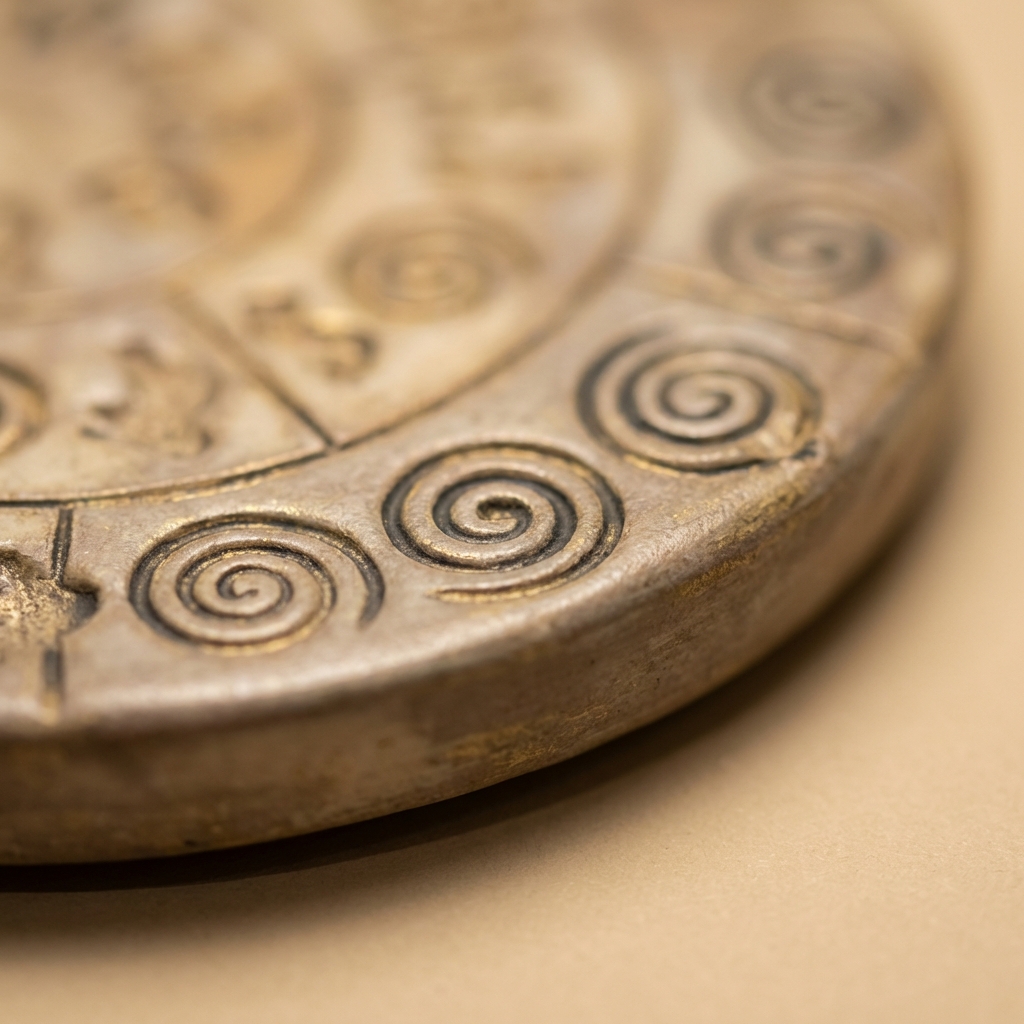
Because the Disc stands alone with no securely associated inscriptions or bilingual texts, the lack of contextual anchors reduces the types of archaeological cross checks normally used to support a decipherment.
Why the phrase phaistos disc ring shows up and what it usually means
Search and catalog reasons for the phrase
Online searches often mix object names and product types, so a search for items inspired by the Disc can return rings, pendants, replicas, or modern jewellery that reference the Disc's signs; this is a catalogue and marketing behaviour rather than a scholarly statement about the Disc's language Heraklion Archaeological Museum collection entry.
Collectors should be aware that a listing containing the words phaistos disc ring is more likely pointing to an aesthetic or motif connection than to evidence of a decipherment, and should consult institutional entries and peer reviewed literature before treating a listing as scholarly confirmation research overview on recent proposals.
How collectors and sellers may use ring related keywords
Sellers sometimes add related keywords to improve visibility; in the context of antiquities this can mean linking a wearable piece to a well known artefact by motif or inspiration, not by implying a new reading of the inscription.
When a listing claims provenance or scholarly backing, buyers should request condition notes, documentation, and references to museum catalogue entries rather than relying on keyword phrases alone overview of excavation context and open questions.
Why mainstream archaeologists and museums still call it undeciphered
Consensus standards in epigraphy and when a decipherment is accepted
Decipherment requires not only a plausible mapping of signs to sounds or meanings but independent corroboration, reproducible tests, and ideally parallel or bilingual inscriptions that allow cross checking; absent those elements a proposed reading will not meet professional standards for acceptance Heraklion Archaeological Museum collection entry.
Major reference works and museum entries emphasise these standards and therefore treat the Disc as undeciphered pending reproducible evidence or securely associated texts Encyclopaedia Britannica article.
Specific reasons the Phaistos Disc falls short of those standards
The Disc lacks any bilingual inscription or parallel corpus, and its total of 241 tokens across both faces gives researchers a very small sample for robust statistical inference, both of which are repeatedly flagged as obstacles in scholarly reviews review essay on single-corpus inscriptions.
Unresolved questions about excavation records and stratigraphy further weaken the case for any definitive chronology dependent reading, because context often provides the external checks necessary to evaluate linguistic claims overview of excavation context and open questions.
Major decipherment claims and common methods used to argue for readings
Examples of claimed linguistic assignments and their variety
Since the Disc's discovery many individual claims have been published proposing links to Linear A, Anatolian languages such as Luwian, early forms of Greek, or artificially constructed mapping systems, but none of these proposals has achieved broad scholarly consensus as of 2026 research overview on recent proposals.
Readers should note that a variety of plausible looking mappings can be produced from a small set of signs, which is why independent corroboration is the decisive test for acceptance.

Overview of methods: phonetic mapping, palaeographic comparison, statistical approaches
Researchers proposing readings typically rely on a mix of typological comparison with known scripts, proposed phonetic mappings, and sign frequency analysis; each approach brings useful perspectives but also limits when applied to an isolated, short corpus method review on statistical analysis of short epigraphic corpora.
Because many proposals are based on selective correspondences or visual resemblance, they require reproducible protocols and tests to be judged credible within the epigraphic community research overview on recent proposals.
Analytical toolbox: palaeography, statistics, and computational pattern recognition
What each method can and cannot do with a small corpus
Palaeographic comparison looks for shared sign shapes and probable sign development across related scripts, but visual similarity alone cannot establish phonetic value without corroborating contexts or parallel texts research overview on recent proposals.
Statistical methods such as sign frequency and entropy analysis measure structural patterns and can detect regularities, but their power falls sharply with very small corpora, where chance patterns and overfitting are major risks method review on statistical analysis of short epigraphic corpora.
Examples of reproducible tests and their limits
Computational pattern recognition can be useful if an approach publishes its data, code, and a clear protocol that allows held out prediction testing, but many historical proposals lack this openness, making independent verification impossible research overview on recent proposals.
Well designed predictive tests would split the corpus for training and testing and report success rates on unseen symbol sequences, but the Disc's size makes those tests statistically fragile unless accompanied by external archaeological evidence method review on statistical analysis of short epigraphic corpora.
Core obstacles in verifying any proposed decipherment
Small corpus size and the problem of overfitting
The Disc's 241 tokens and the limited variety of signs make it easy to fit models that appear to work on the visible text but do not generalise; this overfitting risk explains why many promising looking mappings fail to persuade specialists review essay on single-corpus inscriptions.
Without additional inscriptions or bilingual texts researchers cannot confidently separate genuine linguistic patterns from coincidental sequences produced by a small data set.
Minimum evaluation checklist for a decipherment claim
Use as a starting filter for claims
Unresolved archaeological context and dating questions
Uncertainty in excavation notes, stratigraphy, and associated finds undermines efforts to anchor the Disc chronologically and culturally, which in turn weakens arguments based on proposed linguistic family assignments overview of excavation context and open questions.
Targeted material analysis and careful publication of excavation records are among the concrete steps recommended by reviewers to reduce contextual uncertainty and strengthen any future claim's evidential base Heraklion Archaeological Museum collection entry.
Recommended research steps and what a reproducible claim should demonstrate
Material and contextual studies that would strengthen dating and use-interpretation
Priority research actions include full, transparent publication and re-evaluation of excavation notes and associated finds, plus material science analyses such as thermoluminescence or residue studies that can clarify chronology and possible function Heraklion Archaeological Museum collection entry.
Such studies would not in themselves produce a decipherment but would provide crucial external anchors that any linguistic proposal must respect.
Computational and comparative protocols that test predictive power
Good computational practice for the Disc means publishing sign transcriptions, code, and explicit mapping rules, and then demonstrating predictive power on held out sequences rather than only fitting the visible text; reproducible benchmarks are central to scientific progress in this area method review on statistical analysis of short epigraphic corpora.
Open collaboration and independent replication would allow the community to separate robust patterns from chance correspondences.
How to evaluate a new decipherment claim: decision criteria for readers
Checklist researchers and informed readers can apply
A practical checklist includes whether the author publishes data and code, whether the method predicts held-out sequences, whether there is attention to archaeological context, and whether independent researchers can replicate the results research overview on recent proposals.
Readers can apply these criteria to news reports and media summaries to separate attention grabbing headlines from claims that meet professional standards.
Questions to ask about reproducibility and independent corroboration
Ask whether a proposed sign mapping is ad hoc, whether the analysis reports performance on unseen data, and whether the interpretation accounts for the Disc's archaeological context and possible alternative explanations such as ritual or nonlinguistic use review essay on single-corpus inscriptions.
Red flags include missing data, opaque methods, and a lack of independent attempts to replicate the mapping.
Typical pitfalls and mistakes in proposed readings
Common methodological errors
Frequent errors are overfitting a small corpus, relying on superficial sign shape resemblance without contextual support, and retrofitting translations to match hoped for meanings rather than testing predictive validity research overview on recent proposals.
Confirmation bias can lead researchers or enthusiasts to emphasise correspondences that support a chosen reading while ignoring mismatches or alternative hypotheses.
How wishful patterns and selective sampling mislead
Selective sampling, such as excluding problematic sign sequences or focusing only on segments that appear to match a target language, produces non reproducible results and should be treated with caution by readers and collectors.
Well documented claims will explain why segments were excluded, make data available, and show how the mapping performs on held out material.
A practical example: designing a reproducible test for a proposed reading
Step by step outline of what a test could look like
A pragmatic test would start by publishing a precise transcription of the Disc's signs, splitting those signs into a training set and a held out test set, and making any mapping rules explicit so others can run the same procedure and verify outcomes method review on statistical analysis of short epigraphic corpora.
The test should report success metrics on the held out set and compare those results to simple null models to show that success is not due to chance.
How success and failure would be reported
Success would mean that a proposed mapping produces significantly better predictions on unseen symbol sequences than baseline models and that the mapping respects archaeological constraints; failure would show non reproducible fits or inability to generalise beyond the training subset.
Honest reporting includes publishing failures and negative results because they clarify which approaches are unpromising and which merit further investigation.
What the Disc's unresolved status means for collectors and public interest
How to interpret media reports and popular translations
Media coverage and popular translations can be engaging but should not be conflated with consensus: many entertaining claims reach the public without the reproducible evidence or peer review that specialists require Encyclopaedia Britannica article.
Collectors should reserve judgment and seek museum entries and peer reviewed discussion before treating a new translation as established.
What collectors should look for in documentation
When a Disc related motif appears in commerce, collectors should ask for provenance, condition notes, any documentation of restoration, and references to institutional catalogue entries; Aurora Antiqua emphasises clear documentation and condition notes for items presented as ancient or inspired by antiquity.
Transparent documentation helps buyers understand what they are purchasing and why the object matters historically, regardless of whether the Disc itself ever yields a widely accepted reading overview of excavation context and open questions.
How museums and reference works present the Phaistos Disc today
Typical museum catalogue entries and what they emphasise
Museums and reference works commonly present the Disc as an isolated inscribed object, noting material, condition, possible date range, and the undeciphered status while avoiding strong claims about language or meaning Heraklion Archaeological Museum collection entry.
Authoritative entries matter because they frame what evidence must be produced before a reading can be accepted, and they guide researchers and the interested public to the primary documentation.
Why authoritative entries matter for public understanding
Catalogue entries and reference summaries set expectations about what is known and what remains speculative, reducing the risk that popular portrayals will be misread as scholarly consensus Encyclopaedia Britannica article.
For those tracking developments, following institutional publications and peer reviewed literature is the most reliable way to stay informed.
Conclusion: where things stand and realistic expectations for future claims
Recap of the undeciphered status and credible next steps
As of 2026 the mainstream position remains that the Phaistos Disc is undeciphered, with museum entries and major reference works taking a cautious stance pending new evidence or reproducible tests Heraklion Archaeological Museum collection entry.
Credible next steps include fuller publication of excavation records, targeted material science work, and open computational challenges that require predictive success on held out sequences rather than post hoc fittings method review on statistical analysis of short epigraphic corpora.
Readers interested in ongoing discussion should prioritise primary museum documentation and peer reviewed work over media summaries and product listings when judging new decipherment claims.
No. By 2026 no translation has gained broad scholarly consensus; many claims exist but they lack independent corroboration and reproducible predictive tests.
No. Rings or modern pieces that reference the Disc use its imagery for aesthetic or cataloguing reasons and do not imply a new or accepted linguistic reading.
Request provenance, condition and restoration notes, references to museum catalogue entries, and any documentation that supports a claimed archaeological history.
More from Aurora Antiqua
References
- Trésor hellénistique trouvé à Délos en 1964, École française d'Athènes, via Persée
- L'anneau sigillaire d'Arégonde, femme de Clotaire Ier, découvert à Saint-Denis, Bulletin de la Societe
- couronne, Louvre site des collections, Musée du Louvre, Département des Antiquités grecques
- "Sappho" Earring, Harvard Art Museums / Arthur M. Sackler Museum, Cambridge, Massachusetts
- Research report: export licensing and provenance, GOV.UK, Department for Culture, Media and Sport (DCMS)
- New Acquisitions of Archaeological Material and Works of Ancient Art, Association of Art Museum Directors (AAMD)
- Runer og runemagi, vikingernes skriftsprog, Nationalmuseet, Copenhagen