


Looking for the real thing? Browse our Ancient Roman ring collection, each piece one of one, individually authenticated, with documented provenance. For the background, see the guide to buying ancient artifacts.
Why identifying an authentic ancient Roman ring matters
For collectors and history-minded buyers, determining whether a piece is an authentic ancient Roman ring is about building a defensible attribution rather than establishing absolute certainty. In this guide, "authentic" is used as a working classification based on typology, material and available documentation, not as an unquestionable verdict.
Visual assessment at a distance or from listing photos can often screen items into plausible categories, but it cannot replace targeted testing or independent reports where firm dating or workshop attribution is required. Clear documentation and collection history materially increase confidence and should be requested when evaluating a listing, because provenance ties an object to verifiable ownership or publication history Auriga - Roman Silver Intaglio Ring listing.
By combining typology comparison with museum parallels, checking material and manufacturing signs, reviewing conservation notes and pXRF screening where available, and verifying provenance or seeking independent reports when needed.
Readers should set expectations: a buyer-facing guide can help screen likely genuine items, flag probable reproductions, and indicate when further specialist input is advisable, but some questions still require laboratory methods or third-party reports to resolve.
If you are shopping online, prioritize clear photographs, condition notes and any available documentation. Asking for provenance, prior ownership notes or verification letters can change an attribution from speculative to reasonably supported.
Quick visual typology: common Roman ring types and what to look for
Rome produced a range of ring types that recur in museum catalogues and timelines; using those typologies is the quickest way to triage a listing. Intaglio-set rings and signet rings with carved gemstones are a major group, while plain bands and cast bronze hoops are also common forms used across the Roman world.
Look for bezel shapes common in period examples: simple rectangular or oval bezels for intaglios, sometimes with slightly raised rims, and squat rounded bezels on some signet rings. Band profiles vary from thin, nearly flat bands to thicker, tapered hoops, and these profiles can be compared to published parallels in major collections to narrow a likely date range Metropolitan Museum of Art rings timeline.

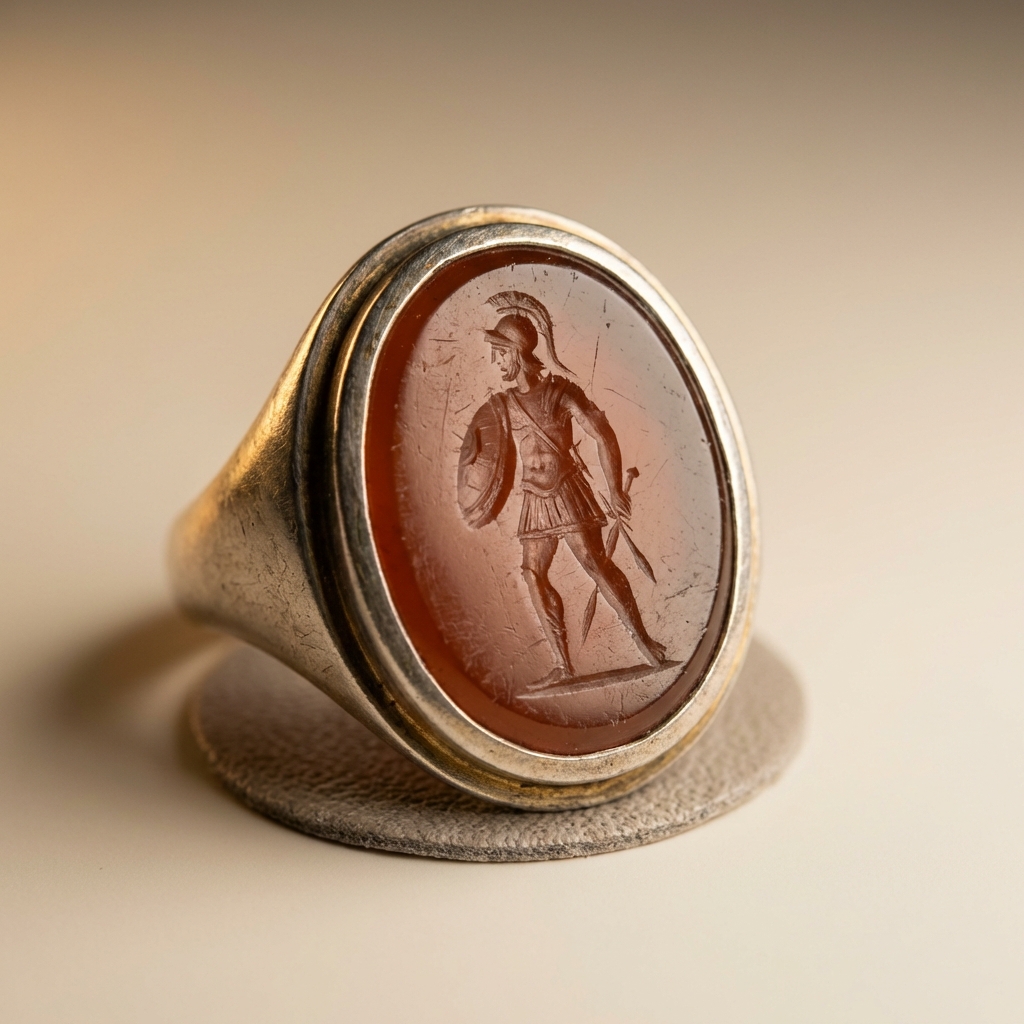
Intaglio carving style is especially diagnostic: Roman intaglios tend to show hand-carved lines with slight asymmetry and tool marks visible under magnification, while modern reproductions often display more regular tooling or machine-made symmetry. When a listing provides clear macro images of the intaglio and bezel, compare them to museum highlights for typology matches before proceeding further.
Using "Roman ring typology" as a search phrase in museum catalogues and collection highlights helps find secure parallels and reduces the risk of mistaking later copies for ancient pieces.
Material and manufacture signs that support ancient manufacture
Typical Roman metals include copper-alloy (commonly described as bronze), silver and gold, and gemstones such as carnelian or jasper are frequent for intaglios. Descriptions that list these materials and show consistent surface behaviour are a positive sign, though material identification from photos alone is tentative at best British Museum Roman jewellery highlights.
Manufacturing signs to look for include faint casting seams on the inner surface of a hoop, small hammering marks where the band was shaped, and hand-engraved bezels that retain irregular tool traces. These technical features are often visible in macro photography and can help distinguish ancient handwork from modern machining.
Ask sellers for specific images and reports to support technical assessment
Request scale in photos
Stone mounting and intaglio cutting techniques also matter: Roman intaglios usually exhibit carving that follows the stone grain, with subtle depth variation and occasional micro-chipping at the design edges. When a listing includes close-up images of the gem under raking light, check for carving nuances that fit known ancient hand-cut intaglios.
One practical step is to ask sellers for notes on any documented restoration or stabilization; stated restoration notes help interpret later alterations that may mimic manufacturing traces and should be considered alongside technical observations.
Patina, wear and conservation: what age-consistent condition looks like
Age-consistent patina and corrosion patterns are a central cue when assessing authenticity. On bronze rings, expect green or black corrosion layers, often uneven and in crevices, while silver commonly darkens and may show stable surface sulphides rather than bright polish. Conservation literature explains these behaviours and what constitutes stable, age-consistent surfaces Getty Conservation Institute conservation resources.
Wear consistent with age typically includes softened high points on decoration, micro-abrasion across surfaces that receive contact, and a general smoothing of sharp edges from long-term handling. These patterns differ from artificially induced wear that often looks even or targeted to only the most visible areas.
See condition and provenance details on @auroraantiqua
When evaluating listings, check condition notes and restoration notes carefully and ask the seller for macro photographs of corrosion zones and repaired areas.
Stabilized restorations are common and acceptable when documented; a clear restoration note should describe what was done, whether any materials were added, and whether the piece was chemically stabilized. Such details allow an informed judgement without assuming repairs increase or decrease overall significance.
Understanding "ancient ring patina" helps avoid overreliance on surface colour alone. Genuine patination is often heterogeneous and integrates with wear; suspiciously uniform green or artificially applied coatings are among the common visual red flags.
Non-destructive analysis in practice: portable XRF and its limits
Portable XRF has become a widely used screening method to examine alloy composition and can flag modern alloying elements or surface treatments, but results are a starting point rather than a final answer. Interpretation requires specialist context and comparison with dated reference datasets to avoid false positives Portable XRF for paintings and metals authentication, npj Heritage Science (Springer Nature), DOI.
What pXRF typically provides is a surface composition reading; that can reveal unexpected elements or enrichments that warrant further inquiry. A reading that suggests composition consistent with Roman-age alloys increases confidence, while anomalous elements or surprising concentrations are grounds to request additional documentation or laboratory testing.
Common false positives arise when surface enrichment from corrosion, conservation layers, or later repairs alters pXRF results. For that reason, pXRF is best used alongside visual manufacture signs and documented restoration notes rather than as a sole determinant.
Escalate to laboratory analysis when pXRF gives inconsistent results, when attribution depends on precise alloy ratios, or when workshop or chronological attribution is under debate. Techniques such as metallography or isotope work can provide more definitive answers but usually require sampling or specialist facilities.
Provenance, documentation and why collection history matters
Clear provenance materially increases confidence in attribution and should always be requested when assessing a listing or a potential purchase. Useful documentation includes prior ownership notes, published catalogue entries, verification letters and any paperwork that links the object to a named collection or excavation context.
Public find databases and catalogue references are practical tools for checking parallels and find records; for example, the Portable Antiquities Scheme maintains searchable records that can help match typologies and local find contexts Portable Antiquities Scheme database.
When a seller provides collection history or a provenance chain, verify the documentation where possible: check publication citations, ask for scans of old catalogue entries, and look for independent confirmation points such as previous auction listings or museum references. Even partial provenance can shift an attribution from speculative to reasonably supported.
A practical buyer checklist and decision framework
Use a four-part screening checklist to classify items quickly: first, typology match with museum parallels; second, visible material and technical checks such as casting seams and intaglio style; third, pXRF screening when available; and fourth, provenance and independent expert opinion. This structured approach helps translate visual cues and reports into consistent decisions Museum typology overview.
Step-by-step workflow: 1) Compare the listing to museum examples for typology match. 2) Inspect macro photos for casting seams, hand-engraved bezels and wear consistent with age. 3) If pXRF readouts are offered, review them or ask for raw data. 4) Request provenance documents or prior collection notes and record what is missing.
Classify outcomes simply: "likely genuine" when typology, materials and provenance align; "doubtful" when key signals conflict or documentation is absent; "modern reproduction" when modern alloys, machine tooling or inconsistent patina are evident. For doubtful or high-value items, pause and ask for independent reporting or laboratory analysis before committing.
When assessing online photos, insist on multiple views, scale references and close-ups of seams, the interior hoop and the intaglio. Condition notes that describe stabilization, repairs and any added materials are essential to contextualize scientific readings and visual signs.
Common mistakes, red flags and how to avoid them
A common error is over-reliance on surface patina alone; artificially induced patina or selective ageing can mislead even practiced eyes. Look for consistency across crevices, inside the hoop and on contact surfaces rather than a single green area that appears freshly applied conservation science guidance.
Misreading modern tooling marks as ancient handwork is another frequent problem. Machine-made symmetry, perfectly regular tooling marks, or a level of finish uncommon in hand-finished ancient work are warning signs. When in doubt, ask for macro photographs showing tool marks at high magnification.
Confusing later repairs or surface treatments with original features happens when restoration notes are missing. Ask sellers for restoration notes and, where possible, photographic evidence of repairs before and after conservation; documented interventions clarify how much of what you see is original.
To reduce risk, request pXRF data where available, insist on provenance detail, and consider seeking an independent opinion for costly purchases. Small steps such as requesting scale bars in photos and multiple angled views make a material difference in remote evaluations.
Practical examples and a brief wrap-up
Consider a documented listing with clear condition notes, macro images of an intaglio, and a provenance statement linking the piece to a private collection. Use the checklist: check typology against museum parallels, look for casting seams or hand-engraving, review any pXRF readouts, and confirm the provenance statements where possible. Listings that combine these elements move from speculative to reasonably supported attribution Auriga - Roman Silver Intaglio Ring listing.
As a next step, buyers should prioritise clear photos and condition notes, request any available technical readouts, and, for higher-value pieces, consider independent reports. Remember that non-destructive screening and typology comparison together form a practical, cost-effective first line of assessment.
In many cases, this approach will let you classify a ring as likely genuine, doubtful, or modern reproduction. When questions remain about alloy composition, workshop attribution or unusual motifs, laboratory analysis and independent expert opinion remain the appropriate escalation path.
Authentic in this context means a working attribution based on typology, material and documentation rather than an absolute, forensic certainty. It reflects the balance of evidence available for an object.
pXRF is a useful screening tool but requires specialist interpretation and comparison with reference data; ask for raw readouts and an expert explanation if results are central to the attribution.
Request prior ownership notes, any published catalogue citations, restoration notes, and any third-party verification letters; partial provenance still improves confidence.
More from Aurora Antiqua
References
- SF-A79B96, Roman copper alloy and glass finger-ring from Norfolk, Portable Antiquities Scheme, British Museum
- Emilie Riha, Der römische Schmuck aus Augst und Kaiseraugst (Roman jewelry from Augst and Kaiseraugst), Römermuseum Augst
- Catalogue of the Engraved Gems and Finger-Rings in the Ashmolean Museum, II: Roman, BAR Publishing, via Fulcrum
- Internet Archaeol. 40. Atkinson and Preston. Objects of personal adornment, Internet Archaeology, Council
- Investigating Ancient “Bronzes”, J. Paul Getty Museum and Getty Conservation Institute, Los Angeles
- Portable XRF for paintings and metals authentication, npj Heritage Science (Springer Nature), DOI
- Research report: export licensing and provenance, GOV.UK, Department for Culture, Media and Sport (DCMS)
- The Past Polluted: A Pigovian Approach to the Black Market in Antiquities, International Journal of Cultural
- The use of Hand-Held XRF for investigating the composition and corrosion, Nature
- PubMed Central
From Aurora Antiqua
We sell authenticated ancient & medieval pieces, each individually examined before listing and backed by a Lifetime Authenticity Guarantee. One of a kind, sold once, never reproduced.
Browse Ancient Roman Rings →