


Looking for the real thing? Browse genuine ancient rings for sale, each piece one of one, individually authenticated, with documented provenance. For the background, see the guide to buying ancient artifacts.
What a hematite roman soldier ring is and why identification matters
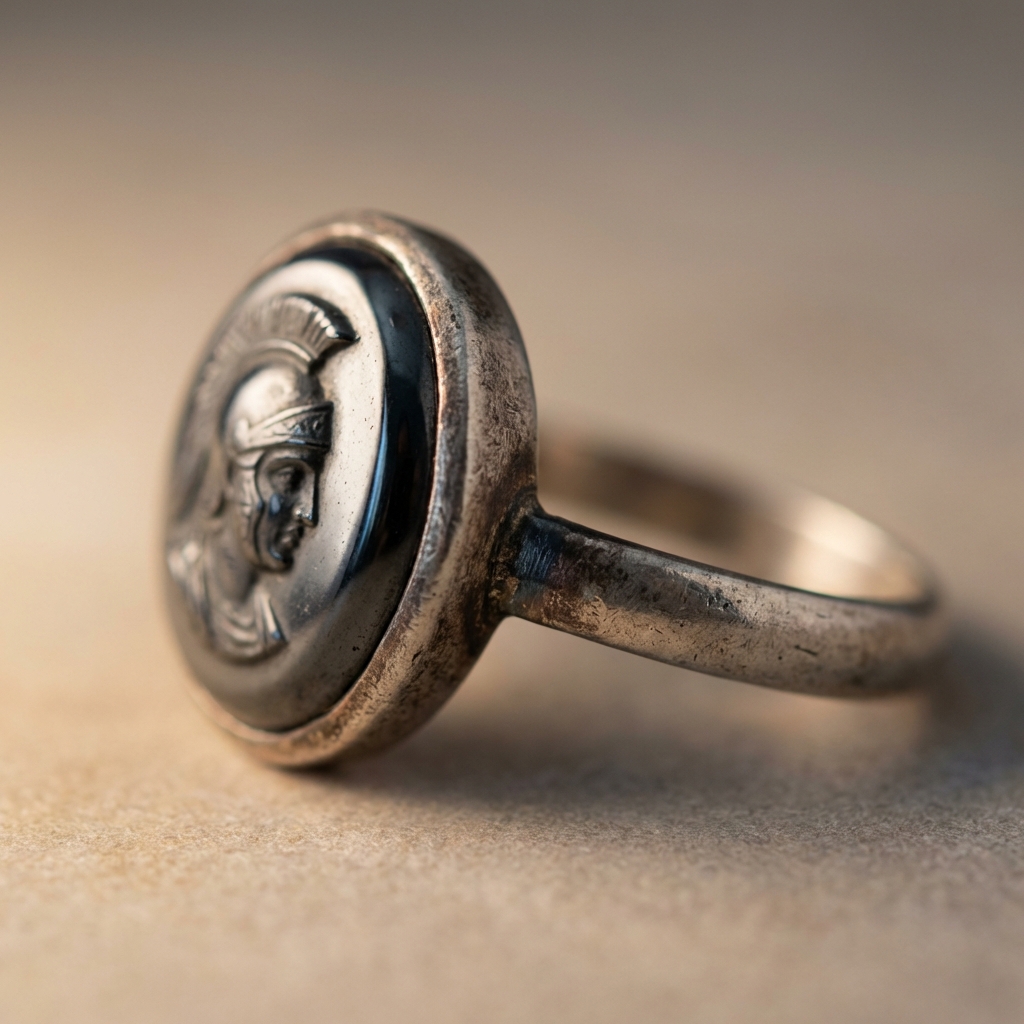
A hematite roman soldier ring is a type of ancient or antiquity-style ring where a polished hematite cabochon or inlay sits within a metal bezel that often reflects military or utilitarian motifs. Hematite itself is a mineral with a metallic to submetallic luster and a characteristically reddish-brown streak, and it is notably dense, properties that help separate it from glass or coated metal imitations Mindat hematite entry.
Collectors encounter the phrase roman soldier ring to describe rings with robust construction, simple iconography, and a functional feel that suit military use or practical wear in Roman contexts; bezel style, integrated shoulders, and consistent wear can suggest a period-appropriate mounting Metropolitan Museum example of a Roman carved stone ring.
Start with non-destructive home tests like streak and magnet checks, assess the bezel and matched patina, document condition and provenance statements, and use laboratory analysis only when value or uncertainty justifies it.
Correct identification matters because it affects conservation choices, handling, and how provenance or collection history is interpreted during purchase or sale. Simple, non-destructive checks are a practical first step before escalating to laboratory testing or accepting a seller claim about materials GIA hematite guide.
For anyone evaluating a piece for a collection or as wearable history, distinguishing the stone from modern substitutes helps set realistic expectations about condition notes, restoration notes, and likely workshop attribution.
Four simple home tests to check hematite in a ring
Streak test on unglazed porcelain
The streak test is a straightforward way to check for hematite: rub the stone gently across unglazed porcelain and observe the powder left behind. Hematite normally yields a reddish-brown streak, while glass and most steels leave colors that are different enough to notice in good lighting Geology.com hematite facts and GemSelect.
Behind-the-scenes at @auroraantiqua
The streak test is low risk if you avoid hard pressure and protect the bezel; use a spare porcelain tile reserved for testing and photograph the result for your records.
Magnet test with a small neodymium magnet
Hematite is only weakly magnetic or effectively antiferromagnetic in many specimens, so a small but strong neodymium magnet will usually produce little or no attraction; a strong pull suggests magnetite or a magnetic composite imitation WebMineral hematite properties.
To perform the magnet check, hold the magnet close to the stone but avoid contact with the metal mounting to prevent scratches; if there is noticeable attraction, treat the result as a red flag and combine it with other tests before concluding the material is not hematite.

Scratch and hardness comparison
Hematite has a modest hardness around five to six on the Mohs scale, so it will resist scratching by softer materials but may be scratched by harder steels; use a careful comparative scratch approach rather than aggressive attempts that risk damaging the bezel or intaglio details WebMineral hematite properties.
A safe comparative method is to use common household items of known relative hardness on an unobtrusive edge of a test sample rather than on the bezel itself, and to rely on photographic closeups rather than physical abrasion when the setting is fragile.
Weight and density impression, plus a small scale check
Hematite is noticeably heavy for its size because its specific gravity is high, so an experienced handler can often sense that heft; for a more objective check, a small jewelry scale and a milliliter drop method can give a quick density estimate that helps separate light glass from dense iron oxide Mindat hematite entry.
Use a compact digital pocket scale and a small, clear container with water to measure displacement if you need a quick numeric comparison, and always dry and photograph the ring after testing to document condition.
As a rule of thumb, combining at least two independent simple tests, for example streak plus magnetism or streak plus density, materially reduces the chance of false positives and increases confidence in a home assessment GIA notes on gem testing.
How to read the setting: clues a hematite roman soldier ring is period-original
Examine the joint between bezel and hoop in high-resolution photographs or under gentle magnification; a modern replacement often shows glue lines, abrupt joins, or a bezel that does not conform smoothly to the stone edge.

Wear patterns and patina are further indicators: original stones and settings frequently show matched wear where the stone's contact points and the metal surface have developed compatible surface changes, while mismatched patina or a pristine stone in an obviously aged metal suggests later insertion Metropolitan Museum example of wear and patina.
Restoration notes or explicit condition notes provided by a seller should describe any stabilization, adhesives used, or replaced elements; treat those notes as important context that complements physical testing rather than as definitive proof of period origin.
When lab confirmation is worth it and what tests professionals use
If home checks leave uncertainty or the purchase value justifies higher certainty, professional techniques such as XRF for elemental analysis, Raman spectroscopy for mineral fingerprinting, and FTIR for identification of organics and surface coatings will provide reliable identification when performed by qualified services GIA on gem identification methods.
Typical reasons to seek lab work include high-value acquisitions, contested provenance, or conservation needs where a precise identification affects treatment decisions; labs and museum conservation departments can also advise on whether sampling is required and how to limit impact on the object.

Costs and logistics vary by technique and region; ask potential laboratories about sample handling, whether tests are non-destructive, expected turnaround, and whether they provide a report suitable for a condition or provenance dossier. Professional reports are most useful when they include clear statements of method, detection limits, and whether sampling was done.
Remember that a lab result identifying the mineral does not by itself date a setting or prove provenance; laboratory confirmation of hematite addresses material identification, while stylistic and documentary evidence addresses period attribution Mindat hematite reference.
A practical buyer's checklist for a hematite roman soldier ring
Before committing to a purchase or accepting a seller's claim, run a small suite of non-destructive checks and assemble clear photographic documentation. Core checks should include a streak test, a magnet test, a weight impression or small scale density check, and close visual inspection of bezel attachment and patina GIA hematite testing notes.
Ask the seller for condition notes, restoration notes, and any available provenance or collection history; if the listing lacks clear photos of the bezel in profile and of the hoop shoulders, request those images before proceeding.
a short household kit and safe usage notes
Use gentle handling to avoid damaging the setting
Keep a written record of your checks and seller responses: date each photo, describe the tests you ran, and save any written provenance statements. This documentation helps later if you need to request a return, seek a second opinion, or provide evidence to a conservator.
Use condition-friendly language in communications and listings; prefer terms such as wear consistent with age, condition notes, and restoration notes rather than absolute claims about originality.
Common fakes and red flags for hematite in rings
Common modern imitations you will encounter include polished glass cabochons, coated metals, and magnetic composites designed to mimic hematite's sheen or heft; these materials can look convincing in photographs but fail one or more simple physical tests GIA on common imitations and SatinCrystals.
Photographic red flags include an overly perfect polish that lacks micro-abrasions, bezel photos that do not show the junction between stone and metal clearly, or listings that omit condition notes and provenance entirely. Such omissions warrant caution even when the image looks attractive.
Another warning sign is a seller claim of a heavy, authentic stone paired with pictures that show a bezel set in a clearly modern fashion; in these cases, combining a streak test with a magnet or density check will help avoid false positives Geology.com hematite overview.
Practical examples and short scenarios
Example A: A listed Roman soldier ring shows a solid, raised bezel integrated into the shoulders and a matched, even patina across stone and metal. Photographs include side views, and a seller supplies condition notes describing gentle stabilization to the hoop. A streak test on a retained sample or comparable example yields a reddish-brown streak, and a magnet check shows no attraction; these combined results increase confidence that the stone is hematite, though provenance still matters Metropolitan Museum example of period wear.
Example B: A heavy-appearing cabochon passes a streak test with a reddish-brown mark but reacts strongly to a neodymium magnet. Strong magnetism suggests a modern magnetic composite or magnetite inclusion rather than pure hematite. In that case, further checks or a lab inquiry are warranted before accepting the material description Mindat hematite entry and Common Minerals.
Document your own checks by saving close-up photos, date-stamped test notes, and any seller replies. Keep images of the bezel in profile, the base of the hoop, and the result of any streak tests so you can compare later or share with a conservator or lab.
Conclusion: balanced next steps for buyers and collectors
Use a layered approach when evaluating a hematite roman soldier ring: start with home-friendly, non-destructive tests, combine those results with a careful reading of the bezel, patina, and condition notes, and pursue laboratory confirmation only when the item value or remaining uncertainty justifies the expense GIA guidance on layered testing.
Request clear photographs and documentation such as provenance or collection history and read restoration notes closely; Aurora Antiqua presents curated ancient rings with condition notes and provenance references when available to help buyers make informed decisions about wearable history.
The streak test on unglazed porcelain is the simplest non-destructive check; hematite typically leaves a reddish-brown streak while glass and many substitutes do not.
No; hematite is only weakly magnetic in many specimens, so a strong attraction suggests a magnetic imitation but a lack of attraction does not alone prove authenticity.
Consider lab testing for high-value purchases, disputed provenance, or conservation decisions when home checks leave important uncertainty.
More from Aurora Antiqua
References
- Hematite, Handbook of Mineralogy, Mineral Data Publishing / Mineralogical Society of America, USA
- Weight in the Form of a Hippopotamus Head, The Cleveland Museum of Art, USA
- Kunststoffe als Imitationen für Edelsteine und organische Substanzen (plastic imitations of gems), Deutsche Gemmologische Gesellschaft
- 16 CFR Part 23, Guides for the Jewelry, Precious Metals, and Pewter Industries, Federal Trade Commission, eCFR
- Gemstones. In: UCLA Encyclopedia of Egyptology (James A. Harrell), University of California, Los Angeles