


Looking for the real thing? Browse authenticated ancient rings, each piece one of one, individually authenticated, with documented provenance. For the background, see the guide to buying ancient artifacts.
What an ancient ruby ring is and why testing matters
An ancient ruby ring is an antiquity that combines an archaeological or historic metalwork setting with a corundum gemstone that is described or believed to be ruby, typically spanning periods collectors call Roman, Byzantine, medieval or early post-medieval. Collectors use the term to describe one of a kind rings whose metalwork, bezel and motif connect them to past workshops rather than modern manufacturing.
Testing an ancient ruby ring can clarify whether the stone is natural corundum, a later replacement, or a modern imitation, but the options and outcomes differ from modern jewelry because the setting, repairs and patina affect what is safe to test. When a gemological statement is required, accredited labs usually provide measured optical data and spectroscopy rather than relying only on visual description; such lab reports are the reference standard for distinguishing natural, treated and synthetic corundum Gemological Institute of America.
See practical pre-purchase examples on @auroraantiqua
Download the pre-purchase checklist PDF to collect the photos and notes a lab will want before you send a piece for testing.
For ancient rings, provenance, condition notes and restoration notes are central to any evaluation. (see our ancient Roman rings collection). A clear history of ownership, specific condition descriptions and records of prior repairs help labs and conservators choose non-destructive analyses first and avoid interventions that could damage the object or remove contextual information British Museum conservation guidance.
Quick at-home checks to triage an ancient ruby ring
At-home checks are useful for triage but cannot prove natural origin. Start with magnified inspection at 10× to look for characteristic inclusions such as silk rutile threads, growth zoning or fingerprint-like features; these inclusion patterns are often the first clue that a stone is natural rather than a glass or some modern synthetic.
Another simple test is the fog test: breathe onto the stone and note how quickly the condensation clears. Real corundum disperses heat faster than glass or plastic, so fog from breath often clears more quickly on a genuine corundum; this method can flag obvious imitations but cannot confirm origin or treatments American Gem Society consumer resources.
Hardness checks are often suggested in hobby guides, but they have limits. Corundum ranks 9 on the Mohs scale and will scratch many common materials, yet some modern simulants and fused glasses can mimic hardness in casual comparisons. For this reason, avoid destructive scratching on historic settings and use hardness only as a suggestive, last-resort observation rather than proof GIA research.

Visual signs gemologists look for in an ancient ruby ring
Gemologists trained in ruby identification rely on inclusion patterns visible under magnification. Natural rubies often show silk, which are fine rutile needles that form a soft shimmer, growth zoning that records the crystal's growth history, and occasional fingerprint inclusions that look like trapped liquid or healed fractures; these features help distinguish natural stones from many synthetics and imitations GIA research.
Start with careful, non-destructive at-home triage using magnification and photographic documentation, request condition and provenance notes, and when authenticity materially matters obtain an accredited laboratory report that includes measured optical data and spectroscopy; involve a conservator before any invasive testing on fragile mounts.
When a stone sits in an ancient bezel, the setting can hide or expose key visual cues. A deep or narrow bezel can obscure side views and make it harder to see growth zoning, while open settings that show the pavilion permit clearer microscopy. Restoration notes and repairs may include re-bezel work or filling that changes how inclusions are seen, so high-resolution photos and condition descriptions are essential before interpreting what you see under magnification British Museum conservation guidance.

Laboratory methods that reliably identify rubies
Laboratories measure optical properties such as refractive index and birefringence and often report specific gravity as foundational, repeatable data points in a gemological report. These measured optical properties remain fundamental because they reflect the crystal physics that separate corundum from most simulants and are reported in accredited lab documentation SSEF gem identification overview. (see advanced testing guides at The Natural Ruby Company).
Spectroscopic methods are the next step and are required to detect many treatments and synthetic origins. Raman spectroscopy, UV-Vis absorption and photoluminescence each interrogate how the stone interacts with light and can reveal signatures of diffusion treatments, flux-grown synthetics or thermal histories that are invisible to the unaided eye Peer reviewed spectroscopy literature. (see a Raman overview at Renishaw).
Advanced trace-element analysis and microscopic inclusion studies are used when origin or treatment questions remain. Trace-element chemistry can indicate geographical sourcing tendencies and can also flag growth mechanisms consistent with certain synthetic processes; such work is conducted by specialized labs and appears on detailed reports when requested Gemological Institute of America.
When to send an ancient ruby ring to a gem lab
Consider lab testing when one or more decision triggers are present: significant purchase price, gaps in provenance, unusual optical appearance, or signs that the stone may have been treated or replaced. Accredited lab reports that include measured optical data and spectroscopy are recommended when authenticity materially affects the purchase or conservation plan Gemological Institute of America.
Cost-benefit choices matter for collectors. If a ring is a modest purchase and the seller provides clear, well-documented provenance and condition notes, a careful at-home triage combined with strong documentation may be sufficient. Conversely, for higher-value items or pieces with ambiguous histories, a formal lab report helps manage uncertainty and supports future conservation or resale discussions SSEF gem identification overview.

Remember that labs may limit or adapt tests for fragile historic settings. When conservation concerns are present, labs and conservators often discuss non-destructive analyses first and will only consider micro-sampling with conservative oversight British Museum conservation guidance.
How labs and conservators handle ancient rings differently
For historic rings, laboratories usually adopt a non-destructive first approach, prioritizing optical and spectroscopic methods that do not require removing the stone. This preserves contextual information and avoids irreversible changes to the mounting or surface while still gathering diagnostic data A non-destructive analytical study of cultural heritage object from Late, Springer Nature.
Before testing, labs will request detailed condition notes, high-resolution photos and any restoration records. These materials let the laboratory assess structural risks and determine whether certain analyses are safe, or whether a conservator should stabilize the piece first British Museum conservation guidance.
Conservators act as intermediaries when invasive sampling is considered. A conservator can document the ring's condition, advise on reversible treatments and provide an assessment that helps the lab select the least invasive tests possible. For fragile or important mounts, conservator input is often a precondition for any destructive analysis British Museum conservation guidance.
Tools and resources to use before you buy an ancient ruby ring
Request clear photographic documentation and take your own observations with a simple toolkit. Ask for high-resolution photos showing the table, crown, pavilion, bezel, hoop and shoulders, and request measurements including millimeter dimensions and carat weight if known. Include a neutral light source in photos to reduce color shifts and request images with a scale for size reference American Gem Society consumer resources. (see our rings collection).
basic pre-purchase visual triage and documentation checklist
Use photos and notes to share with labs and conservators
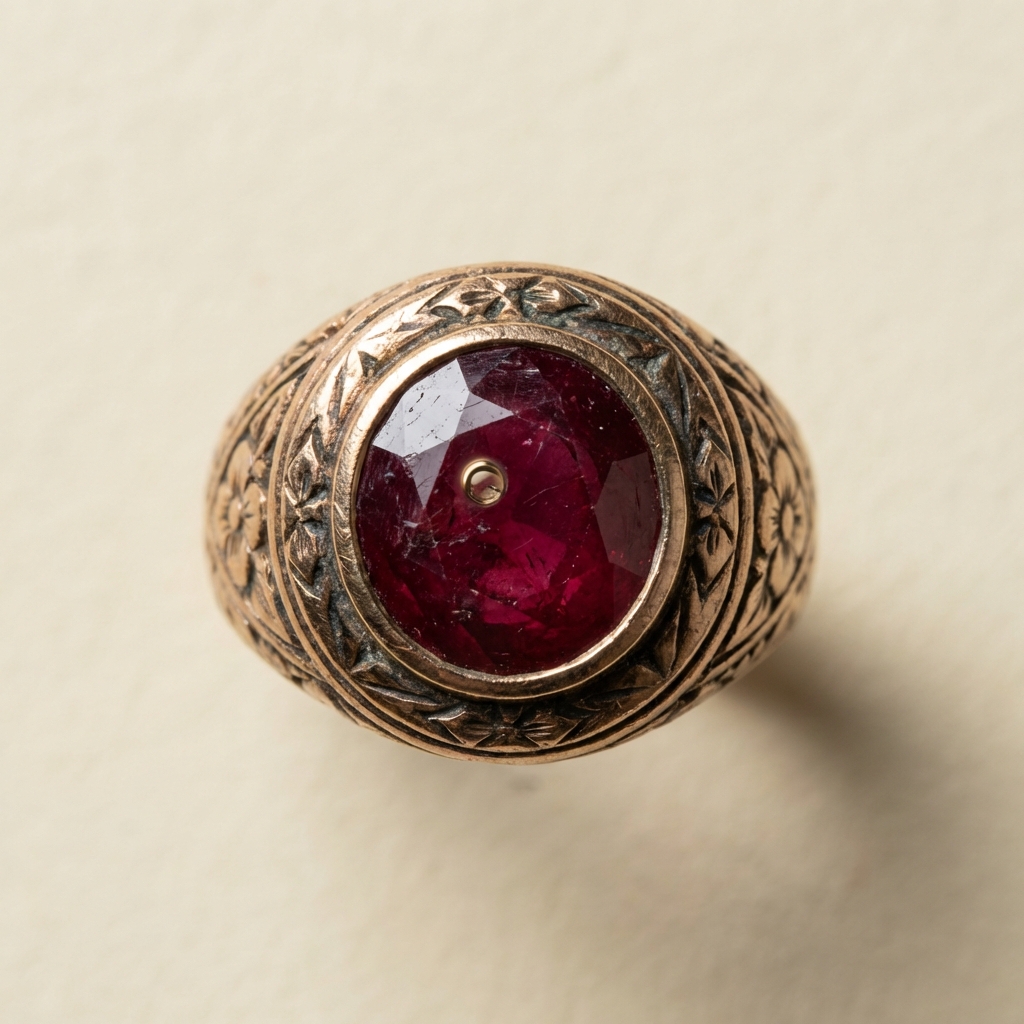
Simple tools to own are a 10× loupe or small stereo microscope, a neutral white LED light, a macro-capable camera or phone and a ruler or scale card. These let you document inclusions, bezel construction and any repairs before purchase, which helps labs and conservators triage what further testing makes sense American Gem Society consumer resources.
Common mistakes buyers make with ancient ruby rings
An over-reliance on seller statements is a frequent error. Seller descriptions are useful lead information but are not a substitute for measured data or documented condition notes when authenticity matters. When possible, request an accredited lab report rather than accepting provenance statements alone Gemological Institute of America.
Misinterpreting patina or historic repairs as proof of authenticity is another common pitfall. Surface wear and patina are context-dependent and can coexist with replacement stones or later repairs; always ask for restoration notes and photographs that show the setting before and after any work British Museum conservation guidance.
Avoid destructive testing on fragile mounts without conservator approval. Scratching, aggressive cleaning or sampling done without conservation oversight can permanently damage both the metalwork and the gemstone context, and may void future lab options Archaeological materials, Icon, The Institute of Conservation (UK).
Real-world scenarios: buying, selling and conserving ancient ruby rings
Scenario A, buyer online: you find a listing with partial provenance and clear photos. First, use your loupe to check for inclusions from the photos or request a short video showing the stone under magnification. If inclusion patterns suggest natural ruby but the provenance is incomplete and the price is significant, request an accredited lab report that includes measured optical data and spectroscopy before finalizing the purchase Gemological Institute of America.
Scenario B, seller preparing a listing: provide high-resolution images from multiple angles, explicit condition notes describing any restoration, and copies or summaries of prior provenance documentation. If you have previous lab reports, include them. Presenting transparent restoration notes and collection history reduces buyer uncertainty and helps prospective conservators or labs assess next steps British Museum conservation guidance.
When a conservator becomes involved, their report can change the testing plan. For fragile settings a conservator may recommend stabilizing the mount and arranging non-destructive analysis first, or they may coordinate minimal surface sampling with the lab to preserve as much context as possible E.C.C.O. Professional Guidelines (II): Code of Ethics, European Confederation of Conservator-Restorers'.
A practical pre-purchase checklist for an ancient ruby ring
A practical pre-purchase checklist for an ancient ruby ring
Immediate red flags to pause and ask questions: missing provenance, images that do not show the stone's pavilion or sides, signs of re-bezel work without documentation, and seller statements that promise authenticity without measured lab data. Any of these should prompt further documentation or a lab report request Gemological Institute of America.
Documentation to request: high-resolution photos from multiple angles, scale measurements in millimeters, clear condition and restoration notes, any existing lab reports, and a provenance summary with collection history where available. Keep records of all communications to support future conservation or valuation work American Gem Society consumer resources.
How to interpret an existing lab report: check that the report provides measured optical data such as refractive index and any spectroscopy results, and that the lab is accredited. If the report mentions diffusion, flux growth or synthesis, request clarification from the issuing lab or seek a second opinion for high-stakes pieces 16 CFR Part 23, Guides for the Jewelry, Precious Metals, and Pewter Industries, Federal Trade Commission, eCFR.
How to read and interpret a gemological lab report for a ruby
Key report elements include measured optical data such as refractive index and birefringence, specific gravity when provided, and spectroscopy or photoluminescence results that identify treatments or synthetic origins. These elements together form the technical basis for the lab's conclusions and are what collectors should check first Gemological Institute of America.
Common disclaimers to expect: statements limiting the scope of testing, notes about non-destructive methods used, and caveats when a sample could not be fully analyzed because of conservation constraints. When a report includes a treatment note or an uncertainty statement, follow up with the issuing lab for specific details and recommendations SSEF gem identification overview.
If a report is unclear, contact the issuing laboratory. Labs can often clarify their methodology and the meaning of measured values, and in many cases will advise on the minimal additional testing needed to resolve remaining questions Gemological Institute of America.
Ethical, conservation and provenance considerations before testing or restoring
Consult a conservator before any invasive testing or restoration on fragile historic settings. Conservators document condition, suggest reversible treatments and advise on how tests might affect the object's integrity and future research value British Museum conservation guidance.
Respect provenance and legal considerations. Do not assume provenance certainty without documentation, and check for export or ownership restrictions that may apply to antiquities. Keep restoration notes and any conservation work clearly documented to preserve the object's history for future owners and researchers British Museum conservation guidance.
Conclusion: practical next steps for a safer purchase
Summary checklist: start with a careful at-home triage using a loupe and neutral light, request comprehensive photographs and condition notes, and treat seller statements as initial information rather than definitive proof. When authenticity matters, seek an accredited lab report that includes measured optical data and spectroscopy Gemological Institute of America.
When to seek professional help: if the piece has unclear provenance, unusual optical features, high value or fragile conservation needs, engage a conservator and request a lab report. Aurora Antiqua presents condition notes, restoration summaries and provenance references where available to help collectors assess rings responsibly.
Use a 10× loupe to inspect for silk, growth zoning or fingerprint inclusions, try the fog test to see how quickly condensation clears, and review bezel and setting construction; these checks can flag obvious imitations but cannot confirm natural origin.
Request a lab report when provenance is incomplete, the purchase price is significant, the stone looks unusual, or you need formal documentation for conservation; accredited labs provide measured optical data and spectroscopy needed for reliable conclusions.
No, labs often prefer non-destructive methods for fragile or repaired mounts and may require conservator assessment before any invasive sampling or micro‑analysis.
More from Aurora Antiqua
References
- A non-destructive analytical study of cultural heritage object from Late, Springer Nature
- 16 CFR Part 23, Guides for the Jewelry, Precious Metals, and Pewter Industries, Federal Trade Commission, eCFR
- The Gemstone Book, CIBJO Blue Book, Coloured Stone Commission, CIBJO, The World Jewellery Confederation
- Chart of Commercially Available Gem Treatments (Gems & Gemology, Winter 2002), Gemological Institute of America
- E.C.C.O. Professional Guidelines (II): Code of Ethics, European Confederation of Conservator-Restorers'
- Archaeological materials, Icon, The Institute of Conservation (UK)
- Gemstones from Roman Britain: Recorded in the Portable Antiquities Scheme, University Debrecen, Hungary
- Kunststoffe als Imitationen für Edelsteine und organische Substanzen (plastic imitations of gems), Deutsche Gemmologische Gesellschaft
- Ruby Gemstone, Gemological Institute of America
- Spring 2026 Gems & Gemology, Gemological Institute of America