


Looking for the real thing? Browse our full ring collection, each piece one of one, individually authenticated, with documented provenance. For the background, see the guide to buying ancient artifacts.
What does testing a silver Roman numeral ring mean and why it matters (roman numeral ring silver)
When collectors and buyers ask whether a roman numeral ring silver is genuine 925 sterling, they are asking two linked questions: does the object contain the expected silver alloy, and is the surface evidence consistent with the ring's reported age and history. A plain definition helps: 925 sterling silver means the alloy contains roughly 92.5 percent silver and 7.5 percent other metals, and assay or hallmarking systems are designed to record that fact for modern commercial pieces, though marks are only one line of evidence and can be added later, so they should be corroborated with other checks Hallmarking Guidance Notes: practical guidance in relation to the Hallmarking Act 1973, the UK Assay Offices. For relevant market listings see Roman examples.
For ancient and historically significant rings, including Roman examples, surface conditions such as corrosion, encrustation and patina can change the appearance of metal and complicate simple tests. Non-destructive methods used in heritage work read surface chemistry that may reflect long-term corrosion layers or past restorations rather than bulk alloy, so interpreting results requires care and context CCI discussion of pXRF limitations.
Follow @auroraantiqua for testing demos and condition notes
Check the seller's condition notes and any available provenance documentation before assuming a single visual test resolves the question.
Because no single observation is definitive for high-value antiquities, a combination of readable hallmarks, clear condition and restoration notes, and independent laboratory results together provide the most reliable basis for confidence in an item described as 925 sterling; pairing those lines of evidence reduces the chance that a single forged mark or misleading surface reading will determine authenticity British Hallmarking Council overview.
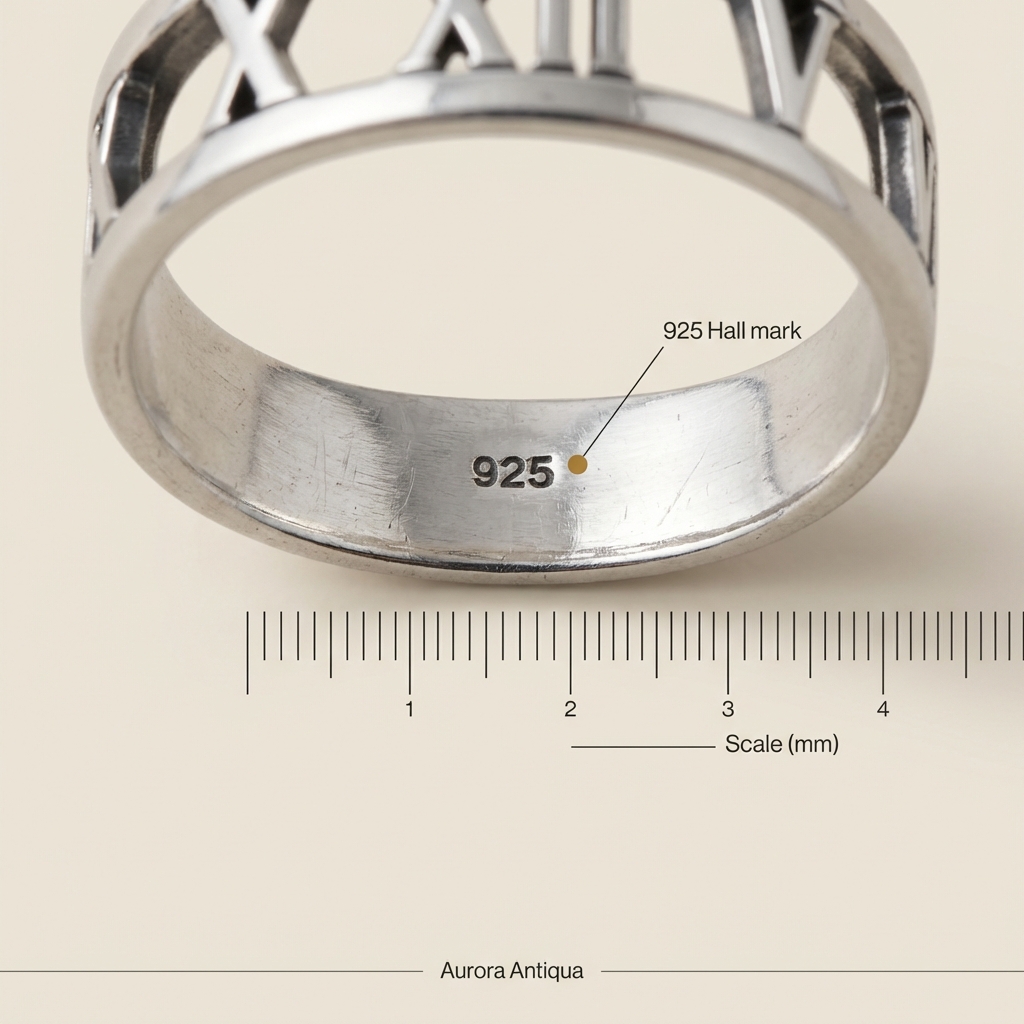
In short, testing a silver ring involves both identifying marks and reading material evidence, then weighing those findings against provenance and any conservation history supplied with the object.
Quick at-home checks that filter likely genuine 925 pieces
Start with photographs and close visual inspection. If a listing has clear, high-resolution images of the interior band and any hallmarks, compare the mark shapes and placement to official hallmarking references when possible; a plainly visible 925 or an assay office punch is strong initial evidence but not conclusive on its own British Hallmarking Council overview.
When you can examine a piece in person, simple physical checks are a quick first filter. A magnet test is straightforward: sterling silver is not magnetic, so a small refrigerator magnet can rule out strongly magnetic base metals, but it cannot detect non-magnetic base-metal cores or silver plating over a non-magnetic core, so use the result only as an initial filter FTC guidance for jewelry testing.

Weight and feel are subjective but useful. Experienced buyers note that silver has a particular heft for its size; a ring that feels unexpectedly light for its dimensions may contain lower-density base metals or internal voids, whereas a heavy feel is at least consistent with solid metal. Photographs that include a scale or ruler help others verify size and expected weight when a physical inspection is not possible.
Tarnish and patina should be evaluated for consistency with age. Genuine age-consistent tarnish often appears in recesses and around decorative details, while patched or uneven surfaces may indicate repairs, plating or aggressive polishing. Portable XRF and other surface methods can misread items that have been heavily polished or relined, so visual notes and high-resolution images are important context for later testing Investigating Ancient “Bronzes”, J. Paul Getty Museum and Getty Conservation Institute, Los Angeles.
Read the seller's condition notes and restoration notes carefully. Phrases such as "stabilized", "cleaned and consolidated", or "repaired solder on shank" are informative; absence of any restoration note for an ancient ring with visible wear is a red flag. Request close-ups of the interior band and any solder joins, and ask whether any modern lining or reinforcement has been applied.
Acid (nitric) spot tests: how they work and important safety limits
An acid spot test uses a drop of nitric acid on a small scraped area to indicate whether a surface contains silver or a base metal by producing characteristic color changes on a testing stone. When applied carefully to a tiny exposed area, the test can suggest whether base metals are present beneath the surface finish, but the method is destructive to surface finish and samples only a tiny spot, so it can be misleading on plated or heavily corroded pieces CCI guidance on analytical limitations.
Step-by-step, the typical at-home acid spot approach involves cleaning a small area, gently removing any surface lacquer or heavy corrosion scale just enough to expose metal, applying the acid to a test stone with the metal rubbed across it, and comparing the resulting mark to reference color charts. This procedure sacrifices a small surface area and can visibly alter patina or finish, so it is not recommended for pieces described as historically significant or for visible surfaces on display objects FTC safety considerations for jewelry testing.
Use a sequence of checks: inspect hallmarks and condition notes, run simple at-home filters like a magnet test, obtain a non-destructive pXRF scan, and commission a professional assay when results conflict or the piece is high value.
False readings happen when plating, heavy corrosion layers, or modern surface repairs are present. A plated object can show a silver result while a non-silver core remains, and an intensely corroded surface can give a misleading reaction depending on corrosion products present. For ancient pieces, those confounding factors are common enough that many conservators recommend non-destructive assessment first and reserve acid testing for cases where other checks leave significant doubt CCI discussion of non-destructive priorities.
Safety note: nitric acid is hazardous. Proper eye protection, gloves and ventilation are required, and the test should not be attempted on valuable or irreplaceable items. If you consider an acid test, prefer to have it performed by a trained professional who can limit surface damage and record findings in a conservation-aware report Metropolitan Museum conservation guidance.
Non-destructive instruments: portable XRF and how to read its results
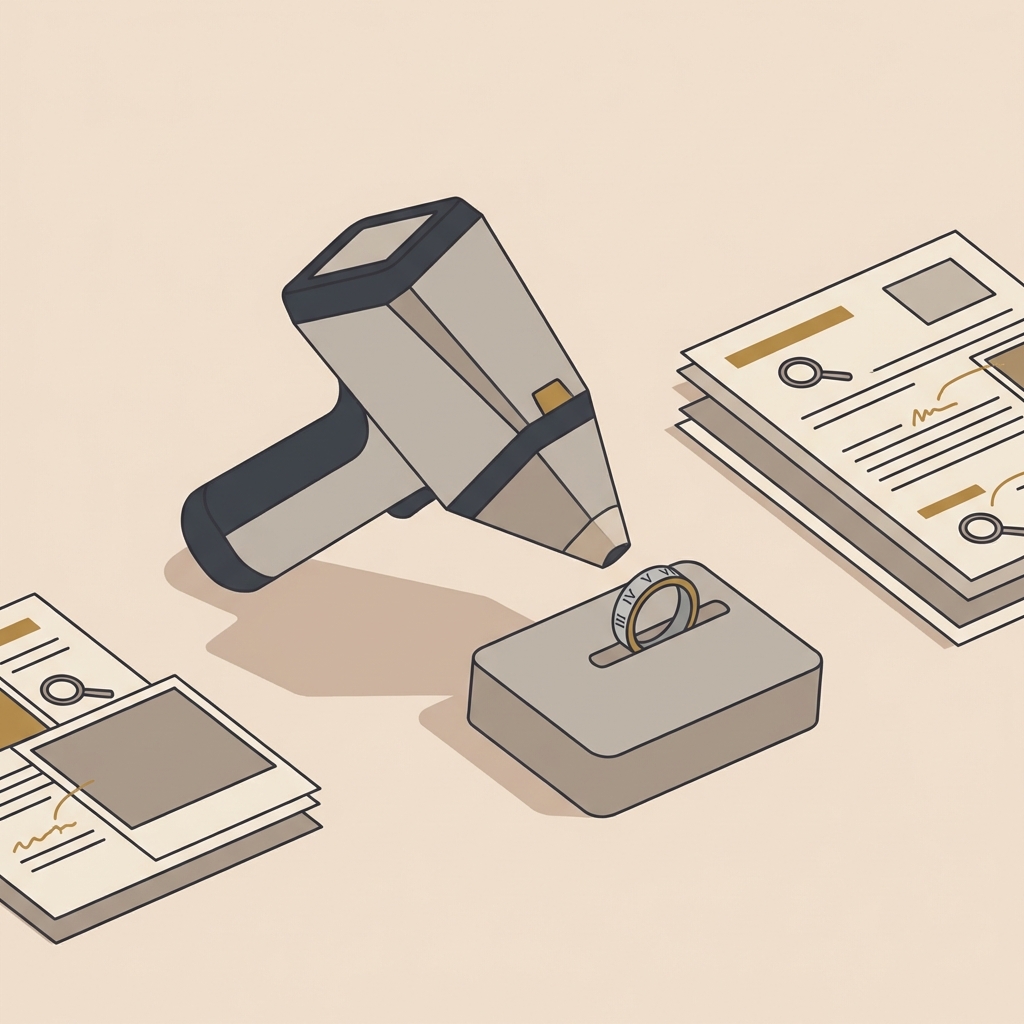
Portable XRF (pXRF) analysts measure X-ray fluorescence from the surface to estimate alloy composition rapidly and non-destructively, which is why the technique has become a common first-line instrument in heritage and museum contexts Portable XRF for paintings and metals authentication, npj Heritage Science (Springer Nature), DOI. Manufacturers and application notes such as Bruker provide practical guidance on instrument use.
Important to know: pXRF reports surface chemistry and is excellent for quick screening, but it can be confounded by surface plating, corrosion layers or recent restorations that mask bulk composition. Operators who document spot location, measurement conditions and representative photos make their reports far more useful, because a surface reading without context can be ambiguous CCI pXRF limitations and best practice.
When you request or receive a pXRF report, ask for the measurement spots annotated on photographs and for the raw spectra or a simple table of elements detected with approximate percentages. A clean silver signal across multiple, well-documented spots is stronger evidence than a single unannotated reading, but even that should be viewed in concert with visual condition and any hallmarks shown A pilot study evaluating challenges using handheld XRF for provenance studies, npj Heritage Science. Commercial providers and service options include companies offering on-location testing such as FastXRF, and some labs supply rental analyzers and equipment listings like XRF Company rentals.

If a pXRF reading shows silver-rich surface chemistry but questions remain about bulk composition, the next steps are clear: clarify whether any repairs or linings were applied, seek additional spot readings in different locations, and consider sending to a laboratory for bulk analysis if value or historical importance justifies that cost Metropolitan Museum conservation guidance.
Operators vary in equipment and reporting style. When possible, choose a conservator or lab operator who regularly works with archaeological metals, because they are better attuned to corrosion products and restoration residues that commonly alter surface readings.
When to seek professional assays and specialist conservation examination
For valuable or historically significant Roman silver rings, professional laboratory assays and specialist conservation examinations are recommended when at-home checks and pXRF leave unanswered questions. Laboratory methods such as ICP-OES, ICP-MS for bulk composition, or fire assay for elemental concentration provide measurements of the whole sample rather than just the surface, and are appropriate when results will influence provenance interpretation or purchase decisions Metropolitan Museum conservation guidance.
Practical criteria to send an item for lab testing include: a) the ring is described as an important antiquity and the purchase price justifies testing costs, b) surface readings and hallmarks disagree in ways that materially affect confidence, or c) the seller requests testing as part of a sale negotiation. In those cases a formal laboratory report gives a defensible, documented result to add to provenance and condition records Echtheitsuntersuchungen (authenticity testing), Curt-Engelhorn-Zentrum Archäometrie (CEZA), Mannheim.
Ask the lab or conservator for a clear brief when you prepare a submission: state the questions you want answered (for example, whether the bulk is consistent with sterling silver), request a description of sampling methods, and ask for a formal report with calibrated results and measurement uncertainty. A conservation report that documents condition and any interventions adds essential context to analytical numbers Metropolitan Museum conservation guidance.
Finding a qualified lab often starts with local university conservation departments or state museum conservation services rather than commercial jewelry shops. When you contact a lab, provide high-quality images, condition notes, any provenance statements and the results of prior quick checks such as pXRF; that background will speed their assessment and help them advise whether bulk assays are warranted Echtheitsuntersuchungen (authenticity testing), Curt-Engelhorn-Zentrum Archäometrie (CEZA), Mannheim.
Interpreting mixed results: building confidence from multiple lines of evidence
When tests disagree, adopt a simple decision framework: corroborate any hallmark claim with at least one additional independent test and with provenance or a lab report for high-value items. If a ring shows a 925 stamp but surface readings and seller notes suggest modern restoration or plating, treat the 925 stamp as an initial clue, not a conclusion, until further evidence resolves the discrepancy British Hallmarking Council overview.
Stepwise approach: first, document everything you have in a single file: annotated photos, seller condition notes, any pXRF outputs, and the results of at-home checks. Second, seek a second non-destructive opinion if possible. Third, when doubts persist for items of material or historical value, commission a lab assay. Keeping all records together helps a conservator or analyst interpret mixed signals and advise next steps Metropolitan Museum conservation guidance.
a simple record workbook to log tests, photos and provenance
Date each entry and note operator
Common discrepant patterns include a clear 925 punch but pXRF readings that vary between spots, which may indicate surface plating or localized repairs rather than uniform sterling alloy. Another pattern is a silver-rich pXRF signal with no corresponding hallmark and ambiguous provenance; in that case provenance research and a conservator report help decide whether bulk assays are needed Testing and Retesting Alexander the Great, J. Paul Getty Museum and Getty Conservation Institute, Los Angeles.
Preserve all test reports and annotated images with the item record. Well-documented files not only help future buyers and conservators, but also make any later sale or valuation more transparent to third parties British Hallmarking Council overview.
Common mistakes and red flags when buying ancient silver rings online
Several listing features commonly signal higher risk. Red flags include no clear images of the interior band and hallmarks, vague or missing condition or restoration notes, and absence of provenance or collection history. These omissions make it hard to assess whether a 925 punch is original or added later https://www.assayofficelondon.co.uk/hallmarking/what-is-a-hallmark#convention, Goldsmiths' Company Assay Office.
Overpolishing and heavy restoration are frequent problems. Aggressive polishing can remove surface corrosion and patina that otherwise help date and contextualize a ring, and heavy soldering or linings can hide core alloys from surface instruments. When sellers describe "professional cleaning" without specifying what was done, request explicit restoration notes and images of the treated areas Conserve O Gram 10/2: Caring For Silver And Copper Alloy Objects, National Park Service, US Department.
Be cautious with hallmarks shown only in a single poor-quality photo. A clear, well-lit image taken at multiple angles makes it far easier to assess whether a mark was punched historically or added later. Ask for a scale bar or a measurement tool in the picture so the mark size and placement can be compared to assay office examples.
If the seller resists independent testing or will not allow a brief pXRF scan by a conservator, include that reluctance as part of your risk assessment. Sellers who proactively provide conservation notes, annotated photos and third-party reports are easier to evaluate than those who do not disclose such information FTC guidance on seller disclosures.
Practical examples and a closing checklist for buyers
Example 1, conditional scenario: a listed Roman ring has a clear 925 punch, consistent patina, and a conservator's pXRF report showing silver-rich surface readings from three well-documented spots. In this pattern, the combined evidence raises confidence, but if any spot is anomalous request bulk assays before a high-value purchase A pilot study evaluating challenges using handheld XRF for provenance studies, npj Heritage Science.
Example 2, conditional scenario: a listing shows a 925 stamp but only one indistinct photo, the seller has no provenance notes and a single pXRF reading provided by the seller shows mixed results. In that case, ask for annotated photos, a second pXRF in different spots, and consider requiring an independent lab assay before completing the purchase if the ring's reported history and price justify it Metropolitan Museum conservation guidance.
Final buyer checklist to request or complete before purchase: 1) high-resolution, scaled photographs of the ring including interior band and hallmarks, 2) clear condition and restoration notes, 3) any provenance or collection history available, 4) at-home checks you have done (magnet, weight notes), 5) pXRF or conservator report if available, and 6) a lab assay if the price or significance warrants it. Save these items in a single file for reference British Hallmarking Council overview.
Aurora Antiqua functions as a curation reference and trust layer: listings typically include condition notes, restoration information and provenance where available, and those materials are intended to help buyers make informed decisions rather than to assert absolute authenticity for every item.
A 925 punch is strong initial evidence but can be added later. For ancient rings it should be corroborated with condition notes, provenance and at least one independent test to increase confidence.
No. A magnet test helps rule out strongly magnetic base metals but cannot detect non-magnetic cores or silver plating and should be used only as a first filter.
Professional assays are recommended when the ring is high value or historically significant, when tests disagree, or when seller documentation is insufficient; labs provide bulk composition analysis not achievable with surface checks.
More from Aurora Antiqua
References
- Hallmarking Guidance Notes: practical guidance in relation to the Hallmarking Act 1973, the UK Assay Offices
- https://www.assayofficelondon.co.uk/hallmarking/what-is-a-hallmark#convention, Goldsmiths' Company Assay Office
- 16 CFR 23.5, Misrepresentation as to silver content, Federal Trade Commission, eCFR
- Investigating Ancient “Bronzes”, J. Paul Getty Museum and Getty Conservation Institute, Los Angeles
- Portable XRF for paintings and metals authentication, npj Heritage Science (Springer Nature), DOI
- A pilot study evaluating challenges using handheld XRF for provenance studies, npj Heritage Science
- Echtheitsuntersuchungen (authenticity testing), Curt-Engelhorn-Zentrum Archäometrie (CEZA), Mannheim
- Testing and Retesting Alexander the Great, J. Paul Getty Museum and Getty Conservation Institute, Los Angeles
- Conserve O Gram 10/2: Caring For Silver And Copper Alloy Objects, National Park Service, US Department