


Looking for the real thing? Browse our full ring collection, each piece one of one, individually authenticated, with documented provenance. For the background, see the guide to ancient jewelry.
What are ancient rings? Definition and why they matter
An ancient ring is an artifact worn on the finger that was made in a previous historical period and is presented as an antiquity or collector piece. Collectors and curators usually treat dating as an estimate, inferred from stylistic clues, material, and manufacturing traces rather than asserted as absolute fact, and these careful conventions help set expectations when assessing listings.
For practical identification and cataloguing, museum literature commonly groups historical rings into a small number of types, a framework that simplifies comparison across periods and workshops. This approach helps buyers frame questions about condition, provenance, and likely date ranges when a listing provides photos and notes, and it is a standard used in public collection guides Metropolitan Museum of Art timeline on rings.
Follow @auroraantiqua for behind-the-scenes documentation and condition notes
Browse curated listings that include condition notes and provenance where available to practice applying this typology to real examples.
When writing or speaking about materials, iconography, or repairs, use conditional language such as appears to be, described as, or likely, because visual inspection alone is usually provisional. That cautious phrasing aligns with museum practice and helps buyers avoid overstated claims about authenticity or date.
The four practical types collectors use
For collectors and cataloguers a useful four-way grouping is: signet or intaglio rings, coin rings, plain bands, and decorative or gem-set rings. Each label describes a common function or construction method and gives initial diagnostic cues for dating and comparison across collections. This four-way taxonomy appears in many museum guides and reference overviews Victoria and Albert Museum overview on rings and Forum Ancient Coins overview on rings.
Using this grouping, a buyer can quickly prioritise what to check in a listing: bezel and carving for signet and intaglio types, legends and mounting for coin rings, material and tool marks for plain bands, and stone setting and testing notes for decorative rings. The classification is practical rather than absolute because many items show overlapping features and may require specialist assessment or testing to resolve ambiguities.
Signet and intaglio rings: features and dating clues
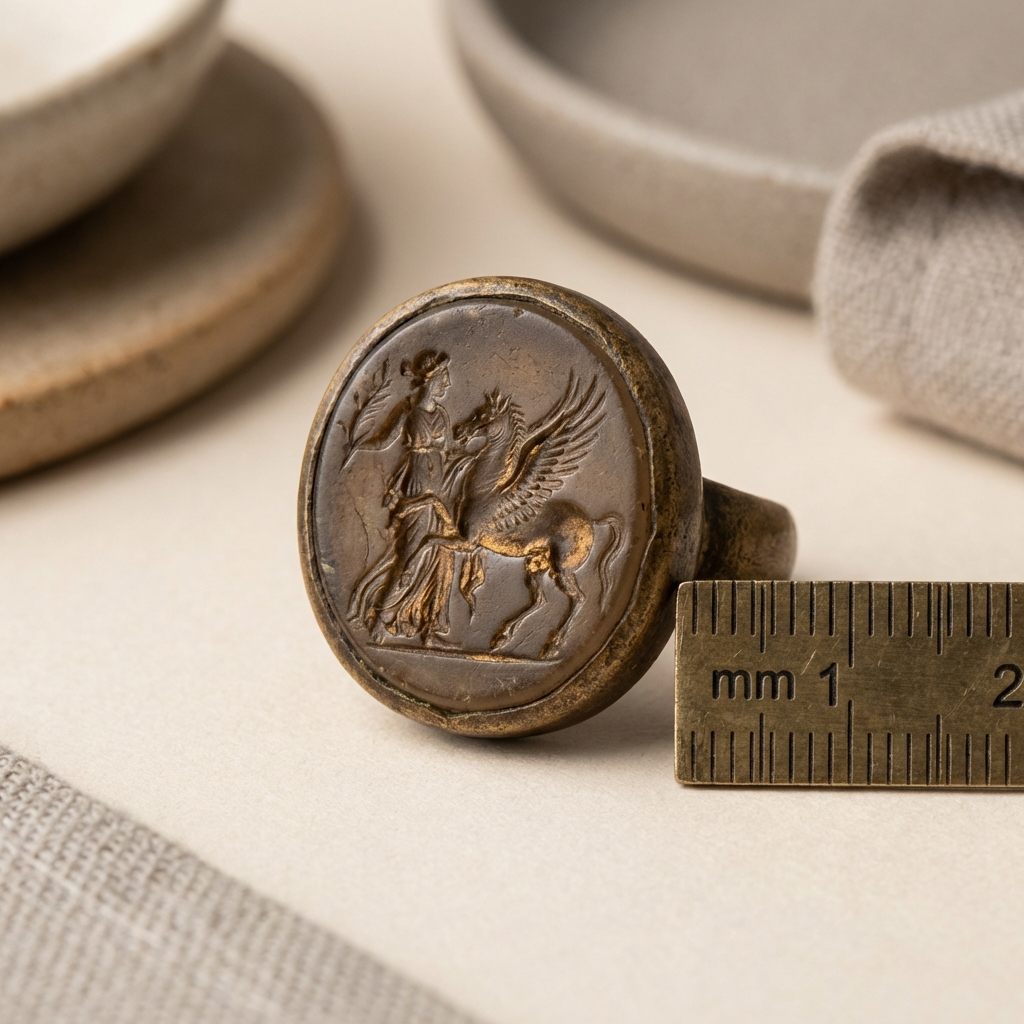
Signet and intaglio rings are typically recognised by a worked stone or carved bezel that could function as a personal seal as well as ornament. In museum and specialist literature, these rings are strongly associated with Hellenistic and Roman social practices and are commonly encountered across those contexts Metropolitan Museum of Art timeline on rings.
Physical clues that help with dating include the carving style and motif, the way the stone is seated in the bezel, and wear consistent with use as a seal. Carving technique, for example fine-line intaglio versus shallower engraving, can be indicative of different workshops or periods, but such observations are provisional and should be supported by documentation or specialist reports when possible Journal of Roman Archaeology article on signet rings.
The four practical types are signet or intaglio, coin, plain band, and decorative or gem-set rings; identify them by type, inspect required photos and measurements, review condition and restoration notes, and seek provenance or specialist reports when necessary.
When comparing listings, note the bezel profile, the edge of the stone where it meets the metal, and any residue or repair around the seat. Many catalogues also document whether stones were recut or reset, and that information is central to understanding whether the current appearance matches the original function.
Coin rings: how to spot a mounted or reworked coin
Coin rings are those made from an actual coin or that incorporate a coin element into their design. Visible legends, coin iconography, and characteristic bending or flattened bands are strong indicators of coin reworking, and museum collections use these features to distinguish mounted coin jewellery from replica or modern conversions Victoria and Albert Museum overview on rings.
Key signs to look for in photographs are readable legend fragments on the coin face, thin flattened bands where the metal has been worked to hold a coin, and small tool marks or bends where a mounting was formed. The presence of a legible legend helps place the coin within a broad date range, though regional and chronological overlap is common and specialist input can refine attributions British Museum jewellery collection notes.
Coin rings span the Roman period into the medieval era and show regional variation in mounting technique. For listings, insist on clear images of the coin face, the reverse, and the rim where the coin meets the band to judge whether the coin is original to the setting or a modern addition.
Plain bands: ubiquity, materials and dating limits
Plain bands are the most widespread ring form across regions and periods. Because the shape is simple, dating often relies on material, manufacturing traces, and contextual documentation rather than form alone. This ubiquity makes plain bands common in museum stores and archaeological reports British Museum jewellery collection notes.
Material indicators such as bronze, silver, or gold and manufacturing traces like tool marks, hammering patterns, or casting seams can narrow plausible date ranges. Still, such physical clues are usually not conclusive without specialist assessment or metallurgical testing, so treat any visual dating as an informed estimate.

When a listing includes condition notes and restoration details, use those statements to assess whether a plain band has been stabilised or altered. Clear condition notes improve confidence and help separate wear consistent with age from modern interventions.
Decorative and gem-set rings: visual ID and testing limits
Decorative and gem-set rings include a wide range of settings, such as intaglio stones cut with engraved designs and cabochon mounts. These rings are catalogued by museums as distinct because the presence of a stone and its cutting technique convey different workshop practices and social meanings Metropolitan Museum of Art timeline on rings.
Visual stone identification is provisional. Common stones described in listings include carnelian, agate, and amethyst, but sight identification can be misleading and laboratory testing provides materially higher certainty about both stone and metal composition. In many catalogues and conservation reports, testing results or specialist comments are used to move an item from probable to better-supported identification Aurora Antiqua product listing for a Roman intaglio ring.
For buyers, ask whether the seller can provide any testing notes or whether the listing describes gem treatments or modern recutting, because such interventions affect interpretation of the piece as wearable history.
A practical identification framework collectors can use
Use a short, repeatable sequence when assessing a listing: determine the type, inspect photos for the same views each time, confirm measurements, read condition and restoration notes, and then check for provenance or third-party reports. This sequence helps standardise first-stage vetting and reduces reliance on single impressions from one image alone Auction Terminology, Christie's.
Strong first-stage indicators include readable legends for coin rings, a clearly photographed bezel for signet rings, and exact inner diameter measurements for plain bands. Items that lack these basic elements are candidates for pause and request for more information.
Practical tools to verify measurements and photos when evaluating listings
Use consistent units and scale in photos
Document your findings for each listing, noting the type label used, the strongest visual clues, any missing data, and the seller responses to targeted questions. This record makes it easier to compare multiple listings and to prepare a clear brief if you choose to seek specialist advice.
Photos, measurements and what to request from the seller
Insist on a set of essential photo views: full ring on and off a neutral background, a close-up of the bezel or coin face, clear images of any hallmarks or legends, side views showing the shoulders, and an inner-band view that can reveal maker marks or repairs. High-resolution images with a consistent scale are fundamental for initial assessment Aurora Antiqua product listing image notes.
Request exact measurements: inner diameter or standard ring size, band width at the shoulder and under the bezel, and bezel dimensions. Ask the seller for a photo including a ruler or scale reference to confirm the measurement claims. These fields are commonly used in museums and dealer catalogues to support identification and scale comparisons.
Provenance, documentation and third-party reports
Provenance entries commonly include collection history, prior ownership notes, verification letters, and catalogue references when available. For many buyers, a clear chain of custody or a documentation note that names previous collections increases confidence in an item's history and helps contextualise dating and attribution Metropolitan Museum of Art timeline on rings.
When provenance is incomplete or absent, independent specialist reports or lab testing are often the most reliable next step to reduce uncertainty. A short verification letter from a recognised specialist or a lab result for metal and stone composition can materially strengthen a listing's claims and should be requested when attributions matter to your decision Aurora Antiqua documentation examples.
Model phrasing to request documentation from a seller includes asking for scans of collection labels, any earlier sale catalogues that mention the item, and clear descriptions of where verification letters or analyses were conducted. Keep requests specific and focused on the items that most affect identification.
Restoration and condition notes: what matters for wearable history
Restoration notes should distinguish between conservation, where an object is stabilised to prevent further loss, and restoration, which may include repairs or replacements. Listings that use clear language such as stabilised, repaired, or left untouched help buyers understand how interventions affect appearance and integrity British Museum jewellery collection notes.
Visible repairs can alter original features and should be photographed and described. Ask for specifics about adhesives, soldering, and any replacement elements so you can judge how interventions change the object and whether the piece still meets your collecting goals as wearable history.

Common mistakes and red flags when evaluating listings
Common mistakes and red flags when evaluating listings
A frequent mistake is overreliance on a single photograph or on the seller's claim without supporting condition notes or provenance. Listings with low-resolution images, missing dimensions, or vague restoration descriptions are common red flags that should trigger requests for more information About us, International Association of Dealers in Ancient Art.
Other warning signs include inconsistent patina across joined surfaces, missing inner-band photos, and price points that seem out of step with condition and documentation. When you encounter these issues, pause and ask targeted questions or request third-party assessment to avoid costly mistakes.
Practical examples and scenarios: applying the framework
Walkthrough, signet listing: start by labelling the listing as a signet or intaglio type, request a close-up of the bezel, note carving technique and wear, confirm inner diameter, and ask for any documentation that references previous collections. If the carving style suggests a broad date range, consider a specialist note before finalising a purchase Metropolitan Museum of Art timeline on rings.
Walkthrough, coin-ring listing: label the item as a coin type, examine legend fragments in images, request full-face and reverse photos, check for bending marks where the coin meets the band, and compare visible iconography with published coin typologies. If the legend is unclear or the mounting ambiguous, request sharper images or seek a numismatic opinion British Museum jewellery collection notes.
Decision checklist: should you buy, or seek expert help?
Buy enablers include clear photos from required angles, exact measurements, transparent restoration notes, and some form of provenance or documentation. When these elements are present and consistent, a first-stage purchase after asking targeted questions is reasonable for many collectors Publication 561 (12/2025), Determining the Value of Donated Property, Internal Revenue Service (IRS), USA.
Triggers for expert referral include ambiguous stone identification, missing provenance for high-value items, structural repairs without specification, or when the attribution affects the historical significance. In these cases, request scans of documentation, a clear condition report, or an independent lab test before proceeding.
Wrap-up: responsible buying and preserving wearable history
Key takeaways are to use the four-type framework to focus your initial checks, prioritise clear photos and measurements, and treat provenance and restoration notes as central to responsible buying of wearable antiquities. These steps reduce uncertainty and help collectors make informed first-stage decisions Metropolitan Museum of Art timeline on rings.
As a curator and seller, Aurora Antiqua provides condition notes, restoration notes, and provenance references when available to help buyers apply this framework to one-of-a-kind pieces. Use the checklist and the cautious phrasing recommended here to maintain good practice when evaluating listings.
Look for a worked stone or carved bezel with a distinct motif, check for wear consistent with seal use, request close-up images of the bezel and any carving details, and ask the seller for documentation or specialist notes if dating matters.
Ask for full-face and reverse photos of the coin, clear images of the rim where the coin meets the band, readable legend fragments if present, and exact measurements to judge whether a coin has been reworked into a ring.
Commission or request lab testing when stone identity affects attribution or value, when the listing lacks provenance, or when visual identification is uncertain; testing provides greater certainty about metal and gemstone composition.
More from Aurora Antiqua
References
- A Corpus of Roman Engraved Gemstones from British Sites, University of Michigan Press / BAR Publishing
- Signet Ring, Victoria and Albert Museum, London
- Bagues et anneaux à l'époque romaine en Gaule, Persée, Persee (CNRS, ENS de Lyon, Ministere francais)
- Internet Archaeol. 40. Atkinson and Preston. Objects of personal adornment, Internet Archaeology, Council
- Online Coins of the Roman Empire: Search, American Numismatic Society
- A. M. Caggiani u. a., Corroborating the autoptic identification, Wiley, Journal of Raman Spectroscopy
- Auction Terminology, Christie's
- About us, International Association of Dealers in Ancient Art
- Publication 561 (12/2025), Determining the Value of Donated Property, Internal Revenue Service (IRS), USA