


Looking for the real thing? Browse our ancient artifact collection, each piece one of one, individually authenticated, with documented provenance. For the background, see the guide to ancient jewelry.
Quick answer: what a silver ankh ring means
One-sentence summary
The ankh is an ancient Egyptian emblem most closely tied to life and the bestowal of vitality by deities, and a silver ankh ring can therefore be read as a life-related motif that may have served amuletic, devotional or identity purposes depending on context and dating, but firm attribution requires object-level evidence and documentation Encyclopaedia Britannica.
How to read this guide
This guide walks through the iconography of the ankh, how ankhs appear in material culture, the particular interpretive challenges silver presents, practical steps that collectors can use to assess age and authenticity, and sensible care recommendations for archaeological silver; each section uses conservative language and points you to the kinds of documentation and specialist input that matter.
Ankh in ancient Egyptian culture: life, deities and amulets
Origins and earliest appearances
The ankh functions in ancient Egyptian writing and visual language both as a hieroglyph and as a symbol associated with living, life force and vitality, appearing in texts and images from early dynastic contexts onward; this basic association is a central conclusion of museum and encyclopaedic scholarship The Metropolitan Museum of Art.
Depictions: gods offering the ankh
In temple reliefs and tomb scenes gods are frequently shown holding or offering the ankh to pharaohs and other figures, a compositional motif interpreted as the granting or sustaining of life, a reading consistently supported across Egyptological literature Encyclopaedia Britannica.
Look for clear provenance, consistent condition and restoration notes, stylistic parallels in published references, and consult a conservator or materials specialist for technical checks rather than relying on metal type alone.
Use in tombs, temples and personal items
The ankh appears on a wide range of objects, from monumental reliefs to small amulets and personal jewellery, and in many cases it served both symbolic and protective roles for individuals as well as official religious meaning for the polity The Metropolitan Museum of Art.
Rings and ankhs: devotional amulet, status symbol, or personal ornament?
How rings functioned in ancient Egypt
Rings in antiquity served varied functions: they could be personal ornaments, tokens of identity, seals, or objects with protective and devotional value, and ankh motifs on rings therefore sit within a broad spectrum of possible uses rather than a single definitive purpose Encyclopaedia Britannica.
When ankh motifs appear on rings
Ankh imagery on small jewellery is well attested, but reading the purpose of a ring with an ankh motif depends on the ring's construction, associated finds and context; for example an incised or intaglio ankh incorporated into a bezel may suggest a different production method and use than an applied or cast motif.
Where possible, compare the ring's technical details and iconography with securely dated parallels before assigning an amulet or status role, since shared motifs can persist across social classes and periods.
Reading wear and context
Physical evidence such as patina, localized wear consistent with fingering, surviving solder joints and tool marks can indicate long use or later repair; conservative interpretation pairs these observations with provenance and comparative study rather than single-factor claims.
Why silver matters: cultural associations and later uses
Silver versus gold in ancient Egyptian jewellery
Gold was the dominant elite metal in much ancient Egyptian high-status jewellery, while silver appears less commonly in elite funerary contexts and can therefore change how scholars and curators read a metal-bound ankh motif Oxford Research Encyclopedias.
Possible social or symbolic meanings of silver
Scholars have proposed cautious hypotheses for silver use including non-elite contexts, different workshop traditions, or later-period production and re-use, but these remain interpretive possibilities that require object-level evidence rather than broad claims Oxford Research Encyclopedias.
Follow @auroraantiqua for condition notes and provenance glimpses
To see how condition notes, restoration history and provenance are presented for curated pieces, view the curated listings and documentation summaries available from specialist dealers who publish condition and restoration details.
Later remounting and cross-period reuse
Ankh motifs were sometimes re-used, remounted or adapted in later periods which can result in silver components being modern additions or repairs; distinguishing original silverwork from later remounting needs careful physical and documentary evidence.
How experts assess age and authenticity of a silver ankh ring
Provenance and documentation to look for
Key provenance elements include clear collection history, prior ownership notes, invoices or catalogue references and any third-party verification letters; such documentation is central to assessing claims that a ring is ancient rather than a later copy or remounting The Metropolitan Museum of Art.
Physical and stylistic examination
Visual checks that specialists often report include patina consistent with burial or long exposure, wear patterns on the hoop and bezel consistent with fingering, tool marks that match known ancient techniques, and stylistic fit with comparable dated examples; these observations are best read alongside documented condition notes and restoration history.
Scientific testing and when to call a conservator
Scientific approaches such as metallurgical analysis, X-ray imaging and non-destructive elemental testing can help establish whether an object and its mounts are consistent with an expected period, and a trained conservator or materials specialist should be consulted for testing and any cleaning or stabilization Victoria and Albert Museum.
Practical buying and care guide for archaeological silver rings
What to ask the seller
Ask sellers for clear, high-resolution photos from multiple angles, precise measurements, written condition notes describing patina and wear consistent with age, restoration notes that list any repairs or remounting, and explicit provenance statements such as prior collection history or catalogue references.
Documentation to request
Request any available paperwork that documents prior ownership, published references, or third-party verification; when a seller provides detailed provenance and restoration notes it allows a potential buyer to weigh claims against objective evidence rather than relying on appearance alone The Metropolitan Museum of Art.

Basic care do's and don'ts for silver antiquities
For archaeological silver the safest approach is to avoid abrasive cleaning, control humidity, minimize handling, and seek conservator advice before attempting stabilization or cleaning, following established conservation guidance rather than home remedies Victoria and Albert Museum.
Common mistakes and red flags when interpreting or buying a silver ankh ring
Assuming metal proves age
Metal type alone is not definitive for dating; a silver mounting can be ancient, later, or modern, and relying on metal alone risks misattribution without corroborating provenance and technical evidence Oxford Research Encyclopedias.
Ignoring restoration and remounting
Failure to note restorations or remounting can lead buyers to conflate an original motif and a later mount; careful sellers provide restoration notes, and buyers should ask for explicit accounts of any soldering, added mounts or modern interventions.
Overrelying on stylistic 'looks right' arguments

Stylistic similarity can be persuasive but also misleading; comparative judgement should be checked against documented parallels, material evidence and, where appropriate, specialist testing rather than used as the only basis for attribution The Conversation.
Modern meanings and contemporary uses of the ankh
Fashion and identity uses
In contemporary settings the ankh has been adapted as a fashion motif and as a marker of cultural identity, and people wear ankh jewellery for aesthetic, spiritual or personal-significance reasons that sit alongside historical meanings The Conversation.
Spiritual and neopagan contexts
Modern spiritual movements, including some neopagan and Afro-diasporic communities, have adopted the ankh as a symbol of life, protection and continuity, which layers new associations onto the ancient iconography without erasing the historical meanings documented by Egyptologists British Museum.
How contemporary meanings relate to ancient symbolism
Contemporary uses and ancient symbolism can coexist as layered meanings where a silver ankh ring worn today may signify personal identity or spiritual affiliation while still referencing the long-standing association of the ankh with life in ancient Egyptian thought The Metropolitan Museum of Art.
A quick checklist to map contemporary reasons for wearing an ankh to historical meanings
Use as a conversation starter
Case studies and example scenarios
Scenario A: well-documented ancient silver ankh ring
Evidence that supports an ancient attribution includes a clear collection history, consistent condition notes, a matching stylistic group in published catalogues and supporting material analyses; next steps would include requesting a conservator report and any published references.
Scenario B: apparent ancient motif with modern remount
If the ankh motif shows old wear but sits in a clearly modern silver hoop or shows recent soldering, this points toward remounting; request restoration notes, technical images and, if needed, non-destructive testing to clarify which components are ancient.
Scenario C: contemporary silver ankh used as a spiritual pendant
When provenance is minimal, the style is modern and the silver shows recent tool marks and finishes, the most likely interpretation is contemporary manufacture or reproduction; buyers seeking ancient pieces should treat such items differently and ask for clear documentation.
Conclusion: reading a silver ankh ring responsibly
Key takeaways
The ankh is primarily an Egyptian symbol of life and vitality and rings bearing that motif can be amuletic, devotional or personal ornament depending on context; interpretation should rely on provenance, condition notes and specialist input rather than assumption Encyclopaedia Britannica.
Where to go next
Use clear photos, condition and restoration notes, and any available provenance to start evaluations, consult a conservator for technical questions, and treat silver components with care when handling or storing to preserve potential scientific information Victoria and Albert Museum.
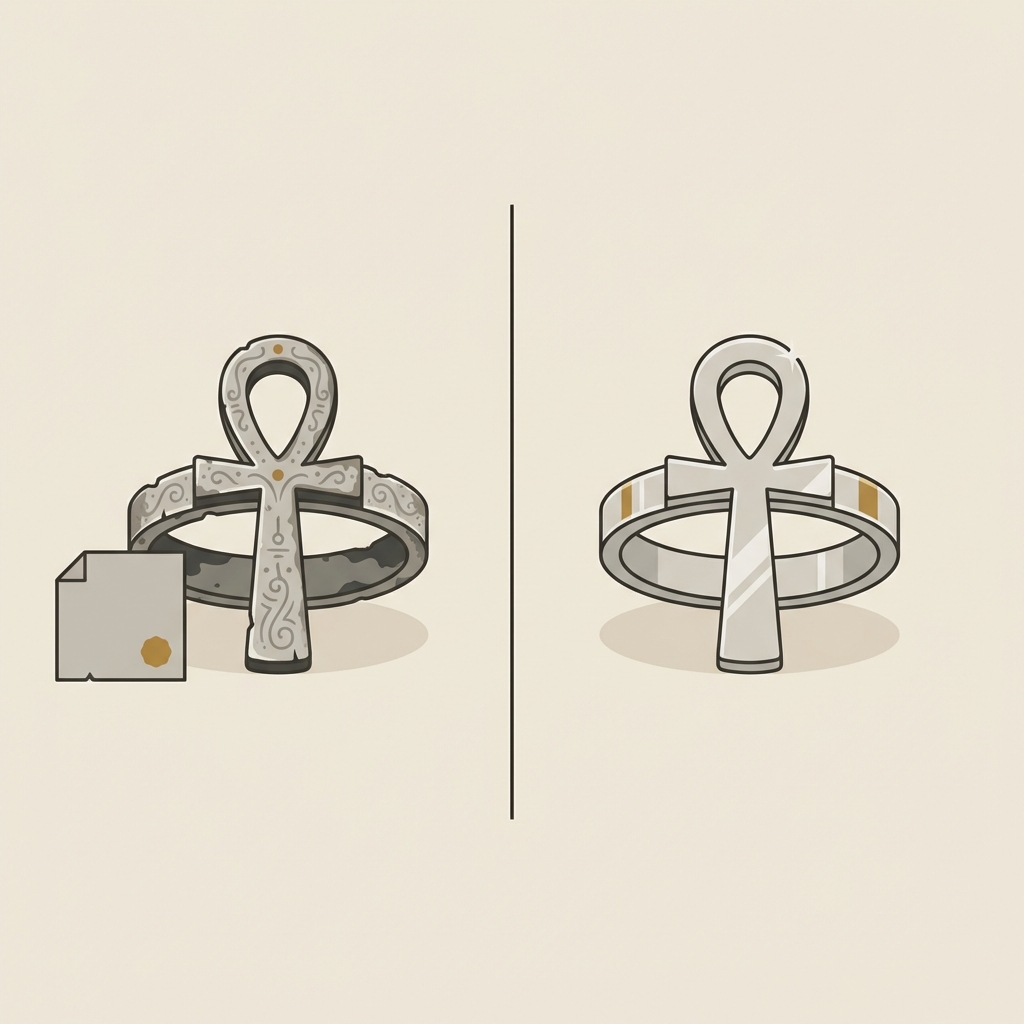
The ankh is widely understood in Egyptology as a symbol of life and vitality, often shown being presented by deities to rulers; its presence on jewellery can indicate protective or devotional intent depending on context.
No, silver does not by itself prove modern manufacture or ancient origin; silver mounts can be original, later remounts or modern, so provenance and technical evidence matter more than metal alone.
Avoid abrasive cleaning and household polishes; keep the piece dry, minimize handling and consult a trained conservator before attempting any cleaning or stabilization.
More from Aurora Antiqua
References
- Amulet of an Ankh, inv. no. 1894.103, Art Institute of Chicago
- 16 CFR 23.5, Misrepresentation as to silver content, Federal Trade Commission, eCFR
- https://www.assayofficelondon.co.uk/hallmarking/what-is-a-hallmark#convention, Goldsmiths' Company Assay Office
- Gesetz über den Feingehalt der Gold- und Silberwaren (FeinGehG, German law on gold and silver fineness), Bundesministerium der Justiz
- Hallmarking, The Assay Office Birmingham
- Protecting silver cultural heritage objects with atomic layer deposited, Heritage Science (Springer Nature)
- Silver and plate, Icon, The Institute of Conservation (UK)
- Archaeological materials, Icon, The Institute of Conservation (UK)
- Hallmarking Act 1973, UK Government, legislation.gov.uk (The National Archives)