


Looking for the real thing? Browse authenticated ancient artifacts, each piece one of one, individually authenticated, with documented provenance. For the background, see the guide to ancient jewelry.
Quick answer: what an ankh ring signifies and what this article covers (for readers scanning for 'egyptian rings')
For collectors of egyptian rings, the simplest, evidence-based summary is that the ankh is an ancient Egyptian hieroglyph and amulet most often translated as a sign of life and life-giving power; it commonly appears in temple reliefs and funerary art as a symbol offered by deities to confer vitality on rulers and the dead Encyclopaedia Britannica entry on the ankh.
This article helps you read ankh imagery on rings and other jewelry, and then walk through practical buying checks: how to evaluate provenance, read condition and restoration notes, compare typology, and ask the right questions of a seller.

Read this as a neutral, collector-focused guide rather than a definitive catalogue of every variant. Where relevant, it points to physical features and documentation that commonly help separate likely antiquities from modern reproductions.
Definition and historical context: the ankh in ancient Egypt (important for anyone researching egyptian rings)
The ankh appears in Egyptian texts and images as a hieroglyph that functions as a sign commonly translated as "life," and it also circulates as an amulet form carried or offered by gods in ritual and funerary contexts The Metropolitan Museum of Art overview of the ankh.
Scholars caution that the English word life does not capture all the ancient Egyptian meanings tied to the ankh; it often connotes vitality, regenerative power connected to the Nile, and divine life-force rather than a single Western concept of immortal soul. That nuance matters when you interpret iconography on an ancient ring or amulet.
The ankh is attested across multiple media, including carved stone reliefs, metal amulets, and jewelry, from at least the Old Kingdom through the Ptolemaic period, which helps explain why ankh motifs show up on a wide range of objects in museum collections and private hands British Museum collection overview.
When you encounter an ankh on a ring, remember it was both a written sign and a portable emblem; either function can influence its intended meaning and the likely period or workshop that produced it.
How the ankh functions in religious and funerary scenes (why context matters for egyptian rings)
In Egyptian iconography the ankh is frequently shown in the hands of deities or in scenes where life is being conferred on a ruler or participant, linking the sign to kingship and divine power as much as to a personal charm for everyday protection The Metropolitan Museum of Art overview of the ankh.
Academic syntheses emphasize that the ankh relates to concepts of renewal and life-force that operate alongside other Egyptian notions such as ka and ba, so the symbol is best read as part of a broader funerary and religious vocabulary rather than as a single, direct translation to "eternal life" British Museum collection and term entry.
Contextual clues in a depiction or object matter: who holds the ankh, what other symbols are present, and where the object was used or deposited can change interpretation and dating. For example, scenes where a deity offers an ankh to a pharaoh suggest state ritual and royal ideology, while small amulets with wear consistent with prolonged personal use may indicate private devotional practice.
Follow behind the scenes at @auroraantiqua for provenance and restoration insights
Download a one-page evaluation checklist to help you spot what to request from a seller; Aurora Antiqua presents this as a neutral tool to help collectors ask focused questions about provenance and condition.
For buyers, then, the lesson is practical: do not read ankh imagery in isolation. The surrounding iconography, the object type, and any associated documentation together point to the most plausible historical and cultural meaning.
Archaeological record and material forms: where ankhs show up and what that means for collectors of egyptian rings
Archaeological and museum records show the ankh in many materials and manufacturing techniques, from stone reliefs to cast metal amulets and inlayed or intaglio jewelry, making certain forms more common in some periods than others British Museum collection overview.
For collectors, the practical consequence is that material and making technique are important dating clues. A cast bronze amulet with uniform mold seams may suggest later mass production tendencies, while carved stone intaglios set into a bespoke hoop might better fit older workshop practices.
Late-period amulets sometimes show signs of more standardized manufacture, and scholars note that precise workshop-level attribution can remain uncertain for many such examples. That uncertainty is why physical evidence, comparative typology, and clear provenance combine to strengthen any claim about a ring’s age.
How ankh motifs appear specifically on rings: styles, variations and reading features (for egyptian rings shoppers)
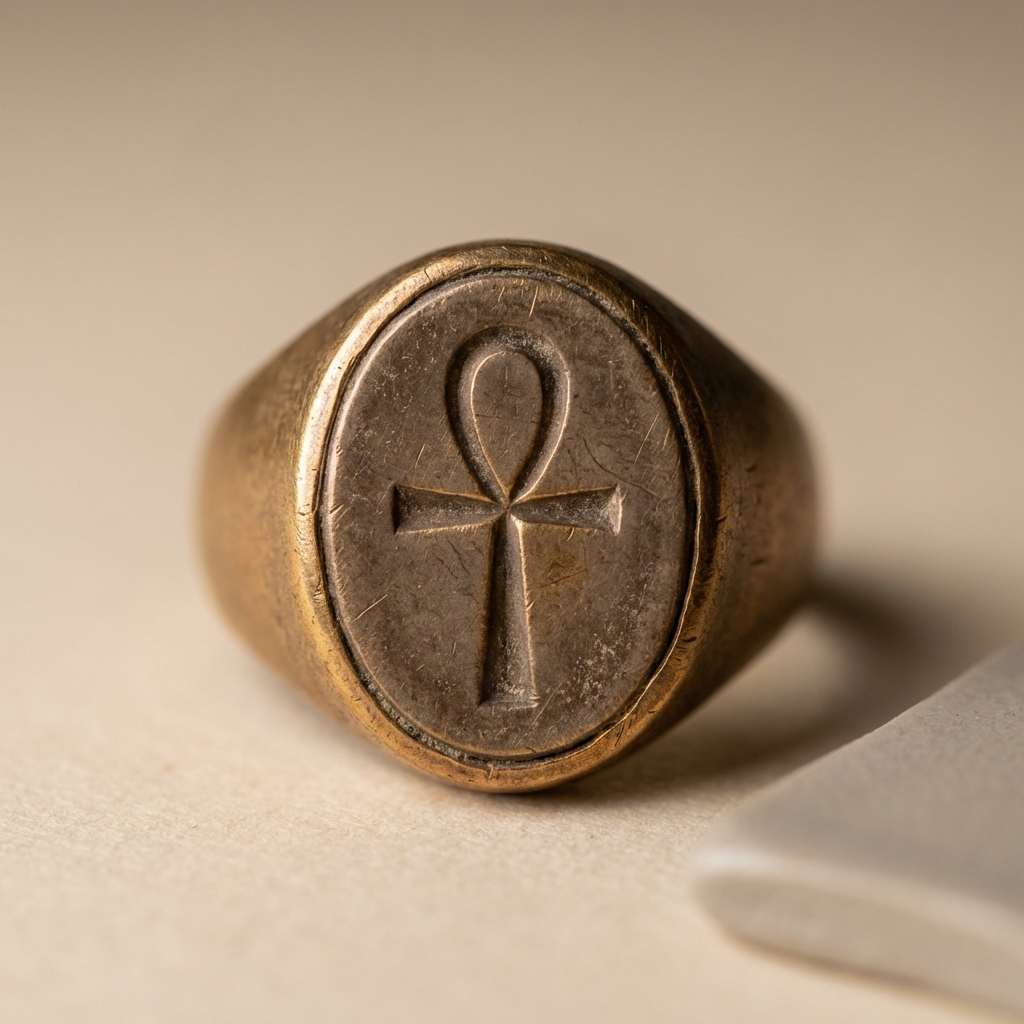
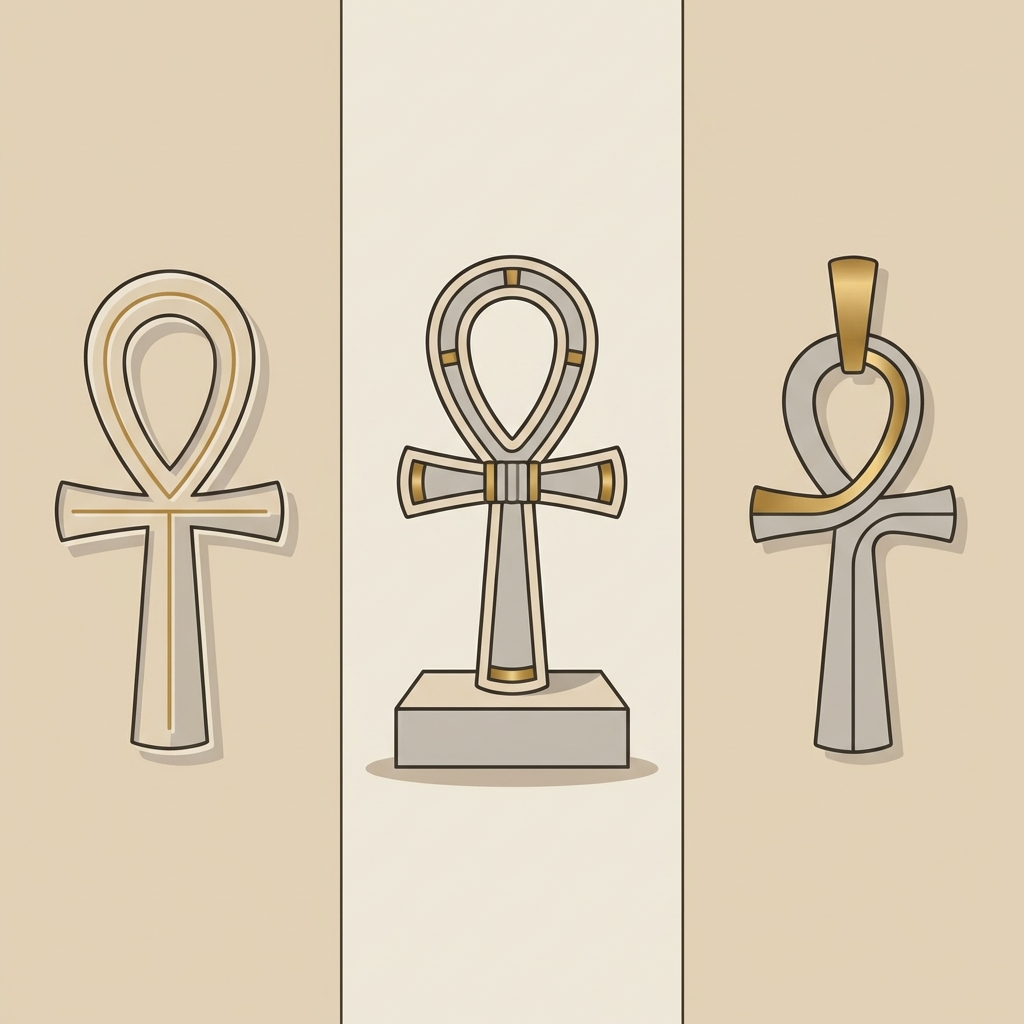
On rings, the ankh appears in several common ways: as an incised or carved intaglio set into a bezel, as a small applied or pierced mount on a hoop, or as a suspended charm. Each presentation carries different clues about likely date and function The Metropolitan Museum of Art overview of the ankh.
Bezel shape, hoop proportions, and shoulder treatment help specialists and experienced collectors read a piece. A wide, heavy hoop with simple shoulders can suggest an older repair or a later resizing; a thin, machine-cut bezel may indicate modern remounting or reproduction. Look for consistent tool marks and wear patterns across the ring to see if the setting and motif share age characteristics.
Historically, the ankh functions as a sign of life and regenerative power often associated with divine bestowal and funerary renewal; in collecting contexts its meaning depends on contextual clues, provenance, and material evidence, so careful documentation and ethical checks are essential.
Wear consistent with age, such as smoothing of high points, tool marks under the bezel, and naturalized patina in crevices, often indicates prolonged use, while sharp tool marks and bright metal surfaces might suggest later modern work or aggressive cleaning Smithsonian Magazine discussion of modern circulation of Egyptian motifs.
In photographs pay attention to the intaglio plane and edge junctions. If the ankh design appears carved into an older gemstone or faience and the bezel shows complementary weathering, that can be a positive signal; if the ankh sits atop a stone with modern adhesive visible, treat that as a cautionary sign.
Core evaluation framework: how to assess an ankh ring listing and documentation before you consider buying
Use a four-part framework that puts provenance and documentation first, followed by condition and restoration notes, comparative typology, and third-party reports. This order helps you prioritize what matters most when assessing egyptian rings UNESCO guidance on cultural-property and provenance.
Part 1, provenance and documentation: ask for collection history, prior ownership notes, certificates of export, or any customs paperwork. Part 2, condition and restoration notes: request written restoration disclosures and images of problem areas. Part 3, comparative typology: compare materials and styles with museum records. Part 4, third-party reports: seek independent conservation or authentication reports when value or risk justifies it.
A compact inspection checklist for initial listing review
Use for pre-purchase comparisons
Photographic evidence can be helpful but also misleading. Ask for controlled, scaled images: one full-shot of the ring on a neutral background, a macro of the ankh motif, shots of the inside of the hoop showing maker marks or repairs, and angled light images to reveal surface texture.
When you combine these four parts, you create a defensible, repeatable approach to evaluate any listing rather than relying on intuition or a single image.
Practical checklist and decision criteria: a buyer’s quick rubric for egyptian rings
Must-have listing elements: clear, measured dimensions; high-resolution photographs from multiple angles; condition notes describing any stabilizations or repairs; provenance or collection history; and any third-party reports or lab documentation UNESCO guidance on cultural-property and provenance.
Deal breakers include missing or contradictory provenance, photos that systematically hide key joins or interior surfaces, clearly modern tooling marks on the motif, and any documentation that indicates illegal export or unresolved legal claims. Strong positives include long collection histories, independent conservation reports, and transparent restoration notes.
Ask sellers to provide timestamps or additional views when a photo appears inconsistent. If the seller declines reasonable requests for more images or documentation, treat that as a signal to pause or walk away.
Condition and restoration notes: what to expect and what to ask about for an ancient ankh ring
Common conservation terms you will see include stabilized, repaired, replaced mount, left untouched, cleaned, and patina retained. Each term has practical meaning: stabilized usually means fragile components have been secured; repaired can range from careful solder repairs to replaced sections; replaced mount indicates the original setting was substituted; and patina retained signals that surface aging was left as found British Museum collection context.
Ask who performed any restoration, when it was done, and what materials were used. A professional conservator will usually provide a brief report; a vague line saying cleaned and repaired without details is less useful. Requesting this information helps you understand whether restoration focused on display, structural stability, or cosmetic improvement.
Restoration is not automatically negative. Well-documented stabilization can make a fragile piece safe to handle or wear. The important point is transparent disclosure: detailed restoration notes help you and future owners maintain provenance clarity.
Provenance, legality and ethical considerations when buying ankh rings
International guidance stresses avoiding items that lack verifiable legal provenance or clear export history. The Convention of 1970 and related cultural-property frameworks encourage buyers to seek documented ownership histories and export documentation before acquiring antiquities, including egyptian rings UNESCO guidance on cultural-property and provenance.
Useful provenance typically includes collection history with dates and prior owners, sale or exhibition records, export or customs paperwork, or independent verification letters. Even partial provenance can be valuable if it is consistent and documented rather than anecdotal.
Cultural-sensitivity matters when ancient symbols are reused in commercial design. Ethical collecting balances respect for cultural meaning, legal ownership, and transparent documentation. When in doubt, prioritize clear paperwork and consider whether a modern reinterpretation would better suit personal taste than purchasing an object of uncertain origin.
Common mistakes, red flags and scams to avoid when shopping for ankh rings
Frequent red flags include vague or missing provenance, photos that obscure details with shadows or heavy filters, inconsistent measurements between images and description, pressure language in listings, and implausible or overly dramatic provenance narratives. These elements are common in problematic listings About us, International Association of Dealers in Ancient Art.
Modern reproductions and fashion pieces can be misrepresented as ancient without clear documentation. If a listing uses broad claims like "ancient style" without provenance or uses contemporary tools in visible photos, treat it skeptically and request close-up images of joins and the interior hoop.
Practical verification steps include requesting additional high-resolution photos, asking for written provenance and restoration notes, and consulting comparative images from museum collections to see if the motif and mounting are consistent with known examples. See the museum search results for comparative typology museum records.
Practical examples and buyer scenarios: reading three hypothetical listings (ancient, vintage, modern)
Example A: Documented funerary-period ankh ring. Listing includes a clear chain of custody spanning a museum deaccession or an established private collection, a conservator report describing past stabilization, measured dimensions, and photographs showing matching wear on the intaglio and the hoop. In such a case, the combined evidence supports a plausible ancient attribution; still, confirm export documentation for legal clarity UNESCO guidance.
Example B: Vintage revival or late-period amulet-mounted ring. The piece shows stylistic cues of later manufacture or remounting: a remade bezel, a modern solder seam, or a stone that is consistent with nineteenth to early twentieth-century revival taste. The listing may include a well-documented private provenance but lack older export papers. Treat the object as collectible and historically interesting, but separate the claim of ancient production from documented revival work.
Example C: Modern fashion ankh ring. The listing asserts contemporary manufacture, uses modern hallmarks, and provides no provenance because the object is new. Ethical checks are simpler here: confirm materials and maker, and consider cultural-sensitivity in display. Modern pieces can be appropriate choices if you want the motif without the complications of antiquities.
Step-by-step buying checklist and next steps: how to proceed responsibly if you decide to buy an ankh ring
Pre-purchase checklist: verify listing details and measurements; request provenance and condition documentation; obtain high-resolution photos including interior hoop views; ask for written restoration notes; and seek a third-party report if the item is high value or uncertain.
Questions to ask the seller and professionals: Where did this piece come from originally? Can you provide export or customs documentation? Who performed any restoration and can you share a conservator report? Are there any prior sale records or exhibition history? Save all correspondence and receipts as part of the object’s provenance record.
After purchase, retain copies of all documentation and consider professional conservation advice for storage and occasional cleaning. Respectful display and accurate recordkeeping preserve both the object and its provenance for future owners.
Conclusion: key takeaways about meaning, buying safely and responsible collecting of egyptian rings
The ankh is primarily an ancient Egyptian hieroglyph and amuletic sign associated with life and divine life-giving power, but its precise meaning depends on context, surrounding imagery, and material evidence The Metropolitan Museum of Art overview of the ankh.
When considering egyptian rings, prioritize verifiable provenance, clear condition and restoration notes, and, where appropriate, third-party reports or conservator assessments. Ethical and legal checks help protect both buyers and source communities and make collections more defensible over time UNESCO guidance.
Continue learning by comparing listings to museum records, saving documentation, and asking sellers for transparent disclosures; treating objects with respect and curiosity helps preserve cultural context and collector confidence.
The ankh typically represents life or life-giving power in ancient Egyptian contexts; on a ring it may signal religious, funerary, or personal protective meaning depending on context and documentation.
Look for clear provenance, consistent wear and patina, detailed restoration notes, and comparative typology; request high-resolution photos and independent reports when in doubt.
Yes. Buyers should seek verifiable export and ownership documentation and be mindful of cultural-sensitivity and international cultural-property guidance before purchasing antiquities.
More from Aurora Antiqua
References
- Amulet of an Ankh, inv. no. 1894.103, Art Institute of Chicago
- The Fitzwilliam Museum, Amulet: E.281.1896, University of Cambridge
- scarabée ; amulette, Louvre site des collections, Musee du Louvre, Departement des Antiquites egyptiennes, Paris
- Conserve O Gram 10/2: Caring For Silver And Copper Alloy Objects, National Park Service, US Department
- About us, International Association of Dealers in Ancient Art
- Research report: export licensing and provenance, GOV.UK, Department for Culture, Media and Sport (DCMS)
- Federal Register, U.S. Customs and Border Protection, Department of Homeland Security
- Archaeological materials, Icon, The Institute of Conservation (UK)
- Fighting the illicit trafficking of cultural property, UNESCO