


Looking for the real thing? Browse our ancient artifact collection, each piece one of one, individually authenticated, with documented provenance. For the background, see the guide to ancient jewelry.
What is an egyptian ankh ring? Definition and context
The term egyptian ankh ring refers to a ring that features the ankh symbol, an ancient Egyptian hieroglyph and amulet most commonly associated with life, vitality, and ritual use in pharaonic contexts. Museums and encyclopedias summarize the ankh as a visual sign linked to concepts of life and the afterlife, and the symbol appears widely across temple reliefs, tomb scenes, and small personal objects held in collections Encyclopaedia Britannica.
On rings and other wearable pieces the ankh can appear as a full form, a simplified motif, or worked into an intaglio or bezel. Many surviving examples in museum collections are small personal amulets and jewelry that likely served as symbols of identity, ritual affiliation, or protective emblem on a wearer, and public facing museum histories tend to present those meanings in concise terms for general audiences The Metropolitan Museum of Art - Heilbrunn Timeline of Art History.
See curated pieces and provenance details on Instagram
Explore curated ancient rings presented with condition notes and provenance context to help you understand what you are seeing, and to decide whether wearing an antiquity fits your collecting goals.
In specialist literature the ankh is treated both as a hieroglyph and as a wearable amulet, so descriptions on display labels or in catalogues often combine linguistic, iconographic, and material observations to give a readable summary for visitors. When you encounter an ankh on a ring the museum label will typically note period, material, and likely use rather than offering a single definitive interpretation The Metropolitan Museum of Art - Heilbrunn Timeline of Art History.
Visual form and common materials
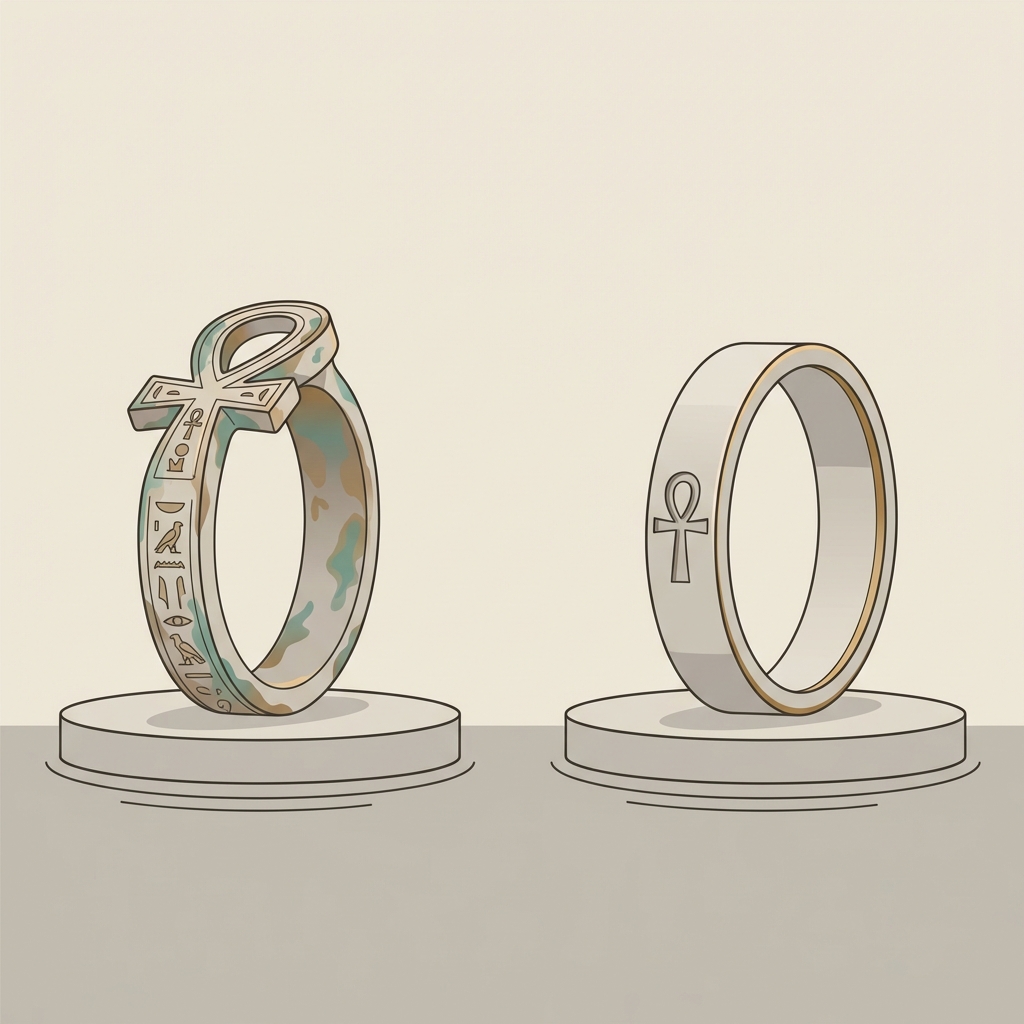
Ankhs on rings appear in varied techniques: cast or hammered metal rings with ankh terminals, intaglio seals where the ankh is carved in reverse on a stone, and inlaid motifs on plated or solid metal bands. Surviving pieces in collections are frequently metal-based, often copper alloy or silver in later periods, and sometimes set with stones like carnelian when they functioned as signet-like intaglios.
Descriptions in museum records will typically identify the material and construction and note wear consistent with age, which can be an important cue when evaluating a piece. Those condition notes help collectors understand whether an item is an intact ancient ring, a modern remake, or a restored object; always look for that level of detail in a listing or catalogue entry The Metropolitan Museum of Art - Heilbrunn Timeline of Art History.
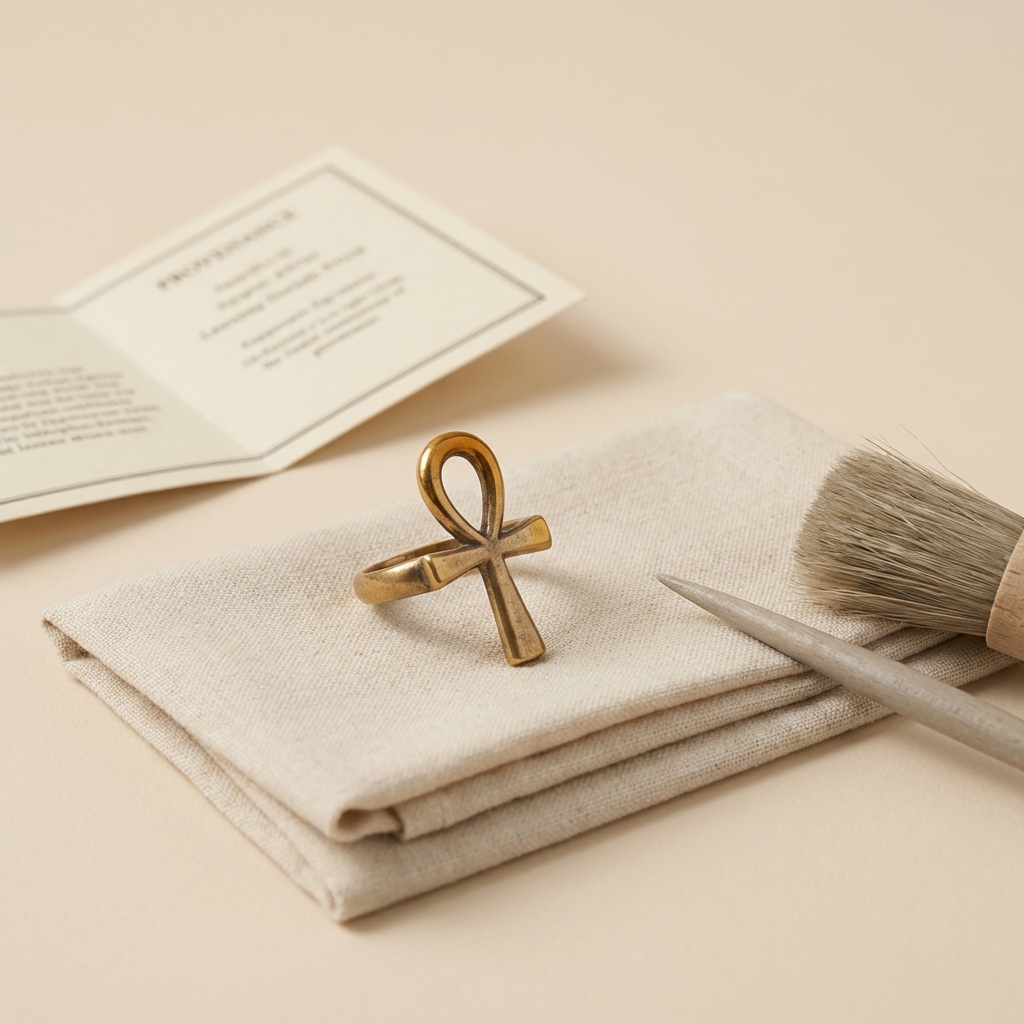
On rings and other wearable pieces the ankh can appear as a full form, a simplified motif, or worked into an intaglio or bezel. Many surviving examples in museum collections are small personal amulets and jewelry that likely served as symbols of identity, ritual affiliation, or protective emblem on a wearer, and public facing museum histories tend to present those meanings in concise terms for general audiences The Metropolitan Museum of Art - Heilbrunn Timeline of Art History.
The ankh is common in temple reliefs and tomb paintings, often held by deities or offered to pharaohs in scenes that underline life, regeneration, or ritual beneficence. On small personal objects, including rings and amulets, the sign can serve as a portable emblem that refers to those broader symbolic fields while functioning in everyday contexts. See also a Metropolitan Museum object discussion for a specific example Metropolitan Museum object.
Public summaries and museum overviews are deliberately concise, so they present the ankh’s association with life and ritual in accessible language. For deeper historical analysis, specialist Egyptological works consider how use, location, and accompanying iconography change what the ankh likely signified in a given object or scene Art Institute amulet.
Scholars emphasize that the ankh’s meanings are context dependent rather than a single fixed spiritual function across time and place. In ritual and temple contexts the ankh can be associated with divine life or the transfer of vitality, while in funerary scenes it may relate to regeneration and the afterlife; museum literature often highlights these associations without treating them as exhaustive explanations The Metropolitan Museum of Art - Heilbrunn Timeline of Art History.
How the ankh's meaning varies across time and context
Scholars emphasize that the ankh’s meanings are context dependent rather than a single fixed spiritual function across time and place. In ritual and temple contexts the ankh can be associated with divine life or the transfer of vitality, while in funerary scenes it may relate to regeneration and the afterlife; museum literature often highlights these associations without treating them as exhaustive explanations The Metropolitan Museum of Art - Heilbrunn Timeline of Art History.
When the ankh appears with gods or pharaohs it is commonly integrated into royal and divine iconography, and that placement affects how curators and scholars read the symbol. For instance, paired with specific deities or with royal titulary the ankh’s role tends to be framed in terms of status and ritual potency rather than as a generic everyday emblem Cambridge University Press.
Ritual, funerary, and royal iconography
In temple reliefs and tomb contexts the ankh is often part of structured scenes that include offering gestures, regalia, or funerary equipment. That means a ring with an ankh motif may refer back to the symbolism present in high status or ritualized images even when the object itself was owned and used by a private individual.
Dating and workshop attribution can change interpretation. A motif produced in a royal workshop or associated with a known tomb context carries different evidential weight than a variant from a later or provincial workshop, so curators and collectors routinely treat dating and provenance as central to how an object’s meaning is understood The Fitzwilliam Museum, Amulet: E.281.1896, University of Cambridge.
Why meaning is not a single fixed spiritual function
Because the ankh appears across genres of material culture and over long chronological spans, its specific function can vary widely. Scholars avoid reducing the sign to a single modern spiritual use and instead read it in relation to the object’s original iconographic program and archaeological context.
This contextual reading is why public-facing museum descriptions aim to be accessible while still noting uncertainty: short gallery labels cannot carry the full complexity of specialist argument, and good cataloguing will flag interpretive limits and evidence used for dating and attribution The Metropolitan Museum of Art - Heilbrunn Timeline of Art History.
Is it okay to wear an egyptian ankh ring? Ethical and cultural considerations
Short answer: it can be appropriate for some people in some contexts, and problematic in others. Contemporary commentary stresses that wearing sacred or cultural symbols can be insensitive depending on intent, context, and power dynamics; these discussions encourage reflection rather than blanket prescriptions The Conversation. For a general cultural-history overview see the National Park Service discussion of the symbol NPS page.
Wearing an ankh can be appropriate when you prioritize provenance, legal documentation, and respectful intent; if documentation or community guidance is lacking, choose a respectful reproduction instead.
One important distinction is between ethical questions about wearing a symbol and legal or heritage concerns about the object’s provenance. UNESCO and related heritage guidance focus on illicit excavation and trafficking of cultural property, so a responsible decision about wearing an ankh ring should consider both personal intent and the object’s documented history UNESCO - Cultural Heritage Protection.
Cultural sensitivity and appropriation debates
Reputable commentary notes that cultural appropriation assessments often depend on the wearer’s relationship to the community connected to the symbol, the context in which the symbol is displayed, and whether the representation distorts or disrespects original meanings. Asking whether one’s use is informed, respectful, and not exploitative is a constructive starting point for collectors and enthusiasts The Conversation.
Because local perspectives vary, community voices are essential to a full ethical appraisal. Where possible, consult written commentary from stakeholder communities or institutions that represent those perspectives rather than assuming a single answer applies across contexts Smithsonian Magazine.
Community perspective gaps and why they matter
Contemporary debate acknowledges that not all community views are widely published or uniform. Some voices may welcome informed interest, while others may see the public wearing of sacred symbols as trivializing. This diversity matters because it means collectors should avoid definitive ethical claims and instead seek local guidance when possible.
Practically, that may mean pausing before wearing a historically sensitive symbol in a setting where it could be misunderstood, explaining the object’s context if asked, and avoiding presenting the symbol as a mere fashion trope. Such practices help reduce the risk of causing offence and show respect for the complex cultural histories behind the motif The Conversation.
How to decide whether to wear an egyptian ankh ring: a practical checklist
Before you wear or buy, run a short checklist to evaluate context, provenance, and intent. Start by learning the symbol’s history and the object’s specific documentation, then reflect on how and where you plan to wear it. Practical decision making reduces risk and aligns your choice with ethical and legal norms UNESCO - Cultural Heritage Protection. For more on our approach see Aurora Antiqua on the web Aurora Antiqua.
Below is a compact, action oriented checklist you can use as a first filter. It is framed for collectors and history minded buyers who want to balance appreciation with responsibility.
- Learn the ankh’s common historical meanings and avoid simplifying them to a single modern spiritual use.
- Request detailed provenance, export permits, and any restoration notes from the seller.
- Assess your intent: educational, commemorative, aesthetic, or commercial. Be honest about audience and setting.
- When in doubt, prefer modern respectful reproductions or museum licensed replicas for everyday wear.
- Consult community perspectives when possible, and be ready to explain the object’s history if asked.
When to prefer a modern reproduction over an antiquity: choose a reproduction if you plan to wear the piece daily in active settings, if provenance is unclear, or if community voices advise against public display of original ritual objects. Reproductions allow expression of interest in ankh symbolism without contributing to market pressure on antiquities. You may also review relevant items in our rings collection rings collection for reproduction options.
Buying ancient ankh rings: provenance, legality and seller documentation
UNESCO and related heritage guidance emphasize stopping illicit excavation and trafficking, and they recommend acquiring pieces with clear export and import documentation alongside provenance records. That focus on legal and transparent collecting should be central to any purchase decision involving ancient rings UNESCO - Cultural Heritage Protection.
Ask sellers for specific provenance elements: collection history with dates, previous ownership notes, any export or customs paperwork, and laboratory or specialist reports if available. Reputable listings for ancient rings will include condition notes and restoration notes that explain what, if any, conservation work was performed and why. If you are looking at comparable pieces, see our ancient Roman rings collection ancient Roman rings collection.

Red flags to avoid include vague histories like "found in the region" without dates, no export or customs documentation where that would be expected, or sellers unwilling to share condition and restoration notes. A gap in documented collection history does not always indicate illicit origin, but it does increase uncertainty and should prompt further inquiry.
If a listing references institutional catalog numbers or prior exhibition history, ask for copies of those records. Verification letters and previous sale catalogues provide stronger documentary trails than short, undated statements in an online listing Encyclopaedia Britannica.
Caring for an ancient egyptian ankh ring: conservation and everyday use
Conservative care is the standard recommendation for ancient jewelry. Avoid aggressive cleaning, keep the object away from prolonged moisture and household chemicals, and store it in a stable environment with controlled humidity and temperature to reduce the risk of corrosion or material stress UNESCO - Cultural Heritage Protection.
Ask the seller for condition notes and any restoration notes before wearing an antiquity. If a seller or conservator reports stabilization or repair work, those notes will indicate limits on handling and any special storage or display needs. Follow the specific guidance provided rather than relying on general tips alone.
Conservative care is the standard recommendation for ancient jewelry. Avoid aggressive cleaning, keep the object away from prolonged moisture and household chemicals, and store it in a stable environment with controlled humidity and temperature to reduce the risk of corrosion or material stress UNESCO - Cultural Heritage Protection.
Do not use abrasive polishes or home remedies on ancient metals. Gentle dusting with a soft brush and storage in acid free materials are appropriate for many pieces, while more complex issues should be handled by a qualified conservator. For stones, avoid exposure to chlorine, high heat, or ultrasonic cleaners that can damage both settings and inlaid materials.
Limit wearing an antiquity during activities that risk impact or chemical exposure. For daily activities such as handwashing, gardening, or sports choose a durable modern ring instead of an ancient ring to avoid accidental damage to patina or structural elements of the antique.
When to avoid wearing an antiquity
Avoid wearing an ancient ring in humid environments, during travel situations where security and customs questions may arise, and in settings where the piece could be easily lost or damaged. If a piece is structurally fragile or has active corrosion, do not wear it until a conservator confirms it is stable.
If a listing includes restoration notes describing reassembled fragments or significant repairs, ask whether those treatments affect the piece’s stability under everyday wear. Sellers who offer clear restoration notes help collectors make informed choices about use and display.
Practical scenarios: modern styling, reproductions, and respectful alternatives
Choosing between an original antiquity and a high quality reproduction depends on your goals. If you prioritize wearing a durable piece daily, a modern reproduction or museum licensed replica is often the more responsible option. If you want wearable history and are prepared to accept limitations on use, an original can be appropriate with the right documentation and care The Conversation.
Scenario: private wear for personal reflection. If you wear an ankh ring in private for study or as a reminder of historical interest, provenance is still important, but public reception is less likely to be an issue. Scenario: public display at cultural events. If you plan to wear the symbol publicly, be ready to explain its history and the care taken to acquire it responsibly.
Prefer a reproduction when you want to avoid contributing to demand for potentially problematic antiquities, when provenance is unclear, or when your intended use involves everyday exposure to wear and tear. Reproductions can be made with respect for the motif while keeping original objects in safe, documented contexts such as museums or private collections.
When a reproduction is a better choice
Prefer a reproduction when you want to avoid contributing to demand for potentially problematic antiquities, when provenance is unclear, or when your intended use involves everyday exposure to wear and tear. Reproductions can be made with respect for the motif while keeping original objects in safe, documented contexts such as museums or private collections.
High quality reproductions or museum licensed pieces also allow you to learn and talk about the symbol without exposing a fragile antiquity to risk. Museums sometimes offer replicas or licensed reproductions that match the visual language of originals while carrying clear documentation about their modern origin Smithsonian Magazine.
How to style an ankh with historical awareness
If you wear an ankh motif, prepare a short, accurate statement that situates the piece: mention whether it is a modern reproduction or an ancient ring, note any provenance or restoration information, and avoid framing it as a generic fashion trope. Simple phrases like "This is a reproduction inspired by ancient Egyptian ankhs" or "This is an ancient ring shown with provenance and condition notes" convey care and context.
Avoid treating the ankh as an exotic prop. When asked about the symbol, explain that it is historically connected to various ideas about life and ritual in Egyptian art and that specific meanings depend on context. This kind of measured explanation demonstrates respect and historical awareness The Conversation.
Conclusions and responsible next steps
Key takeaways: the ankh is historically complex, meanings vary by context, and wearing one today can be appropriate if you prioritize provenance, legal documentation, and respectful intent. Conservative preservation and clear documentation are essential when an original antiquity is involved The Metropolitan Museum of Art - Heilbrunn Timeline of Art History.
Direct next steps include reading museum resources about the ankh, requesting provenance and restoration notes from sellers, and preferring reproductions if your intended use would put an antiquity at risk or if documentation is insufficient UNESCO - Cultural Heritage Protection.
a short provenance and etiquette checklist for prospective buyers
Keep records with images
Resources and further reading
Start with public museum overviews and trusted heritage organizations for baseline information, then follow up with seller provided documentation and specialist catalogues when considering a purchase. Museum pages and UNESCO guidance are useful starting points for understanding both symbolism and ethical collecting practice UNESCO - Cultural Heritage Protection.
When in doubt, prioritize transparency, ask for condition and restoration notes, and seek community perspectives before making definitive claims about meanings or appropriateness.
Many people can wear ankhs respectfully if they choose reproductions or ensure an antiquity has clear provenance and they act with awareness of the symbol’s cultural context.
Request collection history with dates, export or customs paperwork, condition and restoration notes, and any verification letters or prior catalogue references.
Avoid aggressive cleaning, limit wear during active tasks, store in stable humidity and temperature, and follow any seller or conservator restoration notes.
More from Aurora Antiqua
References
- Amulet of an Ankh, inv. no. 1894.103, Art Institute of Chicago
- The Fitzwilliam Museum, Amulet: E.281.1896, University of Cambridge
- scarabée ; amulette, Louvre site des collections, Musee du Louvre, Departement des Antiquites egyptiennes, Paris
- Ring, Victoria and Albert Museum, London
- Finger Ring with Frog, The Cleveland Museum of Art
- Research report: export licensing and provenance, GOV.UK, Department for Culture, Media and Sport (DCMS)
- Federal Register, U.S. Customs and Border Protection, Department of Homeland Security
- Emergency Red List of Egyptian Cultural Objects at Risk, International Council of Museums (ICOM), Paris
- Tensions and war undermine climate cooperation, but there’s a silver lining, The Conversation
- ANKH, Egyptian Symbol of Life, African Burial Ground National Monument, National Park Service