


Looking for the real thing? Browse our full ring collection, each piece one of one, individually authenticated, with documented provenance. For the background, see the guide to ancient jewelry.
eye of ra ring: names, motifs and why wording matters
The term eye of ra ring appears in many listings and conversations, but the wording matters because related motifs come from distinct traditions with different histories and functions. The broader belief in an evil eye, present across Mediterranean, Middle Eastern and South Asian cultures, describes a fear that a look or envy can cause harm and that amulets were used to protect against this threat, and that background helps explain why sellers and wearers often use similar language in listings Encyclopaedia Britannica on the evil eye.
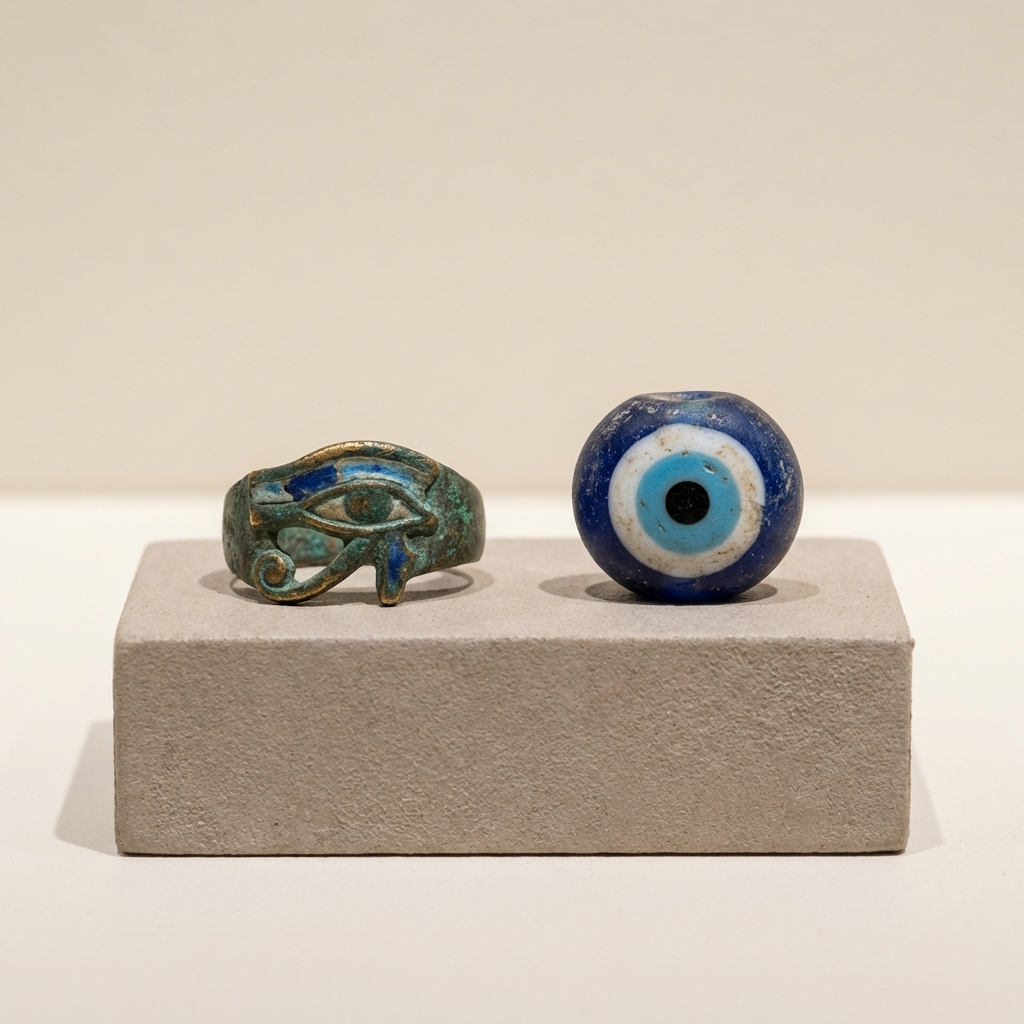
In practice, a buyer who reads "eye" on a label should expect that the phrase could mean a range of motifs, from Ottoman nazar glass beads to Greek mati pendants and to Egyptian protective eyes with very different ritual associations, so the exact term in a listing changes expectations about origin, date and intended function. That difference is important because a ring described as an eye of ra ring may evoke ancient Egyptian symbolism, while a listing that uses nazar or mati suggests more recent or regional folk traditions.
See behind the listings on @auroraantiqua
When you read a listing, check the provenance and condition notes early, since wording often signals the evidence the seller is relying on.
Common names and how they are used in listings
Collectors will encounter several names for similar looking motifs. Dealers and auction houses may use nazar, mati, wedjat, Eye of Horus, or simply evil eye, and those labels can reflect modern naming conventions rather than strict historical categories. Where possible, read the catalogue language to see whether the seller links the motif to a specific tradition or whether the label is shorthand without documentary support Encyclopaedia Britannica on the Eye of Horus.
Why conflating terms can mislead buyers
Conflating names flattens distinct histories and can mislead on dating and use: an Egyptian wedjat element found in funerary contexts has different associations to a Mediterranean talisman used to ward off envy, so a buyer who treats them as identical risks misunderstanding the object's cultural background. For meaningful attribution, names should be supported by provenance, object comparisons and clear condition notes rather than by marketing shorthand.
How museums and scholarship treat the motif: wedjat versus nazar
Museums and scholarly catalogues routinely separate the Egyptian wedjat, commonly called the Eye of Horus, from Mediterranean evil eye talismans because their origins and functions differ, and catalogue entries spell out those distinctions to avoid conflation. For example, museum pages describing Egyptian protective amulets outline funerary and healing roles that are distinct from the protective-bead traditions found elsewhere British Museum on wedjat and protective amulets.
Curators will often note that visual similarity does not equal shared origin or function, and museum object pages are useful starting points when comparing items described in commerce to named typologies in scholarship Metropolitan Museum of Art on Egyptian amulets.

Museum catalogue conventions
When reading catalogues, pay attention to headings like "provenance," "dating," and "condition" because they show the evidence base for an attribution. A confident workshop attribution or a precise period date will be supported by comparison and literature; a casual label without those supporting notes signals the need for caution and further enquiry.
Why curators separate Egyptian and Mediterranean traditions
Scholars separate traditions to preserve historical accuracy: the wedjat is tied to Egyptian religious practice and funerary magic and is treated as an Egyptian motif in museum descriptions, while nazar beads and similar Mediterranean objects are interpreted through folk-protection contexts. Distinguishing those lineages matters when assessing whether a ring was intended as an amulet for protective ritual or served a different decorative or symbolic purpose.
Is it socially acceptable to wear an evil eye or an eye of ra ring?
Wearing protective motifs is widely socially acceptable in many communities, and the visible use of an amulet can be an ordinary, culturally embedded practice in places such as Turkey, Greece and parts of South Asia; acceptability depends on local context and communal meanings Encyclopaedia Britannica on the evil eye.
Wearing such a ring can be appropriate when documentation and condition notes support a careful approach and when the wearer attends to cultural context and respectful use.
At the same time, public display of certain motifs in places where they carry active religious or communal significance can feel different from wearing them as fashion in contexts where that meaning is not present. Observing local use and, when appropriate, asking politely about the motif are prudent steps before wearing or gifting a ring that carries a recognizable symbol Smithsonian Magazine on contemporary use and endurance of the evil eye.
Regional differences in social acceptability
In Turkey and Greece a nazar or mati may be so commonplace that it is rarely read as a foreign or sensitive symbol, whereas an Egyptian wedjat motif displayed in a ritual or museum setting carries a different set of associations that may require more careful consideration. Regional practice matters for how others will interpret visible amulets and for how wearers should describe them to others.
Modern fashion versus local practice
Modern fashion adoption can separate an object from its original communal meanings over time, but that process varies and may be experienced differently by members of the source communities; consulting thoughtful cultural commentary helps avoid trivialising motifs that remain meaningful to many people Smithsonian Magazine on fashion and local practice.
Cultural sensitivity and etiquette when wearing symbolic rings
Respectful use means learning a little about the motif, avoiding trivialisation and asking recipients about their beliefs before gifting. Contemporary cultural criticism and museum guidance advise wearers to treat sacred or communal symbols with attention to context rather than as fashion-only items The Conversation on cultural symbols and respect.
If you plan to gift a ring or wear one in a social setting where the emblem has an active communal meaning, a short conversation that shows you have considered the background is usually appreciated and can prevent unintended offense. When in doubt, prioritize context and curiosity over novelty.
Do no harm: avoid trivialisation
Avoid casual or joking uses that reduce a motif to mere decoration in ways that may feel disrespectful to people who attach meaning to it. Simple practices like learning a correct term and noting whether an item is a modern copy or a historic object help keep the conversation substantive.
Gifting and asking about beliefs
When gifting, ask whether the recipient is comfortable with the symbol, and if relevant, explain what you understand about the piece and what evidence supports that understanding. Framing the gift as curiosity-driven and open to correction communicates respect.
Quick decision framework: Should you wear an eye of ra ring or similar amulet?
Three central questions help most decisions: what documentation supports the piece, what is the local or community context where you will wear it, and what is your intent in wearing the ring. Provenance and documentation can change how a piece should be described and whether wearing it is appropriate, so start with those points of evidence Encyclopaedia Britannica on the Eye of Horus.
Answering these questions in order creates a simple decision tree: if a piece lacks clear provenance or comes from an undocumented source, treat symbolic claims cautiously; if the motif has a living communal meaning in the place where you will wear it, prefer respectful inquiry; if your intent is to honour context and history, that affects how you describe and care for the piece.
Three questions to ask yourself
Ask: 1) Can the seller show provenance or documentation that ties the ring to a time and place? 2) Will wearing the symbol in your social environment respect local meanings? 3) Is your intent to learn about and acknowledge the motif or to use it solely as fashion?
When to choose context over style
If any answer points to uncertain provenance or active local significance, choose context and restraint. That might mean reserving the ring for private wear, asking about appropriate usage, or seeking additional documentation before public display.
Buying and wearing historic amuletic rings: provenance and condition checklist
For collectors, provenance, condition notes and restoration statements are practical safeguards that help contextualise origin and intended use; these elements allow a buyer to distinguish between a historic amulet and a modern decorative piece British Museum guidance on amulets and catalogue information.
When evaluating a listing, request clear collection history, prior ownership notes, any verification letters, and transparent restoration and condition notes. Those items are the most reliable indicators available in commerce for determining how to describe or wear a piece.
When evaluating a listing, request clear collection history, prior ownership notes, any verification letters, and transparent restoration and condition notes. Those items are the most reliable indicators available in commerce for determining how to describe or wear a piece.
Quick checklist to evaluate provenance, condition and intent when assessing an amuletic ring
Use responses to decide wearability and need for specialist input
What to look for in provenance and documentation
Look for precise statements such as a documented collection history, prior auction or museum references, and written verification from previous owners or specialists. Such evidence does not prove every detail but raises the confidence that a seller has considered the object history carefully Encyclopaedia Britannica on the evil eye.
How restoration notes affect interpretation
Restoration notes that list what was stabilised, repaired or left untouched indicate the conservator's assessment and help you judge whether the ring can be worn. A note that a ring was stabilised for safe wear implies limited, cautious use may be possible, whereas major structural repairs often suggest that display rather than daily wear is the safer option Encyclopaedia Britannica on the Eye of Horus.
How Aurora Antiqua frames listings for an eye of ra ring and related pieces
Aurora Antiqua positions itself as a curator and trust layer for buyers seeking wearable history, offering curated ancient rings spanning Roman, Greek, Byzantine, Islamic, Celtic, medieval, and post medieval periods and presenting provenance and documentation references when available. Listings typically include condition notes and restoration notes so buyers can see what was stabilised or left untouched.

On curated listings expect clear editorial context explaining iconography, suggested period attributions and conservative language about attribution when documentation is incomplete. Aurora Antiqua uses condition notes, restoration notes and provenance statements to help readers understand how the seller reached an attribution without implying certainty beyond the provided documents.
What buyers should expect in a curated listing
Good listings state measurements, photographs that show patina and wear consistent with age, and notes where a stone or bezel has been reattached or stabilised. Those details let a buyer assess whether a historic ring is a wearable artifact or better suited to careful handling and occasional display.
How editorial context is used to explain motifs
Editorial notes often explain whether a motif likely functioned as an amulet, a decorative emblem, or both in various periods. Clear phrasing that ties attributions to documented references and condition evidence helps buyers make informed choices without overreaching claims.
Common mistakes buyers make when evaluating 'evil eye' rings
A frequent error is conflating superficially similar motifs, for example treating a wedjat motif as equivalent to a nazar talisman; visual similarity is not a reliable guide to origin or function Metropolitan Museum of Art on Egyptian amulets.
Another common mistake is overreliance on marketing language without requesting provenance, condition reports or specialist input; asking for verification letters, clearer photos of areas like intaglio work and the bezel, and explicit restoration notes reduces the risk of misattribution Encyclopaedia Britannica on the Eye of Horus.
Conflating motifs and misreading visual cues
Intaglio carving, bezel style and patina offer clues about age and technique, but these visual cues need to be read alongside provenance. A well carved intaglio in a later mount is not the same as an in situ ancient setting, and patina consistent with age supports a claim only when tied to documented history.
Overreliance on seller claims without documentation
Seller statements about symbolism or period that are not backed by documentation should trigger follow up questions. Request condition notes and provenance details and, where necessary, consult with an independent specialist to interpret technical language in listings.
Practical wearing scenarios: what to consider in different settings
Daily wear of a historic ring requires confidence about structural integrity and sensitivity to context: a stabilized repair may allow limited occasional wear, but fragile bezels and thin hoops are at risk of damage with regular use Encyclopaedia Britannica on the evil eye.
In ceremonial or travel contexts, think about how the motif will be read locally. In regions where the symbol has strong communal meaning, public display can draw attention and responses that differ from wearing the same object at home. When travel is planned, consider reserving fragile or sensitive pieces for private viewing rather than public display Smithsonian Magazine on regional meanings.
Wearing in areas where the motif has strong local meaning
If you will be in a place where the symbol remains an active part of daily life, ask local contacts or hosts about norms and be ready to adjust your use. A short conversation that signals respect is usually much appreciated and helps avoid misunderstandings.
Care for altered or restored surfaces when wearing historically fragile pieces
Follow restoration notes about what was stabilised and how the piece should be handled. Conservators can advise on safe wearing conditions and on whether a ring should be tightened, padded, or reserved for occasional use to preserve its structure.
How to ask sellers about religious or cultural significance without causing offense
Use neutral, curious language when requesting provenance and symbolism. Ask for copyable evidence such as prior ownership notes, catalogue citations or verification letters, and phrase questions so the seller understands you seek context rather than a challenge Encyclopaedia Britannica on the Eye of Horus.
Three short, copyable questions help: 1) Can you share the collection history or prior ownership references? 2) Do you have any verification letters or catalogue citations for this piece? 3) Are there specific restoration notes that describe what was stabilised? These keep the conversation factual and respectful.
Sample questions to request provenance and meaning
Keep phrasing direct and neutral, for example: "Could you share the ring's collection history or any prior catalogue references?" or "Does a conservator report or restoration note accompany this object?" Those prompts elicit documentary evidence without implying mistrust.
Interpreting seller responses
If a seller provides clear documentation, use it to shape how you describe and wear the object; if documentation is absent, treat symbolic claims provisionally and prefer context-aware language when discussing the piece with others.
Conservation and wearability: when a historic ring is suitable to wear
Some stabilised repairs enable gentle, occasional wear, but many conservators recommend reserving altered or fragile rings for careful handling rather than daily use; specific restoration notes will indicate which approach is appropriate Encyclopaedia Britannica on the Eye of Horus.
When in doubt about wearability ask for a conservator's opinion, especially if a piece has metal fatigue, a thin hoop or a glued-in setting. A conservator's note clarifying the scope and limits of wearability is a useful addition to a listing and helps buyers manage expectations.
How restoration notes affect daily wear
Notes stating that a ring was stabilised for safe occasional wear suggest limited public use; statements that list major structural repairs often imply that the object is best reserved for display. Read these notes carefully and factor them into your decision about daily use.
Basic care recommendations for fragile pieces
Protect fragile ancient rings from knocks, moisture and chemicals, and consider using a soft insert or limiting wear to low-risk activities. When wearing any historic piece, handle it as you would a delicate artifact rather than as a modern, durable accessory.
Short case studies: three realistic buying or wearing scenarios
Scenario 1: A documented Roman intaglio ring accompanied by a clear collection history and a conservator's note allows the buyer to wear the ring with informed care because the provenance and condition notes explain how it was stabilised and what risks remain Encyclopaedia Britannica on the evil eye.
Scenario 2: A mass produced nazar-style ring marketed as vintage without documentation is a red flag; visual similarity alone is not enough to assert age or cultural authenticity, and the safe choice is to treat the object as a modern decorative piece unless evidence proves otherwise Smithsonian Magazine on modern production and endurance.
Scenario 3: A wedjat motif pendant sold without documentation calls for caution; because the Eye of Horus has specific Egyptian funerary and healing associations, lack of provenance changes how you should describe and wear the piece and suggests further enquiry before public display Metropolitan Museum of Art on the wedjat.
Summary and how to decide: wearing with respect and curiosity
Deciding whether to wear an eye of ra ring or a related amulet combines practical evidence with attention to context. Prioritise provenance, condition notes and conservative descriptions, and favour quiet inquiry and respect for living traditions when a motif remains meaningful to a community The Conversation on cultural respect.
When documentation supports a historic attribution and restoration notes allow safe wear, wearing a ring can be an act of informed curiosity; when evidence is absent, choose restraint, private use or further research before making the ring a public accessory.
Further reading and trusted starting points
Begin with institutional object pages and museum essays when you want reliable context for motifs. Museum catalogue entries for wedjat amulets and protective beads help distinguish origin and function and are a sensible first stop for research Encyclopaedia Britannica on the Eye of Horus.

For etiquette and cultural commentary, look to thoughtful essays that discuss when motif use becomes appropriation and how to respect living traditions. Use provenance and condition notes as the primary evidentiary basis for attribution rather than fashion articles that copy market language The Conversation on cultural symbols.
No. The Eye of Horus, or wedjat, is an Egyptian symbol with funerary and healing associations, while the evil eye describes a trans regional folk belief and talismanic practice; the two are separate despite sometimes similar visual elements.
If restoration notes indicate stabilisation for wear and a conservator has approved limited use, gentle daily wear may be possible, but many documented pieces are still best reserved for occasional use or private wear.
Request the ring's collection history, any verification letters or catalogue references, and full condition and restoration notes so you can assess origin, dating and wearability.
More from Aurora Antiqua
References
- Amulette contre le mauvais oeil, Persée, Echos d'Orient, later Revue des etudes byzantines
- Eye of Horus (Wedjat) Amulet, Egypt, Ptolemaic Period, Art Institute of Chicago
- Amulet with the wedjateye of the god Horus, Victoria and Albert Museum, London
- Garment, Cleveland Museum of Art
- Necklace (ashän ketab) with amulet pendants (tälsäm), Cleveland Museum of Art
- Talismans, Visitatori salutem, Szepmuveszeti Muzeum, Museum of Fine Arts Budapest
- Amulette grecque trouvée en Syrie, Persée, Revue des Etudes Grecques
- How Ancient Civilizations Reacted to Eclipses, Smithsonian Magazine
- EU law would require Big Tech to do more to combat child sexual abuse, The Conversation