


Looking for the real thing? Browse genuine ancient rings for sale, each piece one of one, individually authenticated, with documented provenance. For the background, see the guide to ancient jewelry.
Quick answer: is it appropriate to wear a snake ring today?
The short, balanced answer is: often yes, but it depends on meaning, context, and the object's condition. In many ancient and later sources the ouroboros, the snake biting its tail, is linked to cyclical time and renewal, so wearing an ouroboros snake ring commonly communicates those themes in a historically resonant way Encyclopaedia Britannica.
Short verdict and who this applies to, ouroboros snake ring
For collectors, museum-minded owners, and wearers who enjoy symbolic jewelry, a well-documented ancient or modern ouroboros snake ring can be an appropriate personal emblem when worn in secular settings and handled with conservation care.
That said, acceptability varies: if the ring is an antiquity, confirm provenance and conservation status before regular wear; if it is a modern piece, check materials for allergy risk and choose settings that suit your daily life The J. Paul Getty Trust.
Watch behind-the-scenes provenance and restoration stories on @auroraantiqua
Explore curated pieces that include condition notes and provenance so you can decide when and how to wear an ancient ring with confidence.
When public or formal contexts are at play-for example, ceremonies, places of worship, or community events-consider whether figurative animal imagery may be sensitive to others and choose discreet styling or reserve the piece for secular occasions Oxford Research Encyclopedia of Religion.
Immediate practical reminders: check product labelling for metal content, get a patch test if you suspect contact allergies, and do not wear an ancient ring in situations where loss or damage is likely until you have restoration and condition notes from the seller Contact dermatitis, NHS, NHS (National Health Service, England).
What the ouroboros motif is and where it comes from
The ouroboros, an image of a snake eating its own tail, is an ancient motif attested in Egyptian and Hellenistic sources and later adopted in diverse traditions; reference works summarize its long iconographic history and recurring association with cycles and unity Encyclopaedia Britannica.
Museums and collection catalogues discuss snakes and serpents as repeated motifs in jewelry and small objects, noting the materials and techniques used on rings such as cast bronze hoops, chased details, and occasional intaglio work set in bezels The Metropolitan Museum of Art collection overview.
In jewelry contexts, it helps to distinguish ouroboros imagery from more general snake motifs: the ouroboros specifically evokes the tail-biting posture and a concept of wholeness, whereas snakes shown in profile or paired forms can signal other meanings tied to protection, healing, or decorative taste.
Collectors and curious wearers often find that the same motif appears across materials and periods, from Egyptian amulet forms to Hellenistic bronze rings, so examining style, technique, and any inscriptions is the best route to narrow down date and intent The Metropolitan Museum of Art collection overview.

Common symbolic meanings of snake rings across periods
The ouroboros commonly represents cyclicity, renewal, and unity in many ancient sources, and this interpretation has been influential in later symbolic traditions as a shorthand for repetition and return Encyclopaedia Britannica.
Alongside that positive reading, snake imagery also carried protective or alchemical senses in some contexts, where the serpent could function as an emblem of transformation and guarded knowledge The Metropolitan Museum of Art collection overview.
A short iconography checklist to read a snake motif on a ring
Use as a quick guide when viewing a ring
Conversely, in some Christian textual and visual traditions, snakes could carry negative or cautionary associations, so reading a single ring requires attention to provenance and iconographic detail rather than assuming one universal meaning Encyclopaedia Britannica.
To interpret an individual piece, compare emblem posture and surrounding symbols, check for accompanying iconography such as alchemical signs or protective motifs, and consider documented dating and findspot to infer the most likely cultural sense.
Religious and cultural sensitivities: when a snake image can be sensitive
Some traditions practice forms of aniconism or discourage representational animal imagery, and scholarship indicates that sensitivity varies by community and historical circumstance, so wearing a figurative ring can be delicate in certain settings Oxford Research Encyclopedia of Religion.
Common signals that suggest extra care include places of worship, formal religious ceremonies, or community gatherings where figurative representations have known restrictions; in such venues, opt for discreet styling, cover the ring, or choose to leave it at home.
When in doubt, ask a host or a community contact, follow event guidance, or default to wearing the piece in secular environments where symbolism is less likely to be read as provocative.
Practical safety: materials, allergies, and everyday wear
Contact allergies, especially to nickel, are common and well documented; check product labelling for metal content, consider a metal patch test, and avoid prolonged skin contact with unknown alloys if you have a known sensitivity Nickel Allergy, DermNet, New Zealand.

If a ring is an antiquity, restoration and preservation notes can reveal whether modern solder, lacquers, or stabilizing coatings are present; ask the seller for these details because added materials can affect skin contact and long-term wearability The J. Paul Getty Trust.
Practical options for allergy-prone wearers include selecting acknowledged hypoallergenic alloys, applying a reversible protective barrier on the interior surface before occasional wear, or reserving the piece for short, symbolic use rather than continuous wear.
Buying ancient snake rings: provenance, legality, and due diligence
Buying an ancient snake ring responsibly requires clear provenance documentation and compliance with international cultural property standards; the UNESCO convention provides a baseline for lawful export and ownership concerns to watch for UNESCO convention text and guidance.
Good provenance information typically includes collection history, prior ownership notes, export permits where required, and any third party verification letters; major museum guidelines recommend tracing ownership back as far as possible and documenting gaps The J. Paul Getty Trust.
If documentation is absent or unclear, avoid wearing an antiquity publicly until a specialist or provenance researcher can clarify its export history and legal status, because lawful ownership is a key part of responsible collecting.
Care, conservation, and how to wear an ancient ring safely
Museum and conservation guidance favors minimal, reversible treatments for ancient metal rings and warns against household polishing or harsh chemicals that can remove patina or historical surface evidence The J. Paul Getty Trust.
For everyday precautions, limit exposure to water, lotions, and chlorine, remove the ring during strenuous activity, and store it on soft padding to prevent abrasion and knocks that can exacerbate existing damage The Metropolitan Museum of Art collection overview.
It can be appropriate in many secular contexts, but acceptability depends on the ring's provenance, materials, condition, and the cultural or venue-specific sensitivities; when in doubt, prioritize provenance checks, conservation advice, and discreet styling.
Ask sellers for restoration notes so you know what was stabilized, repaired, or intentionally left untouched; those notes help decide whether a ring can be safely worn and how often to use it The J. Paul Getty Trust.
If a ring shows unstable joins, loose insets, or active corrosion, consult a conservator before attempting to wear it, because interventions performed without specialist oversight can worsen the condition.
How to style a snake ring: modern looks and appropriate contexts
A statement snake ring can work well for social events, evening wear, or casual outfits where symbolic jewelry is welcome; let the piece's history be part of the conversation rather than trying to disguise its origin or style.
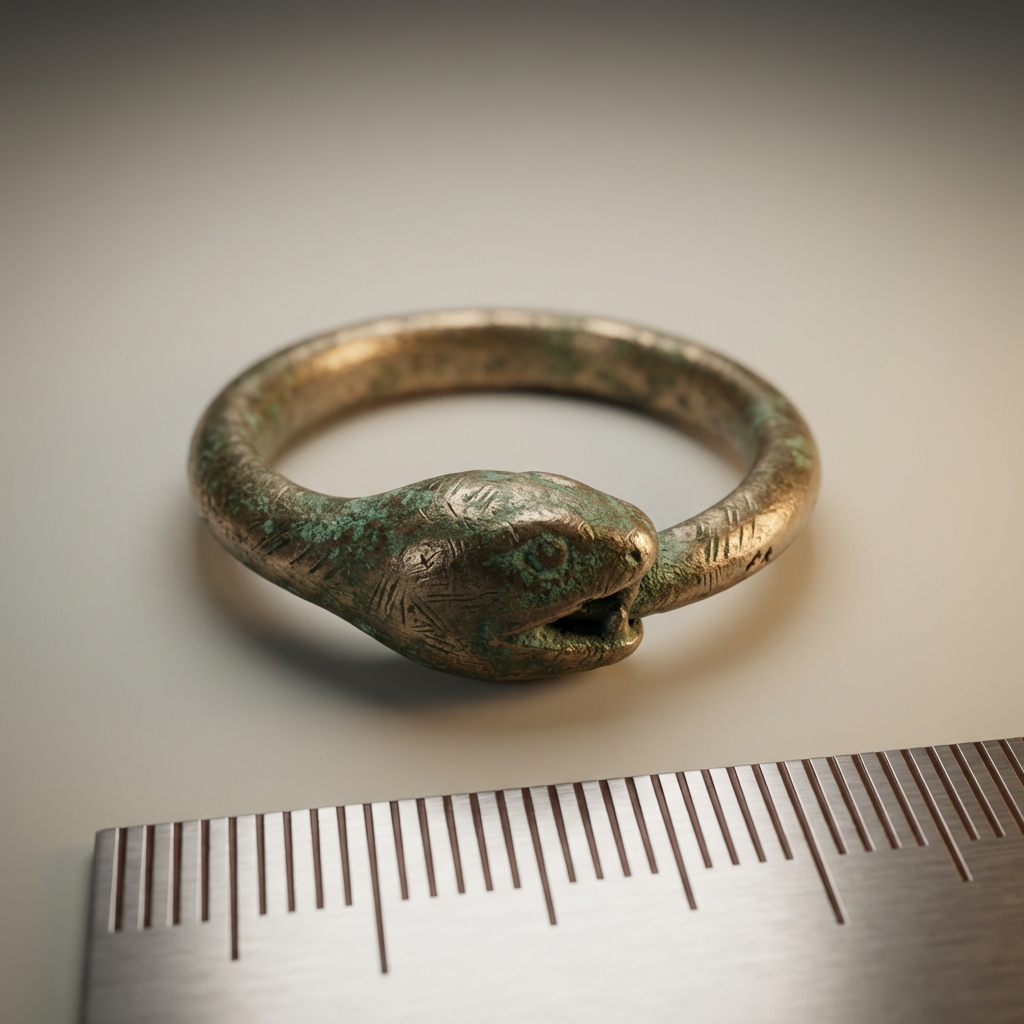
Pair an ancient ouroboros ring with simple contemporary pieces to let its motif read clearly: a single minimal chain, a neat cuff, or a plain band can balance the ring without competing for attention, and always check condition notes if layering might press against fragile elements.
For more formal or sensitive venues, choose discreet mounting options or wear a modern replica for everyday public use and reserve an original antiquity for private showings or controlled events.
Sizing, fit, and comfort for wearable antique rings
Accurate measurement is important because historic rings may have nonstandard proportions and narrow hoops that feel different from modern sizing; obtain an accurate finger size and compare internal hoop measurements rather than guessing by external look.
Resizing can be risky for ancient metals or complex constructions, so request restoration notes and a conservator's opinion before any modification. If resizing is advised, prefer reversible, minimal interventions and get a written record of what was changed The J. Paul Getty Trust.
When regular wear is planned, consider a removable internal sleeve or lightweight liner that improves comfort without altering the object permanently.
Typical mistakes and pitfalls when buying or wearing a snake ring
Common mistakes include accepting unclear provenance, ignoring restoration and condition notes, and assuming materials are hypoallergenic without testing; these oversights can lead to legal exposure, health problems, or preventable damage UNESCO guidance on cultural property.
Health oversights such as ignoring nickel allergy risk are frequent; if you or a recipient has a history of contact dermatitis, request material testing or avoid wearing the ring in prolonged skin contact until safety is confirmed Fact-sheet: Nickel, The Danish Environmental Protection Agency, Miljoestyrelsen.
Corrective actions are straightforward: ask sellers for provenance and restoration documentation, consult specialists for uncertain cases, and patch-test materials before regular wear.
Case scenarios and a decision checklist
Scenario 1: A modern gold snake ring bought new. Typical outcome: safe to wear daily after checking karat and any plating; confirm metals if you have sensitivities.
Scenario 2: An ancient ring with complete provenance and restoration notes. Typical outcome: often suitable for occasional wear in secular settings after conservator advice, with attention to patina and structural stability The J. Paul Getty Trust.
Scenario 3: An ancient ring with unclear export history. Typical outcome: do not wear publicly until legal status is clarified, and seek provenance research or postpone the purchase UNESCO convention guidance.
Printable checklist: Provenance present, Restoration notes provided, Metals tested for allergies, Venue sensitivity considered, Conservator consulted if unstable. Follow-up actions: safe to wear, wear with caution, or do not wear pending more information.
When to consult a conservator or specialist
Red flags that require professional assessment include unstable joins, active corrosion, loose insets, or unclear previous repairs; these signs mean a conservator should evaluate before you attempt to wear the piece The J. Paul Getty Trust.
Conservators, gemologists, and provenance researchers have distinct roles: conservators focus on condition and safe interventions, gemologists advise on stones and settings, and provenance researchers trace ownership history and legal status.
To find qualified help, ask museums for local conservator referrals, prepare clear photographs and any available documentation, and request written assessments rather than verbal assurances.
Concluding guidance: making a respectful, informed choice
Deciding to wear a snake ring should rest on four checks: the iconography and likely meaning, clear provenance, material safety for skin contact, and the object's conservation status Encyclopaedia Britannica.
Dos and donts: do request documentation and restoration notes, do patch-test metals if needed, and do consider venue sensitivity; dont wear uncertain antiquities publicly, dont attempt aggressive cleaning, and dont assume modern materials without verification The J. Paul Getty Trust.
With careful checking and respect for the object's history and potential cultural sensitivities, an ouroboros snake ring can be a meaningful and appropriate wearable emblem for many collectors and enthusiasts.
Resources and further reading
Encyclopaedia Britannica provides a concise overview of the ouroboros motif useful for initial context Encyclopaedia Britannica.
The Metropolitan Museum of Art's essays on snakes in ancient art and conservation perspectives are helpful for understanding how museums approach these motifs and their care The Metropolitan Museum of Art collection overview.
For provenance standards and lawful collecting, consult UNESCO's convention materials and major museum guidelines such as the Getty's provenance resources UNESCO convention text and guidance.
Not usually. Daily wear is possible only after confirming stable condition, documented restoration notes, and that the metal is safe for your skin; consult a conservator if the piece shows instability.
Ask the seller for metal composition, get a patch test through a dermatologist, or choose known hypoallergenic alloys or protective interior coatings before prolonged wear.
Request collection history, prior ownership notes, any export or permit paperwork, and third party verification letters when available; avoid items with unclear export histories.
More from Aurora Antiqua
References
- Contact dermatitis, NHS, NHS (National Health Service, England)
- Nickel Allergy, DermNet, New Zealand
- Fact-sheet: Nickel, The Danish Environmental Protection Agency, Miljoestyrelsen
- Black Dermographism: An Uncommon Cause of Skin Discoloration, PMC, Indian Dermatology Online Journal, DOI
- Evaluation of a two rubber band technique for finger ring removal, PMC, Annals of the Royal College of Surgeons
- How to Care For Your Jewellery: The Ultimate Guide by the National Association
- Archaeological materials, Icon, The Institute of Conservation (UK)
- Bronze disease, Conservation Wiki, AIC Wiki, American Institute for Conservation
- Fighting the illicit trafficking of cultural property, UNESCO