


Looking for the real thing? Browse genuine ancient rings for sale, each piece one of one, individually authenticated, with documented provenance. For the background, see the guide to ancient jewelry.
eye of horus ring: origin and core meaning
The phrase eye of horus ring refers to an object that bears the wedjat motif, a symbol that, in Egyptian religion, is closely tied to Horus and a narrative of injury and restoration. The wedjat originated in the Horus and Seth myth where the injured eye is healed, and the symbol became an emblem of restoration and protection in religious practice, not a marker of malice, as summarized in standard reference works on the subject Encyclopaedia Britannica. See also the Wikipedia entry.
In Egyptian texts and iconography the wedjat is commonly named and used with the explicit intent to protect life, bodily wholeness and safe transition to the afterlife. This practical meaning appears across periods and object types in museum and academic descriptions, where the symbol functions as amulet and sign rather than an accusation or curse UCL Digital Egypt.
Historically the wedjat functioned as a protective and restorative symbol; modern interpretations vary by cultural frame and personal intent.
The word wedjat itself signals a concept of completeness and being whole, and that etymological and textual linkage helps explain why the motif appears on objects meant to secure health and restoration for individuals and the dead. Egyptological treatments that survey religious practice continue to treat the symbol in protective and restorative terms rather than as a hostile sign British Museum Press.
How ancient Egyptians used the wedjat in amulets and jewelry
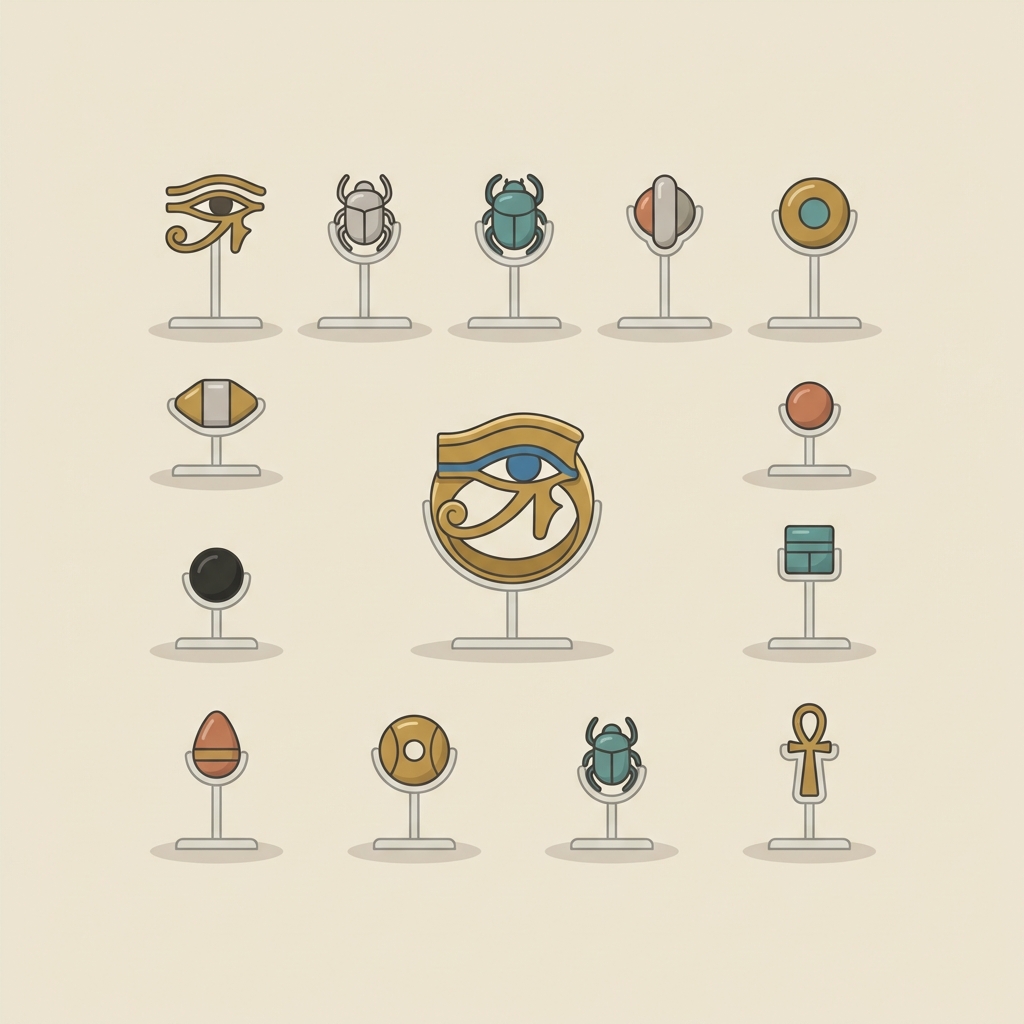
The wedjat appears across a broad spectrum of small objects: carved amulets, beads, inlays, ring bezels and funerary equipment where the symbol serves a protective and votive function. Museum catalogs and timelines show the motif on everyday items as well as objects intended for burial use The Metropolitan Museum of Art. A further discussion of the symbol in art and medicine appears in a specialized review PMC article.
On personal jewelry the motif could be set into a bezel or worn as a small pendant; in some cases beads or inlaid pieces carried the sign as part of an amulet group. These appearances across material culture underscore a long-lived association between the symbol and protective practice rather than any evidence of it being used to mark wrongdoing Encyclopaedia Britannica.
Museum collection pages and object records document examples spanning pharaonic periods, with clear descriptions that link the iconography to funerary equipment and votive deposits. The distribution of these finds, and the contexts in which they occur, point to a practical, apotropaic role for the motif in daily and mortuary practice British Museum collection pages. Recent academic discussions of udjat amulets and finds are also available in the archaeological literature.
eye of horus ring: what it meant to wear it then and what it can mean now
Historically, wearing a wedjat on a ring or other small object would likely have been understood as invoking protection, bodily integrity and safe passage-functions consistent across amuletic practice in ancient Egypt. The design's origin story with Horus and Seth explains why the sign is associated with healing and restoration in everyday religious thinking Encyclopaedia Britannica.
In the modern era the wedjat and eye of horus ring motifs are reused in a wide range of cultural contexts: fashion, popular culture, and as personal amulets. This reuse is often decorative, sometimes ritual, and occasionally contested; contemporary commentators note that ancient religious symbols can be reinterpreted with varied and sometimes conflicting meanings in the 21st century The Conversation.
Explore curated documentation and listing notes
Read curated listing notes and editorial context to understand an object's documentation and condition before you decide to wear it.
For collectors the continuity between ancient apotropaic intent and modern reuse means intention matters: a historic eye of horus ring can be treated as wearable heritage, a decorative motif, or a devotional object depending on the wearer and community. Where the piece is presented as an antiquity, emphasize provenance and condition rather than relying on the motif alone to establish origin or meaning The Metropolitan Museum of Art. For comparable items see our ancient Roman rings collection.
Is the Eye of Horus evil? Historical evidence versus contemporary concerns

Scholars of ancient Egypt do not classify the wedjat as an evil symbol; rather, the weight of Egyptological literature treats it as protective and restorative. Foundational studies and museum summaries demonstrate that the motif's primary functions were to secure well-being and safe passage rather than to threaten or harm others Encyclopaedia Britannica.
At the same time, modern viewers can and do reassign meanings. Some religious or cultural commentators, particularly in contexts sensitive to perceived occult or foreign religious imagery, may interpret ancient symbols like the wedjat as problematic. This divergence reflects differences in contemporary cultural frames and personal beliefs rather than a historical indictment of the symbol itself The Conversation.
Practical guidance for respectful wear begins with awareness: understand the symbol's origins, be prepared to explain your intent, and consider how a community you frequent might perceive an eye of horus ring. That approach balances historical evidence with sensitivity to modern responses and reduces the risk of unintended offense UCL Digital Egypt.
How to read an eye of horus ring listing before you buy
A well-written listing for an eye of horus ring should include clear photographs, measurements, a material description, condition notes and any restoration notes. It should also state provenance or collection history when known, and point to supporting documents if they exist. Museum and collection pages provide models for the level of detail that helps buyers assess a piece British Museum collection pages. See our rings collection for examples of listing presentation.

Look for listing language that specifies what was stabilized or repaired, what was left unrestored, and whether any professional conservation reports are available. Vague phrases or missing photos are legitimate reasons to request more information before purchase Encyclopaedia Britannica. You can also view our product page for the 'Celestia' ring Celestia as an example of a described listing.
Red flags include stock photography, absence of provenance statements, promises about value or investment, or overly broad assertions about age without supporting documentation. Prefer listings that are transparent about restoration notes and that offer to share documentation or high-resolution imagery on request British Museum collection pages.
A framework for deciding whether an eye of horus ring is appropriate for you
Start by asking why you want the piece: aesthetic appreciation, personal connection to the motif, devotional use, or as wearable history. Clarifying intent helps determine whether to seek a well-documented antiquity or a modern decorative piece The Conversation.
Next, consider community context. If you belong to a community where certain symbols can cause concern, weigh the potential responses and whether you are prepared to explain the ring's history and your reasons for wearing it. This step is about respect and situational awareness rather than censorship UCL Digital Egypt.
Finally, incorporate provenance and condition into your decision. If you prefer a piece with wearable heritage, insist on documentation; if you are comfortable with a modern reproduction as decoration, focus on materials and craftsmanship. Clear documentation supports ethical collecting and informed stewardship of antiquities British Museum collection pages.
What to check in provenance, condition and restoration notes for a ring
Provenance statements can take several forms: a clear collection history, prior ownership notes, a verification letter from a recognized authority, or references to museum or auction records. Each form adds different weight to the claim and should be read critically British Museum collection pages.
When restoration is described, look for straightforward terms: stabilized, consolidated, repaired, or left unrestored. Transparent sellers will describe what was done, who performed it if known, and why it was necessary; such notes help buyers assess condition and potential conservation needs Encyclopaedia Britannica.
Request essential provenance and condition documents before purchase
Ask for scans or high-res images
Requesting documentation is reasonable. If a listing claims museum provenance or a verification letter exists, ask to see it or for a clear citation; if a seller cannot provide basic documentation or clear photos, treat the claim cautiously British Museum collection pages.
Common mistakes and pitfalls when interpreting ancient symbols on jewelry
A common error is to assume modern meanings equal ancient intent. The presence of a wedjat motif on a piece does not, by itself, prove a particular date or function; archaeological context and documentation are necessary to support claims about age or purpose UCL Digital Egypt.
Another pitfall is over-reliance on stylistic appearance from photographs. Photos can mislead on material, wear consistent with age, or later repairs. If a listing lacks scale, multiple angles, or clear close-ups of the bezel and band, request additional images before deciding Encyclopaedia Britannica.
Watch for language that suggests certainty without evidence. Phrases like "definitely ancient" or broad age ranges without documentation are cause to ask for provenance details. A careful buyer prefers transparency and corroborating records over confident-sounding but unsupported claims Encyclopaedia Britannica.
Cultural sensitivity and ethical considerations for wearing ancient motifs
Modern reuse of the wedjat can raise appropriation concerns in some contexts. How reuse is perceived depends on the wearer, the objects documentation and the social or religious setting in which it is displayed. Sensitivity is a practical stance rather than a moral verdict The Conversation.
Simple acts reduce potential harm: learn the symbol's basic historical context, acknowledge provenance when known, and avoid asserting contemporary religious authority based solely on wearing an ancient motif. These steps help frame the object responsibly and transparently UCL Digital Egypt.
Restoration, preservation and what repairs tell you about a piece
Sellers commonly use specific terms to describe conservation: stabilized means the object was made safe to handle, consolidated indicates fragile material was strengthened, repaired notes joined broken parts, and left unrestored signals no intervention beyond cleaning. Understanding these terms helps buyers assess how intrusive a treatment might have been Encyclopaedia Britannica.
Some restorations are routine and appropriatestabilizing a loose bezel, securing an intaglio or consolidating corroded metal to prevent loss. Others can be more invasive and affect appearance and integrity. Ask for before and after photos or conservator reports when descriptions indicate significant work Encyclopaedia Britannica.
Practical examples and scenarios: reading three typical listings
Scenario A: A well-documented bezel. The listing includes a clear collection history, a verification letter scan, multiple high-resolution photos and a concise restoration note stating stabilization only. In this case, a buyer prioritizing wearable heritage can reasonably proceed after confirming shipping and insurance details British Museum collection pages.
Scenario B: Stylistically early-looking ring with limited provenance. A ring may display a convincing wedjat motif yet lack documentation or earlier collection references. Ask for close-ups, metallurgical testing if available, and a clear restoration history. If evidence remains inconclusive, consider purchasing for aesthetic reasons rather than claiming antiquity UCL Digital Egypt.
Scenario C: Modern reproduction sold as decorative. The seller labels the piece as modern but uses an ancient motif for decoration. Verify materials and construction; a modern-made eye of horus ring can be appropriate if you want a wearable symbol without antiquity claims. Distinguish reproduction from antiquity in your purchase decision The Metropolitan Museum of Art.
Caring for an ancient eye of horus ring: handling, storage and display
Handle sparingly and with clean hands; when surfaces are fragile consider gloves for brief handling. Avoid household chemicals and routine polishing that can remove patina or original surfaces that convey age and character Encyclopaedia Britannica.
Store in a stable environment with controlled humidity and temperature, use padded mounts or soft pouches to prevent abrasion, and keep items out of direct sunlight. For significant or fragile pieces, consult a professional conservator for specific storage and display guidance Encyclopaedia Britannica.
Summary: is the Eye of Horus evil? Key takeaways and next steps for buyers
Short answer: historically the wedjat and eye of horus ring motif functioned as a protective and restorative symbol in ancient Egypt; the academic and museum literature supports that reading rather than an interpretation of inherent evil Encyclopaedia Britannica.
Next steps for buyers: ask for clear provenance, verify condition and restoration notes, and reflect on personal and community intent when choosing to wear such a symbol. These practical actions help ensure respectful collecting and informed decisions Encyclopaedia Britannica.
No. Historical evidence shows the wedjat was used as a protective and restorative symbol in ancient Egypt; modern interpretations vary depending on personal or community beliefs.
Seek clear photographs, measurements, material descriptions, explicit restoration notes and provenance or verification letters when available.
Yes, if you learn basic context, acknowledge provenance, and consider how your community might perceive the symbol.
More from Aurora Antiqua
References
- Four Eyes of the God Horus (Wedjat) Amulet, inv. no, Art Institute of Chicago
- Eye of Horus (Wedjat) Amulet, Egypt, Ptolemaic Period, Art Institute of Chicago
- Bristol City Council : Museum Collections, Bristol Museums (Egyptology Collection)
- Amulet with the wedjateye of the god Horus, Victoria and Albert Museum, London
- Amulette contre le mauvais oeil, Persée, Echos d'Orient, later Revue des etudes byzantines
- Garment, Cleveland Museum of Art
- Faience Technology. In: UCLA Encyclopedia of Egyptology (Paul T. Nicholson), University of California, Los
- Don’t go changing: Stockdale still president as Liberals go for status quo, The Conversation
- Eye of Horus, Wikipedia
- PubMed Central