


Looking for the real thing? Browse authenticated ancient artifacts, each piece one of one, individually authenticated, with documented provenance. For the background, see the guide to ancient jewelry.
Quick overview: What we mean by an Eye of Horus nose ring
Short answer: an eye of horus nose ring, when attested in images or suggested by small ornaments, is most often read as a protective or health-related motif rather than a single, fixed social-status marker. Many statements rest on imagery and a small number of isolated finds rather than on large, securely provenanced series, so interpretations tend to be cautious in the literature Metropolitan Museum of Art overview.
Why this question matters for collectors: readers who seek ancient pieces or study iconography benefit from understanding the difference between what images can imply and what surviving objects can prove. The wedjat motif is widespread in Egyptian amulets, and when it appears near facial ornamentation it can suggest protective intent, but the archaeological record does not provide a simple, universal meaning. study iconography
See provenance and restoration details on @auroraantiqua
When considering any ancient facial ornament, prioritise clear provenance and detailed condition notes rather than short listing claims.
The practical point for buyers is straightforward: ask for documentation, clear photos and restoration notes, and treat claims about social role or ritual use as interpretative suggestions unless tied to solid provenance or comparative assemblages.
The wedjat (Eye of Horus): origins and symbolic range
The wedjat, commonly called the Eye of Horus, is one of ancient Egypt's most persistent protective symbols and appears on amulets and jewellery from the Old Kingdom through the Ptolemaic period. Museum collections record many examples that make this continuity visible across centuries British Museum wedjat collection entry. Beyond Beauty catalogue
Scholars generally connect the wedjat with protection, restoration and bodily wholeness. In funerary and everyday contexts the motif can function as a talisman against harm and as a sign of healed or preserved integrity, which explains its prominence on both worn jewellery and placed grave goods.
Materials and techniques for wedjat amulets vary, and surviving examples are made in gold, silver, copper alloys, faience and sometimes set with semi-precious stones; these material choices reflect both symbolic value and available technology in different periods Penn Museum research on materials.
The wedjat appears on amulets and jewellery
On personal jewellery the wedjat appears as standalone amulets, as intaglio designs on rings, and as small inlaid motifs on broader pieces. Its use on wearable objects links the symbol's protective meaning directly to the individual who wore it, whether in life or as part of funerary assemblages. personal jewellery
Because the wedjat is versatile, its presence alone does not fix a single reading; context, associated objects and wear patterns are all necessary to support stronger conclusions. When found alongside facial depiction or small facial ornaments in iconography, many Egyptologists favour a protective or health-related reading.
What the archaeological record actually shows about nose rings
Physical nose rings securely identified from pharaonic contexts are uncommon; most claims about nasal ornamentation rely on iconography and isolated objects in museum holdings rather than on large, well-documented series Metropolitan Museum of Art overview.
How common are physical nose-rings in the archaeological record?
It most plausibly functioned as a protective or health-related emblem in some contexts, but firm conclusions depend on context, provenance and comparative evidence; physical examples are rare and many interpretations rest on iconography.
Iconographic sources such as tomb paintings, reliefs and small sculptural depictions provide more frequent references to facial adornment than do securely provenanced physical nose-rings, and that discrepancy complicates frequency estimates and social attributions Journal of Egyptian Archaeology article.
Museum catalogues and collection notes can include items argued to be facial jewellery, but these objects often need careful contextual analysis; similar materials and manufacturing techniques appear in other small ornaments, so provenance and detailed condition notes are essential for confident identification. museum catalogues and collection notes
Materials, construction and design cues that suggest a nasal ornament
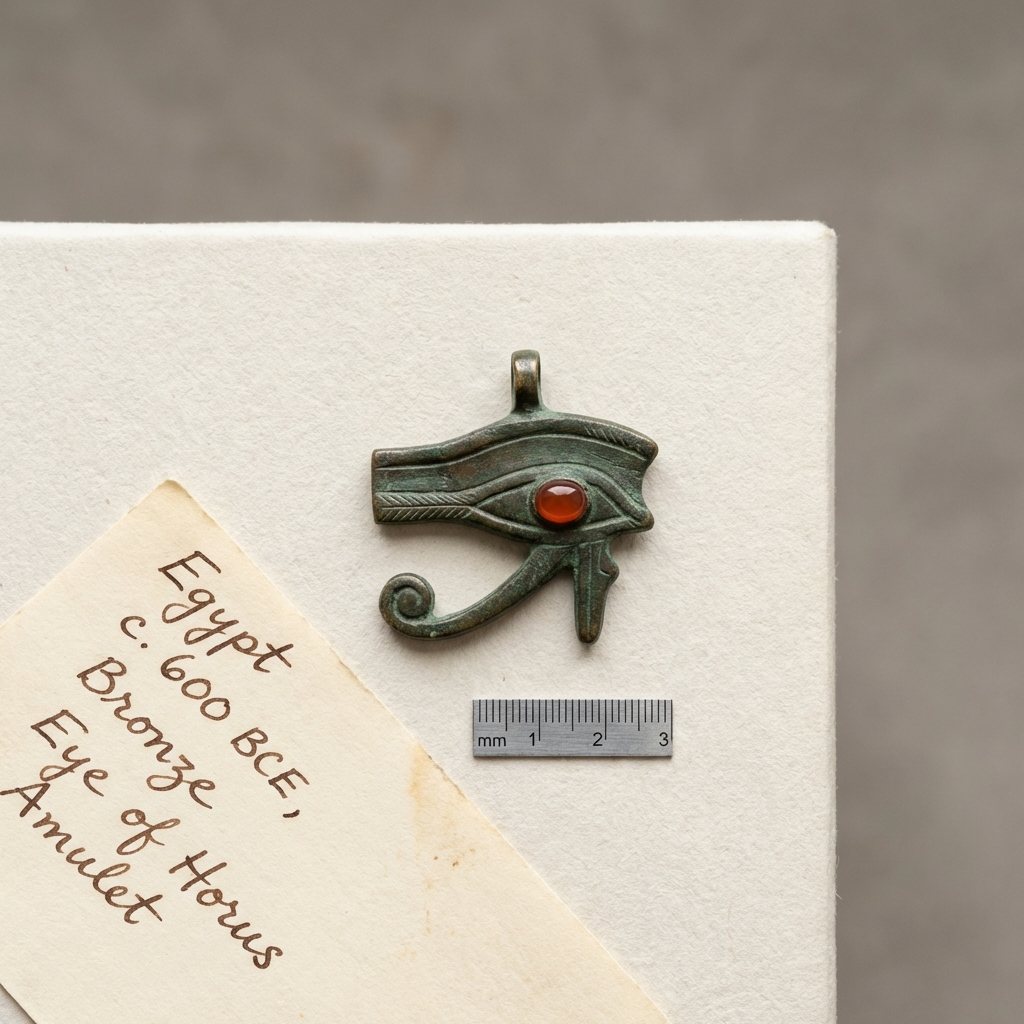
Materials recorded for small Egyptian ornaments in museum collections include gold, silver, copper alloys or bronze, faience and semi-precious stones, and these appear in pieces suggested to be facial jewellery Penn Museum research on materials.
Typical construction cues that can indicate facial use include very small hoop diameters consistent with nasal placement, delicate bezels sized for tiny inlays, and wear patterns suggesting contact with skin or textiles. Such features are suggestive rather than decisive without contextual information from excavation records or comparative assemblages.
Distinguishing a nasal piece from a tiny earring, pendant or amulet requires examining mounting traces, hinge or closure types, and any bending or abrasion consistent with facial wear; technical analysis and microscopy can help, but published catalogues and conservation reports are often the clearest source of such information technical analysis and microscopy.
How scholars interpret wedjat with facial adornment
When the wedjat motif occurs alongside facial or nasal adornment in imagery, many Egyptologists interpret the pairing as protective or linked to health and wholeness rather than as a single, uniform social-status marker Metropolitan Museum of Art overview.

Methodologically, scholars are cautious because small sample sizes, iconographic ambiguity and regional variation complicate confident, generalised claims. Alternative readings include ritual display, regional fashion choices, or funerary symbolism, and each requires its own supporting evidence.
In short, the wedjat's presence near facial decoration can indicate protection or a symbolic link to bodily wellbeing, but a single fixed meaning for every example is unlikely; context and provenance are decisive for stronger interpretations.
Dating, regional patterns and who might have worn nose ornaments
Questions remain about regional and chronological frequency because surviving physical examples are few and many interpretations rely on iconography rather than comparative assemblages Journal of Egyptian Archaeology article.
Hypotheses about social strata vary: some imagery implies formal or ritual contexts where facial ornamentation may be part of costume or funerary presentation, while occasional small finds could indicate personal adornment among a wider social range. Without larger assemblages, however, it is difficult to generalise about who routinely wore nose ornaments.
Readers should treat attributions of status or broad prevalence as provisional and look for well-documented grouping evidence or excavation records before accepting broad social claims.
Ethical collecting and legal responsibilities for buyers
The modern handling, purchase and display of ancient facial jewellery raises clear provenance and legal questions; buyers should request clear provenance documentation and follow UNESCO and museum guidelines UNESCO Convention guidance.
Due diligence checklist for buyers of small antiquities
Ask for originals or certified copies
Ask for collection history, prior ownership notes, verification letters and any export or import paperwork. If paperwork is missing, vague or inconsistent, consider declining the purchase or seeking independent documentation from specialists.
Following museum and legal best practice protects both buyers and source communities, and it helps preserve the object's context for future scholarship.
Reading listings: condition notes, restoration and provenance phrasing
When evaluating listings, check for clear, high-resolution photos, complete measurements, explicit condition notes and transparent restoration or conservation information; reputable sellers and catalogues will provide these details rather than relying on brief promotional copy About us, International Association of Dealers in Ancient Art.
Typical responsible restoration phrasing identifies what was stabilised, what was repaired and what was left untouched. Phrases like stabilised crack, conserving loose inlay or non-invasive cleaning can be helpful, while vague terms such as restored without specification are a red flag.
Other red flags include missing provenance, inconsistent paperwork, or assertive authenticity claims that lack supporting documentation. Where doubts remain, ask for condition reports or offer to consult an independent conservator or a qualified dealer who will discuss documentation rather than simply make declarative statements. contact
Common mistakes, myths and final recommendations
A common myth is that wedjat nose-rings have one fixed meaning; in reality protective and health-related readings are common but not universal, and many cases require contextual evidence to support stronger interpretations Metropolitan Museum of Art overview.
Before you buy or wear an ancient piece, use a short checklist: verify provenance, review condition and restoration notes, confirm materials, ask for museum or publication references if claimed, and request export/import paperwork when relevant. Treat dating and authenticity claims as provisional unless supported by documentation or specialist reports.
Collectors can benefit from the calm habit of documenting questions and responses in writing; this record is useful for future resale, scholarship or conservational needs and aligns with best practice in ethical collecting.
Iconography and a small number of objects suggest nose ornaments could carry symbolic or protective meaning in some contexts, but securely provenanced physical examples are rare and meanings vary by context.
Look for very small hoop dimensions, delicate bezels, wear consistent with facial contact and clear provenance or conservation reports; technical analysis can help but context is decisive.
Request collection history, prior ownership notes, any export or import paperwork, detailed condition and restoration notes, and high-resolution photographs.
More from Aurora Antiqua
References
- Bristol City Council : Museum Collections, Bristol Museums (Egyptology Collection)
- Four Eyes of the God Horus (Wedjat) Amulet, inv. no, Art Institute of Chicago
- Amulet with the wedjateye of the god Horus, Victoria and Albert Museum, London
- Gemstones. In: UCLA Encyclopedia of Egyptology (James A. Harrell), University of California, Los Angeles
- Exploring the Composition of Egyptian Faience (Falcone, Aquilino, Stoppa), Minerals (MDPI)
- About us, International Association of Dealers in Ancient Art