


Looking for the real thing? Browse authenticated ancient rings, each piece one of one, individually authenticated, with documented provenance. For the background, see the guide to ancient jewelry.
What the Eye of Ra means, quick definition and historical context
The term eye of ra ring describes instances where the solar, royal emblem associated with the sun god Ra appears as a motif on personal jewellery, most commonly on amulets and rings in pharaonic contexts. In many reference works the Eye of Ra is framed as a solar, royal and sometimes aggressive protective symbol, which differs in emphasis from the restorative meanings tied to the Eye of Horus, an interpretation supported by museum treatments of the motif Encyclopaedia Britannica entry on Eye of Horus.
To place the motif quickly, think of two related strands: one links the eye to the sun and royal authority, the other links the eye family of symbols to personal protection worn on the body or buried with the dead. Curators and Egyptologists use this distinction when cataloguing amulets and jewellery because it helps explain why similar iconography can carry different ritual emphases British Museum collection pages.
Collectors encountering an eye motif on a ring should therefore note iconography that suggests a solar disk or uraeus, which often points toward Ra associations, and contrast that with wedjat features that imply the Eye of Horus and a restorative function. Both eyes appear on personal jewellery according to museum object records, so presence on a ring alone does not settle meaning or date The Met collection entries on amulets.

Visual differences: how to tell Ra's eye from Horus's eye on a ring
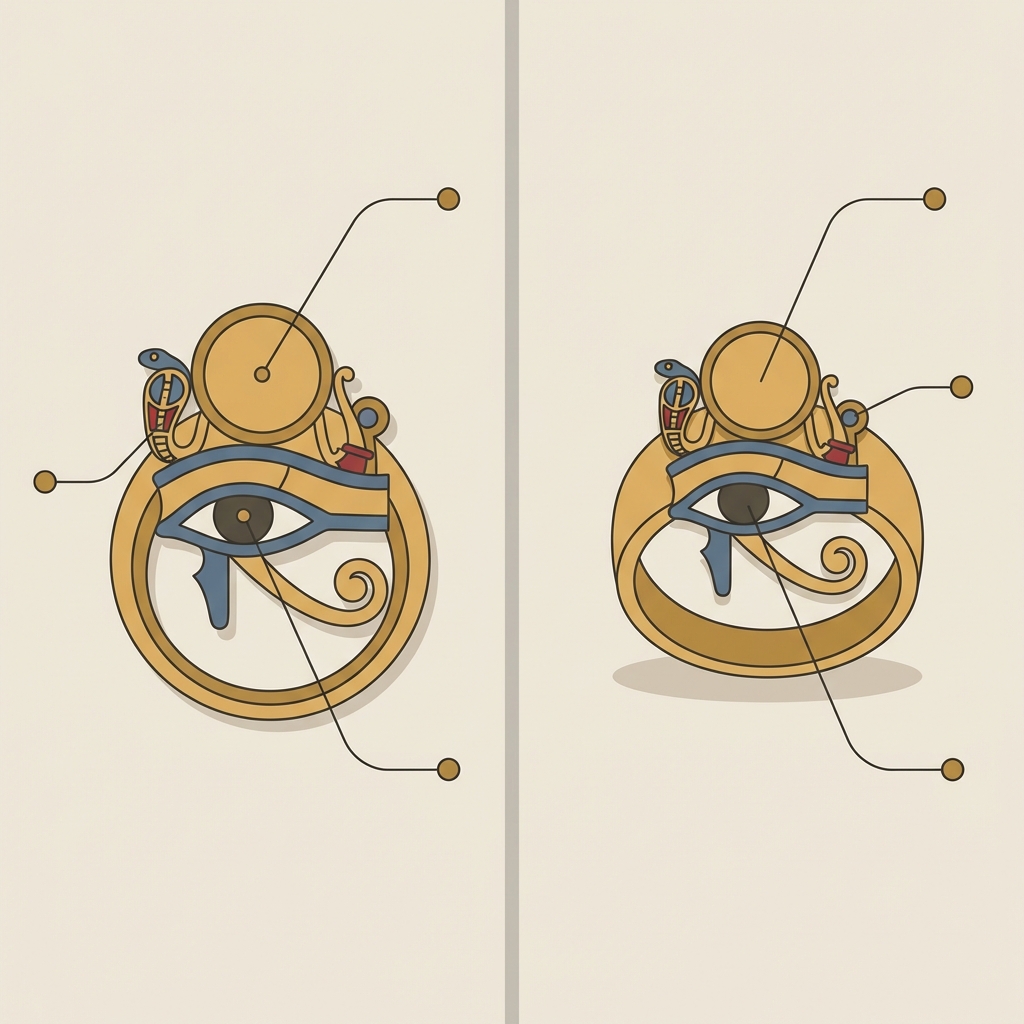
When you inspect an eye motif on an ancient ring, look first for solar attributes such as a disk, radiating elements or an accompanying cobra, the uraeus. Those additions can indicate a solar or royal reading that is typically associated with Ra; museum and reference descriptions frame Ra's eye in this solar-royal context Oxford Reference entry on Ra.
By contrast, the Eye of Horus or wedjat is often shown with features that signal wholeness and restoration, and it is frequently recorded on amulets intended to protect the wearer or aid in funerary contexts Encyclopaedia Britannica entry on Eye of Horus and the Wikipedia article on the Eye of Horus.
Small details change interpretation. For example, a carved intaglio set in a bezel that includes a small solar disk above the eye will lean towards a Ra reading, while the presence of standard wedjat elements such as stylised teardrop markings may indicate Horus. Because these elements sometimes overlap on compact ring surfaces, positive identification should be cross checked with provenance and comparanda rather than iconography alone British Museum collection pages.
Why ancient Egyptians wore eye symbols on rings and amulets
Both the Eye of Ra and the Eye of Horus appear in archaeological and museum records as motifs on personal jewellery where they likely functioned as wearable protection and as markers of social or religious identity The Met collection entries on amulets.
The contexts differ. Some eye amulets are clearly funerary, placed with the dead to ensure safety in the afterlife, while others show wear consistent with everyday use and thus served protective functions for the living. These parallel uses show how the same visual language could be adapted to private, practical needs as well as public or temple meanings Penn Museum guide on amulets and jewellery.
Collectors should prioritise clear provenance, detailed condition and restoration notes, high quality photos and, when necessary, specialist testing such as metallurgy or gem identification to support attribution.
The question for many collectors is whether the private, wearable use of a Ra-eye variant implies a different ritual role than the version used in temples, and in many cases that remains a specialised research question rather than something a single listing can resolve.

Aurora Antiqua presents curated ancient rings with condition notes and provenance-style descriptions so buyers can see the documentary context that accompanies a wearable antiquity. When an eye motif appears on a listing the supporting documentation and condition notes help explain whether the piece was likely intended as private protection, a status marker, or a later reuse of an older symbol.
Materials, manufacture and common ring forms that carry the Eye motif
Ancient Egyptian amulets and rings are commonly made in a small range of metals and set stones, often using stones such as carnelian and agate for intaglios and simple silver or gold hoops for mounts, as illustrated in museum records of jewellery and amulets Penn Museum guide on amulets and jewellery.

Intaglio carving, where the motif is carved into a hardstone and then set into a bezel, is a frequent technique for eye motifs on rings. Bezel forms protect the carving and create a flat surface for the motif, but they also limit how much detail can be visible at a glance, which complicates iconographic identification on small rings UCL Digital Egypt project on amulets. See Aurora Antiqua's blog entry on intaglio technique the intaglio rings article for related examples.
Metals and mounting choices affect both appearance and the kinds of tests a conservator might run. For example, silver and copper alloys show different corrosion patterns and may be subject to different metallurgical analyses, while the identification of a stone as carnelian rather than a modern substitute requires gemological inspection rather than iconographic reading alone Penn Museum guide on amulets and jewellery.
How to authenticate an ancient Eye of Ra ring
Authentication rests centrally on clear provenance and documentation, including collection history and any available verification letters, rather than on iconography alone; museum-oriented guides and specialist catalogues consistently emphasize documentation as the primary evidence for attribution Penn Museum guide on amulets and jewellery, and further discussions of authentication debates are available in a Getty publication on forgeries and authentication.
Scientific testing can strengthen an attribution where documentation is incomplete. Common approaches include metallurgy for metal rings, gem identification for intaglios, and where applicable thermoluminescence for fired components; these tests supply material evidence that complements provenance notes and expert assessment UCL Digital Egypt project on amulets.
See documentation examples on @auroraantiqua
For guidance on documentation practices and editorial resources, consider Aurora Antiqua's approach to condition notes and provenance summaries as a model for the type of information to request from any seller.
Iconography by itself is insufficient for a firm authenticity judgement. A ring that looks like it bears a Ra eye may be ancient, modern, or restored, and only the combination of clear provenance, condition notes, and targeted laboratory testing commonly gives collectors the confidence needed to proceed.
Reading condition and restoration notes for wearable ancient rings
Condition notes in professional listings typically describe what was stabilised, what repairs were undertaken, and what was intentionally left untouched, language that helps buyers judge the degree of intervention the object has experienced Penn Museum guide on amulets and jewellery.
Patina and consistent surface wear can indicate age, but their presence alone does not prove antiquity; documented repairs, modern adhesive residues, or inconsistent tool marks are signals to query further. Good listings include close photographs of mounts, shoulders and the underside of bezels so wear patterns can be evaluated visually before purchase.
Provenance, documentation and how to check museum records
A useful provenance entry typically lists prior ownership, collection history, acquisition circumstances and any verification letters or expert opinions, plus clear photographs and measurements that match the written record. These elements create a narrative that can be compared with museum entries and collection essays to test plausibility The Met collection entries on amulets.
Museum object pages are practical comparanda because they often include typological notes, material descriptions and accession numbers that help place a motif in a broader corpus. Use museum records to check iconographic and technical parallels rather than to certify a private item automatically British Museum collection pages.
Quick fields to check on a museum object entry when using it as a comparandum
Look for accession and provenance entries
When comparing a listing to museum comparanda, note differences in recording standards. Museums typically provide controlled object IDs and measured dimensions, while private listings sometimes omit these details; such omissions are valid reasons to request more documentation before purchase.
Decision checklist for collectors buying an Eye of Ra ring online
Use a short step by step checklist when you first view a listing: 1 identify whether the listing states prior ownership or a collection history, 2 confirm clear scale and measurements, 3 review condition and restoration notes, 4 check for photos showing the underside and shoulders, 5 ask for any lab reports or specialist opinions, 6 compare the motif to museum comparanda Penn Museum guide on amulets and jewellery.
Recommended seller questions include requesting high resolution detail photos, written restoration descriptions, the name of any conservator involved, and scans or transcriptions of provenance documentation. If these items are unavailable or vague, pause and seek an expert opinion rather than buying on impulse.
Typical mistakes and red flags when assessing ancient eye rings
Overreliance on iconography is a common pitfall. A motif that resembles the Eye of Ra can be a modern reinterpretation or a recent carving on an old mount, so iconography must be balanced with documentation and material testing UCL Digital Egypt project on amulets.
Other red flags include missing measurements, vague restoration notes, lack of clear provenance, and sellers who refuse reasonable requests for additional photos or documentation. These gaps often indicate either incomplete records or a higher risk purchase that deserves independent scrutiny.
Practical examples and short case studies
Museum comparanda teach what to expect. For instance, comparison with well-documented amulet rings in museum collections can show the typical scale and carving depth of ancient intaglios, which helps distinguish a heavy modern carving from a shallower ancient technique The Met collection entries on amulets.
Scenario one: a listing shows a small bezel-set intaglio described as an eye motif with a short provenance note and clear photos. Apply the checklist, ask for detailed measurements and any lab reports, and compare with museum examples before offering a deposit. Scenario two: a ring marketed with dramatic claims but without supporting documents or high resolution images should prompt a pause and likely an expert consultation.
How modern designers use the Eye of Ra and how that differs from ancient usage
Contemporary jewellery makers often use the Eye of Ra for themes of protection, power and solar symbolism. These modern uses are culturally resonant but represent layered meanings rather than direct continuations of ancient religious function Penn Museum guide on amulets and jewellery, and readers can see a recent review of modern jewellery using the motif in a jewellery review.
Buyers should expect clear disclosure when a piece is modern, a reproduction or inspired by ancient motifs. If authenticity is important, prioritise listings that provide provenance, condition notes and laboratory testing over marketing language that emphasises symbolism without documentation.
Caring for an ancient ring, handling, storage and conservation considerations
Handle ancient rings gently and avoid aggressive cleaning. Conservators advise minimal intervention for stable pieces and professional assessment for fragile or corroded items, since improper cleaning can remove evidence useful for later testing or provenance verification UCL Digital Egypt project on amulets.
Document condition on receipt with dated photographs and maintain stable storage conditions away from humidity and strong light. For high value or fragile items consider a professional condition report and appropriate insurance to support future conservation and provenance records.
When to seek expert evaluation or laboratory testing
Tests that commonly help include metallurgy for metal rings, gem identification for intaglios, and thermoluminescence for fired components where relevant. These methods provide material evidence that complements provenance and can reveal inconsistencies that merit further inquiry UCL Digital Egypt project on amulets.
Expert opinions rarely produce absolute certainty, but they do increase confidence when combined with clear documentation and condition notes. Commissioning tests is most practical when an object has clear commercial or scholarly importance and when the results would change a buying decision or conservation approach.
Conclusions, what an Eye of Ra ring likely meant and what to watch for when buying
In summary, the Eye of Ra is best understood as a solar, royal and protective emblem distinct in emphasis from the restorative Eye of Horus, though both motifs appear on rings and amulets in museum records Encyclopaedia Britannica entry on Eye of Horus.
Authentication depends on provenance, condition and, where appropriate, scientific testing rather than on iconography alone. Practical next steps for collectors are to request documentation, ask specific questions about restoration, and seek expert input when doubts remain Penn Museum guide on amulets and jewellery.
The Eye of Ra is associated with solar power and royal authority while the Eye of Horus emphasises restoration and protection; both may appear on personal jewellery but carry different ritual emphases.
Request clear provenance notes or collection history, high resolution photos showing all angles, explicit restoration records, measurements, and any laboratory reports or specialist opinions.
No, iconography alone is not sufficient; authentication relies on documentation, condition notes and, when needed, scientific testing and specialist evaluation.
More from Aurora Antiqua
References
- Four Eyes of the God Horus (Wedjat) Amulet, inv. no, Art Institute of Chicago
- Amulet with the wedjateye of the god Horus, Victoria and Albert Museum, London
- Finger Ring with Frog, The Cleveland Museum of Art
- Faience Technology. In: UCLA Encyclopedia of Egyptology (Paul T. Nicholson), University of California, Los
- Gemstones. In: UCLA Encyclopedia of Egyptology (James A. Harrell), University of California, Los Angeles
- Scarab. In: UCLA Encyclopedia of Egyptology (Kathlyn M. Cooney), University of California, Los Angeles
- The Fitzwilliam Museum, Amulet: E.281.1896, University of Cambridge
- Emergency Red List of Egyptian Cultural Objects at Risk, International Council of Museums (ICOM), Paris
- Eye of Horus, Wikipedia
- The Getty Kouros Colloquium