


Looking for the real thing? Browse authenticated ancient rings, each piece one of one, individually authenticated, with documented provenance. For the background, see the guide to ancient jewelry.
What marks inside a gold ring are for and why they matter
When you inspect a gold band you may find a sequence of tiny marks, letters or numerals stamped on the inner face of the hoop. These marks serve different practical purposes: they can indicate the metal fineness, name the maker or sponsor, mark the assay office that checked the metal, or record a date letter used in some national systems. A clear first step for any reader is to recognise the usual categories so you know what to record and why it may matter for condition and provenance.
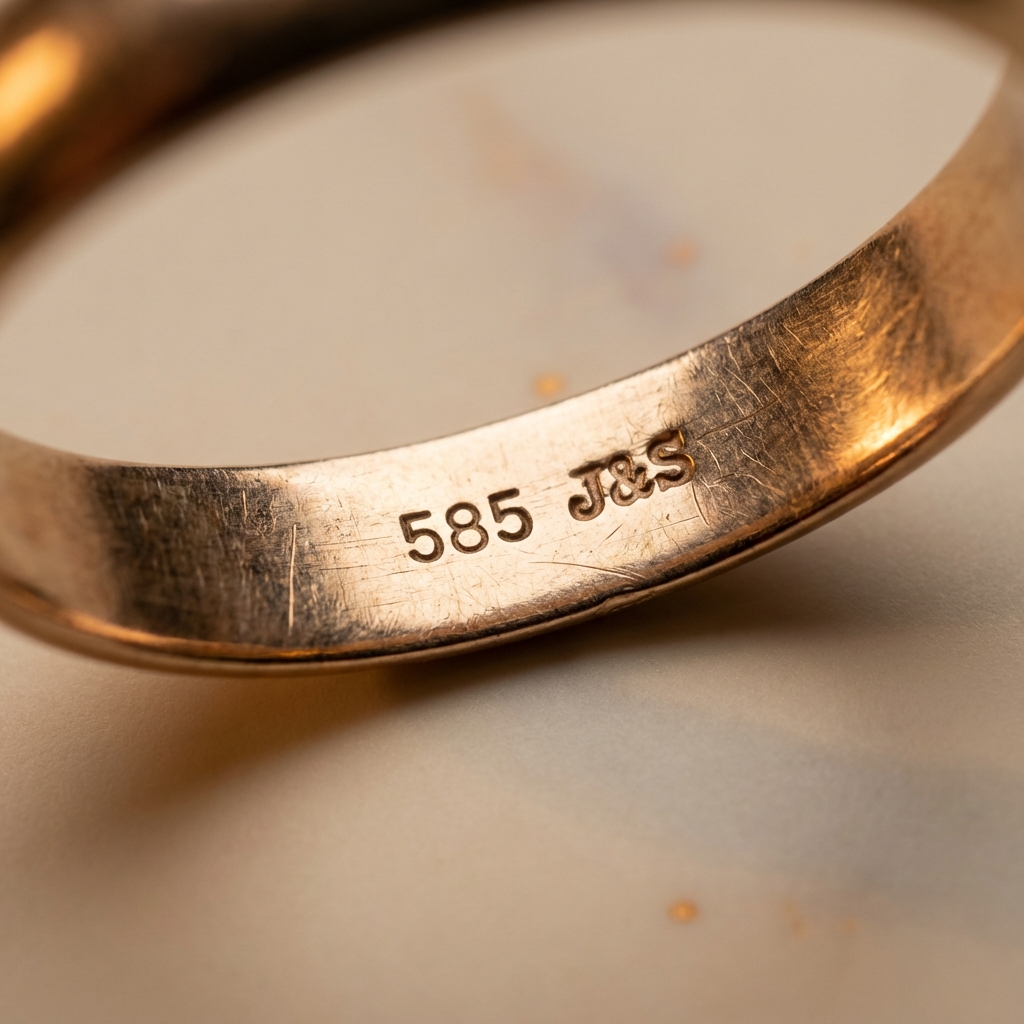
Numeric fineness marks, such as 375, 585 or 750, are the most direct indicator of gold purity and remain the clearest quick check for buyers and owners; these numbers express parts per thousand and are widely used in many systems Gemological Institute of America hallmark guide.
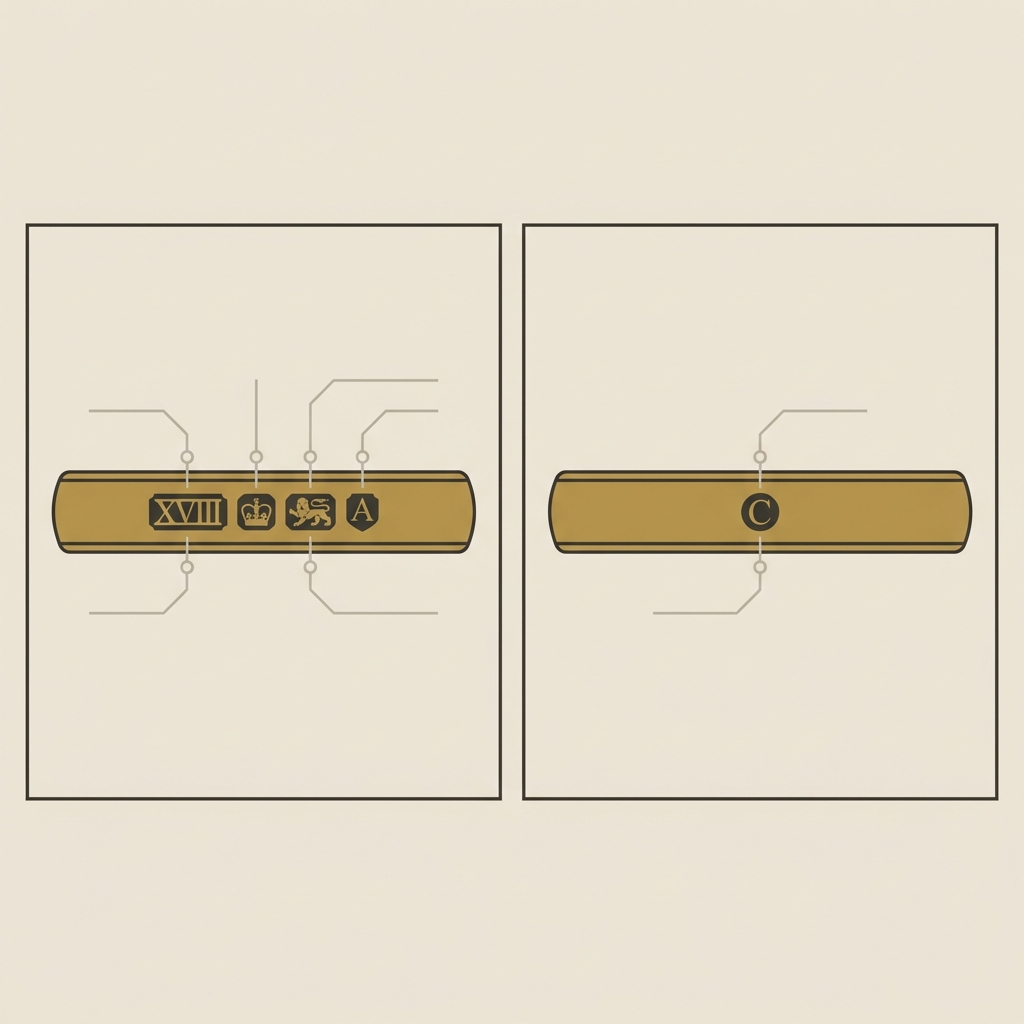
Maker's or sponsor marks are usually initials or small symbols that identify the workshop or person responsible for the piece. An assay office mark points to the town or official office that tested the article and, in many UK and European sequences, a date letter may follow to indicate the year of assay. Isolated letters or Roman numerals can also appear and may represent size marks, later-owner initials or internal inventory codes rather than formal date letters, so their meaning can be ambiguous without further context Hallmarking, The Goldsmiths' Company, London.
Basic definitions: fineness, maker's mark, assay office, date letter
Fineness is the proportion of pure gold in the alloy, usually expressed as parts per thousand for modern marks. A maker's mark is a registered symbol or initials used to link a piece to a workshop or sponsor. An assay office mark identifies the official test centre, and in some national schemes a date letter is a single letter that corresponds to a year on a chart maintained by that office. These basic definitions help frame what you are seeing and guide the next steps when researching a mark.
Why marks matter for condition, dating and provenance
Marks provide objective starting points for assessing a ring: they can confirm the stated metal content, offer leads for dating, and point to registries or catalogues where further attribution is possible. For condition and provenance work, marks should be read alongside patina, tool impressions and any restoration notes, because stamps can be added, altered or misread if the metal has been reworked.
Quick ID checklist: what to look for first inside a gold ring
1. Note any numeric fineness stamps exactly, for example 375, 585 or 750, and record their position on the band.
2. Look for maker's initials or a small sponsor symbol near the fineness mark.
3. Check for assay office symbols or town marks; copy or photograph them clearly for later comparison.
4. Photograph any isolated letters or Roman numerals and note whether they sit with other hallmarks or alone.
5. Make a short note of patina, tool impressions and whether a mark appears superficial or cut into the metal.
Fast home checks include examining marks with a loupe, using even lighting to avoid shadows, and placing a clear ruler or coin next to the mark for scale in photos. If the ring bears a clear three digit fineness number, that is the most reliable quick indicator of the metal content you can note before consulting registries or experts Gemological Institute of America hallmark guide.
See marks and provenance up close on @auroraantiqua
Save or print this checklist and keep clear photos of any marks so you can compare them with assay office charts or send them to a specialist if needed.
How hallmark sequences usually work in the UK and Europe
Many UK and European hallmarking systems follow a typical sequence that helps readers interpret multiple marks together. A common order you will encounter is a sponsor or maker mark, followed by a fineness number, then an assay office symbol and, in many cases, a date letter that can be matched against that office's chart https://www.assayofficelondon.co.uk/hallmarking/what-is-a-hallmark#convention, Goldsmiths' Company Assay Office.
National assay office guides explain local symbol conventions, how date letters are cycled and where to find official charts. Because each country or office can use different symbols and letter sequences, comparing the full group of marks is often required to form a working interpretation rather than relying on a single isolated stamp Goldsmiths' Company Assay Office overview.
The wider legal and treaty context also shapes modern practice. International agreements and long‑standing conventions provide a framework many states follow when defining fineness marks and controls, though national differences remain and should be checked against the relevant assay office resources Strasbourg Convention on precious metals.
Researching maker's marks and initials
Where to look: assay office registries, museum catalogues, specialist lists
Maker's marks are typically initials or small symbols that were registered to a workshop or sponsor and can often be checked against assay office registries or museum catalogues. Photograph marks with scale and orientation, then search registries and specialist catalogues for matching shapes or letter sequences. Museum resources and curated catalogues can be particularly useful for historic or unusual marks because they provide comparative images and context British Museum research resources.
Compare the letter with the assay office's date-letter charts, check for surrounding marks like a fineness number or assay office symbol, document patina and tool impressions, and consult provenance or a specialist when the reading affects valuation or historic attribution.
Limits of attribution and when provenance is required
Accurate attribution to a specific maker sometimes requires provenance, documentation or comparison with specialised catalogues. A matching initial is helpful, but identical initials can belong to different workshops across time and place, so provenance notes, sale records or prior collection history can be decisive when attribution matters for scholarship or sale.
How the US system differs: karat stamps, FTC guidance and what that means for reading marks
The United States does not operate a single national hallmarking system as many European states do. Instead, the legal framework focuses on truthful karat and fineness disclosure and prohibits deceptive marking under consumer protection rules. For practical purposes, you will often see karat stamps or numeric marks, but these should be corroborated with invoices or testing for high value items FTC Jewelry Guides.
Because there is no unified assay office sequence, a US-marked ring may lack the layered town and date marks common in UK examples; this difference changes how you triage marks and the documents you request. When a seller is in the United States, sensible steps include asking for clear sale documentation and, for high-value pieces, considering independent testing or a third-party report before purchase.
Interpreting isolated letters and Roman numerals inside a ring
Single letters or Roman numerals inside a band can have several meanings and are frequently context-dependent. In historic UK practice a single letter may function as a date letter tied to an assay office chart, while in other situations an isolated letter could be a size mark, an inventory code, or an owner's initial placed later in the ring's life Hallmarking, The Goldsmiths' Company, London.
To decide whether a letter is a formal date letter you should compare the form and style of the letter with the assay office's date-letter charts and check surrounding marks for an assay office symbol or fineness number that would place the letter in context. If those surrounding marks are absent, the letter is more likely to be a size or inventory mark and will need caution in interpretation British Museum research resources.

When you encounter Roman numerals inside a band they can sometimes indicate size, especially in historic systems, but they may also be later-owner marks or inventory numbers. Careful photographic documentation and noting whether numerals sit within a hallmark group are practical initial steps before asking a specialist for confirmation.
Common meanings: date letters, size or inventory marks, owner initials
Practical interpretation begins with context: a letter placed alongside a fineness number and assay symbol is likelier to be a date letter, while a lone letter near a joint or repair may be an owner or workshop inventory mark. Looking for patina differences and tool marks around the stamp helps establish whether the mark is original or a later addition.
Why context and provenance change the reading
Provenance records and clear documentation shift a reading from tentative to more confident. If a listing or prior ownership note ties a ring to a period or region, you can cross-check the letter against the relevant assay office charts. Without that context, single letters and numerals remain ambiguous and should be recorded as such.
When to escalate: testing, assays and asking for provenance
A quick visual ID is often sufficient for everyday use or low-value items, but there are clear triggers for escalation. Consider independent testing or a formal assay when the marks are ambiguous and the item has high value, when you suspect that marks have been altered, or when the metadata supplied is insufficient for confident attribution Gemological Institute of America hallmark guide.
Escalation options include non-destructive XRF testing, which can profile alloy composition, and independent laboratory reports from accepted third-party facilities. For rings with scholarly or market significance, combining a material test with a conservation report that documents condition and any restoration gives a stronger basis for attribution and display.
When requesting documentation from a seller, ask for provenance notes, prior ownership history and any verification letters the seller can provide. Keep in mind that documentation quality varies; well-documented pieces typically include clear condition notes, any restoration performed, and an explanation of how the provenance was established Goldsmiths' Company Assay Office overview.
Common mistakes, red flags and what to avoid when reading ring marks
Frequent errors include treating any letter as a date letter without consulting assay office charts, assuming that a numeric stamp is infallible evidence of purity, or ignoring surface patina and tool impressions that can indicate later alterations. Read marks with a critical eye and prefer corroboration to certainty Hallmarking in the UK: consumer protection, GOV.UK, British Hallmarking Council / GOV.UK.
Typical red flags for altered or non-standard marks are mismatched mark styles, shallow tooling inconsistent with expected hand-stamped marks, duplicate modern stamps on an otherwise historic-looking band, or a lack of supporting provenance when bold dating is claimed. In such cases, ask for high-resolution photos and consider laboratory testing before accepting a description at face value.
prepare clear, scaled photos of marks for comparison
include a plain background for contrast
When you see a red flag, stop and document. High-quality images, with a ruler and notes about where the mark sits on the band, give an independent reviewer the information they need to advise whether testing or conservation assessment is the right next step.
Practical examples and short scenarios: reading marks step by step
Example A: a modern European gold wedding band with 585 and a town mark
Step 1: Photograph the full sequence of marks, making sure to include scale and orientation. Step 2: Note the 585 fineness number and look for the assay office symbol nearby. Step 3: Use the assay office chart or registry to match the town mark and then compare the maker's initials against that office's sponsor list. For many modern European pieces this sequence allows a straightforward confirmation of fineness and a likely maker identification Hallmarking, The Goldsmiths' Company, London.
Practical action after this walkthrough: if maker identification matters for purchase, request the seller's documentation or a scanned page of the registered sponsor list; if the fineness matches the description and there are no other concerns, a purchase may proceed with routine caution.
Example B: a historic ring with a single letter and worn maker's mark
Step 1: Record high-resolution images from multiple angles and note differences in patina around the marks. Step 2: Compare the lone letter's shape to the date-letter charts for the relevant assay offices; Step 3: If maker's marks are worn, consult museum catalogues and specialist lists for similar mark shapes. If the letter cannot be matched confidently, treat the date as provisional and seek provenance or expert input before making historic claims British Museum research resources.
Practical action after this walkthrough: request any available provenance documents and, if the piece is of high value or particular interest, consider a conservation report that will document condition and any past restorations prior to formal attribution.
Summary: a practical checklist and next steps for buyers
Condensed checklist: record any numeric fineness, photograph marks with scale, copy or photograph any assay office symbols, note maker's initials and record any isolated letters or Roman numerals. These steps give you the evidence you need for both simple and more complex follow-up research Gemological Institute of America hallmark guide.
When marks are ambiguous or the item is high value, ask the seller for provenance documentation, condition and restoration notes, and consider independent assay or XRF testing. Aurora Antiqua lists condition notes, restoration notes and provenance references where available to help collectors decide what further checks to request, but these references are presented as documentation rather than guarantees.
Final practical advice: keep careful records, work from the clearest marks first (numeric fineness), and escalate to testing or specialist comparison only when the stakes or ambiguities justify the cost.
A 585 stamp indicates the gold fineness expressed as parts per thousand, commonly used for 14 karat gold; it is a reliable quick check but can be confirmed with documentation or testing for high value items.
No. Single letters can be date letters in certain national hallmark systems, but they can also be size marks, inventory codes or owner initials; comparison with assay office charts and provenance is needed.
Request testing when marks are ambiguous, when the item is high value, or when marks suggest alteration; start with clear photos and seller documentation and escalate to XRF or an independent assay when necessary.
More from Aurora Antiqua
References
- https://www.assayofficelondon.co.uk/hallmarking/what-is-a-hallmark#convention, Goldsmiths' Company Assay Office
- Hallmarking, The Goldsmiths' Company, London
- Hallmarking in the UK: consumer protection, GOV.UK, British Hallmarking Council / GOV.UK
- Hallmarking Guidance Notes: practical guidance in relation to the Hallmarking Act 1973, the UK Assay Offices
- Gesetz über den Feingehalt der Gold- und Silberwaren (FeinGehG, German law on gold and silver fineness), Bundesministerium der Justiz
- Hallmarking, The Assay Office Birmingham
- Home, Edinburgh Assay Office / Incorporation of Goldsmiths of the City of Edinburgh
- Hallmarking Act 1973, UK Government, legislation.gov.uk (The National Archives)