


Looking for the real thing? Browse authenticated ancient rings, each piece one of one, individually authenticated, with documented provenance. For the background, see the guide to ancient jewelry.
What 'black' can mean on ancient wedding rings
Overview of color versus material
When a ring from antiquity appears black, that visual impression can arise from very different materials or post-depositional processes, so the colour alone is not a reliable statement about use or meaning. The collector faced with a dark bezel or band should treat visual blackness as a hypothesis that needs checking against material description, iconography and documented condition notes rather than a final interpretation. The Metropolitan Museum of Art entries on rings
Three technical causes commonly explain black appearance on ancient rings: intentional black inlays such as niello, the use of genuinely black stones like jet or onyx, and dark patinas or corrosion on copper-alloy and bronze that can look black after burial. Each cause carries different implications for how we read a ring as a sign of marriage, mourning or decorative taste, so collectors should avoid assuming a single symbolic meaning from colour alone. British Museum notes on niello
Why a careful reading matters
For collectors and history-minded buyers, distinguishing among these possibilities affects what the piece can tell us about date, function and cultural context. A dark stone set into a bezel likely has different social associations than a deliberate niello decoration, and both differ again from a darkened bronze that gained its colour in the soil. Asking for provenance, close-up images and condition statements is therefore central to responsible buying. A review of bronze patination and conservation
@auroraantiqua behind the scenes and documented listings
Explore curated listings with clear condition notes and provenance statements at Aurora Antiqua to see how material descriptions and restoration notes change interpretation.
Materials and techniques that produce black: a short catalogue
Niello: sulphide inlays
Collectors will encounter three broad technical categories when a ring looks black: niello inlays, black stones or organic materials, and dark patination or corrosion on metal. Each category is visually distinct to a practiced eye and is commonly identified in museum or auction descriptions, though clear photography and close-up bezel shots are essential for confident reading. British Museum resources on technique
Black gemstones and organic materials
Black gemstones such as jet and black onyx appear in listings with characteristic gloss and grain that differ from metal inlay, and collectors should note that jet is an organic material with specific tactile and visual cues. When a listing mentions jet, it often implies a worked organic stone rather than a metal inlay, and this distinction matters when assessing possible funerary or symbolic associations. Natural History Museum explanation of jet

Dark patina, burial corrosion and surface treatments
By contrast, a bronze or copper-alloy ring may look black as the outcome of long-term corrosion, mineral deposition or deliberate chemical treatments applied in antiquity or by later conservators. These dark surfaces can be uneven, brittle or layered, and the listing language should reflect whether the finish is original, stabilised or the result of past conservation work. Journal of Archaeological Science review on patination
Short practical comparison: niello is a black sulphide inlay often neat in engraved lines; jet or onyx reads as stone set in a bezel with different reflectivity; burial-altered bronze shows textural changes and context-dependent discoloration. Use photographs, lighting notes and any conservation statements to separate these categories before inferring meaning. Metropolitan Museum context on materials
Niello: identification, historical use and what museum studies show
How niello is made and where it is applied
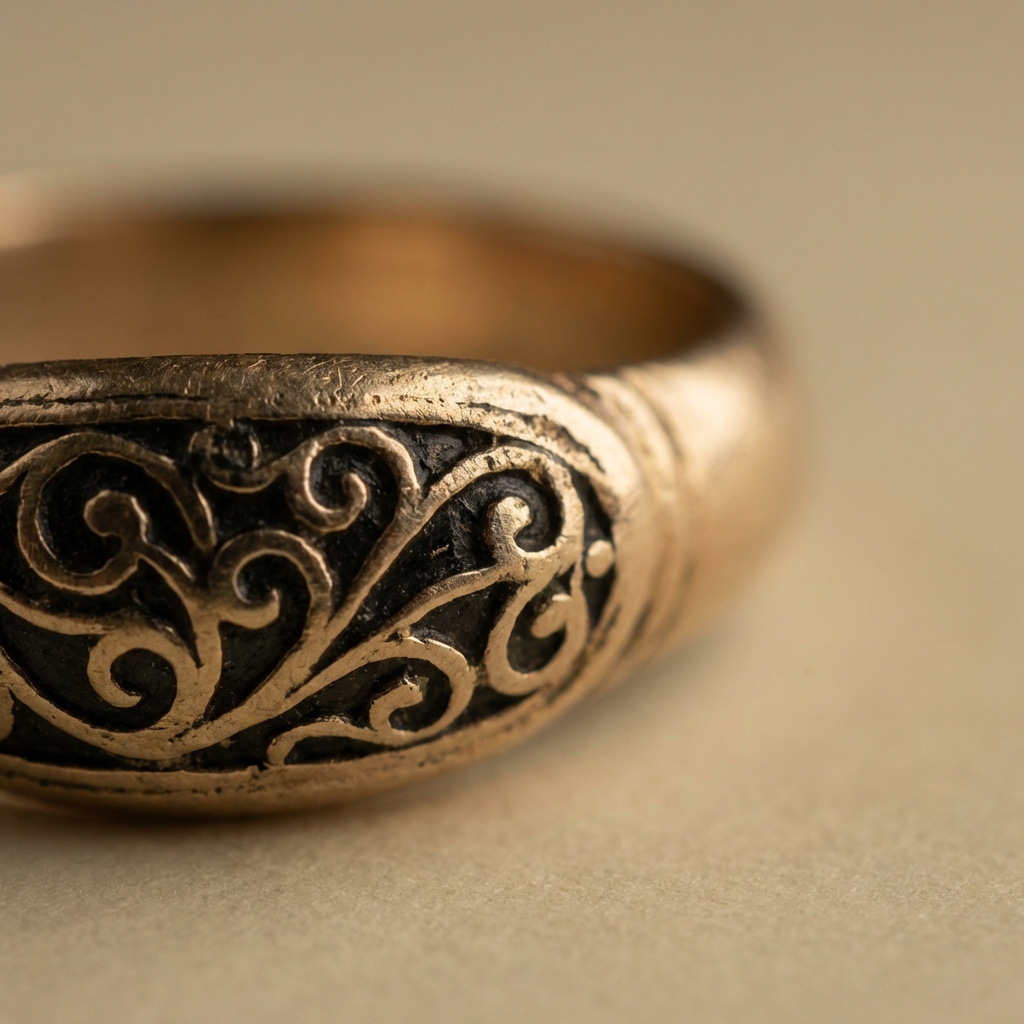
Niello is a deliberate decorative technique that produces a stable black inlay by using sulphide compounds to fill engraved lines or recessed motifs on metal, most commonly on silver or finely worked bezels. The method is documented from antiquity into the medieval period and appears in museum catalogues where technical studies confirm its presence. British Museum on niello technique
Niello tends to sit within engraved decoration rather than forming the entire surface, so a careful examination of edges and line work in photographs can reveal whether black areas are inlay or part of the base metal’s surface. Where a listing notes inlay, sulphide or blackened engraved lines, niello is a leading candidate and should be cross-checked with conservation comments. Metropolitan Museum entries on ring materials
A black appearance can result from niello inlay, black stones such as jet or onyx, or dark patina and corrosion on bronze; determining meaning requires material identification, dating, iconography and provenance rather than colour alone.
When you look at images of a dark bezel, consider whether the black follows engraved motifs and whether the edge between black and metal is crisp, as this visual cue often aligns with niello inlay.
Museum examples and dated occurrences
Technical studies and museum entries note niello on a range of objects including rings, signet pieces and small ornaments, and these published examples provide comparanda that collectors can use when reading a listing. References that document niello include collection labels and conservation reports where available, offering a firm basis for calling a decoration niello rather than a later darkening. Metropolitan Museum documentation on ring materials
When a seller uses precise terms such as inlay, sulphide or niello, treat those as meaningful signals but still ask for close-ups and conservation notes to confirm the claim, because visual similarity to corrosion or later overpainting can mislead even experienced readers. British Museum niello reference
Black gemstones and mourning contexts: jet, onyx and historical meanings
Properties of jet and how it was used
Jet is an organic, coal-derived material with a deep black appearance and a warm, slightly alluvial feel that differs from hard stones and metal inlays; it was used historically for personal ornaments and can appear in rings with smooth, polished bezels. Recognising jet in listings helps distinguish a worked stone from metal inlay and guides questions about possible funerary or symbolic use. Natural History Museum on jet
Onyx and other hard black stones are harder and have different reflective qualities from jet, so listings that state the stone type or that include detailed macro photographs allow a buyer to prefer one identification over another. When stone names appear in a condition or materials line, treat them as informative but not conclusive without visual confirmation. GIA overview of black gemstones
Contextual meanings: funerary and later mourning traditions
Explicit mourning rings and jewellery that carry overt bereavement symbolism are best documented in later centuries, notably the 18th and 19th, and should not be assumed for earlier periods on the basis of black colour alone. While black materials were used across eras, the specific social practice of wearing black to mark recent bereavement is a historically situated tradition and usually requires supporting context to attribute to an ancient piece. V&A overview of mourning jewellery
When a listing links a black stone with funerary imagery, dates or documented burial context, that combination strengthens a symbolic reading; without such supporting evidence it is safer to read the material as a decorative choice until further documentation is produced. Metropolitan Museum on ring contexts
Bronze patina, corrosion and how to tell an original finish from burial alteration
Types of archaeological patina
Bronze and other copper-alloy rings often acquire dark crusts, mineral films and chemical layers through burial processes, and these changes can produce surfaces that read as black in photographs. Archaeometallurgical studies and conservation literature explain the variety of patinas and their diagnostic features, which helps distinguish original finishes from burial alteration. Review on patination and conservation Apport de l'analyse statistique des produits de corrosion à la compréhension, Revue d'Archeometrie
Signs of corrosion versus intentional blackening
Visual cues that suggest burial corrosion rather than intentional black finishing include uneven texture, porous crusts, loss at the high points of detail, and soil-derived encrustation; intentional finishes such as niello tend to have sharper edges and sit in engraved lines. When these distinctions are unclear, a conservation report or materials analysis can resolve ambiguity. Journal review on identifying corrosion

In listings, transparent condition notes that describe stabilisation, removed encrustation or areas left untouched are especially valuable for judging whether dark surfaces are original or later-altered, and buyers should expect clear language about any conservation work. Met Museum guidance on condition statements
How period, iconography and provenance shape interpretation
Why dating and iconography matter
The same black appearance can mean different things in different periods: a niello-decorated Roman bezel likely reflects decorative practice, while a black stone in a later medieval ring might relate to personal taste or funerary custom, so dating and imagery shift plausible readings. Attention to iconography such as matrimonial motifs or religious symbols alters how we weigh material evidence. Metropolitan Museum on iconography and dating
Using provenance and documentation to avoid assumptions
Provenance, collection history and any verification letters change interpretive weight by supplying context that photographs alone cannot. A documented findspot, prior collection entry or conservation report can convert a tentative reading into a more confident one; in their absence the material remains open to multiple plausible interpretations. British Museum guidance on documentation
Practical steps to identify a black ancient wedding ring
Checklist for initial listing review
Start with high-resolution photos in varied light, clear measurements, and close-ups of the bezel, shoulders and inner band; listings that lack these elements make confident material reading difficult. Requesting a scale or ruler in images and shots from several angles can reveal whether black areas follow engraved lines or sit as a surface coating. Metropolitan Museum recommendations for images
Quick visual triage checklist for buyers assessing black rings
Request close-ups and conservation notes early
When to request further information
If the material remains ambiguous after initial images, ask sellers for conservation reports, provenance documentation or a materials analysis. Short tests such as simple ultraviolet imaging or a conservator report can often distinguish organic stone from metal inlay or identify corrosion products that cause darkening. Polite, specific requests for these documents help sellers respond without misunderstanding. Journal of Archaeological Science on testing
Red flags to watch for include vague material descriptions, heavy retouching in photographs, or restoration notes that are opaque about what was stabilised or replaced. In such cases, consider seeking an independent appraisal before purchase or insisting on a clear return policy if material identification is essential. Met guidance on condition transparency
What to say in condition and restoration notes: reading seller language
Typical restoration terms and what they mean
Sellers often use phrases like stabilised, conserved, or unrestored; each term carries a specific implication about the intervention. "Stabilised" typically means minimal work to prevent further deterioration, while "conserved" may indicate active cleaning or consolidation; clear descriptions of what was done allow buyers to judge whether original black surfaces were preserved or altered. Journal review on conservation terminology
How condition statements affect interpretation
When restoration notes state that inlays were replaced or that metal surfaces were polished, those interventions can change the appearance of black decoration and complicate reading. Buyers should ask for pre- and post-treatment images or a short conservation note that explains the steps taken and materials used. Metropolitan Museum on conservation reporting
Sample phrasing to request clarification from a seller might include: Describe any cleaning or stabilisation performed, provide images before treatment if available, and state whether any inlays were refilled or replaced. These direct questions help distinguish original features from later interventions. British Museum on technical description

When restoration notes state that inlays were replaced or that metal surfaces were polished, those interventions can change the appearance of black decoration and complicate reading. Buyers should ask for pre- and post-treatment images or a short conservation note that explains the steps taken and materials used. Metropolitan Museum on conservation reporting
Common misreadings and typical errors buyers make
Assuming symbolic meaning from colour alone
A common error is to project later traditions of mourning or contemporary symbolic meanings directly onto ancient pieces simply because they are black. Without supporting documentation such as burial context or period-specific iconography, those symbolic attributions are speculative and can mislead collecting decisions. V&A on mourning traditions
Confusing burial patina with intentional inlay
Another frequent mistake is to read a patinated bronze as if it were an intentional black finish; textural clues, edge definition and conservation history help separate these cases, and when in doubt a conservator or lab report is decisive. Relying on photographs alone increases the risk of this misreading. Journal review on patination identification
Practical corrective actions include asking for macro photos under raking light, requesting a conservator statement, and comparing the item to well-documented museum examples rather than assuming continuity with modern symbolism. Metropolitan Museum comparisons
Case studies: short examples across periods
Example 1: a niello-inlaid Roman ring
Case note: a ring photographed showing black pigment neatly confined to engraved motifs on a silver or silver-alloy bezel, with a listing that mentions inlay or sulphide, points strongly to niello as the cause of blackness. When a seller provides a conservation note confirming inlay rather than blackening of the metal, the niello reading is reinforced. British Museum niello examples
Example 2: a medieval jet-set funerary ring
Case note: a polished black stone set into a bezel and associated in the listing with funerary context or religious imagery may suggest a funerary or commemorative function, but the buyer should avoid assuming Victorian-style mourning without explicit dating and contextual evidence. Documentation that links the object to a burial context or a dated assemblage increases confidence in such readings. Natural History Museum on jet use
Example 3: a corroded bronze ring with dark patina
Case note: a bronze ring with an uneven black crust, surface loss and a soil-stained appearance often represents burial-altered patination. In this scenario, a short conservation report describing stabilisation and any removed encrustation is the most useful document for assessing whether the black surface is original or a post-depositional effect. Journal of Archaeological Science on bronze corrosion
How modern black wedding rings differ from ancient examples
Materials and cultural meanings today
Modern black wedding rings are often made from materials such as blackened metals, ceramic, or tungsten and commonly signal contemporary preferences like alternative identity or minimalist aesthetics, which are not direct analogues for technical or cultural practices in antiquity. Understanding this distinction helps prevent anachronistic readings of ancient objects. GIA overview of modern black materials
Why modern analogies can mislead
Projecting modern symbolism such as strength or nonconformity onto an ancient piece based solely on black colour risks ignoring the specific technical reasons that produced the appearance in the first place. Collectors should rely on material evidence and documentation rather than implying modern cultural values to explain ancient practice. Metropolitan Museum on contextual interpretation
Using documentation and testing: what actually proves material or use
Types of useful documentation
Helpful documentation includes collection history, prior catalogue entries, short verification letters from qualified specialists, and conservation reports that explain treatments and materials observed. These documents increase confidence about material identification and contextual interpretation when present. Metropolitan Museum guidance on documentation
What conservation or lab reports can show
Conservation reports and materials analyses such as X-ray fluorescence, microscopy or spectroscopy can distinguish metal inlays from corrosion products, and can identify stone types versus organic jet. When a listing offers such tests, buyers gain much stronger evidence for reading material cause and likely use. British Museum technical studies
How to ask sellers for documentation politely
Sample phrasing that is respectful and precise: Could you provide any conservation notes or previous catalogue entries for this piece, and are there close-up images of the bezel and inner band? If available, would the seller share any prior verification letters or lab results? Such requests focus the seller on the documents that matter. Met Museum on asking for provenance
Checklist for buying a black ancient ring online
Quick pre-purchase checklist
Prioritize the following: high-resolution photos from multiple angles, a clear measurement or ring size, close-ups of bezel and shoulders, explicit mention of inlay or stone type, and transparent condition and restoration notes. Having these items greatly improves the ability to judge whether blackness is intentional or a result of burial. Metropolitan Museum checklist guidance
Questions to copy and paste to a seller
Suggested short questions: What material is the black area identified as? Are there conservation reports or prior catalogue entries? Were any stabilisation or inlay repairs performed? Please include scale photos of the bezel and inner band. These precise queries reduce ambiguity and encourage useful seller responses. British Museum on technical queries
Consider return policy and independent appraisal
If material identification is decisive for you, ask about return terms and whether an independent appraisal within a short window is acceptable; this practical step helps manage risk in the absence of definitive lab work. Metropolitan Museum on appraisal practice
Conclusion: cautious, evidence-based meanings for black rings
Summary of key takeaways
Visual blackness on an ancient ring can arise from niello inlay, black stones such as jet or onyx, or from dark patinas and burial corrosion of bronze; each cause carries different interpretive implications, and colour alone should not determine meaning. Collectors should prioritise material identification, iconography and provenance when forming an interpretation. British Museum on comparative identification
Final guidance for collectors
When evaluating a black ancient ring, ask for clear photographs, specific condition and restoration notes, and any available conservation reports or provenance records. If important, seek a materials test or a conservator opinion rather than relying on photographs alone. With careful, evidence-first questions you can turn a striking visual impression into a defensible reading of an artifact’s history and likely use. Metropolitan Museum recommendations
Look for sharp edges of black within engraved lines, mention of inlay or sulphide in the description, and request conservation notes; corrosion tends to be uneven and crusty.
No, mourning traditions are historically specific; a black stone can be decorative, funerary, or later-associated, and dating plus context are required to support a mourning reading.
Request high-resolution photos, condition and restoration notes, provenance or collection history, and any available conservation or materials analysis reports.
More from Aurora Antiqua
References
- The Gemstone Book, CIBJO Blue Book, Coloured Stone Commission, CIBJO, The World Jewellery Confederation
- Quartz, Handbook of Mineralogy, Mineral Data Publishing / Mineralogical Society of America, USA
- Fund des Monats August 2019 (Find of the Month), Landesamt für Denkmalpflege und Archäologie Sachsen-Anhalt
- Apport de l'analyse statistique des produits de corrosion à la compréhension, Revue d'Archeometrie
- Long-term corrosion of copper alloys in the soil, Heritage Science (Springer Nature)
- Reproducing bronze archaeological patinas through intentional burial, Heliyon (Elsevier, Open Access)
- Bronze disease, Conservation Wiki, AIC Wiki, American Institute for Conservation
- Microstructure and chemical composition of Roman orichalcum coins emitted after, Scientific Reports, Springer