


Looking for the real thing? Browse genuine ancient artifacts for sale, each piece one of one, individually authenticated, with documented provenance. For the background, see the guide to ancient jewelry.
What is an antique scarab ring? Definition and historical context
An antique scarab ring is an ancient or antique ring that incorporates a carved scarab, the beetle motif called kheper in Egyptian tradition, often set as an intaglio or mounted stone. In many cases the motif stands for transformation and the solar cycle associated with the sun god Re, a central point in museum and reference summaries of scarab symbolism Encyclopaedia Britannica.
Scarabs appear in a range of forms: some were small amulets worn for protection, others were carved as seals and used to impress clay or wax, and some were incorporated into rings as personal jewelry or identity marks. Museum treatments and collection records show these distinct uses and typical time ranges for scarab objects across pharaonic and later periods The Metropolitan Museum of Art.
Because modern labels like ancient ring or scarab ring can be applied loosely, the best practice is to anchor any description to provenance and condition notes rather than assumption. When a listing or catalog entry includes clear collection history and restoration notes, it gives readers a firmer basis to interpret the piece and its likely original function British Museum collection records. Market listings can also show how similar items appear in commerce, though they do not substitute for provenance documentation.

How scarabs functioned in daily life: amulet, seal, and identity
In daily life a scarab could serve as a protective amulet, placed on the body or worn in a ring to invoke regeneration and safeguarding qualities; museums and specialists discuss this role in their amulet overviews The Metropolitan Museum of Art.
Other scarabs are clearly designed as seals, with carved bases carrying names or motifs that could be pressed into clay to indicate ownership, authority, or to secure documents; collection records provide documented examples of such administrative uses British Museum collection records.
Form and inscription usually indicate likely use: a finely carved intaglio with lettering is more suggestive of a seal, while a looser motif and suspension hole may indicate amuletic wear. Review articles and museum catalogs discuss the stylistic cues that help distinguish these functions Journal of Egyptian Archaeology review.

How to read meaning when someone gives an antique scarab ring
Start with context: who gave the ring, what did they say, and how was it presented. Modern gifting often overlaps symbolic meanings, so an initial conversation about why the giver chose the piece is the clearest route to interpretation.
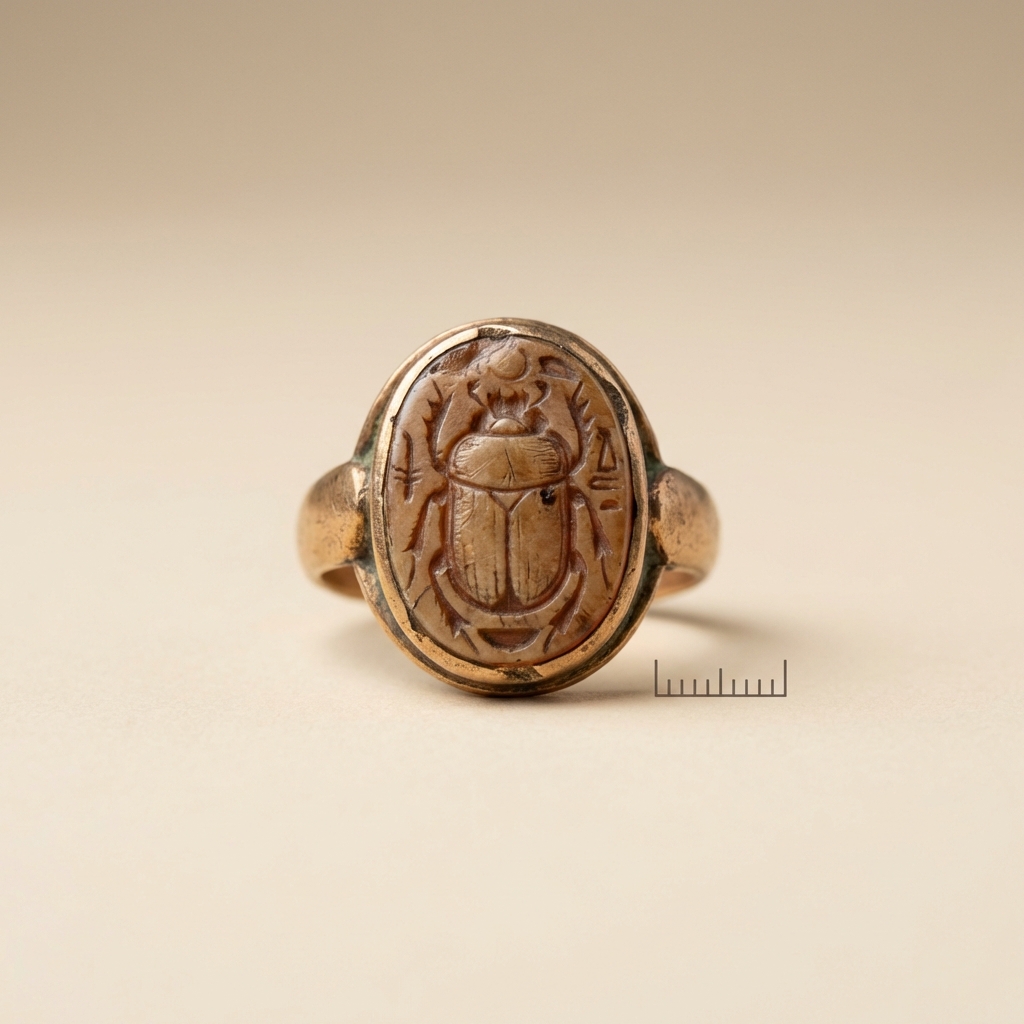
Next, assess the object itself. If the scarab is carved as an amulet, contemporary meanings such as protection or remembrance are plausible. If it is carved for sealing, administrative or status signals may be more likely, depending on inscriptions and form Penn Museum research highlights.
Checklist, quick items to work through:
- Ask for written provenance and any documentation that accompanies the piece.
- Request condition notes and any restoration history from the giver or seller.
- Check whether the scarab bear inscriptions or name elements that imply a seal function.
Quick step: verify documentation and care instructions
If you received a scarab ring, check any available provenance and condition notes, and consider downloading a basic care checklist before wearing the piece.
Finally, interpret with caution: even with a ring in hand, intent is often ambiguous and depends on period, form, and the social context in which it changed hands, so treat modern readings as provisional rather than definitive Encyclopaedia Britannica.
A scarab gift can signify protection, transformation, status, or personal sentiment, but the exact intent depends on the social context, the object's form, and any accompanying documentation.
What a scarab gift likely meant in antiquity
Across Egyptian religious thought the scarab, associated with kheper and the sun god Re, often symbolized transformation, rebirth, and the solar cycle; these religious meanings shaped why people wore or exchanged scarabs in different contexts Encyclopaedia Britannica.
When a scarab was used as a seal it could also signal office, authority, or household identity; museum collection entries document scarabs bearing names or titles that link them to administrative functions British Museum collection records.
Expressions of personal affection or memorial exchange are attested in some contexts and may be possible interpretations, but such readings are less certain if inscriptions or supporting archaeological context are absent Penn Museum research highlights.
Interpreting an antique scarab ring today: a practical checklist
When you need to decide what a scarab gift most likely meant now, begin with documentation. Provenance elements to request include collection history, prior ownership notes, and any verification letters or museum links that accompany the object British Museum collection records.
Next, read the condition notes closely. A clear statement of what was stabilized, repaired, or left untouched helps determine whether the object is suitable for wear and how previous interventions affect interpretation V&A conservation guidance.
Look at inscriptions and mounting: an intaglio with lettering or a flat base likely served as a seal, while a rounded carved scarab with suspension holes often points to amuletic use. Stone type and how the scarab is set can also change a reading of intent The Metropolitan Museum of Art.
Practical next steps:
- Document current condition with macro photos and measurements.
- Ask the giver for any written context about why they selected the piece.
- Retain any existing paperwork and add a personal note recording how you received the ring.
Interpreting an antique scarab ring today: a practical checklist continued
If documentation is limited, consider a short professional appraisal or a conservator inspection before wearing. A conservator can both verify structural safety for wear and provide language for future provenance records British Museum collection records.
Where interpretation matters, combine the social context of the gift with physical clues from inscriptions, mounting, and restoration notes to reach a cautious, evidence-based reading rather than assuming a single meaning The Metropolitan Museum of Art.
Interpreting an antique scarab ring today: a practical checklist final note
Preserve any paperwork and take care not to clean the piece at home; simple documentation and restraint preserve both meaning and material information that specialists rely on when assessing objects V&A conservation guidance.
Interpreting an antique scarab ring today: a practical checklist summary
In short, combine provenance, condition notes, and the social context of the gift before drawing conclusions about intent. This approach protects the object and yields the most reliable interpretation British Museum collection records.
Interpreting an antique scarab ring today: a practical checklist closing
Remember that modern gifting may signal protection, remembrance, romantic feeling, or simply a shared interest in history; without clear context, treat any one reading as provisional Encyclopaedia Britannica.
Interpreting an antique scarab ring today: a practical checklist additional guidance
For ongoing collectors, keeping a folder of condition notes and provenance statements creates a durable record that increases clarity for future owners and researchers British Museum collection records.
Interpreting an antique scarab ring today: a practical checklist final reminder
When in doubt, favor conservation-safe choices and add context to the object record rather than assuming a sentimental or symbolic narrative without evidence V&A conservation guidance.
Interpreting an antique scarab ring today: an editorial aside
These checklist steps mirror museum practices where labels and documentation are essential to interpretation, a helpful model for private owners who want reliable context for a scarab ring British Museum collection records.
Interpreting an antique scarab ring today: wrap-up
Use the combined evidence of social context, inscriptions, and documentation to form a measured reading of a scarab gift rather than a single assumption about its meaning The Metropolitan Museum of Art.
Interpreting an antique scarab ring today: note on language
Throughout, prefer conditional phrasing such as may, can, or likely when describing ancient practices to reflect the interpretive nature of the evidence Encyclopaedia Britannica.
Interpreting an antique scarab ring today: practical closing
Keeping records and avoiding amateur cleaning preserves both the physical object and the interpretive information it contains, and that helps you and future owners understand the ring's likely original role V&A conservation guidance.
Interpreting an antique scarab ring today: final practical suggestion
If you plan to wear a ring regularly, ask for a conservator's opinion on mounting security and on whether wear will damage the original carving or setting British Museum collection records.
Interpreting an antique scarab ring today: end
Thoughtful inquiry and modest conservation steps will keep the object and its meanings available to you and future researchers.
Interpreting an antique scarab ring today: additional resources
For more on symbolism and types of scarabs, museum overviews and collection records provide a foundation for study and comparison The Metropolitan Museum of Art. The Cincinnati Art Museum offers a detailed conservation case that illustrates treatment challenges for scarab rings Revealing the Details of an Egyptian Scarab Ring.
Interpreting an antique scarab ring today: final citation note
Readers who want primary catalog comparisons should start with major museum collection pages and conservation guidance for practical handling advice British Museum collection records.
Interpreting an antique scarab ring today: end of extended checklist
This extended checklist is intended to give recipients and buyers a concrete path to interpret and care for a scarab ring responsibly.
Interpreting an antique scarab ring today: brief conclusion
Combine context, object study, and documentation for cautious and defensible readings of a scarab gift.
Interpreting an antique scarab ring today: editorial sign-off
When in doubt reach out to a conservator or a knowledgeable curator to avoid irreversible handling mistakes V&A conservation guidance.
Interpreting an antique scarab ring today: final thought
Allow the object to speak through its material traces and the paperwork that accompanies it, and interpret modern gifts with a blend of empathy and evidence.
Interpreting an antique scarab ring today: note
Careful record keeping is the most durable way to preserve both material and meaning for an antique scarab ring British Museum collection records.
Interpreting an antique scarab ring today: closure
Finish by gathering the documentation and considering conservation before making decisions about wear or resale.
Interpreting an antique scarab ring today: final recommendation
Conservative handling and clear records protect both the ring and the interpretation you attach to it V&A conservation guidance.
Interpreting an antique scarab ring today: end note
Document, preserve, and consult where needed to keep context intact.
Interpreting an antique scarab ring today: summary line
Evidence and context give the best answers for what a scarab gift likely meant Encyclopaedia Britannica.
Interpreting an antique scarab ring today: final wrap
With care and records, you can turn a beautiful object into a responsibly interpreted piece of wearable history.
Interpreting an antique scarab ring today: concluding paragraph
Good practice preserves both the artifact and the narrative you choose to attach to it.
Caring for an antique scarab ring: conservation-aware handling
Museum conservation guidance recommends avoiding household cleaning and seeking professional care for cleaning, stabilization, or repairs; following these practices reduces the risk of damaging original surfaces or patina V&A conservation guidance.
A short conservation checklist to use before wearing an antique scarab ring
Keep records and avoid household cleaners
Store scarab rings in stable conditions with low light, moderate humidity, and padded supports to avoid abrasion and chemical exposure; museum practice emphasizes stable environments to preserve delicate materials V&A conservation guidance.
Documenting condition before any wear with macro photographs and measurements helps track changes and supports future conservation decisions; this practice aligns with how collection records are kept by museums British Museum collection records.

Consult a conservator when the mounting appears loose, when previous repairs are noted in restoration statements, or when you need a professional assessment of whether the piece is structurally safe to wear V&A conservation guidance.
Common mistakes when interpreting or gifting scarabs
A frequent error is assuming a single universal meaning for all scarabs; in fact they can serve multiple roles depending on form and context Encyclopaedia Britannica.
Another common mistake is relying solely on attractive images without condition notes or provenance documentation; photos alone cannot replace written records and close inspection British Museum collection records.
Avoid amateur restoration or cleaning that removes patina and archaeologically useful traces; museum conservation guidance cautions that household cleaners often do more harm than good V&A conservation guidance.
How to read condition notes and restoration statements
Common conservation terms such as stabilized, consolidated, or repaired have specific implications: stabilized often means measures were taken to prevent further deterioration, while repaired typically implies restorative intervention that changed the original structure V&A conservation guidance.
Condition statements that specify what was left untouched versus what was replaced or filled provide essential context for whether a ring is safe to wear or should be preserved for display British Museum collection records.
Always request macro photos that clearly show any fills, solder lines, or substrate changes so you can corroborate the written restoration notes before making decisions about wear or repair V&A conservation guidance.
Typical buyer and recipient scenarios
Receiving a scarab as a romantic or memorial gift is one possibility; in those cases the giver often frames the meaning directly, which reduces ambiguity about intent (research synthesis).
Gifts exchanged between collectors or academics typically include more documentation and explicit provenance, which helps clarify the object's history and original use British Museum collection records.
When an object is purchased for wear versus display the conservation needs differ: wearable use requires attention to mounting stability and exposure controls, while display allows for more protective supports and controlled lighting V&A conservation guidance.
Short case studies and museum examples
Museum-held scarabs illustrate the diversity of uses, from clearly amuletic forms to inscribed seal scarabs; collection entries provide cataloged examples and interpretive notes that are useful models for private owners British Museum collection records.
Common ring mounts and intaglio types reflect different periods and workshops; specialist reviews discuss how mounting style and carving detail inform dating and probable use Journal of Egyptian Archaeology review and period examples from dealers and catalogues Antique Jewellery Company.
Museum labels typically connect interpretation to documentation and context, a practice private collectors can emulate by keeping thorough records and citing known collection histories British Museum collection records.
Decision framework: should you accept, wear, or resell an antique scarab ring?
First assess documentation: accept or buy when there is clear provenance, acceptable condition, and restoration notes that you can live with; collection records and museum practices outline what trustworthy documentation looks like British Museum collection records.
Second balance sentimental value against conservation needs: if you intend to wear the ring often, prepare for periodic conservator checks and limit exposure to moisture and chemicals V&A conservation guidance.
Third get expert input when provenance is unclear or structural repairs are needed; an appraisal or conservator report can provide objective language for future records and support ethical transfer of ownership British Museum collection records.
Conclusion: balanced meanings and next steps for recipients and buyers
Scarab motifs can symbolize transformation, protection, status, or affection, but any one gift's intent depends on its social and material context; treat meanings as conditional and evidence based Encyclopaedia Britannica.
If you received or are considering an antique scarab ring, three practical next steps are to check documentation, preserve current condition, and consult experts when needed; those actions support responsible stewardship and clearer interpretation British Museum collection records. See more in our questions and answers section.
A calm, cautious approach that combines empathy for the giver with attention to documentation and conservation will give you the best basis for understanding and caring for an antique scarab ring V&A conservation guidance.
Look at the base and carving: a flat, inscribed base suggests a seal, while rounded carved scarabs with suspension holes often indicate amuletic use; compare with museum descriptions and ask for close photos and condition notes.
No, avoid household cleaning; follow conservation guidance and consult a professional conservator to prevent damage to patina or original material.
Request collection history, prior ownership notes, any verification letters, clear condition and restoration notes, and macro photographs to support interpretation and care decisions.
More from Aurora Antiqua
References
- Scarab. In: UCLA Encyclopedia of Egyptology (Kathlyn M. Cooney), University of California, Los Angeles
- Heart Scarab of Nefer, The Cleveland Museum of Art
- Das altägyptische Totenbuch (Book of the Dead), spell 30B, Nordrhein-Westfälische Akademie der Wissenschaften und der Künste
- Artifacts: Amulets, Mummification, Online Exhibits, Spurlock Museum of World
- OIP 118. Scarabs, Scaraboids, Seals, and Seal Impressions from Medinet Habu, Institute for the Study of Ancient
- scarabée ; amulette, Louvre site des collections, Musee du Louvre, Departement des Antiquites egyptiennes, Paris
- Faience Technology. In: UCLA Encyclopedia of Egyptology (Paul T. Nicholson), University of California, Los
- Finger Ring with Frog, The Cleveland Museum of Art
- Client Challenge, JSTOR
- Conservation · V&A, vam.ac.uk