


Looking for the real thing? Browse authenticated ancient artifacts, each piece one of one, individually authenticated, with documented provenance. For the background, see the guide to ancient jewelry.
What is an antique scarab ring?
Definition and basic anatomy of a scarab ring
An antique scarab ring is an ancient or historic ring that incorporates an Egyptian scarab amulet or a scarab-shaped bezel as its central element; museums and collection records use the term scarab for a class of amulets that were worn, carried, or set into jewelry, and an antique scarab ring adapts that amulet into a wearable mounting.
Read as a single object, the piece typically shows a carved or modelled scarab placed within a bezel and attached to a hoop and shoulders that form the ring; where an intaglio carving exists on the base of the scarab it may be used as a signet or decorative motif, and careful study of bezel mounting, hoop construction, and intaglio style helps identify age and use, following museum typology guidance British Museum collection term.
See fresh finds and behind the scenes at @auroraantiqua
Sign up for curated listings and condition summaries to receive alerts when notable scarab rings are posted.
How scarabs were used in antiquity versus later adaption as rings
In antiquity, scarab amulets served symbolic, ritual, and sometimes administrative roles; they appear in burial contexts, personal adornment, and administrative seals, and later periods adapted scarab forms into newer ring types, reusing ancient scarabs or copying scarab motifs in hardstones and faience, an evolution described in museum overviews Metropolitan Museum of Art overview.
Because museum literature underpins typology, a definitive assignment of an object as an antique scarab ring will often require specialist assessment of both the scarab element and the ring mounting, and listings that claim an object is an ancient ring should be matched to condition notes and documentation before purchase.
Why scarab jewelry matters: symbolism and historical context
Iconography and common inscriptions
Scarab imagery draws on Egyptian symbolism, with motifs that include royal names, protective formulas, and iconography tied to rebirth and creation; such inscriptions and motifs are useful for typological comparisons and for suggesting probable date ranges when compared to museum exemplars Metropolitan Museum of Art overview.
Collectors who value cultural meaning often look beyond market price, seeking pieces with clear iconography or readable inscriptions because these features can link an object to a period, workshop style, or known corpus of examples; that cultural importance can influence desirability even when it does not produce a fixed market value.
Museum perspective on cultural and ritual roles
Museums treat scarabs first as archaeological and cultural objects, documenting typology, archaeological context when known, and the object's inscriptions and use; this scholarly framing is the foundation for identification practices used by reputable sellers and buyers British Museum collection term.
It is important to note that cultural significance does not automatically determine price on the open market, because price depends on additional factors such as documented provenance, material, and condition.
Materials and condition: how material changes value and care needs
Common materials: faience, carnelian, agate, hardstones, gold mounts
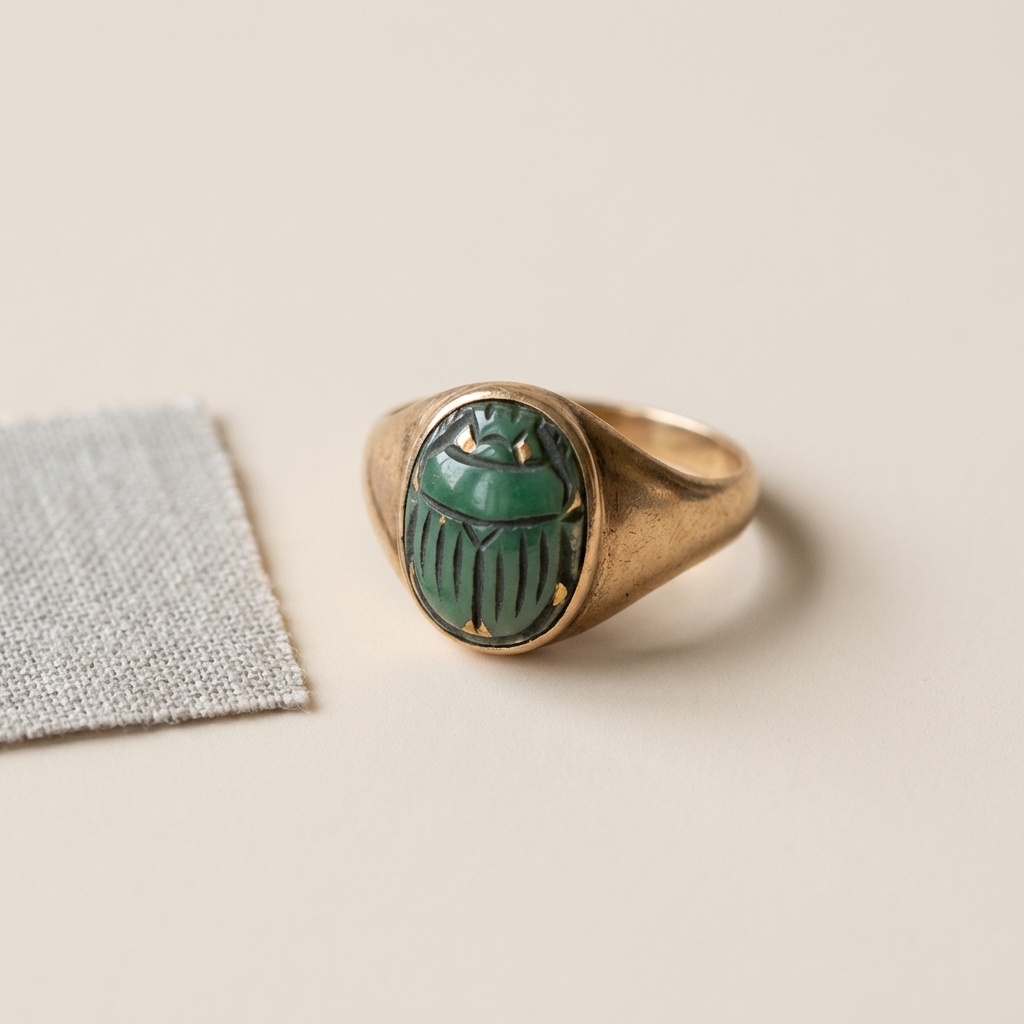
Scarab amulets are commonly made in glazed faience and in various hardstones such as carnelian and agate; some scarabs appear mounted in gold or other metals, and differences in material strongly influence both market value and conservation needs according to gemological and museum guidance GIA carnelian guidance.
Glazed faience scarabs are culturally important and abundant in collections, but because they are more common and less durable as wearable elements they typically command lower market sums than carved hardstones or gold-mounted examples, where material and secure settings may raise buyer interest.
A scarab ring can be worth pursuing when it combines meaningful iconography, verifiable provenance, clear condition and restoration notes, and independent material identification; without those elements value is uncertain and risk increases.
Hardstones such as carved carnelian or agate often require different conservation treatments than faience; they can be more suitable for secure mounting but still need careful inspection for surface weathering, fills, or previous adhesives before being offered as wearable rings GIA carnelian guidance.
Condition notes and restoration histories are therefore central to assessing value: a well documented hardstone scarab with clear restoration notes can be preferable to a visually cleaner but undocumented example because transparent conservation reporting reduces post sale uncertainty.
What patina, wear, and restoration tell you about history and preservation needs
Patina and expected surface wear can indicate long use and a plausible history but must be evaluated alongside microscopic analysis and comparison to museum examples; conservators and specialists look for wear consistent with age rather than modern tooling traces when assessing authenticity Metropolitan Museum of Art overview.
Restoration notes that specify what was stabilized or repaired are especially important when a scarab is set in a ring because some repairs affect whether a piece is safe to wear; buyers should ask for precise descriptions and photographs of repairs before committing to use.
How experts identify and authenticate scarab rings: a step by step workflow
Visual typology and inscriptions
Identification typically begins with visual typology: shape of the scarab, drilling method, inscription style, and form of the mounting are compared to published museum typologies and catalogues to suggest likely period and function Metropolitan Museum of Art overview and to relevant catalogues such as the Getty Museum catalogue.
A careful typological assessment is essential because many modern reproductions borrow ancient motifs; a typology assessment alone is rarely definitive, but it guides which additional tests will be most informative. For practical advice see an authentication guide.
Microscopic wear and tooling analysis
Microscopic wear and tooling analysis looks for minute tool marks, polishing patterns, and micro-wear that are consistent with historical manufacturing and long-term use; such analysis can also reveal modern rotary-tool traces or suspiciously uniform wear that indicate recent alteration, and specialists commonly include this step in pre-sale assessments Metropolitan Museum of Art overview and related analytical studies.
Buyers should request close-up images or reports covering microscopic inspection when authenticity or age is material to their decision, since photographs at low magnification may hide modern tooling evidence.
Material testing options and when to use them
Material testing can include non destructive gemological examination, refractive index or other standard gem tests, and instrument-based approaches such as XRF to read elemental composition; laboratories and qualified specialists recommend these tests to confirm whether a scarab is glazed faience, carnelian, another hardstone, or a modern composite GIA carnelian guidance.
Third party lab reports that explain methods and results increase market trust because they remove some ambiguity about material and treatment; where a buyer plans to pay a premium for material or dating, insist on clear lab documentation before purchase.
Legal and ethical checks every buyer should run
Key legal frameworks and export restrictions
International law and market practice make legal provenance and export paperwork central to whether an object can be lawfully sold across borders, and the 1970 UNESCO Convention remains a standard reference shaping export and import rules for cultural property UNESCO convention.
Because national laws and import rules differ, buyers should ask sellers for any export permits, previous ownership records, or collection history that bear on the object's legal status and avoid transactions where export documentation is unclear or missing.
Provenance documentation and due diligence practices
Provenance and collection history materially affect marketability: a chain of ownership, acquisition dates, or prior collection names give buyers and institutions a basis for accepting a sale, and reputable market guides recommend seeking third party checks when provenance is incomplete Stolen Works of Art Database, INTERPOL.

When provenance is stated, examine the documentation carefully: look for acquisition dates earlier than modern export restrictions, prior collection names, and any laboratory reports that accompany the sale.
Market patterns: what drives price and why prices vary
Why material, provenance, and condition cause dispersion
Market observations through recent years show wide price dispersion: common small faience scarabs tend to appear at modest sums in dealer markets, whereas carved hardstone scarabs and gold-mounted scarab rings can achieve much higher results when provenance and documentation are strong TEFAF Art Market Report 2024.
This dispersion arises because buyers pay premiums for verifiable material, clear provenance, and secure condition; conversely, absent documentation increases risk and typically suppresses realized prices even for visually appealing pieces.
How auction evidence and dealer markets differ
Auction houses and curated dealers operate to different logic: auctions often reward documented provenance and catalogue research with competitive bidding, while dealer markets can offer a wider range of undocumented pieces at lower price points, making it essential to compare listings and to note when provenance is included Auction Terminology, Christie's.
Because of this, broad price benchmarks are hard to set without case by case data; prospective buyers should treat price ranges as indicative rather than prescriptive and factor in documentation and testing costs when evaluating value.
Decision framework: is an antique scarab ring worth it for you?
Buyer goals, risk tolerance, and use case
Start by clarifying why you want a scarab ring: if your priority is cultural context and display, you may accept incomplete wear or older restorations; if you intend to wear a ring regularly, prioritize structural integrity, documented restoration notes, and secure mounting.
Collectors with low risk tolerance should insist on provenance and third party material identification, because these elements materially improve market trust and reduce the chance of post purchase disputes Publication 561 (12/2025), Determining the Value of Donated Property, Internal Revenue Service (IRS), USA.
A concise decision checklist to weigh material, provenance, condition, use case
Use this to score items before purchase
Checklist to balance cultural value against cost and risk
A simple approach is to score the following items: material clarity (faience or hardstone), presence of provenance documentation, clarity of condition and restoration notes, and existence of a lab report; weigh those scores against your intended use to decide whether a listing matches your priorities The Past Polluted: A Pigovian Approach to the Black Market in Antiquities, International Journal of Cultural.
For many buyers, an antique scarab ring is worth pursuing when it combines meaningful iconography with verifiable provenance and a clear restoration record; absent those elements, the purchase is more speculative and may carry legal or resale risk.
Practical buying checklist: documents and questions to request
Essential paperwork and images to request from a seller
Ask sellers for high resolution photos from multiple angles, measurements of the scarab and ring, close ups of drilling and mounts, and any written condition and restoration notes; where available, request provenance documents such as prior collection records or export permits to clarify legal status scarabée ; amulette, Louvre site des collections, Musee du Louvre, Departement des Antiquites egyptiennes, Paris.
Phrase your request clearly: for example, ask 'Please provide high resolution views of the scarab base, the drilling, and the ring shoulders, plus any written conservation report or provenance entries.' Keeping these requests in writing helps preserve evidence for later due diligence.
How to interpret condition and restoration notes
Look for precise language in restoration notes: stabilization, in situ consolidation, or documented fills are different from vague claims of 'refurbished' or 'cleaned'; detailed notes that name materials and methods are more helpful for conservators and for future buyers GIA carnelian guidance.
If restoration descriptions are brief or absent, consider commissioning a specialist inspection before purchase or pricing the uncertainty into your offer, since unknown repairs can affect both wearable safety and market trust.
Restoration and condition notes: what restorers and listings often disclose
Typical conservation treatments and what they mean for wear
Common conservation actions include stabilization of fragile faience, consolidation of flaking surfaces, and discreet fills to secure detached fragments; such treatments are often necessary to prevent further loss but should be described so the buyer knows whether a ring is safe to wear GIA carnelian guidance.
Cosmetic cleaning may improve appearance but can obscure surface evidence used for typology; conservators will usually state methods so a buyer can judge how treatments affect interpretation and future conservation needs.
How to read restoration notes and their limits
Restoration notes are most useful when they provide dates, conservator names, and materials used; vague statements reduce confidence because they do not allow later specialists to assess risk or reversibility of treatments About us, International Association of Dealers in Ancient Art.
Remember that some restorations are structural and necessary for safe wearing, while others are purely cosmetic; ask whether repairs were done to the scarab itself or only to the mounting and request before and after photographs when possible.
Common red flags and mistakes to avoid
Listing and provenance red flags
Clear red flags include absent provenance, evasive answers about export paperwork, vague condition notes, and claims of a broad dating range without supporting documentation; such gaps increase legal and financial risk and merit caution and further inquiry Scarab. In: UCLA Encyclopedia of Egyptology (Kathlyn M. Cooney), University of California, Los Angeles.
Avoid transactions where the seller cannot produce any prior collection history or where export documentation is ambiguous, particularly for objects originating from countries with strict cultural property controls.
Authentication and testing mistakes buyers make
Common mistakes include relying only on photographs, assuming declared material without lab confirmation, and accepting a seller's dating claim without typological or microscopic support; whenever the item's authenticity affects price or legality, demand third party checks before finalizing a purchase Metropolitan Museum of Art overview.
When in doubt, consult a conservator or a qualified specialist to avoid paying a premium for an object with unresolved questions.
Reading real listings and auction descriptions: practical examples
How to parse an auction lot description
When reading a lot description, note whether the catalogue entry includes provenance, condition reports, and references to comparable museum pieces; auction catalogues that cite prior collections or catalogue numbers provide a stronger basis for dating and authenticity assessments Auction Terminology, Christie's.
If a lot description omits restoration details or only supplies a short provenance line, follow up with the specialist for condition images and any available lab reports before bidding.
How dealer listings differ and what to trust
Dealer listings can be useful because they sometimes include long term availability and more direct seller communication, but they also vary widely in documentation standards; compare listings that include laboratory reports and explicit restoration notes to those that do not, and remember that dealer prices often reflect the level of documentation provided About us, International Association of Dealers in Ancient Art.
Trust increases with transparent condition notes, verifiable provenance entries, and the seller's willingness to support third party inspections or to provide high detail photography on request.
Care and wearable use: how to protect an antique scarab ring
Handling, storage, and wearing advice by material
Care differs by material: avoid harsh chemicals and impact for faience, be cautious with glued repairs on hardstones, and store gold mounted pieces separately to prevent abrasion; these material based precautions follow standard conservation advice for hardstones and glazed materials GIA carnelian guidance.
Before wearing an antique scarab ring regularly, inquire whether repairs were structural and whether a conservator has rated the mounting as safe for wear, because some stabilizations are meant only for display.
When to avoid wearing and when to get professional conservation
Avoid regular wear when the ring shows unstable joins, loose bezel settings, or undocumented fills; in such cases professional conservation is advisable to secure the object and to document any interventions for future owners Archaeological materials, Icon, The Institute of Conservation (UK).
Keep photographic records of condition before first wear and after any conservation work to maintain a clear history that supports future sales or institutional inquiries.
When to consult a specialist and how to get reliable third party testing
Types of specialists and labs to consult
Consult museum curators for typology questions, qualified conservators for condition and restoration advice, and accredited gemological labs for material identification; each specialist type contributes different evidence useful for establishing market trust Metropolitan Museum of Art overview.
For material tests, choose labs that explain methods and limitations in their reports so you can understand whether results address the questions most important to your purchase decision.
What to expect from a lab report
Lab reports should state the tests performed, the instruments used, and the conclusions reached about material and treatments; they increase market trust by making the basis of material claims transparent and reproducible GIA carnelian guidance.
Be prepared for modest costs and turnaround times when commissioning tests, and factor those expenses into the overall evaluation of whether a particular antique scarab ring is worth the price asked.
Conclusion and next steps for potential buyers
Summary checklist
Decide by weighing material, provenance, condition and legal status: prefer pieces with clear documentation, independent material identification, and detailed restoration notes, and use photographic and written records to preserve the object's history for future owners Object ID, International Council of Museums.
When these elements align with your collecting goals and risk tolerance, an antique scarab ring can be worth it as a cultural and collectible piece; when they do not, proceed cautiously and seek specialist input.
Where to learn more and document your purchase
Keep copies of all documentation and consider having a conservator or lab add condition and material reports to your records; continued learning from museum catalogues and authoritative references will also improve your ability to evaluate listings over time Metropolitan Museum of Art overview. For discussion and additional Q and A see our Questions and Answers blog.
Collect responsibly, document carefully, and prioritize transparent transactions that respect legal and ethical frameworks.
Start with typology and microscopic inspection, and obtain material testing or a lab report; provenance and condition reports are essential to support any age claim.
Material is a major factor but provenance, condition, and documentation often influence price as much or more than material alone.
Only if a conservator or qualified specialist has verified structural integrity and restoration work; otherwise limit wear and document condition beforehand.
More from Aurora Antiqua
References
- Scarab. In: UCLA Encyclopedia of Egyptology (Kathlyn M. Cooney), University of California, Los Angeles
- scarabée ; amulette, Louvre site des collections, Musee du Louvre, Departement des Antiquites egyptiennes, Paris
- Stolen Works of Art Database, INTERPOL
- Auction Terminology, Christie's
- The Past Polluted: A Pigovian Approach to the Black Market in Antiquities, International Journal of Cultural
- Publication 561 (12/2025), Determining the Value of Donated Property, Internal Revenue Service (IRS), USA
- About us, International Association of Dealers in Ancient Art
- Object ID, International Council of Museums
- Archaeological materials, Icon, The Institute of Conservation (UK)
- Fighting the illicit trafficking of cultural property, UNESCO