


Looking for the real thing? Browse our ancient artifact collection, each piece one of one, individually authenticated, with documented provenance. For the background, see the guide to ancient jewelry.
What an antique scarab ring is and why it mattered
An antique scarab ring combines an emblematic scarab amulet with a metal mounting so the object could be worn. In ancient Egypt a scarab could function as a protective amulet, a personal seal used for administrative purposes, or simply as personal jewellery, and these roles shifted through time and between contexts; museum catalogues and typologies remain the primary baseline for tracing those functions and forms British Museum collection guide.
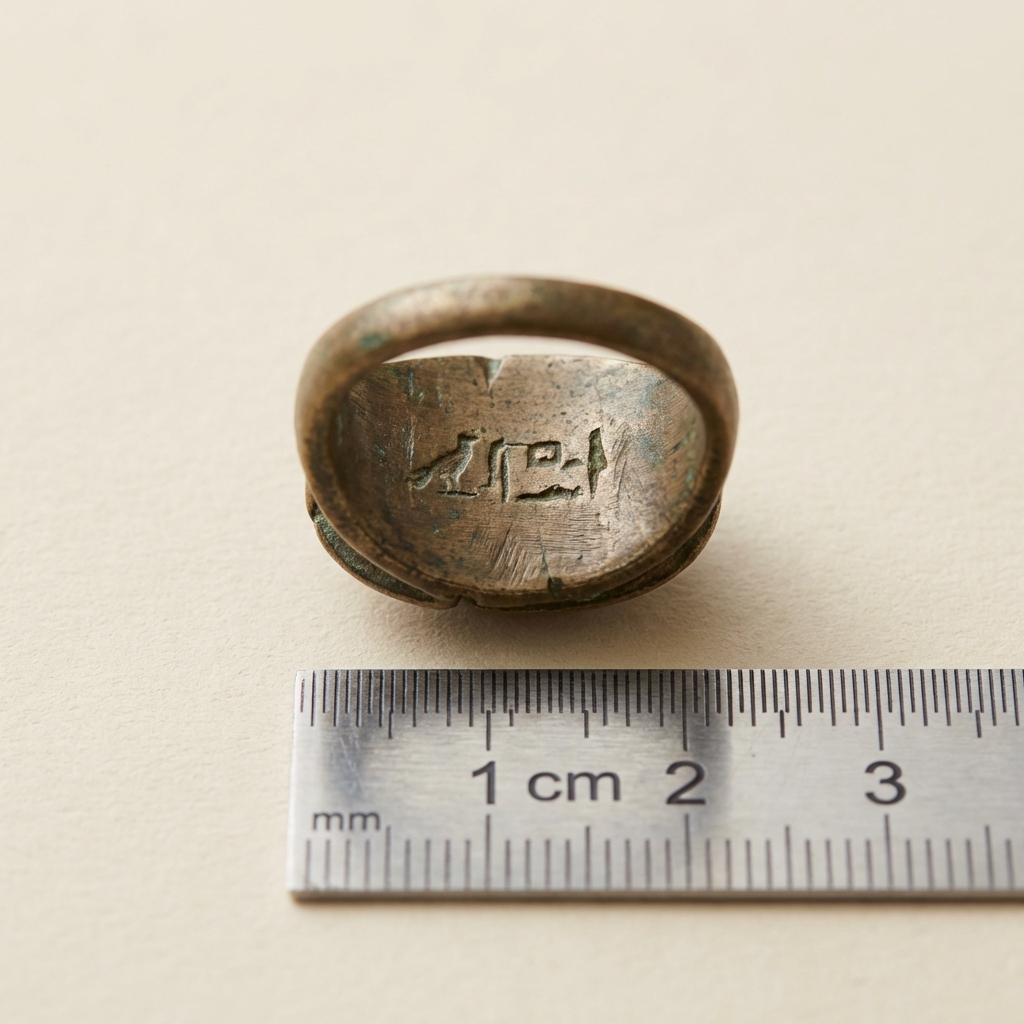
Forms vary from small, drilled scarabs set in simple hoops to larger, inscribed scarabs mounted as intaglios or bezel stones. Early examples are often simple and personal, while later official scarabs may bear royal names or standardized motifs linked to public messaging. Where archaeological context is missing, catalogued typologies and collection entries are the practical reference for attributing a likely function or date Petrie Museum resources.
Because the same scarab shape served multiple purposes, attribution rests on a combination of form, inscription and mounting. A large scarab with royal titulary set into a substantial bezel is more likely to have been associated with official or elite use, whereas a small faience scarab on a simple hoop commonly appears in domestic or artisan contexts. Typologies assembled in museum catalogues are therefore the starting point for identifying which role a given piece likely played in its original society Petrie Museum resources Petrie facsimile.
Forms: amulet, seal and wearable ring
Scarab amulets can be independent objects, perforated for stringing, or worked as seals with an inscribed base so they could be impressed into clay. When incorporated into rings the scarab became both a visible symbol and a functional device for sealing documents or goods. The presence of an intaglio or clear impression surface is a strong indicator of seal use, whereas plain bases suggest primarily amuletic or decorative roles Petrie Museum resources Newberry introduction.
Historical roles from Bronze Age to New Kingdom
Across the Bronze Age and into the New Kingdom scarabs evolve in style and purpose. Early scarabs are often uninscribed or simply modelled, while Middle and New Kingdom scarabs increasingly bear inscriptions, royal names or standardized iconography that reflect broader administrative and ideological functions. For readers evaluating an antique scarab ring, these shifts in style and inscription are central to understanding likely use and date British Museum collection guide.
Who wore scarab beetle jewelry: social roles and status
Scarab beetle jewelry was not limited to one social class; evidence in museum collections and archaeological studies shows that scarab rings and amulets were worn across social strata. Royal and official scarabs often carry names, titles or standardized imagery and are visually and materially distinct from smaller, simpler scarabs found in more modest contexts Journal of Egyptian Archaeology study.
Large inscribed scarabs set into robust mounts are typically associated with high officials or members of the royal household, where the device could serve both as an emblem of authority and as a practical seal. By contrast, small faience or steatite scarabs mounted on simple hoops are frequently recovered in domestic assemblages and workshop rubbish, suggesting use by artisans or ordinary people British Museum collection guide.
Size, inscription presence and standardized iconography are practical clues for inferring original wearer status when context is lacking. For example, the appearance of royal titulary or state motifs on a scarab is a signal that the object may have had an official or propagandistic function, while undecorated examples are more likely to have served personal protective or decorative roles Journal of Egyptian Archaeology study.
See curated examples and condition notes
Explore curated listings with clear condition and provenance notes to see how form and material affect attribution without pressure to decide immediately.
Collectors should therefore read size and inscription as part of a wider set of clues rather than as decisive proof on their own, because the same workshop styles could be used at different social levels and because later reuse and remounting are common in private assemblages British Museum collection guide.
Royal and official use
Royal and state scarabs frequently display standardized motifs and names that served propagandistic and administrative functions, particularly in the Middle and New Kingdom. Such pieces are often larger, more carefully inscribed and sometimes associated with higher quality materials or more elaborate settings Journal of Egyptian Archaeology study.
Private, artisan and popular use
Smaller scarabs made in faience or steatite and set into simple hoops are commonly found in domestic contexts and near artisan quarters, which indicates broad adoption beyond elite circles. These pieces are often cheaper to produce and easier to replace, and they give a useful counterpoint to the official scarabs found in administrative deposits British Museum collection guide.
Size, inscription and iconography as social clues
When assessing an individual example, consider size, quality of carving and whether the base carries an inscription or an impression surface. Each of these variables contributes to a probabilistic reading of who might have worn the piece, but none offers absolute proof without additional context such as findspot or catalogue comparison Petrie Museum resources.
Materials, manufacture and what they reveal about wearer and date
The most common materials for ancient scarabs include glazed faience, steatite and hard stones like carnelian, and material choice often correlates with social access and workshop practice. Faience was widely used for more affordable amulets, while carnelian and other hard stones were less common and often associated with higher status objects Petrie Museum resources.
Manufacture techniques and glazing approaches vary between workshops and periods. Glazed steatite scarabs show a different technical profile from carved carnelian examples, and the style of engraving or intaglio can help narrow down a likely period or workshop family when compared to typologies Petrie Museum resources.
Scarab beetle jewelry was worn across social groups; royal and official use is signaled by larger inscribed scarabs with standardized imagery, while smaller faience and steatite scarabs are common in artisan and popular contexts. Buyers should combine material, inscription style, typology comparison and provenance or restoration notes to assess whether a scarab ring is an antiquity or a later revival.
Wear, patina and documented repairs are practical clues for dating and assessing life history; patterns of surface erosion, the presence of residues in the base, and the way a mounting is joined to the scarab all contribute to an overall reading that complements material analysis Journal of Egyptian Archaeology study.
Common materials: faience, steatite, carnelian
Faience scarabs are identifiable by their vitrified surface and often bright colours, which come from a silica-based paste with a glazed coating. Steatite is softer and often glazed to mimic other materials, while carnelian and similar hard stones require different cutting tools and produce a distinct finish. These material differences are useful when assessing whether a scarab was likely a common personal amulet or a more carefully made object from a workshop with access to higher quality stones Petrie Museum resources.
Manufacture techniques and glaze types
Tool marks, drill traces and the nature of the glaze reveal workshop practices. Machine or modern tool marks are a red flag for later production, while period tool marks and hand finish align with historically produced objects. Comparing these marks to documented examples in museum catalogues helps place a piece within a typological tradition Petrie Museum resources.
Wear, patina and repair patterns as dating clues
Patina and wear consistent with age, together with clear restoration notes, are part of a cumulative case for antiquity and likely period. However, patina can be simulated and mounts can be replaced, so condition notes and any restoration documentation must be read carefully and paired with typology checks Journal of Egyptian Archaeology study.
How to identify an antique scarab ring: practical steps for buyers
Begin with a visual inspection checklist that notes material, tool marks, inscription style, bezel mounting and evidence of wear. Each of these visual cues can be compared with museum typologies to form an initial hypothesis about date and likely wearer status Petrie Museum resources.
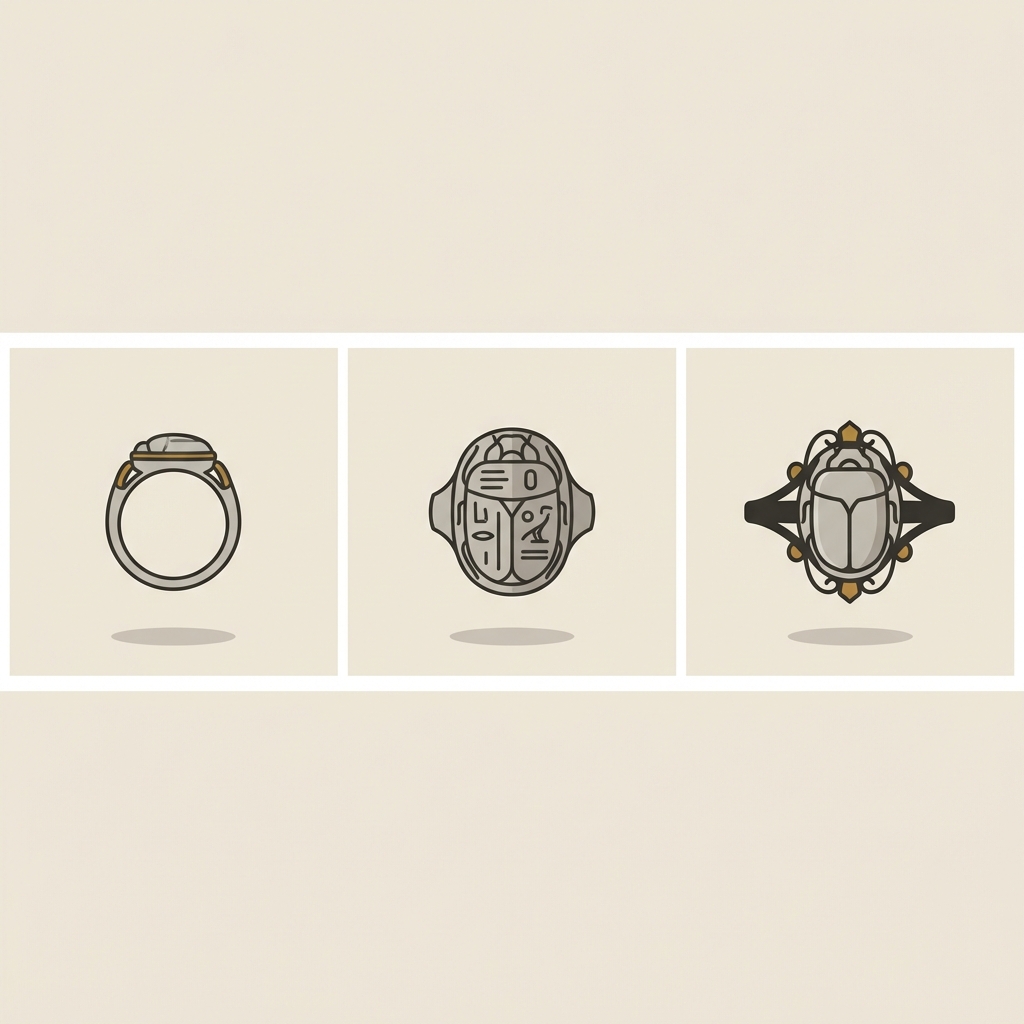

When photographs are all you have, examine high-resolution images of the base for tool marks and compare the inscription style to catalogued examples. If the listing includes condition notes, read them to see whether any restoration was carried out and how it was documented; a clear description of repairs is more useful than silence on the topic Metropolitan Museum of Art collection entries. See our article on the timeless appeal of Roman intaglio rings for image examples.
Compare the object to typologies in museum catalogues and Petrie-style references to corroborate stylistic attributes such as scarab proportions, the angle and depth of carving, and common motifs. These comparisons cannot replace archaeological context, but they provide the best available visual baseline for dating and attribution when context is absent Petrie Museum resources. Also compare to similar market offerings in our Ancient Roman rings collection.
Visual inspection checklist
Use a structured checklist when viewing images or an object in person: note material, any visible drill or tool marks on the base, whether the base is plain or inscribed, how the scarab is mounted in its bezel, and whether the patina looks natural and consistent with wear patterns. Record these observations and compare them to catalogued examples Metropolitan Museum of Art collection entries.
Using typologies and museum catalogues for comparison
Match the scarab's shape, inscription style and material to typologies and catalogued parallels. Museum entries and typology corpora are the most reliable non-archaeological references for dating and likely function because they aggregate documented finds and established forms Petrie Museum resources.
When to seek scientific testing or third party opinion
Scientific testing or independent examination is warranted when a piece is high value or when visual evidence is ambiguous. Tests might include material identification or non-destructive surface analysis carried out by qualified specialists, and buyers should ask for written reports or catalogue references when such work has been done Metropolitan Museum of Art collection entries.
Dating, typologies and the limits of stylistic attribution
Typologies and Petrie-style catalogues provide a practical framework for grouping scarabs by common features, but they cannot always yield precise dates or workshop attributions. Museums assemble typologies from excavated material and collection history, which gives them a comparative edge when context is known Petrie Museum resources.
Without archaeological context or scientific testing, stylistic attribution remains probabilistic. Many workshop attributions are unresolved, and similar styles could be produced over extended periods within a region, so treat stylistic matches as suggestive rather than definitive British Museum collection guide.
quick typology comparison for scarab attributes
Use alongside museum catalogue entries
Practical consequences for buyers include the need to document uncertainty in listings, to ask sellers for catalogue comparisons, and to prefer clear condition and provenance notes over categorical stylistic claims. A cautious, evidence-seeking approach reduces the risk of misattribution when relying on typology alone Petrie Museum resources.
Victorian and modern revivals: how revival pieces complicate the market
The 19th century Victorian Egyptomania and later Art Deco revivals reintroduced scarab motifs into fashionable jewellery, producing pieces that look ancient but were made centuries later. These revival pieces create a layer of supply that collectors must distinguish from antiquities when assessing listings V and A article on Egyptomania.
Common signs of revival work include modern tool marks, machine drilling, use of modern alloys in mounts, or stylistic mixtures that do not align with documented typologies. Auction catalogues and modern market records show that revival scarabs are frequent and can be deliberately aged or remounted to resemble older objects Auction catalogue notes.
Because revival pieces are historically significant in their own right, the goal for buyers is clarity: determine whether a piece is a true antiquity or a later decorative revival, and then judge it on the appropriate set of expectations. Provenance, clear condition notes and catalogue comparisons are the primary tools for making that distinction V and A article on Egyptomania.
Buying checklist: provenance, condition and restoration notes
Essential provenance entries should include collection history, prior ownership notes and any verification letters or catalogue references that accompany the object. These items help establish a chain of custody or at least demonstrate the documentation that has been used to support past attributions Metropolitan Museum of Art collection entries.
Condition and restoration notes should be specific: list the repairs made, the materials and methods used, and whether any stabilisation occurred. A transparent restoration note is more useful than silence, and careful buyers read these notes to understand how the object's visible state reflects its conservation history Metropolitan Museum of Art collection entries.
For higher-value pieces, request catalogue references or independent reports from qualified specialists. When third party examination has been carried out, ask for a written summary that explains methodology and conclusions rather than relying on broad assertions in a listing Publication 561 (12/2025), Determining the Value of Donated Property, Internal Revenue Service (IRS), USA.
What provenance entries should include
A useful provenance entry lists prior owners with approximate dates, collection or exhibition history if any, and any supporting documents such as invoices or verification letters. These items, while not definitive proof, increase confidence in a piece's documented history Metropolitan Museum of Art collection entries.
How to read condition and restoration notes
Look for explicit descriptions of repairs, including where metalwork was replaced or soldered, whether adhesives were used, and whether any surface treatments were applied. Clear notes that specify the scope of restoration help distinguish conservation from alteration Metropolitan Museum of Art collection entries.
When to ask for catalogue or third party references
Request additional references when a listing claims a notable date, workshop attribution or an association with a known collection. A catalogue reference or independent report adds weight to a stylistic claim and gives buyers a firmer basis for comparison to museum-held examples OIP 118. Scarabs, Scaraboids, Seals, and Seal Impressions from Medinet Habu, Institute for the Study of Ancient.
Common mistakes and pitfalls when assessing scarab rings
An overreliance on visual similarity to museum pieces is a common error because look alone cannot substitute for provenance or typology matches. Similar forms can be produced in different periods or by modern workshops attempting to reproduce historic styles Scarab. In: UCLA Encyclopedia of Egyptology (Kathlyn M. Cooney), University of California, Los Angeles.
Misreading patina or mistaking deliberate surface treatments for genuine age is another frequent pitfall. Artificial patination and added surface deposits can be applied to create an appearance of age, so condition notes and, when necessary, specialist surface analysis are important checks V and A article on Egyptomania.
Ignoring documented restoration is risky because repairs can change the object's structure and visual cues used for dating. Always ask for detailed restoration notes and, if absent, request further information before forming a confident attribution Metropolitan Museum of Art collection entries.
Examples and short case studies from museum and auction records
Compare a large inscribed scarab in a museum catalogue with a small faience scarab found in a domestic assemblage to see how typology and context alter attribution. Museum collection entries provide curated comparisons that show common features and variants, which help buyers recognise where a given example fits in an established typology British Museum collection guide British Museum scarab entry.
Auction catalogue notes and modern listings often include condition and provenance commentary that reveals how attributions were reached or revised. When an auction entry cites catalogue parallels or previous collection history, it becomes a practical teaching example for buyers comparing listings to typologies Auction Terminology, Christie's.
Readers can practise by selecting a museum example and a market listing and systematically checking material, inscription, tool marks and mount against the typology. This exercise shows how small differences in carving style or mounting joinery can shift an attribution from likely antiquity to probable modern revival Petrie Museum resources.

Conclusion: key takeaways for collectors
Scarab rings served multiple functions as amulets, seals and personal jewellery and were worn across social groups; materials and inscriptions are the main practical clues for assessing who might originally have worn a piece British Museum collection guide.
For buyers, the most reliable steps are to compare objects with museum typologies, insist on clear provenance and condition notes, and seek independent examination when listings make strong claims about workshop or high-value attribution. Prioritise documentation and cautious comparison over assumption Metropolitan Museum of Art collection entries.
Look for consistent material and tool marks, clear provenance, and specific condition and restoration notes; compare the piece to museum typologies and seek independent examination if in doubt.
No; patina can be simulated or added. Use condition notes, specialist reports and typology comparison to assess whether surface aging is consistent with authentic wear patterns.
Request testing for high-value pieces or when material and stylistic evidence are ambiguous; non-destructive material analysis or a specialist report can clarify uncertainty.
More from Aurora Antiqua
References
- Scarab. In: UCLA Encyclopedia of Egyptology (Kathlyn M. Cooney), University of California, Los Angeles
- OIP 118. Scarabs, Scaraboids, Seals, and Seal Impressions from Medinet Habu, Institute for the Study of Ancient
- Heart Scarab of Nefer, The Cleveland Museum of Art
- Das altägyptische Totenbuch (Book of the Dead), spell 30B, Nordrhein-Westfälische Akademie der Wissenschaften und der Künste
- scarabée ; amulette, Louvre site des collections, Musee du Louvre, Departement des Antiquites egyptiennes, Paris
- Amulet in the form of a winged scarab, Collections, Antiquities Museum, Bibliotheca Alexandrina Antiquities
- Faience Technology. In: UCLA Encyclopedia of Egyptology (Paul T. Nicholson), University of California, Los
- Auction Terminology, Christie's
- Publication 561 (12/2025), Determining the Value of Donated Property, Internal Revenue Service (IRS), USA
- Client Challenge, JSTOR