


Looking for the real thing? Browse authenticated ancient artifacts, each piece one of one, individually authenticated, with documented provenance. For the background, see the guide to ancient jewelry.
ancient egyptian scarab ring price: why the ring's materials change what you pay
The materials used to make a scarab ring are one of the primary factors that influence ancient egyptian scarab ring price because they affect durability, visual appeal and the likelihood of surviving in original condition; for many buyers the material listed on a catalogue or in condition notes is the first practical clue to an object's likely market band Christie's antiquities sale catalogue.
Material alone does not determine value: condition, documented provenance and any third-party reports are commonly decisive in moving a piece from the lower to the higher end of the market; auction evidence shows a wide dispersion of realised prices depending on these combined factors Christie's antiquities sale catalogue.
Materials such as faience, steatite and hardstones influence durability and visual detail, which together with condition and provenance determine the likely market band for an ancient scarab ring.
To assess an item properly you will often need specialist input or non-destructive testing, especially when photos and short descriptions are inconclusive conservation science summaries. A recent material-analysis project provides additional examples of XRF and Raman use in scarab studies University of Hamburg research.
Quick overview
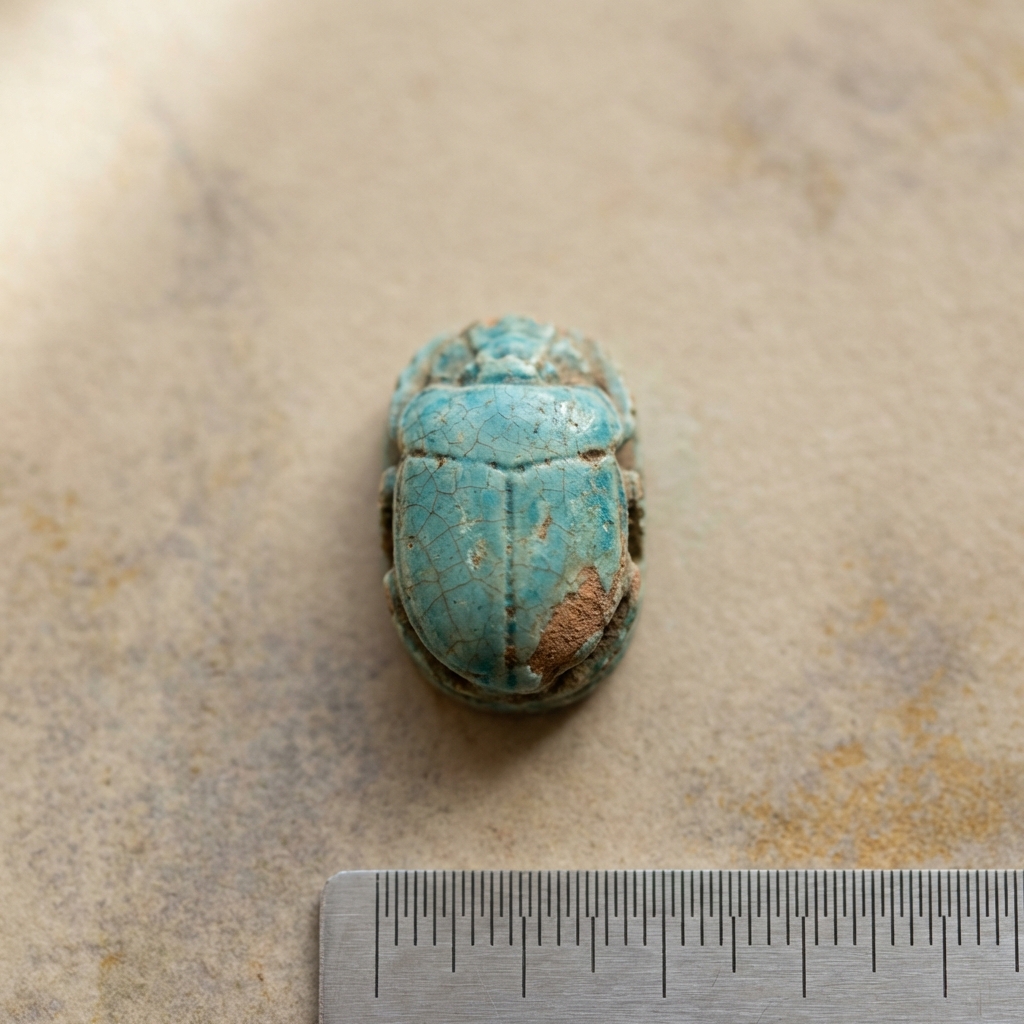
Collectors should expect to see faience, steatite and a range of hardstones in scarab examples, typically mounted in copper-alloys, silver or gold; each combination creates a different conservation profile and pricing expectation Penn Museum object records.
How materials link to condition and documentation
Items described as faience or glazed steatite often require careful condition notes to understand glaze loss or core exposure, while hardstone intaglios often preserve sharper carving and may command higher prices when they are well documented Metropolitan Museum faience overview.
What is a scarab ring: definition and historical context
A scarab ring is an ancient ring set with a carved scarab-shaped seal or intaglio that served various functions, commonly as an amulet, personal seal and wearable jewelry across ancient Egyptian society and into later periods; the motif and iconography carry symbolic meaning that collectors study when assessing authenticity and dating British Museum collection guides.
Dating and workshop attribution can be approximate for many scarab types because production was geographically widespread and stylistic changes are sometimes gradual; this is one reason condition notes and collection history are important when assessing a ring.

Function and symbolism of scarab seals
Scarab seals commonly bear motifs such as hieroglyphs, deity heads or personal marks and were worn as amulets or used to impress clay, so the same object can be both symbolic and practical; motif analysis is useful but rarely sufficient alone for firm dating British Museum collection guides.
Time periods and typical workshops
Many scarabs and scarab rings date to broad periods rather than single years, and curators often give workshop attributions as tentative; buyers should treat workshop names as helpful but not definitive unless supported by technical or provenance evidence.
Common materials used in scarab rings
Across museum collections and technical literature, the material groups most commonly reported for scarabs are Egyptian faience, steatite (soapstone), hardstones such as carnelian and agate, and metal mountings in copper-alloy, silver or gold; understanding these families helps translate a listing's short material line into realistic expectations Metropolitan Museum faience overview.
In many listings the scarab itself is the faience or steatite element while an intaglio might be hardstone and set into a metal hoop; descriptions that separate scarab material and mounting metal are more informative for buyers Penn Museum technical notes.
Quick inspection checklist for scarab ring material ID
Use with listing photos
Each material group shows characteristic signs that are often mentioned in condition notes, for example glaze crazing on faience, tool marks on steatite and drill traces in hardstone intaglios; those signs help separate likely ancient production from recent reparations or copies conservation science summaries.
Material categories at a glance
Faience generally appears as glazed blue-green pastes, steatite as softer carved stone often with a fired surface, and hardstones like carnelian and agate as translucent, polished intaglios that hold crisp engraving; mountings vary in composition and age Penn Museum technical notes.
How mountings and intaglios combine
Examples range from a faience scarab directly adhered to a metal hoop to a hardstone intaglio set into a gold bezel; careful listings will state whether the mounting is ancient or a later addition because that affects both conservation priorities and market positioning Penn Museum technical notes.
Egyptian faience: what it is and how to recognise it
Egyptian faience is a silica-rich, self-glazing paste with a core and a glaze layer that was widely used for scarabs and inlays; conservation literature describes faience as a distinct material with those layered characteristics, which matters because glaze loss can expose a different-looking core Metropolitan Museum faience overview.
Faience can show glaze crazing, wear through glaze to a lighter core, and pooling of glaze in recessed areas; these are common condition notes that help conservators and buyers distinguish faience from modern glassy repairs or imitations conservation science summaries.
When a listing names faience, request whether any stability work was done and ask for close-up photos of the base and edges where glaze thinning or core exposure is often evident; a technical report or conservation note will raise confidence if testing has been performed.
Composition and manufacturing
Faience production involves a silica-rich paste that develops a glazed surface in firing or through self-glazing recipes; technical studies outline the layered nature of many ancient examples and why that layering is visible in cross-sections and conservation reports conservation science summaries.
Visual cues and condition notes
Look for glaze crazing, localized glaze loss that reveals a different-coloured core, and consistent wear patterns rather than abrupt surface repairs; accurate condition notes will describe these features and any stabilisation treatments applied by conservators Metropolitan Museum faience overview.
Steatite (soapstone) and glazed variants: common signs and treatments
Steatite is a relatively soft soapstone that was widely carved for scarabs and was often fired and sometimes glazed to imitate harder stones; museum object records and technical studies note this common practice, which can make photographic ID challenging Penn Museum technical notes.
Fired or glazed steatite can resemble faience or softer hardstone in a photo, so condition notes that mention firing, glaze remnants or distinctive tool marks are valuable for distinguishing these materials conservation science summaries.
See behind-the-scenes at @auroraantiqua
Check a listing's condition notes for explicit mention of firing, glaze remnants and any stabilisation before forming a buying view.
Steatite typically shows different fracture patterns and softer tool marks than true hardstone intaglios; look for fine routing marks and slightly dulled engraved edges that point to a softer substrate rather than a dense carnelian or agate surface.
How steatite was used and sometimes glazed
In practice, steatite was carved to shape and sometimes given a fired finish or glazing layer to harden or alter appearance; conservators and technical descriptions will often explain whether firing or glazing was applied and whether it was original or a later intervention conservation science summaries.
What glazing vs glazing imitation looks like
True glazing on steatite often appears as a thin, fused surface with characteristic crazing or wear at edges, while modern overpainting or adhesive-based fills tend to present as abrupt surface transitions; restoration notes should clarify what treatments were done.
Hardstones and intaglios: carnelian, agate and treatments
Carnelian and agate were commonly cut and engraved for scarab intaglios and are noted in museum records as a frequent choice for durable, clearly carved seals; these materials often survive with clearer detail than softer carved media Penn Museum technical notes.
Work traces such as drill holes for mounting, facet polishing on bead-cut surfaces and signs of heat treatment used to enhance color are features buyers can look for in high-resolution photos and condition reports Metropolitan Museum faience overview.
Why hardstones matter for durability and appearance
Hardstones like carnelian and agate resist abrasion and often preserve fine intaglio detail, making them desirable on rings where crisp iconography can increase perceived quality; listings that specify these materials should also include photos of carved faces and sides for assessment.
Signs of heat treatment and drilling
Heat treatment can deepen carnelian colour and may be visible as enhanced translucency; drill traces for setting are typically small and regular when ancient, and condition notes that document these features or any stabilising conservation work add to buyer confidence Penn Museum technical notes.
Metal mountings: copper-alloys, silver and gold
Ancient mounting metals commonly include copper-alloys, silver and gold, and each metal behaves differently in terms of corrosion, surface deposits and conservation needs; documentation that states metal composition and any stabilisation is valuable for assessing condition and potential restoration requirements Penn Museum technical notes.

Mountings may be original, reconditioned or modern; when a precious metal claim is central to price, request documentation such as assay notes or clear seller condition and restoration notes that explain any interventions.
How metals were used to mount scarabs
Metals were formed into hoops, bezels and shoulders to hold scarabs and intaglios, sometimes soldered rather than cast, and repair marks or re-soldering are common in long-lived wearable objects; clear restoration notes help distinguish ancient joins from modern repairs Penn Museum technical notes.
What metal types imply for condition and conservation
Copper-alloys often show verdigris and active corrosion that require stabilization, silver can show surface tarnish and gold typically remains stable but may indicate a higher asking price; every claim about metal should be tied to condition or documentation in the listing.
How experts and labs identify materials: non-destructive testing explained
Non-destructive techniques such as portable XRF and Raman spectroscopy are widely recommended to distinguish ancient material compositions from modern reproductions, because they detect elemental or molecular signatures without sampling the object conservation science summaries.
Portable XRF can identify bulk elemental composition of metal mountings or detect elements associated with glazing, while Raman spectroscopy can characterise molecular phases in glazing and some mineralogy; combined reports help conservators and buyers interpret material claims.
Portable XRF and Raman basics
Portable XRF provides elemental readouts that indicate metals and some glaze components, whereas Raman identifies mineral and glassy phases; both techniques are non-destructive and frequently cited in conservation reports as practical first-line tests conservation science summaries. Further practical overviews of portable Raman in fieldwork are available in a portable Raman review, and compact XRF and Raman case studies appear in specialist journals portable XRF studies.
When to ask for technical reports
Request technical reports or a summary of any testing when high value or uncertain material identification is at stake; sellers who have had non-destructive analysis performed should provide concise reports or allow independent inspection by a qualified specialist.
How materials, condition and provenance affect ancient egyptian scarab ring price
Well-provenanced, well-preserved hardstone intaglios in original precious metal mountings typically sit at the higher end of price bands because they combine durable materials with secure documentation; auction evidence supports wide price dispersion across the market Christie's antiquities sale catalogue.
Conversely, common steatite examples with sparse provenance or extensive restorations are often offered in the lower hundreds, while reproductions and novelty pieces occupy a separate, lower-priced market segment; buyers should treat low price as a flag to demand documentation and photos.
Price drivers at a glance
Key drivers include material family, survival of original mounting, condition details such as glaze loss or restoration, the presence of export paperwork and third-party reports, and clear collection history; these factors interact so that good documentation can outweigh a less desirable material in some cases UNESCO guidance on provenance.
Why provenance matters
Provenance, export documentation and third-party reports are central to responsible buying and are emphasised in international guidance on antiquities trade and museum acquisition policy, both for legal and due diligence reasons UNESCO guidance on provenance.
Decision framework for buyers: a practical checklist before purchase
Start by confirming the material description in the listing and compare it with high-resolution photos focused on the scarab face, sides and base; if the description is vague, request more images and a written condition note that lists restorations and stabilisation work conservation science summaries. You can also compare examples to our rings collection for typical listing formats Aurora Antiqua rings collection.
Next, seek provenance details such as collection history, prior ownership and any export paperwork, and prioritise items with third-party reports or conservation notes when price or legal risk is significant UNESCO guidance on provenance.
Quick yes/no checklist
Before committing, run through: is the material clearly stated and pictured, are condition and restoration notes present, is there provenance or export documentation, and are any lab reports available; if answers are equivocal, consult a conservator or request technical testing.
How to weigh material versus documentation
Place stronger weight on clear provenance and third-party testing when material identification is ambiguous, because documentation reduces legal and attribution risk even if the material itself is less desirable for collectors. For comparative browsing of artefacts and listings see related artifact pages Aurora Antiqua artifact listings.
Common pitfalls and red flags when shopping for scarab rings
Visual red flags include low-resolution photos that hide surface texture, material descriptions that are vague or inconsistent, and abrupt surface transitions that suggest modern fills or overpaint rather than historic wear Christie's antiquities sale catalogue.
Documentation red flags are absent or incomplete provenance, no export paperwork for items where it is expected, and refusal to allow independent technical inspection or to provide recent condition reports; these gaps increase legal and attribution risk UNESCO guidance on provenance.
Practical examples: reading a listing and comparing two scarab ring cases
Example A, a common steatite scarab: a listing may describe steatite with a fired surface, show wear and glaze loss in photos, and offer limited provenance; this combination typically places the item at a lower market band and suggests buyers focus on clear restoration notes before purchase Penn Museum technical notes.
Example B, a documented hardstone intaglio: a carnelian intaglio with collection history, export paperwork and a short non-destructive analysis report will usually attract higher bids because the material, condition and documentary trail combine to reduce uncertainty and legal risk Christie's antiquities sale catalogue.
Example A: common steatite scarab with sparse provenance
Annotate the listing with the checklist: confirm steatite identification from photos, request condition notes on firing and glaze, and ask for any collection history; if these are missing, treat the listing as higher risk.
Example B: hardstone intaglio with documentation
Annotate likewise: confirm carnelian details, check for drill and polish traces in photos, and verify collection history and any lab report; if documentation is present, the combined confidence can justify a higher asking price.
Care, conservation and interpreting restoration notes
Common restoration terms include stabilised, consolidated, filled and re-mounted; sellers should describe exactly what was done and condition notes should explain whether interventions are reversible or cosmetic, which helps buyers anticipate display and handling needs conservation science summaries.
Different materials respond differently to handling: faience and glazed steatite can show glaze loss if abraded, hardstones are more durable for everyday wear, and metal mountings may require periodic conservation to prevent active corrosion.
What common restoration terms mean
Stabilised indicates surface or structural consolidation to arrest active deterioration, while filled suggests material loss has been replaced with a compatible fill; good listings explain these interventions and provide before-and-after images when possible.
How restoration affects display and handling
Restoration typically changes display choices and handling precautions but does not automatically make an object modern; transparency in restoration notes is the factor that most affects buyer confidence.
Conclusion: approaching ancient egyptian scarab ring price with confidence
Materials, condition and provenance together govern ancient egyptian scarab ring price and risk; treating material claims, clear photos and condition notes as the starting point, and prioritising provenance and non-destructive testing for higher-value items, helps buyers reach informed decisions UNESCO guidance on provenance.
When in doubt, ask sellers for detailed condition and restoration notes, request any available lab reports, and consult a conservator or technical specialist for items where the material identification or legal history is unclear. If you need to contact the seller directly use our contact page Contact.
Look for glaze characteristics, glaze crazing and core exposure for faience; steatite often shows softer tool marks and a fired surface. If photos are inconclusive, request condition notes or a conservator assessment.
Not always; hardstone intaglios often command higher prices when well-preserved and documented, but strong provenance or rare iconography can raise the value of faience or steatite examples.
Request non-destructive analysis like portable XRF or Raman when material identification affects price or legal risk, or when high-value items lack clear provenance or condition reports.
More from Aurora Antiqua
References
- Auction Terminology, Christie's
- The Past Polluted: A Pigovian Approach to the Black Market in Antiquities, International Journal of Cultural
- About us, International Association of Dealers in Ancient Art
- Federal Register, U.S. Customs and Border Protection, Department of Homeland Security
- Emergency Red List of Egyptian Cultural Objects at Risk, International Council of Museums (ICOM), Paris
- Scarab. In: UCLA Encyclopedia of Egyptology (Kathlyn M. Cooney), University of California, Los Angeles
- Gemstones. In: UCLA Encyclopedia of Egyptology (James A. Harrell), University of California, Los Angeles
- Faience Technology. In: UCLA Encyclopedia of Egyptology (Paul T. Nicholson), University of California, Los
- OIP 118. Scarabs, Scaraboids, Seals, and Seal Impressions from Medinet Habu, Institute for the Study of Ancient
- Client Challenge, Springer