


Looking for the real thing? Browse genuine ancient artifacts for sale, each piece one of one, individually authenticated, with documented provenance. For the background, see the guide to ancient jewelry.
What is an ancient scarab ring? Definition and context
Short definition and essential features
An ancient scarab ring is a ring that incorporates a scarab amulet or seal, a small carved object modelled on the Scarabaeus beetle that served both symbolic and practical functions in ancient Egypt and its wider networks. Curatorial literature treats the scarab first as an amulet associated with rebirth and solar regeneration and second as a functional seal or jewellery component, roles reflected when scarabs are mounted as intaglios in rings or set into other wearable mounts Metropolitan Museum of Art. For a short overview of the scarab ring type see Scarab ring.
Scarabs appear with archaeological continuity from the Early Dynastic and Old Kingdom periods through the New Kingdom and later eras, and they were adapted into personal jewellery, administrative seals, and grave assemblages in many contexts. When a scarab is mounted into a ring it can be an intaglio with an incised base used for sealing, or a raised amulet fixed in a bezel and worn for protection and symbolism British Museum collection overview.
Where scarabs appear in archaeological contexts
Curatorial records and museum catalogues show scarabs placed in burial assemblages, included in private devotional sets, used as administrative seals, and circulated through Mediterranean trade networks, which explains why scarabs and scarab-mounted rings are found in varied archaeological contexts OIP 118. Scarabs, Scaraboids, Seals, and Seal Impressions from Medinet Habu, Institute for the Study of Ancient. The topic is also treated in museum-focused notes such as The Sacred Scarab.
Dating of scarab rings most often relies on typological features, such as shape and base inscription formulae, and on contextual information from findspots or associated material. Scientific compositional and glaze studies can support a date or attribution but are not available for every object, so collectors should treat dating as an interpretive judgement informed by published typologies and condition notes Exploring the Composition of Egyptian Faience (Falcone, Aquilino, Stoppa), Minerals (MDPI).
Why ancient scarab rings mattered in antiquity
Symbolic role and connections to Khepri
In ancient Egyptian belief the scarab beetle was linked to the sun and the concept of renewal through the deity Khepri, a connection that made scarabs a natural choice for amulets intended to secure rebirth or regeneration in funerary contexts. Museums and specialist guides frame this symbolic function as a primary reason scarabs were included in burials and personal amulet sets Metropolitan Museum of Art.
Start with high-resolution images of the base inscription and the ring contact points, review condition and restoration notes, ask for any provenance or publication references, and compare the form to published typologies before seeking specialist input.
Administrative and funerary uses
Beyond devotional symbolism, scarabs served as practical seals and personal markers. Many examples show incised bases used to impress clay or wax, supporting administrative and identity functions in both private and official settings. Curatorial notes underline that the same basic scarab form could function differently depending on inscription, context and how it was mounted into jewellery or a ring British Museum collection overview.
Because scarabs circulated in Mediterranean trade and were adapted in far-reaching contexts, their inscriptions and forms can vary considerably. That variability is one reason collectors and scholars value clear typological comparison and careful documentation when interpreting a scarab ring's original use "A Faience Amulet from Rosh Ha-‘Ayin, Miẓpe Afeq (pp. 25*, 26*)" by Naomi Sidi, Israel Antiquities Authority.
Materials and manufacture of scarab rings
Common materials and surface treatments
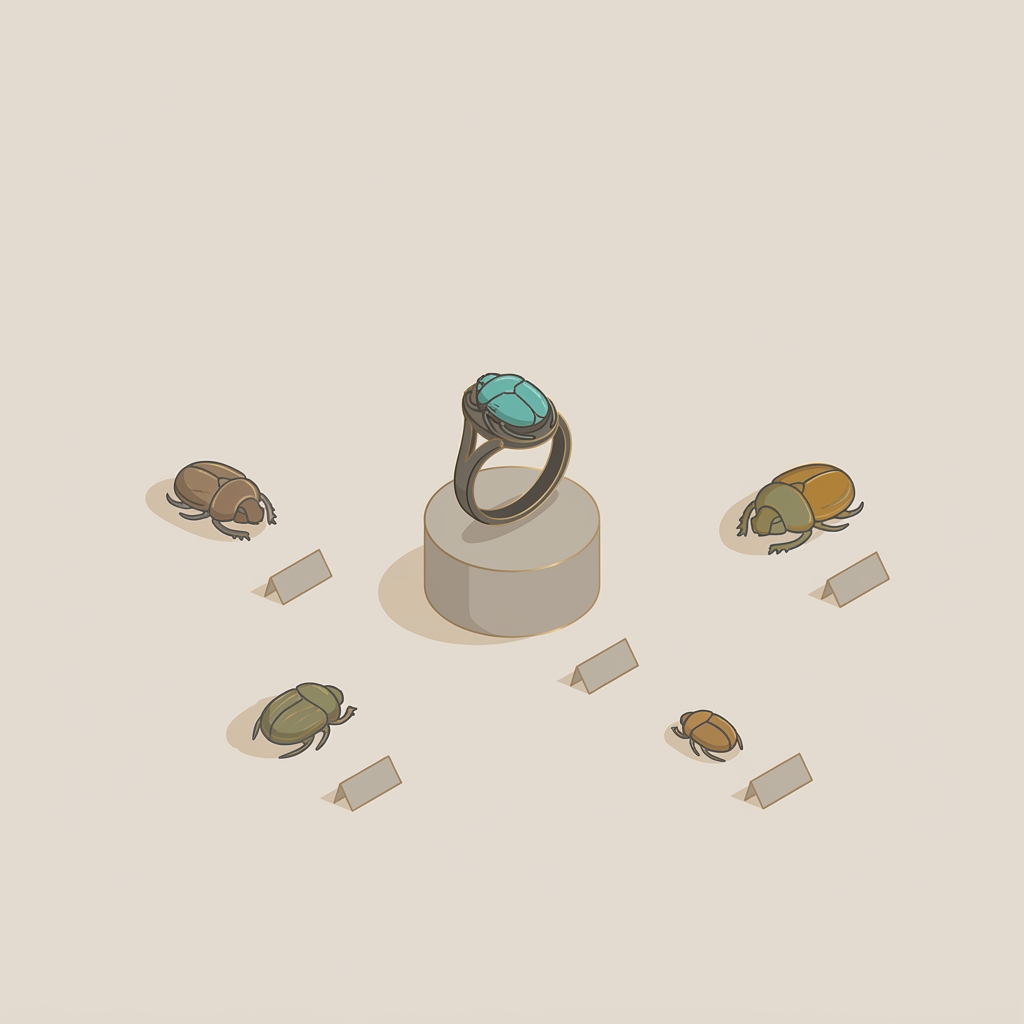
Typical scarabs are carved from soft stones such as steatite, often finished with a glazed surface that resembles faience, while higher-status examples are made from harder gems like carnelian or jasper. Recent compositional studies confirm this broad pattern in material use and glazing across periods, and museums routinely describe such differences in catalogue entries Gemstones. In: UCLA Encyclopedia of Egyptology (James A. Harrell), University of California, Los Angeles.
Manufacturing steps and glazing practices
Manufacture commonly involved carving a beetle form, incising details and inscriptions on the base, and applying a frit glaze or firing a steatite body to achieve a faience-like surface. These techniques produce characteristic surface textures and wear patterns; when glazed, a scarab may show craze lines, glaze loss or patina where contact occurred. Museum studies describing compositional and typological traits help collectors understand what to expect visually and physically for different materials British Museum collection overview.
Hardstone scarabs are less common and typically reserved for pieces intended to signal higher status or for use as durable seals. Such variants can look and feel different under magnification, with clearer carving and less glaze-related wear. Where available, compositional analysis can distinguish a glazed soft stone from an actual hardstone, which is why specialist testing is sometimes recommended for high-value items compositional study overview.
High-status hardstone variants
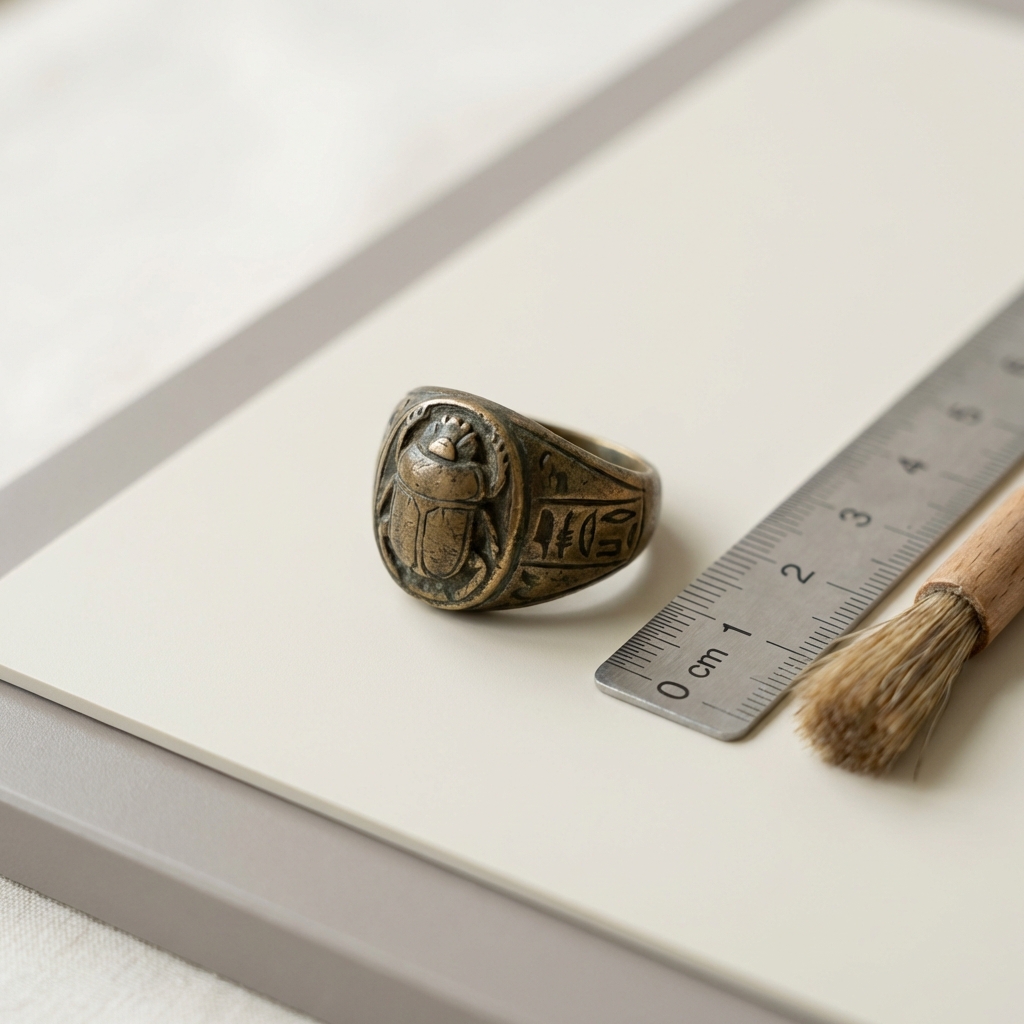
Examples in carnelian, amethyst or jasper occur in museum collections and auction catalogues and are usually described as higher-status variants. Because hardstones were more durable they were preferred for seals that saw regular use, and they also present differently in photographic images, often catching light in ways that glazed steatite does not British Museum curatorial notes. A comparable museum example is illustrated at the Walters Walters Museum scarab ring.
How experts date and attribute an ancient scarab ring
Typological dating: shape and base inscription formulae
Specialist typologies group scarabs by form, base inscription style and manufacturing traits so that shape and engraving can be compared against dated examples. Typological comparison is often the first step in a reasoned attribution because many scarab forms changed in recognizable ways over time Scarab. In: UCLA Encyclopedia of Egyptology (Kathlyn M. Cooney), University of California, Los Angeles.
Contextual dating and scientific analyses
Contextual dating uses findspot information and associated datable material to refine a scarab's date. Scientific methods such as compositional analysis of glaze or stone can support typological assessments when samples or lab reports exist, but these tests are not always available for every object and so are supplementary rather than universally decisive OIP 118. Scarabs, Scaraboids, Seals, and Seal Impressions from Medinet Habu, Institute for the Study of Ancient.
Follow @auroraantiqua for behind-the-scenes documentation
Check condition descriptions and any available provenance documentation on curated listings before forming a final judgement about age or attribution.
When a ring contains a base inscription, photographing the base in high resolution and comparing letter forms or formulae to published typologies can be decisive. If the findspot is documented in a catalogue or publication, that contextual data is especially valuable because it links the scarab to stratified material or dated objects, strengthening attribution claims OIP 118. Scarabs, Scaraboids, Seals, and Seal Impressions from Medinet Habu, Institute for the Study of Ancient. For more on intaglio rings see our discussion in the Aurora Antiqua blog intaglio rings explained.
For collectors, a practical workflow is to compare shape and inscription to typologies, inspect material and glaze under magnification and request any available lab or publication reports. When uncertainty remains, seek specialist input from a curator or accredited conservator rather than relying on general descriptions alone British Museum collection overview. See related items in our rings collection.
Assessing condition, restoration notes and provenance
What condition notes should say
Condition notes should describe structural integrity, surface loss, patina, repairs, and whether the mounting is original or modern. Museums and professional sellers often list which parts were stabilised and which features are original, helping readers parse what wear is consistent with age and what has been altered British Museum collection overview.
Look for phrases that clarify whether glazing is intact, whether the base inscription shows wear consistent with use as a seal, and whether there are modern fills or adhesive residues around the bezel or hoop. Clear vocabulary in condition notes reduces ambiguity and enables better comparisons with published examples British Museum curatorial notes.
How to read restoration and stabilization notes
Restoration notes should identify what was stabilised, repaired or left untouched. Common descriptions include consolidation of fragile stone, discreet inpainting of losses, or replacement of a modern mount. Responsible notes will state the treatment and, if available, the conservator or laboratory that performed it British Museum collection overview.
When restoration is extensive, ask for conservation reports. If the seller provides clear images of any interventions and explains their purpose, you can judge whether the work preserves the scarab's integrity or obscures original features that matter for typology and dating British Museum curatorial notes.
Using provenance and documentation responsibly
Provenance and documentation such as collection history, prior ownership notes or verification letters should be examined critically. Catalogued examples and published entries offer the strongest context, while a clear chain of custody or a documented museum deaccession can add confidence. When publications or catalogue entries exist they should be requested and compared to the object in hand Metropolitan Museum of Art. Related comparative items are available in our Ancient Roman rings collection.
If documentation is limited, ask for specific records: where and when the piece left a collection, any publication references, and whether any third party examinations exist. Treat provenance statements as evidence to weigh, not as absolute confirmation, and prefer records that can be independently verified British Museum collection overview.
Common mistakes and red flags when buying an ancient scarab ring
Overreliance on small or cropped images
One predictable error is relying on a single, low-resolution image or cropped photos that hide the base or the bezel joints. A listing should provide multiple views that include close-ups of the base inscription and the ring's contact points so buyers can assess wear and repair evidence Object ID, International Council of Museums.
Unclear or absent provenance
A missing or vague provenance statement is a major red flag. Ask sellers for prior ownership notes, any publication references, and whether the object was part of a documented collection. Clear provenance helps separate catalogue-documented examples from items with uncertain histories scarabée ; amulette, Louvre site des collections, Musee du Louvre, Departement des Antiquites egyptiennes, Paris.

Misidentified materials and modern repairs
Misidentification of materials and undisclosed modern repairs are common problems. Modern hardstone imitations, recent recarving of bases, or hidden adhesive repairs can all mislead a buyer. Ask for magnified images and, when in doubt, seek a conservator's assessment to identify modern interventions About us, International Association of Dealers in Ancient Art.
Practical follow-ups include requesting full size images of the base at different angles, asking whether any tests were performed on the glaze or stone, and getting a written record of any conservation treatment. These steps reduce the risk of surprises on receipt British Museum curatorial notes.
Practical examples: reading three scarab ring scenarios
Museum-documented example and what the record shows
A museum-documented scarab ring entry typically includes a clear catalogue number, a publication or accession note, condition details and often a photograph of the base. Such records make it easier to match typology and inscription to a known group, and they illustrate how publication and context together strengthen attribution and interpretive claims Metropolitan Museum of Art.
When a museum entry includes a findspot and associated datable objects, that contextual evidence can be decisive. In practice, collectors should ask for the same kinds of information from sellers: publication references, collection history and clear condition notes that can be compared to the published example British Museum collection overview.
Auction listing example and how to evaluate its claims
An auction catalogue entry may combine provenance statements, spectroscopic or lab notes, and condition reports. Cross-check auction claims against typologies and ask for high-resolution images of any inscriptions, especially the base. Auction catalogues are useful when they cite experts or publications, but buyers should verify the references cited rather than taking them at face value British Museum curatorial notes.
Pay attention to whether the auction provides conservation reports and whether the provenance chain includes named collections or publications. If those elements are absent, treat the lot with caution and request further documentation before bidding Auction Terminology, Christie's.
Private sale example with a checklist of questions to ask
In a private sale scenario, the buyer should follow a short checklist: request multiple photos including the base, ask for documented provenance and publication references, request condition and restoration notes, and ask whether any scientific tests exist. If the seller cannot provide these items, the buyer should proceed carefully About us, International Association of Dealers in Ancient Art.
Specific questions to ask a private seller include: Can you show the base inscription in close-up? Is there a recorded findspot or collection history? Were any conservation treatments performed and can you provide written reports? These questions help reproduce the scrutiny a museum catalogue would provide when assessing an item Metropolitan Museum of Art.
Checklist and next steps for collectors
Short buying checklist
Use a concise checklist to standardise how you evaluate listings: clear photos that include base inscriptions, detailed condition notes, explicit restoration records, and provenance statements or publication references. Comparing these elements with published typologies and catalogue entries makes assessments more reliable OIP 118. Scarabs, Scaraboids, Seals, and Seal Impressions from Medinet Habu, Institute for the Study of Ancient.
When uncertain, ask for a time-stamped photo of the base and request an independent conservator inspection for high-value items. These extra steps can prevent common mistakes and clarify whether an object fits a known typological group compositional study overview.
Record photos, inscriptions and provenance details for a single object
Use this when evaluating a listing
Care and maintenance basics
For handling and care, avoid abrasive cleaning and do not attempt invasive restoration. Seek a professional conservator for cleaning or consolidation, and store scarab rings in stable humidity and soft packing to prevent knocks and abrasion. Simple preventative care prolongs the readable surfaces that matter for typology and value British Museum curatorial notes.
Further reading and trusted catalogue sources
Continue research by consulting museum catalogues, specialist typology guides and compositional studies. Published museum entries and recent scientific reports provide the most reliable comparative data for dating and material identification, and they should be requested or consulted when a listing cites them Metropolitan Museum of Art.
When in doubt, contact a curator or a accredited conservator who can advise on tests and interpret condition and restoration notes. Building a habit of documentary scrutiny will improve confidence and outcomes when collecting scarab-mounted rings British Museum collection overview.
Look for clear provenance or publication, compare shape and base inscriptions to published typologies, inspect material and glaze under magnification, and request any available conservation or compositional reports.
Most scarabs are carved from steatite with a glazed surface resembling faience, while higher-status examples appear in hardstones such as carnelian or jasper; photographic appearance can be ambiguous without closer inspection.
Avoid abrasive or invasive cleaning; consult a professional conservator for advice and request documentation of any past treatments before purchase.
More from Aurora Antiqua
References
- OIP 118. Scarabs, Scaraboids, Seals, and Seal Impressions from Medinet Habu, Institute for the Study of Ancient
- Scarab. In: UCLA Encyclopedia of Egyptology (Kathlyn M. Cooney), University of California, Los Angeles
- Exploring the Composition of Egyptian Faience (Falcone, Aquilino, Stoppa), Minerals (MDPI)
- "A Faience Amulet from Rosh Ha-‘Ayin, Miẓpe Afeq (pp. 25*, 26*)" by Naomi Sidi, Israel Antiquities Authority
- Gemstones. In: UCLA Encyclopedia of Egyptology (James A. Harrell), University of California, Los Angeles
- Object ID, International Council of Museums
- scarabée ; amulette, Louvre site des collections, Musee du Louvre, Departement des Antiquites egyptiennes, Paris
- About us, International Association of Dealers in Ancient Art
- Auction Terminology, Christie's
- Scarab ring, Wikipedia