


Looking for the real thing? Browse authenticated ancient rings, each piece one of one, individually authenticated, with documented provenance. For the background, see the guide to ancient jewelry.
What an ancient mens ring is and why it matters
An ancient mens ring is a historic ring made in antiquity that was made for or commonly worn by men, and it can take several forms: a signet ring with an engraved face used for sealing, an intaglio set into a bezel, a plain metal band, or an inscribed piece that carried names or short phrases. Collectors and historians use the term to describe objects that survive from Roman, Greek, Byzantine, and Near Eastern contexts and that bear features consistent with male use or function.
These rings matter for reasons that are both personal and curatorial. For collectors, an ancient mens ring can be a wearable link to specific cultural practices, workshops, and iconography. From a curatorial standpoint, provenance, condition notes, and restoration notes are central to understanding what is original and what has been altered. Museum catalogs and curatorial descriptions help buyers and researchers read these details reliably, especially when a piece is presented as a one of a kind antiquity The British Museum rings collection, and for examples see our Ancient Roman Rings collection.
See curated finds and preservation details on @auroraantiqua
The following article is meant as a curator-informed guide from a dealer perspective, helping readers weigh historical context and documentation without promising authentication details for any individual object.
In many ancient societies men commonly wore rings for practical sealing and public display rather than as a single moral statement. The archaeological record shows that rings served functions from sealing contracts to signalling status, which is why an object labelled an ancient mens ring can represent both personal ornament and administrative tool The Met timeline on rings in the ancient world.
Definition and common forms
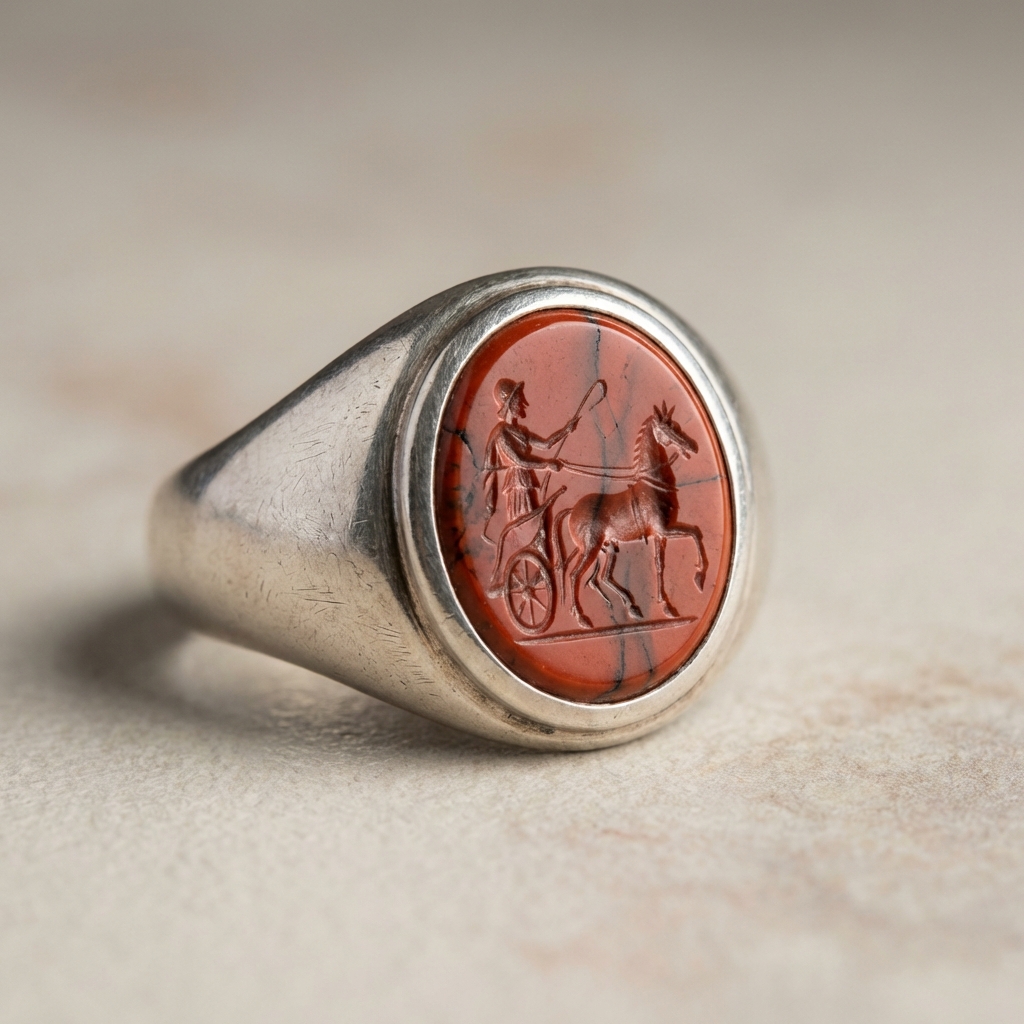
Signet rings and intaglio rings are the two forms people most often mean by ancient mens ring. A signet ring carries a carved motif used to impress soft wax or clay, while an intaglio contains a recessed design often cut into carnelian, agate, or other hardstone. Bezel settings and hoop construction vary by period and workshop, and small inscriptions or simple plain bands are also commonly encountered.
Why collectors value one of a kind ancient rings
Collectors value one of a kind ancient rings for their connection to specific iconography, workshop techniques, and the wear consistent with age. Documentation such as collection history, prior ownership notes, and verification letters helps place a ring within a provenance framework, while restoration notes explain what was stabilised, repaired, or intentionally left untouched. Those details shape both ethical considerations and practical expectations about condition and display ICOM ethics guidance on provenance and trade.

Rings in the Hebrew Bible and biblical narrative
Rings appear in several biblical narratives as markers of authority and delegated power rather than as simple personal accessories. One clear example is the story in which a ruler places a signet ring on a subordinate to mark office and authority, and this usage is part of the social vocabulary of ancient Near Eastern royal practice Genesis 41:42 in the ESV. See an overview at Bible History Online on the signet ring The Signet Ring - Bible History Online.
Esther and other narrative passages likewise use rings as tokens of delegated legal power, showing how rings functioned within administrative and legal systems in antiquity rather than serving as explicit moral addresses about personal dress. Reading these stories against ancient Near Eastern practice helps explain their social meaning and legal force The Met timeline on rings in the ancient world.
Key narrative examples and their function
Genesis 41:42 and passages such as Esther 8:2 place rings in the role of official signet and emblem of delegated authority. In those narratives the ring is a legal and social token, used to seal documents or to mark power transferred from one officeholder to another. That legal-social role is distinct from the way later interpretive debates treat jewelry as a matter of personal morality.
How ancient Near Eastern practice helps explain those passages
Scholars and curators point out that the use of rings for sealing and authority was common across the ancient Near East and Mediterranean, which is visible in material collections and museum records. Recognising rings as administrative equipment clarifies why they appear in legal and royal contexts within biblical narrative The British Museum rings collection. Comparative inscriptions such as Jezebel's royal seal illustrate this practice Fit for a Queen: Jezebel's Royal Seal.
New Testament passages often cited about jewelry and modesty
Two passages most often cited in discussions about jewelry are 1 Peter 3:3-4 and 1 Timothy 2:9-10. Both passages discuss adornment in terms of modesty and proper appearance, with attention to inner disposition and community witness more than to a literal list of forbidden objects. Modern readers commonly see these texts as addressing social expectations and gendered norms in the first century rather than issuing explicit prohibitions.
No. Biblical texts use rings largely as symbols of authority, and New Testament instructions about adornment address modesty within first-century contexts rather than imposing a blanket ban on wearing rings.
Careful translations and recent commentary emphasise that these verses are shaped by the social order and rhetorical aims of their authors. They are typically read as counsel for modest behaviour and community reputation; contemporary exegesis stresses the need to situate the instructions within first-century expectations rather than applying them without contextualisation A contextual reading of modesty and adornment.
What 1 Peter 3:3-4 and 1 Timothy 2:9-10 actually say
Both passages contrast outward ornament with inner virtues, asking readers to value a modest and respectful appearance. The language targets attitudes and social markers of status and seeks to guide communal life. That framing helps explain why the texts are often cited in conversations about jewelry yet do not list specific items as categorically forbidden.
How scholars read these verses in context
Scholarly interpretation tends to treat these verses as addressing gendered dress and behaviour within first-century communities. Exegetes note that cultural signals then differ from modern signals now, so direct application to contemporary male wearers of historic pieces requires care and contextual judgement rather than literal reading Exegesis and cultural context on modesty.
Archaeology and museum records: men wearing rings in the ancient world
Material culture and museums record frequent use of signet and intaglio rings by men in Roman and Greek contexts, both as practical seals and as personal display. Curatorial highlights and collection descriptions document a range of designs, from plain bronze bands to carefully carved intaglio stones set in silver and gold, showing that male ring use was widespread across social strata The British Museum rings collection. The Getty Museum catalogue on ancient gems and rings provides comparative reference Ancient gems and finger rings - Getty Museum.
These objects are preserved in numismatic and small-objects collections, and museum catalogues often explain function in language accessible to collectors. The material evidence helps explain why rings appear so often in textual sources: they were a normal part of civic and private life, used for sealing, identity, and ornament The Met timeline on rings.
Examples from museum collections
Catalogues and gallery highlights from major institutions present signet and intaglio rings with notes on materials, iconography, and workshop attributions. These records are useful for buyers because they show comparable forms, motifs, and typical wear consistent with age and use. Curatorial notes can also clarify when a ring served a sealing function versus being mainly ornamental.
Functions: sealing, identity, and display
Signet rings served a practical sealing function that linked an individual to documents and legal acts, while intaglio and gemstone-set rings could serve both identification and display. Understanding these functional categories helps modern readers see how ancient mens ring use intersects with the legal and social worlds recorded in biblical and classical texts The Met timeline on rings.
How scholars interpret adornment verses: context, genre, and gender
Exegesis begins with genre and historical situation. Passages about adornment appear in pastoral and epistolary literature that addresses community order and reputation. Readers are advised to attend to authorial intent and the social pressures that shaped those instructions, because textual form and audience matter when applying ancient moral language today Recent exegesis on modesty and adornment.

Because the texts engage with social norms about gender and presentation, many scholars argue that literal application without cultural translation can mislead modern readers. Theological commentary often suggests consulting trusted commentators and denominational guidance when readers seek concrete practice for modern life Scholarly guidance on modesty passages.
Exegesis basics for non-specialists
For non-specialists, practical exegesis begins by asking about the author, the intended audience, and the social pressures the text addresses. Those factors explain why advice about clothing and adornment functions more like community ethics than a checklist of permitted objects.
Limits to literal application
Interpreters caution against transferring first-century gender norms directly to every modern situation. While some communities may legitimately emphasise restraint, applying ancient instructions to a modern wearer of an ancient mens ring requires negotiation with contemporary norms and pastoral counsel Contextual reading of adornment texts.
How modern denominations treat jewelry and modesty
By 2026 major traditions generally treat jewelry as morally neutral when it is used modestly, while some conservative communities emphasise restraint and avoidance of ostentation. Official statements and pastoral guidance vary, so the same piece may be welcomed in one context and discouraged in another Contemporary denominational perspectives.
Because congregational norms often shape practice more than central pronouncements, readers should consult local leaders for specifics. The balance between personal conviction and communal witness is central to how many Christians think about jewelry and public display ICOM ethical guidance.
Overview of typical official stances
Roman Catholic and most mainline Protestant traditions typically allow modest jewelry as morally permissible, emphasising the interior virtues that the New Testament passages foreground. Conservative traditions may frame jewelry as a matter of prudence and witness, urging simplicity in visible adornment.
Why local practice often matters more
Local congregational norms and workplace expectations commonly determine what is appropriate in worship or professional settings. That means a thoughtful wearer should consider both denominational guidance and the specific culture of their congregation or workplace.
Deciding whether to wear an ancient mens ring: a practical checklist
Deciding whether to wear an ancient mens ring begins with documentation. Before purchase or public display, ask for clear provenance, photographs that show condition, and explicit restoration notes that describe what was stabilised or repaired. Those items protect collectors from ethical and legal issues and help set realistic expectations about condition and wear ICOM provenance guidance.
Second, evaluate how the piece will be worn. Consider workplace norms, congregational expectations, and personal theology about modesty. Simple adjustments such as choosing a less conspicuous hand or wearing the ring only for small gatherings can balance historical appreciation with situational respect.
Practical pre-purchase checklist for ancient rings
Use this list to prompt seller documentation
Third, verify condition and restoration language. Ask whether any repairs were made and whether stabilisation was required. Clear condition notes allow collectors to know what is original and what is modern intervention, which matters for both conservation and ethical transparency Museum catalog practices for small objects.
Finally, prioritise verified sourcing and transparent listing details when buying, and review our rings collection for reference. A seller that provides clear collection history and verification letters helps reduce uncertainty and aligns with best practices recommended by curatorial and ethical organisations ICOM ethics guidance.
Provenance and documentation
Demand specific provenance statements: collection history, prior ownership notes, and any independent verification letters. Vague provenance statements are a red flag; documented chain of custody is the clearest way to show responsible collecting and selling.
Condition, restoration, and display considerations
Look for explicit notes describing what was stabilised, what was repaired, and what remains untouched. Photos from multiple angles and detailed measurements let you assess fit and display options without relying solely on descriptive language.
Common mistakes and pitfalls when buying or wearing ancient rings
Buyers commonly accept vague provenance or overlook restoration language, which can lead to surprises later. When documentation is incomplete or ambiguous, assume greater uncertainty about dating and attribution until you see supporting evidence from a credible source ICOM guidance on ethical collecting.
Other frequent mistakes include assuming modern testing was performed when it was not, and taking claims of rarity at face value without corroborating documentation. These oversights can result in ethical and legal problems for collectors, especially with cross-border purchases.
Mistakes in attribution and dating
Misreading stylistic cues or accepting a seller's quick dated estimate without supporting rationale is a common error. If dating or attribution is important to you, request the basis for those claims or look for comparative examples in museum records.
Overlooking restoration or unclear provenance
Ignoring restoration notes can hide modern repairs that affect how an item should be conserved or worn. Unclear provenance increases the risk of ethical complications, so prioritise documented history when possible.
Buying and authentication: provenance, condition, and restoration notes explained
A sound provenance statement names prior collections or owners, lists dates when known, and notes any relevant documentation such as auction records or verification letters. Such statements do not prove absolute authenticity by themselves but they provide a transparent chain of custody that curators and ethical codes recommend prioritising ICOM provenance guidance.
Condition statements often describe whether an object was stabilised to arrest corrosion, whether soldering or other repairs were performed, and whether fragile elements were left untouched. That level of detail matters for conservation and for setting expectations about wear consistent with age.
What to look for in documentation
Look for named collections, clear dates, and any independent verifications. Verification letters or catalog references strengthen a provenance statement, but absence of such documentation increases uncertainty and the need for caution.
How curatorial records help evaluate an ancient mens ring
Museum records, photographs, and comparative catalog entries are practical tools: they show how similar forms look, list materials, and explain likely functions. Those comparative resources are especially helpful when assessing claims about signet ring history and stylistic dating The Met timeline on rings.
Practical scenarios: wearing an ancient mens ring in faith, work, and social settings
Wearing an ancient mens ring to church can be straightforward when your congregation values historical objects, but in communities that emphasise plain dress or visible simplicity you may need to adjust. Ask local leaders about expectations for worship or communal observance, and consider keeping an object in a pocket or bag for services if vibrant display would distract from communal norms Contextual guidance on adornment and worship. See our Q&A on whether you can wear ancient rings Can you wear ancient rings?.
At work, the ring's visibility and the workplace culture determine appropriateness. In conservative professional settings you may prefer a subtle placement or reserve the piece for after-work events; in creative contexts the same ring may be a welcomed conversation piece.
Wearing with religious observance
For formal religious observance, consider whether the ring's iconography or provenance is likely to be noticed and how that attention aligns with your values. Some wearers choose to keep documentation on hand, especially when the piece may prompt questions about origin or conservation.
Adapting display to workplace norms
Simple adjustments such as wearing the ring on the nondominant hand or selecting understated clothing can reduce visual emphasis. Prioritise documentation and condition notes when you anticipate public display in professional or social settings.
Conservation and basic care for ancient rings
Handle ancient mens ring items with care: minimise wear by removing rings for heavy work, avoid exposure to chemicals, and photograph condition before and after any use. A clear condition report is a practical starting point for deciding how often to wear a historical piece Museum handling and catalog notes.
Store rings in inert padding away from humid environments to protect patina and fragile settings. Simple storage and gentle handling preserve surface detail and slow deterioration, which is often the main conservation goal for wearable antiquities.

Handling and storage basics
Use soft cloth pouches or archival boxes, and avoid humid basements or hot attics. Keep documentation and condition photos with the storage so that any future conservator or buyer can see the piece's recorded history.
When to consult a conservator
Consult a qualified conservator for unstable alloys, loose settings, or when corrosion appears active. Professional condition reports clarify what treatment, if any, was done and help future owners maintain the object responsibly.
Legal and ethical considerations when buying antiquities
International ethical guidance emphasises documented provenance and transparent export paperwork. Professional codes advise against accepting objects with murky histories and encourage buyers to prioritise verified documentation before purchase ICOM code of ethics.
Red flags include missing collection history, ambiguous export paperwork, and pressure sales that discourage time for verification. Prioritise sellers who provide complete documentation and time to review materials before purchase.
International codes and buyer responsibility
Organisations that set curatorial and ethical standards recommend documented provenance and responsible trade practices. Buyers who follow these recommendations reduce legal and ethical risk while supporting best practices in the market.
Red flags in provenance and export documentation
Unspecified prior ownership, absence of export paperwork when relevant, or a seller unwilling to provide reasonable documentation are valid reasons to decline a purchase. Responsible collecting requires patience and due diligence.
Conclusion: balancing historical context, faith, and personal choice
The biblical texts do not issue a single blanket ban on wearing rings; narrative passages often use rings as symbols of authority, and New Testament passages about adornment are most often read as guidance about modesty within first-century social norms rather than fixed prohibitions. Understanding those distinctions helps readers make balanced, contextual decisions about wearing ancient mens ring pieces 1 Peter 3:3-4 in context.
For modern collectors the practical priorities are clear: request documented provenance, insist on precise condition and restoration notes, and align wearing choices with your congregation and workplace norms. Those steps let you appreciate wearable history while minimising ethical and social friction ICOM guidance on ethical collecting.
No. Biblical narratives show rings as symbols of authority, and New Testament passages about adornment address modesty and social norms rather than issuing a categorical ban for men.
Ask for clear provenance, detailed condition and restoration notes, measurements and photos, and any independent verification. Avoid purchases with vague documentation.
Often yes, but consider your congregation and workplace norms. When in doubt consult local leaders and favour modest display or documentation when questions arise.
More from Aurora Antiqua
References
- Pliny the Elder, The Natural History, BOOK XXXIII, Perseus Digital Library, Tufts University (edition Bostock)
- Aulus Gellius, Attic Nights, Book X, LacusCurtius, Bill Thayer, University of Chicago (Loeb Classical Library edition)
- L'anneau sigillaire d'Arégonde, femme de Clotaire Ier, découvert à Saint-Denis, Bulletin de la Societe
- William Wytlesey's ring, Victoria and Albert Museum, London
- Internet History Sourcebooks: Medieval Sourcebook, Internet Medieval Sourcebook, Fordham University, New York
- ring, Victoria and Albert Museum, London
- Talismans, Visitatori salutem, Szepmuveszeti Muzeum, Museum of Fine Arts Budapest
- Code of Ethics, International Council of Museums, ICOM
- Fit for a Queen: Jezebel’s Royal Seal, Biblical Archaeology Society, biblicalarchaeology.org
- Ancient Gems and Finger Rings: Catalogue of the Collections, The Getty