


Looking for the real thing? Browse our full ring collection, each piece one of one, individually authenticated, with documented provenance. For the background, see the guide to buying ancient artifacts.
What an ancient wedding band means historically and in this article
When I use the phrase ancient wedding band here I mean a historical ring that functioned in antiquity as a personal token often associated with identity or a marital exchange, described cautiously because dating and local practice can vary. The term covers a range of forms and functions, from simple hoops worn as daily jewelry to intaglio rings used as seals, and it is not a single, uniform object across time and place. See The GIA's overview of the origin of wedding rings The Origin of Wedding Rings.
Quick evaluation checklist for viewing online listings of historic rings
Ask for provenance when unclear
This article treats biblical passages and archaeological material in dialogue rather than assuming one kind of evidence entirely settles the other. Studying what the Bible says about adornment alongside museum documentation helps clarify how rings operated socially in the ancient Mediterranean and why biblical writers spoke the way they did, but archaeological patterns do not by themselves translate automatically into legal or theological rules.
Readers should note limits: local customs, dating, and terminology vary, so claims are framed as likely or reported in the scholarship rather than as definitive facts. For example, museum overviews make clear rings played multiple roles across centuries and regions, which affects how we read references to personal ornament in biblical texts The Met rings overview.

How the New Testament uses clothing and jewelry language
Two New Testament passages most often cited in discussions about jewelry are 1 Timothy 2:9-10 and 1 Peter 3:3-4, and they appear within instructions about appearance and conduct in communal contexts rather than as standalone legal codes. These verses advise modesty and a focus on inner virtues in ways that respond to particular community concerns, and many modern readers understand them as exhortations about worship and social signaling rather than blanket bans.
The genre and audience matter: both passages sit inside letters that offer guidance on public worship, household order, and communal witness, and scholars caution against reading them as universal prescriptions for every personal choice. A bibliographic overview of adornment and dress emphasizes attention to rhetorical purpose and audience when interpreting such instructions Adornment and Dress in the Ancient World.
In practice that means these New Testament statements can be read as rules for how people should present themselves in specific situations such as worship gatherings, where clothing and jewelry operate as visible social markers. That does not, on the evidence scholars collect, equate to a universal ban on wearing rings in all private contexts.
Close reading of 1 Timothy 2:9 and 1 Peter 3:3 in context
A close reading shows the Greek vocabulary and images in 1 Timothy and 1 Peter center on modesty and on avoiding ostentatious displays that could distract in worship contexts; the immediate concern of the authors is communal order and constructive witness. The passages mention braided hair, gold, and fine clothing as examples of outward show, and the point is argumentative rather than legislative, urging an emphasis on inner good character.
Scholars commonly advise reading these verses as part of household codes and worship instructions that regulated appearance in public gatherings. Treating them as targeted exhortations helps explain why different communities have adopted distinct practices rather than a single uniform rule for private ornamentation 1 Timothy 2:9-10, Bible Gateway.
How communities apply these verses today varies: some traditions emphasize plainness and avoid conspicuous jewelry in worship, while others allow personal adornment as long as it does not communicate pride or status in a way that harms communal harmony. These different outcomes reflect interpretive choices about audience, local norms, and what constitutes appropriate witness.
See behind the scenes at @auroraantiqua
If you are weighing how these texts relate to collecting or wearing historical rings, consider reading both the biblical passages and the museum documentation, and reach out to knowledgeable sellers for condition and provenance information.
Old Testament imagery: Ezekiel 16 and jewelry as metaphor
In the Old Testament the prophet Ezekiel uses jewelry images rhetorically to describe Israels relationship with God, employing adornment as metaphor for covenantal blessing, unfaithfulness, and restoration. The description is poetic and polemical, not a legal code about daily dress; the images are meant to communicate moral and covenantal meaning through vivid material language.
Recognizing Ezekiels passages as prophetic rhetoric helps avoid treating symbolic language as straightforward behavioral regulation for ordinary life. The author uses the language of adornment to make theological points about idolatry and faithfulness rather than to issue practical instructions about wearing rings in private Ezekiel 16, Bible Gateway.
What museum collections and archaeology tell us about rings and marriage tokens
Museum catalogues and timelines document that rings were widely used across the ancient Mediterranean and often served functional roles such as seals as well as symbolic roles like status markers or possible marital signs. Collections overviews provide concrete material patterns showing rings as everyday items and as objects with social meaning Rings highlights, The British Museum, and for a specific documented object see the British Museum entry wedding-ring.
The Bible contains passages that caution about adornment in specific contexts such as worship or as prophetic imagery, but it does not issue a universal ban on jewelry; reading these passages alongside archaeological evidence shows they function as contextual guidance rather than blanket prohibitions.
Archaeological evidence supports the idea that some rings were exchanged or used in contexts connected to betrothal and marriage, but practices varied considerably by place and period. The presence of intaglios and seal grooves on many rings also points to administrative and identity functions that coexist with symbolic uses, making it important not to assume a single clear meaning for every find The Met rings overview.
Because museum collections preserve diverse forms and functions, they help us see that references to jewelry in textual sources interact with a rich material culture: rings might function as tokens in some communities and as personal seals or display objects in others, and archaeological context is crucial for narrowing plausible interpretations.
Specific functions of rings in antiquity: seals, status, and marriage signs
Physical features like intaglio carving, bezel shape, and evidence of repeated handling provide clues to whether a ring served as a seal, a display piece, or perhaps a token exchanged between partners. Museums list many examples where the form and wear of a ring indicate its likely uses, and conservators often point to patina and wear patterns as part of interpretation The Met rings overview.
Case studies from large collections illustrate variety: some rings show sharp intaglios used to impress clay or wax, others are plain hoops likely meant for everyday wear, and some bear iconography associated with marital or protective symbolism. Combining typology, findspot, and documentary parallels helps archaeologists make cautious inferences about function rather than definitive claims about every object. The V&A collection includes an example entry that many readers find instructive V&A ring entry.
How modern scholars read biblical instructions about adornment
Contemporary scholarly syntheses emphasize hermeneutical steps such as identifying genre, determining the immediate audience, and asking what social signals clothing or jewelry communicated in the original setting. These steps often lead scholars to treat Pauline and Petrine remarks as contextual guidance rather than absolute proscriptions Adornment and Dress in the Ancient World.
Applying those principles to questions about rings and marriage tokens suggests caution: while some ancient rings likely functioned in betrothal or marital contexts, the biblical texts that mention adornment do not systemically address every possible artifact or custom. The scholarly tendency is to read the moral aim of the texts, such as promoting modesty and avoiding idolatry, and then let those aims guide modern application.

Aurora Antiqua presents curated ancient rings with condition and provenance notes to help readers apply these hermeneutical principles practically when deciding whether to wear a historical piece, and the seller role here is to provide clear documentation and context rather than to pronounce theological rulings.
Practical implications for wearing an ancient wedding band today
For many readers the Bible offers principles about modesty and avoiding idolatry that inform personal choices rather than absolute prohibitions, so choosing to wear an ancient wedding band typically becomes a matter of conscience, community norms, and context. The biblical texts point to aims rather than to a comprehensive ornamental code.
Scenarios where wearing an ancient ring might be uncontroversial include private daily wear where the object does not draw attention as a status symbol, or settings where the historical interest of the piece is understood and respected. Conversely, wearing a showy historical ring in a setting where it is read as a display of wealth could raise questions about witness or intent 1 Peter 3:3-4, Bible Gateway.
How to assess an online listing for an ancient wedding band

Request provenance or collection history when it is not provided. Helpful provenance statements include prior collection ownership, exhibition history, or verification letters; vague or absent provenance statements are a red flag. Also ask for explicit restoration notes describing what was stabilized or repaired so you can weigh structural integrity against any invasive interventions Rings highlights, The British Museum.
Start with clear condition notes and high-quality photos. Images that show the ring from multiple angles, with scale, and with close views of the bezel and intaglio give the best immediate information about wear consistent with age and any modern repairs. Museum and collection overviews remind buyers that clear imagery is a primary tool for preliminary assessment The Met rings overview.
When reading restoration notes, look for language that distinguishes stabilization from reconstruction. Stabilizing a fragile shank to prevent further loss is different from adding modern metal to recreate an original form, and sellers who provide transparent restoration notes allow buyers to make informed decisions about wear and display.
Common mistakes and misconceptions when linking the Bible to jewelry practice
One common error is overreading brief exhortations as blanket legal prohibitions. The New Testament passages discussed earlier function rhetorically in specific community contexts, so treating them as universal bans ignores the textual genre and audience and risks imposing measures those texts do not themselves argue for 1 Timothy 2:9-10, Bible Gateway.
Another mistake is ignoring material culture that shows rings had multiple social roles. Archaeology and museum collections document that rings could be seals, identity markers, or personal adornments, so a single textual exhortation does not automatically negate long historical practices of wearing rings The Met rings overview.
Finally, assuming uniform marriage customs across the Mediterranean is risky; practices vary by region and period, and careful interpretation takes that variation into account rather than smoothing it into a single narrative Rings highlights, The British Museum.
Short case studies: reading passages with local customs in mind
Imagine a Pauline community where public worship sought to minimize status displays; in that environment leaders might urge restraint in jewelry within the assembly to prevent division, and the same community might still allow modest personal tokens in private life. Reading the text alongside local practice helps resolve how far public exhortations should shape private behavior Adornment and Dress in the Ancient World.
Contrast that with a Mediterranean town where ring exchange appears in domestic records or burial contexts: there, an ancient wedding band could function as a recognized marital token without carrying the same public-worship connotations, and combining archaeological notices with textual evidence yields a more nuanced judgment about wearing such a ring today Rings highlights, The British Museum.
Responsible buying checklist for an ancient wedding band
Essential documentation includes clear photos, readable measurements, and explicit condition notes. Ask for collection history or provenance when available, and request verification letters in cases where prior ownership is documented. Good listings make these items prominent rather than tucked away in fine print The Met rings overview.
Watch for red flags: vague provenance language, absence of close-up images of the bezel or shank, and no restoration notes are reasons to pause. Where restoration is described, check whether work was stabilizing conservation or more extensive reconstruction, and ask for photographic evidence of interventions when necessary Rings highlights, The British Museum.
Finally, consider conservation needs: even wearable antiquities can require limits on daily exposure to chemicals and physical stress, and sellers who provide basic care guidance help buyers use such objects responsibly without risking further loss. Ask sellers to specify any metal additions, soldering, or modern replacements, and request before and after images when possible. If needed, use our contact page to request details Contact.
What restoration and preservation notes tell you about an item
Conservators commonly distinguish stabilizing work that prevents further deterioration from restorative additions that try to re-create missing material. Stabilization is typically conservative and aimed at preserving original fabric, while reconstructive work may alter appearance and complicate claims about how much of the object is original The Met rings overview.
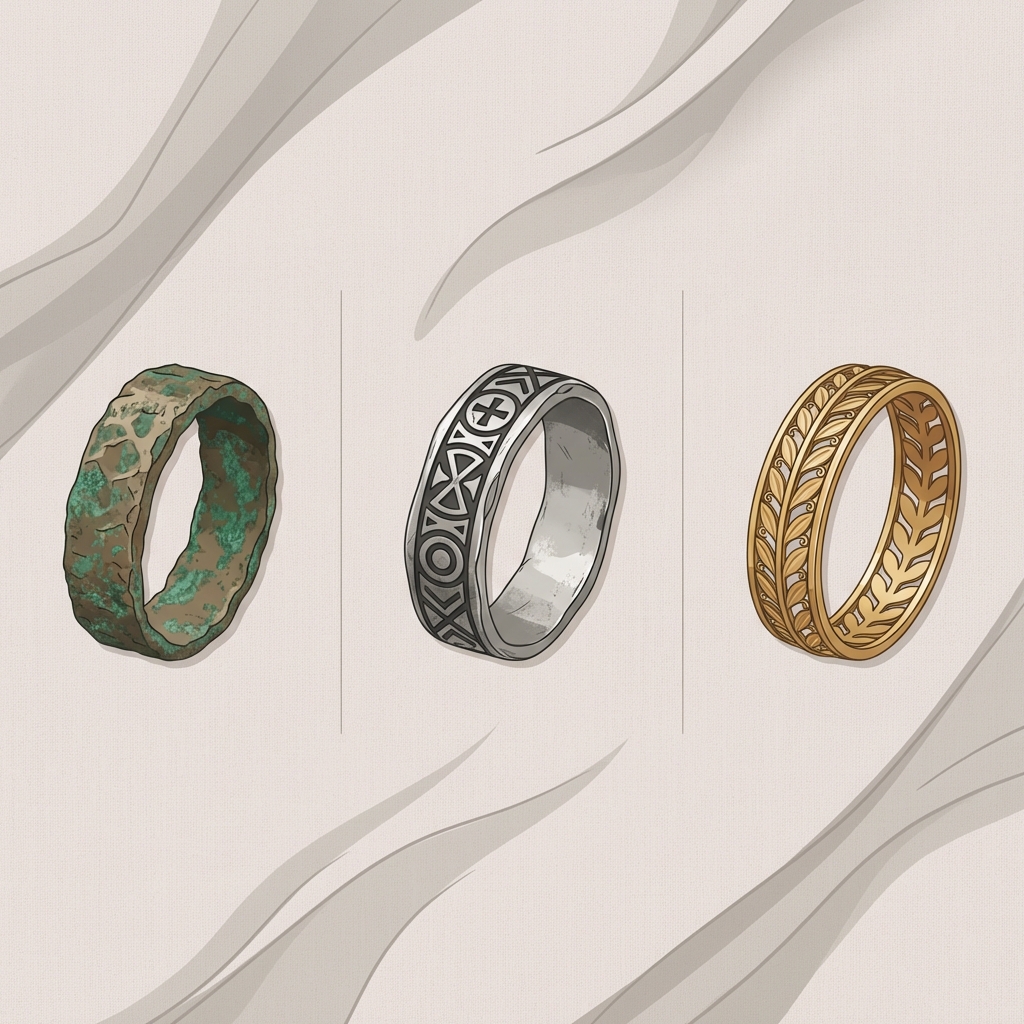
Ask sellers to specify any metal additions, soldering, or modern replacements, and request before and after images when possible. That information helps you understand whether a ring is structurally safe to wear and what visual features are original versus later interventions.
Summary: what the Bible says and what it does not say about jewelry
Key takeaways are that the Bible generally offers contextual exhortations about modesty and avoiding idolatry rather than a single, definitive prohibition on jewelry for all believers and times. New Testament writers use clothing and jewelry language to make rhetorical points about communal witness and worship conduct, and prophetic texts deploy adornment imagery as metaphor 1 Peter 3:3-4, Bible Gateway.
Archaeology and museum evidence show rings were common in antiquity and sometimes served marital functions in particular localities, but practices varied by region and period. For readers considering an ancient wedding band the sensible next steps are to consult available documentation, weigh community norms and personal conscience, and prioritize clear condition and provenance information when buying.
No, the Bible does not present a single universal ban on jewelry. Key passages typically function as contextual exhortations about modesty and worship conduct rather than blanket prohibitions.
Some ancient rings appear in contexts consistent with betrothal or marital exchange, but practices varied across regions and periods, so each object should be evaluated on its evidence and context.
Request clear photos, measurements, condition and restoration notes, and any provenance or collection history; ask for verification letters or supporting documentation when available.
More from Aurora Antiqua
References
- Catalogue of the Engraved Gems and Finger-Rings in the Ashmolean Museum, II: Roman, BAR Publishing, via Fulcrum
- Philip Kiernan and Klaus-Peter Henz, Rings from the Forbidden Forest, Cambridge University Press
- Ring, Victoria and Albert Museum, London
- William Wytlesey's ring, Victoria and Albert Museum, London
- Une bague-amulette judéo-chrétienne, Persée, Revue des etudes juives
- ring, Victoria and Albert Museum, London
- Internet History Sourcebooks: Medieval Sourcebook, Internet Medieval Sourcebook, Fordham University, New York
- About us, International Association of Dealers in Ancient Art