


Looking for the real thing? Browse genuine ancient rings for sale, each piece one of one, individually authenticated, with documented provenance. For the background, see the guide to ancient jewelry.
Quick overview: what 'samurai jewelry' usually includes and where ancient japanese rings fit
Collectors often use the phrase samurai jewelry to describe a wide range of personal ornaments associated with warrior households, but the most characteristic objects are actually parts of sword mountings and dress fittings such as tsuba, menuki and kozuka that combined practical and symbolic roles rather than standalone rings, and museum catalogues reflect that concentration on fittings and mounts The Metropolitan Museum of Art. NPO Japan Mokumegane Research Institute.
A short definition of terms helps clarify conversation. A tsuba is the handguard of a Japanese sword, menuki are small decorative grips placed under the wrapping of the hilt, kozuka is a small utility knife set into a pocket on a sword mount, and kanzashi are hair ornaments used within samurai households. The phrase ancient japanese rings refers here to rings produced in the same cultural and chronological circles that can be associated with samurai owners, rather than implying a single distinctive samurai ring type.
Rings appear less frequently in samurai inventories than fittings, amulets, or hair ornaments, and when rings are present they tend to reflect wider Japanese fashions or continental influences rather than forming a discrete samurai corpus, a pattern visible in period records and later collection summaries Encyclopaedia Britannica.

Materials and techniques: metals, alloys and finishes used by samurai artisans
High-status fittings and personal ornaments were often made from specialized alloys and surface treatments chosen for their colour, finish and corrosion behaviour; common materials include shakudo and shibuichi, mixed copper alloys, gilt silver and lacquered metalwork, and these selections affect both appearance and long term patina The Metropolitan Museum of Art.
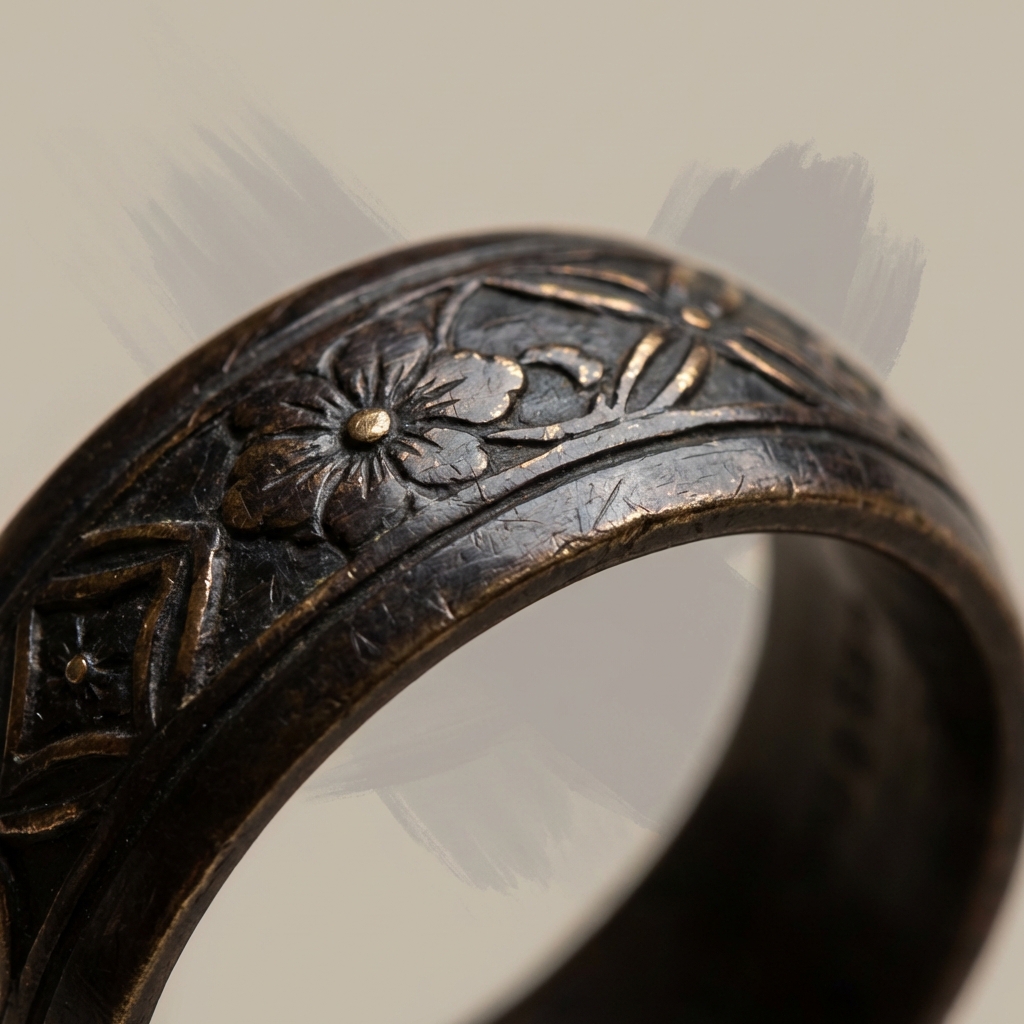
Shakudo typically yields a dark, almost black patina when treated, while shibuichi produces subtle grey-green tones; these results come from deliberate finishing and ageing processes, and recognising those patinas helps collectors distinguish original surface treatment from recent chemical alteration Asian Art Museum, San Francisco.
In many cases a visual assessment of surface texture, inlay edges and soldering gives reliable clues to technique, but when material identification is uncertain or when the item's history is complicated, specialist metallurgical analysis can provide objective confirmation of alloy composition and manufacturing sequence.

Forms and functions: tsuba, menuki, kozuka and how ancient japanese rings relate to them
Functional roles of fittings are often obvious: a tsuba protects the hand and balances the blade, menuki improve grip and are visible elements of the hilt, and kozuka are small utility blades set into the mount; together they create a visual ensemble that signals style, affiliation and the owner's taste The British Museum.
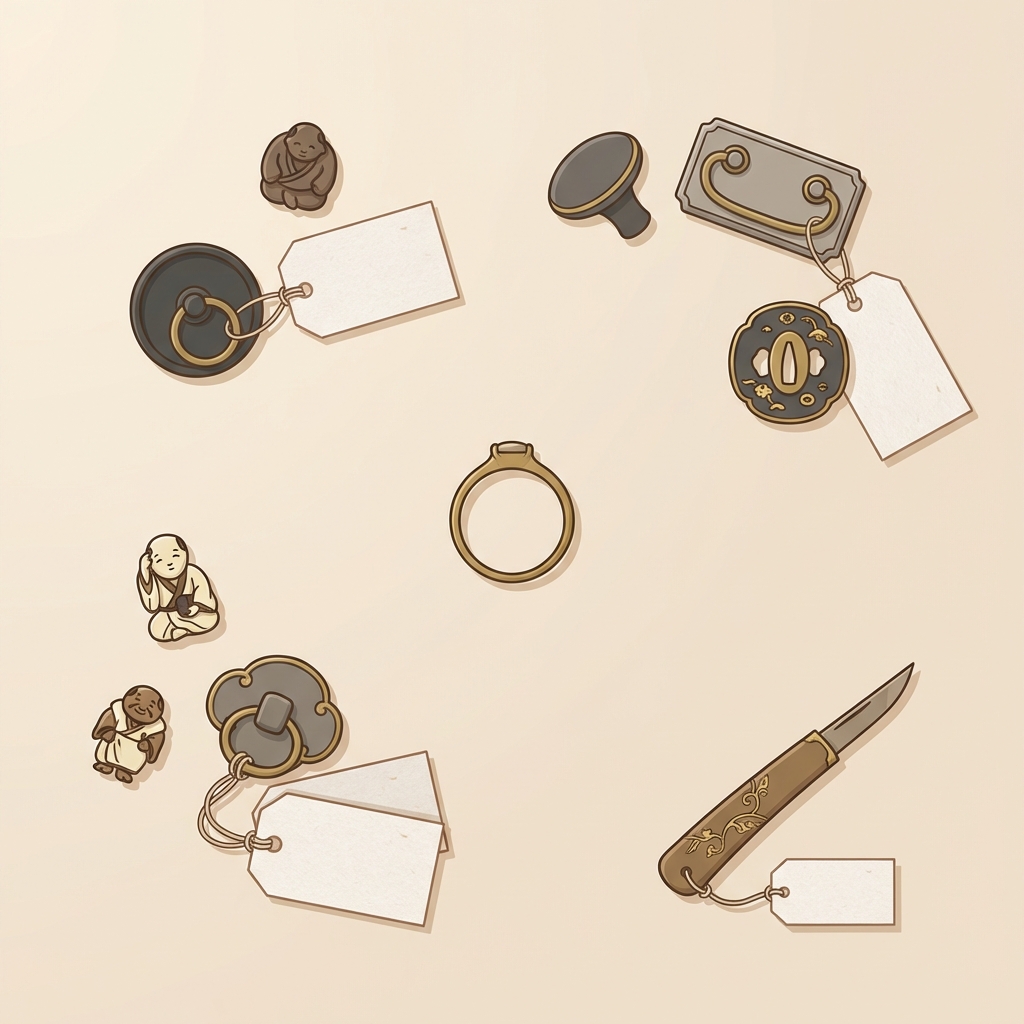
Beyond pure function, menuki and tsuba commonly carried symbolic content and status signaling through motifs, materials and finishing techniques; a well decorated tsuba could indicate a workshop, a patron's taste or a clan association without being a separate class of jewelry in the way a signet ring might be elsewhere The Metropolitan Museum of Art.
Follow behind the scenes at @auroraantiqua for provenance notes and restoration insights
If you are assessing a listing that claims samurai association, consider requesting clear close-up photos and any available documentation before you pursue an offer; sellers and curators can usually provide additional shots or condition notes on request.
Where rings do appear with samurai provenance they are often personal choices reflecting wider dress fashions, foreign influence or family preference rather than a standard samurai ring form. That is why collectors should treat rings described as samurai-associated with particular care, and look for contextual evidence beyond a single stylistic similarity.
Iconography and motifs: reading designs on samurai fittings and ornaments
Designs on fittings draw on a small set of expressive families: religious and mythic imagery, natural motifs such as plants and animals, and clan emblems or heraldic devices; these choices signalled protection, affiliation or aesthetic taste rather than a single fixed meaning The British Museum.
Nature motifs, including waves, cranes, chrysanthemums and stylised plants, could be decorative while also alluding to seasonal or poetic associations familiar to the wearer; similarly, religious iconography could be protective or devotional depending on context and accompanying objects.
To interpret a motif responsibly, compare the object to museum catalogue entries and collection guides that document workshop attributions and recurring patterns, as repetitive imagery alone does not substitute for provenance or maker attribution The Metropolitan Museum of Art.
How museums and specialists identify genuine samurai ornaments
Museum practice emphasises typological comparison and maker-school attribution as primary methods for identifying fittings and ornaments, using documented examples and curated catalogues to match form and decoration rather than relying on a single laboratory test Encyclopaedia Britannica. For historic tsuba compendia see the Museum of Fine Arts, Boston scan catalogue.
Condition notes are central: patina, tool marks, soldering patterns and traces of old repairs are routinely recorded by curators because they help distinguish original manufacture from later interventions, and those observations should appear in any credible listing or condition report About us, International Association of Dealers in Ancient Art.
When documentary evidence is missing or doubtful, conservators and specialists may recommend scientific techniques such as metallurgical analysis or X-ray imaging to test alloy composition and internal structure; these methods supplement typology and provenance rather than replace them The British Museum.
Why rings are comparatively uncommon in samurai material culture
Socially and sartorially, samurai ornament tended to centre on arms, sword mountings and dress fittings rather than finger rings; inventories and household records often list fittings and amulets more consistently than rings, so rings do not form a clear, distinctive samurai typology Encyclopaedia Britannica.
Samurai jewelry is primarily sword fittings and household ornaments such as tsuba, menuki and kozuka; ancient japanese rings do exist but are comparatively uncommon and usually reflect broader fashion or personal taste rather than a distinct samurai ring type.
If a listing presents a ring as samurai-associated, ask whether there is supportive provenance, documented collection history, or maker attribution before accepting the claim; these are the same checkpoints museums use when classifying fittings and ornaments.
Complicating assessment further are secondary markets and trade in the 19th and 20th centuries, which sometimes mixed fittings and jewellery across collections and dealers; that trade history can blur provenance chains, so a careful provenance summary is especially important for rings with samurai association Research report: export licensing and provenance, GOV.UK, Department for Culture, Media and Sport (DCMS).
A practical buyer checklist: how to assess an ancient Japanese piece before you buy
Good listings give prospective buyers both measured photos and clear measurements: overall dimensions, weight where relevant, and close-ups of areas that show maker marks, solder points and the edge of any inlay or applied decoration The British Museum.
Request explicit provenance information: prior ownership notes, any collection history, and copies of verification letters or catalogue entries if available. Those documentary traces form the core of what museums use to connect an object to a workshop or owner J. Paul Getty Museum Collection Policy, Board of Trustees.
a short evaluation checklist for photographic and provenance checks
Use this to guide questions to the seller
Insist on transparent restoration and preservation notes: what was stabilised, whether any structural repairs were carried out, and whether surface cleaning was limited to non-invasive methods. Sellers should state what was left untouched as well as what was repaired.
Common pitfalls and red flags collectors should watch for
Watch for over-reliance on a single decorative motif as proof of samurai association; stylistic similarity can suggest influence but is not sufficient evidence for attribution without supporting provenance or typological match The Metropolitan Museum of Art.
Unclear or missing provenance is a frequent red flag. Listings that lack collection history, prior ownership notes, or independent verification should prompt caution, and buyers should ask for documentary evidence before proceeding The Past Polluted: A Pigovian Approach to the Black Market in Antiquities, International Journal of Cultural.
Be sceptical when condition descriptions read as too-good-to-be-true. Very optimistic language about condition with no supporting photos of critical areas such as solder joints or patina transitions is a warning sign and a reason to request more detail or decline the purchase.
Reading condition and restoration notes: what restorers often record
Restoration notes typically distinguish stabilisation from visible repair; stabilisation often means corrosion inhibitors or discrete structural consolidation, while visible repair refers to soldering, replaced elements or filled losses, and both should be described in detail in a condition report ICOM-CC, International Council of Museums, Committee for Conservation.
In photographs, look for consistent patina across joins, visible tool marks that match known workshop practice, and the absence of fresh filing or bright solder where old joins should show age; restorations often show different texture and reflected light than original surfaces The Metropolitan Museum of Art.
Sellers and conservators should disclose any chemical cleaning or aggressive polishing that could have altered the surface appearance. Transparent restoration notes help buyers set realistic expectations for display or wearable use and for future conservation needs Conserve O Gram 10/2: Caring For Silver And Copper Alloy Objects, National Park Service, US Department.
Examples and scenarios: reading three sample listings for samurai-related pieces
Sample A, a tsuba with a clan motif, should be evaluated for maker marks, construction of the guard, and the motif's typological matches in museum catalogues; if a tsuba shows consistent inlay technique and documented provenance, typological comparison may suffice to support a reasonable attribution Encyclopaedia Britannica.
Sample B, a menuki offered with sparse provenance, asks the buyer to prioritise condition photography, close-up images of solder and attachment areas, and any prior collection labels; if those are absent, a specialist opinion or comparative catalogue entry should be sought before payment Standards: Konservatorische Behandlung von archäologischen Funden (conservation of archaeological finds), Bundesdenkmalamt Österreich.
Sample C, a ring described as samurai-associated, is the scenario that most often requires extra caution. A ring might match a period style, yet lack the contextual chain tying it to a samurai household, so ask for explicit collection history and look for corroborating evidence such as estate inventories or documented provenance that links the ring to known owners or collections The British Museum.
Decision points for all three samples follow a simple rule: if the listing provides clear images of maker marks, consistent condition notes, and reasonable provenance, proceed to specialist assessment where necessary; if any of those elements are missing, pause and request the evidence before committing.
How Aurora Antiqua approaches curation, documentation and condition notes
Aurora Antiqua acts as an expert curation reference and trust layer for buyers who want clear context and documentation rather than as an archaeological authority; listings emphasise historical background, condition notes and the limits of online description.
The brand offers curated ancient rings spanning Roman, Greek, Byzantine, Islamic, Celtic, medieval, and post medieval periods, select small artifacts and relic objects offered alongside jewelry, restoration and preservation notes that describe what was stabilised, repaired, or left untouched, provenance and documentation references when available, and editorial and historical content that explains cultural context, symbolism, and historical background tied to pieces. These capabilities are presented to help readers set expectations and to encourage requests for supporting documentation when needed.
Buyers should understand that online descriptions have limits; when dating or attribution is critical for a purchase decision, request scans or copies of provenance documents or consider independent specialist assessment.
Where to get specialist assessment and further research
Museum catalogue entries and collection guides remain the first reference points for typological comparison; consulting up-to-date online catalogues and curated collection essays can help match motifs and workshop practice to documented examples The British Museum.
For technical questions, conservators and independent metallurgical analysts can perform alloy tests or imaging, and academic specialists in material culture can advise on stylistic and typological attribution; when such reports are produced, keep copies as part of the provenance record.
Use scientific testing responsibly: where documentary evidence is lacking, selected analytic techniques can clarify composition or internal structure, but these tests should be commissioned through qualified conservators and laboratories so results can be interpreted in the wider typological and provenance context E.C.C.O. Professional Guidelines (II): Code of Ethics, European Confederation of Conservator-Restorers'.
Final checklist and next steps for collectors
Summary checklist: request high-resolution photos, precise measurements, maker marks and close-ups of patina and solder joints; ask for provenance notes, prior ownership information and any verification letters; insist on clear restoration notes that distinguish stabilisation from repairs The Metropolitan Museum of Art.
Prioritise actions by risk: for rings described as samurai-associated, demand provenance and typological matches before bidding; for fittings with clear maker marks or published comparisons, specialist advice may be sufficient for confident purchase decisions.
When in doubt, pause and request a professional opinion. Documentation and transparent condition reporting are the tools that let collectors treat ancient objects responsibly and enjoy wearable connections to the past.
No. Rings appear less frequently in samurai inventories than sword fittings, hair ornaments and amulets and often reflect wider fashion rather than a distinct samurai ring type.
Look for typological matches in museum catalogues, consistent patina and tool marks in photos, and clear provenance records; if those are missing, consider specialist assessment.
Request metallurgical analysis or imaging when provenance is unclear or when the piece's material or construction is critical to its attribution.
More from Aurora Antiqua
References
- About us, International Association of Dealers in Ancient Art
- Research report: export licensing and provenance, GOV.UK, Department for Culture, Media and Sport (DCMS)
- J. Paul Getty Museum Collection Policy, Board of Trustees
- The Past Polluted: A Pigovian Approach to the Black Market in Antiquities, International Journal of Cultural
- ICOM-CC, International Council of Museums, Committee for Conservation
- Conserve O Gram 10/2: Caring For Silver And Copper Alloy Objects, National Park Service, US Department
- Standards: Konservatorische Behandlung von archäologischen Funden (conservation of archaeological finds), Bundesdenkmalamt Österreich
- E.C.C.O. Professional Guidelines (II): Code of Ethics, European Confederation of Conservator-Restorers'