


Looking for the real thing? Browse authenticated ancient artifacts, each piece one of one, individually authenticated, with documented provenance. For the background, see the guide to ancient jewelry.
What wearing an antique scarab ring signified in ancient Egypt
Wearing an antique scarab ring can mean different things depending on date, form and context. In many ancient Egyptian sources the scarab motif is closely associated with the solar idea of regeneration tied to the god Khepri, a reading reflected in museum interpretive entries that trace the motif's symbolic links to rebirth and the rising sun Metropolitan Museum of Art scarab entry and the Wikipedia scarab ring entry.
In practice, scarabs functioned as both amulets placed on the body or in tombs and as small seals used in daily administrative and personal contexts, so a scarab mounted in a ring could carry devotional, protective or practical meanings depending on how it was used British Museum collection term page for scarabs.
Wearing a scarab ring can signify renewal, protection or personal identity depending on form and context; determine likely antiquity by combining typology, material identification, mounting and provenance documentation, and seek specialist input when evidence is unclear.
Different scarab types transmit slightly different emphases: a heart-scarab used in funerary contexts often emphasizes an afterlife function, while a flat-back scarab used as a seal can indicate identification or administrative purpose, so reading a ring requires attention to type and use Encyclopaedia Britannica entry on the scarab.
Khepri and the scarab image
The link between the scarab and Khepri, the morning sun manifestation, means that for many ancient wearers the motif could symbolise renewal or a daily rebirth, often in personal devotional practice rather than as a single fixed message Metropolitan Museum of Art scarab entry.
Rebirth, regeneration and solar symbolism
The scarab's solar and regenerative associations are durable interpretive threads in scholarship, but they should be balanced with evidence of how an individual object was used, since meaning can shift by type, inscription and archaeological context Encyclopaedia Britannica entry on the scarab.
Common forms of an antique scarab ring: materials, shapes and mountings
Recognising whether a ring contains steatite, faience or a harder stone such as carnelian or agate is a first step in estimation, because material and surface finish can help narrow likely periods and workshop practices OIP 118. Scarabs, Scaraboids, Seals, and Seal Impressions from Medinet Habu, Institute for the Study of Ancient.
Typical materials include carved steatite often glazed or unglazed, faience variants with a bright surface, and glazed or polished hardstones such as carnelian, agate and occasionally amethyst; each material responds differently to wear and cleaning, which affects visible patina and surface detail Gemstones. In: UCLA Encyclopedia of Egyptology (James A. Harrell), University of California, Los Angeles.
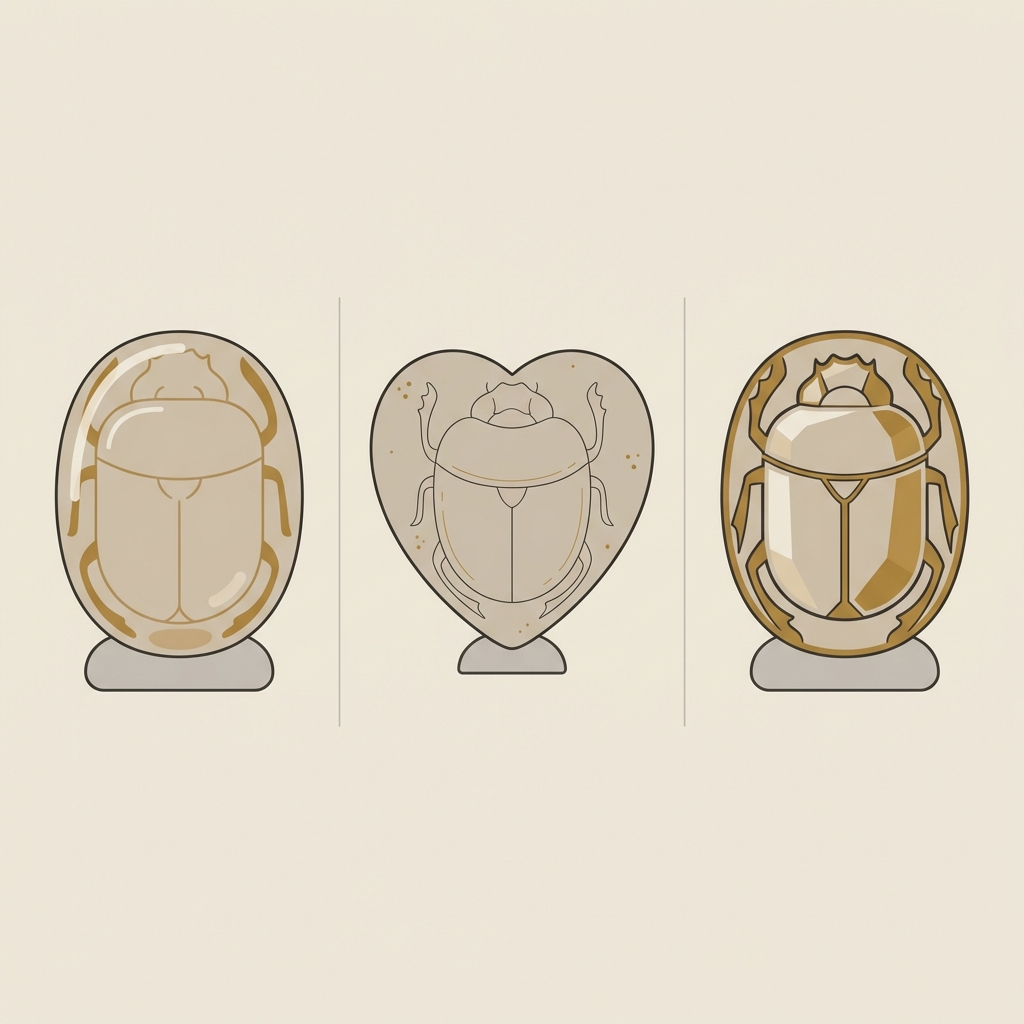
Materials: steatite, faience and hardstones
Steatite was a common, workable base that could be glazed; faience offered a glasslike sheen and harder stones were often used for more personal or higher status seals and ornaments, so material can be a rough proxy for intended use but rarely provides a conclusive date without comparative study Metropolitan Museum of Art scarab entry.
Typologies: flat-back, heart-scarab, intaglio mounts
Flat-back scarabs often served as seals and therefore may show a carved base with an inscription or device intended to leave impressions, while heart-scarabs are commonly associated with funerary installations and may show different mounting choices when later adapted as rings Scarab. In: UCLA Encyclopedia of Egyptology (Kathlyn M. Cooney), University of California, Los Angeles.
Mounting methods used in different periods
Rings can be ancient mounts or later remounts where an older scarab was set into a newer hoop; common historic mount styles include simple bezels and wire hoops, and later adaptations sometimes use soldered settings that alter original context and complicate dating Ashmolean Museum guide to scarabs.
How scarabs worked as seals and amulets: function and evidence
From the Middle Kingdom onward many scarabs served both as amulets and as seals for personal and administrative use, so a base with an intentional design for impression strongly suggests sealing use rather than purely symbolic wear British Museum collection term page for scarabs.
Evidence of sealing use can include a clearly carved base with an incised design or hieroglyphs and, where available, surviving impressions in clay that match the device, which helps confirm an object functioned as a seal in antiquity British Museum collection term page for scarabs.

Mounting a scarab into a ring can be an ancient practice or a later reuse; when a scarab is remounted the archaeological context changes and details such as drill marks or solder joints should be considered when estimating date and origin British Museum collection term page for scarabs.
Seal impressions and administrative use
Where documentation or comparative collection images show matching impressions, that evidence strongly supports an interpretation of sealing use, which can alter how a ring was valued and worn in daily life OIP 118. Scarabs, Scaraboids, Seals, and Seal Impressions from Medinet Habu, Institute for the Study of Ancient.
Personal amuletic use and funerary contexts
Scarabs placed in tombs or paired with funerary texts often underline regenerative meanings rather than administrative identity, so when a scarab ring exhibits forms typical of funerary heart-scarabs its original use may have been devotional before any later conversion into jewellery Metropolitan Museum of Art scarab entry.
A step-by-step approach to assessing date and attribution for an antique scarab ring
Begin with typology: compare the scarab's profile, the carving style and the material to museum typologies and catalogued examples to form an initial impression of period and workshop tendencies OIP 118. Scarabs, Scaraboids, Seals, and Seal Impressions from Medinet Habu, Institute for the Study of Ancient.
Next inspect mounting and toolmarks: look for drill angles, recarving signs and soldered joins that indicate later remounting or restoration, and consider whether abrasions are consistent with age or modern handling Fitzwilliam Museum scarab collection notes.
Start with typology and material
Typology and material together narrow plausible timeframes: for example, glazed steatite forms and certain base motifs can point to long-standing types used across centuries, so comparison to dated examples is essential rather than relying on visual similarity alone Scarab. In: UCLA Encyclopedia of Egyptology (Kathlyn M. Cooney), University of California, Los Angeles.
Check mounting and toolmarks
Toolmarks can be diagnostic because ancient drills and later power tools leave different traces; if photographs show uniform modern drill patterns or machine-sanded surfaces that is a reason to question a strictly ancient attribution and to request clearer condition notes Fitzwilliam Museum scarab collection notes.
Cross-check with documented examples
Use museum collection pages and published catalogues to find closely matching examples, and prefer documented parallels with clear collection histories and publication entries when forming an attribution Metropolitan Museum of Art scarab entry.
Later reuse: why a scarab motif does not always mean Pharaonic origin
The scarab motif was reused and reinterpreted in Coptic, Byzantine and Islamic regional jewellery traditions, so the presence of a scarab device alone does not guarantee a strictly Pharaonic origin in every case Penn Museum overview of scarab seals and amulets.
Technical clues that indicate later regional manufacture include different mounting conventions, alternative carving conventions and combinations of materials not typical of earlier Egyptian workshops, which together with provenance information help separate original pharaonic objects from later adaptations Ashmolean Museum guide to scarabs.
Compare base, drill marks and mount to museum examples
Use with listing photos
Coptic, Byzantine and Islamic reinterpretations
Regional reinterpretations often preserve the iconography while changing technical execution, so a careful read of toolmarks and mount style alongside documented parallels is essential to avoid assuming an older date than the evidence supports Penn Museum overview of scarab seals and amulets.
Signs of regional or later manufacture
Look for later soldering, polished modern metalwork or composite mounts combining non-contemporary materials; when such features appear they suggest adaptation rather than a pure pharaonic object and point to a layered history of reuse Ashmolean Museum guide to scarabs.
Warning about motif-only dating
Because the scarab motif persisted across periods, confident dating relies on combined evidence: material identification, mounting examination and provenance records rather than motif alone Penn Museum overview of scarab seals and amulets.
Condition, restoration notes and conservation best practices for scarab rings
Sellers and catalogues should include clear restoration notes indicating what was stabilised, what was repaired and what was intentionally left untouched, because those statements affect how conservators and researchers read surface features and patina Metropolitan Museum of Art scarab entry.
Museum conservation guidance stresses avoiding aggressive cleaning that can remove patina and diagnostic wear; when work is necessary consult a conservator who can advise on reversible treatments that preserve evidence used in attribution Archaeological materials, Icon, The Institute of Conservation (UK).
What restoration notes should tell you
Useful restoration notes specify adhesives or consolidants used, areas that were restored, and whether repairs are visible in photographs; transparent condition notes allow buyers to evaluate how much intervention may have altered diagnostic features such as toolmarks or surface residues Metropolitan Museum of Art scarab entry.
Conservation do's and don'ts
Do keep patina and loose accretions intact when possible and document them; do not attempt strong mechanical cleaning or harsh chemical dips that can erase microscopic wear patterns important for specialist assessment Conserve O Gram 10/2: Caring For Silver And Copper Alloy Objects, National Park Service, US Department.
Provenance and documentation: what helps build confidence in an antique scarab ring
Good provenance notes include prior collection history, acquisition dates, any export documentation available and clear statements about past ownership or cataloguing because these elements allow researchers to trace an object's documented chain of custody and context British Museum collection term page for scarabs.
Third-party checks such as published collection entries, accession numbers or catalogue citations increase confidence, especially when the same object appears in institutional records or has been compared to securely dated parallels scarabée ; amulette, Louvre site des collections, Musee du Louvre, Departement des Antiquites egyptiennes, Paris.
See curated scarab ring examples and their documentation on @auroraantiqua
Review a curated selection of scarab rings that include condition and provenance notes to better understand how documentation changes confidence in attribution.
Types of useful provenance statements
Statements that cite prior collection names, acquisition circumstances, or references in published catalogues are more informative than generic phrasing; clear language about gaps or uncertainties is preferable to assertions of certainty without evidence British Museum collection term page for scarabs.
Third-party checks and collection records
Consulting museum collection pages and published catalogues lets you compare form and inscription details to dated examples, and documented parallels in institutional holdings are often more persuasive than unattributed visual similarity alone Metropolitan Museum of Art scarab entry.
A practical buying checklist for evaluating an antique scarab ring
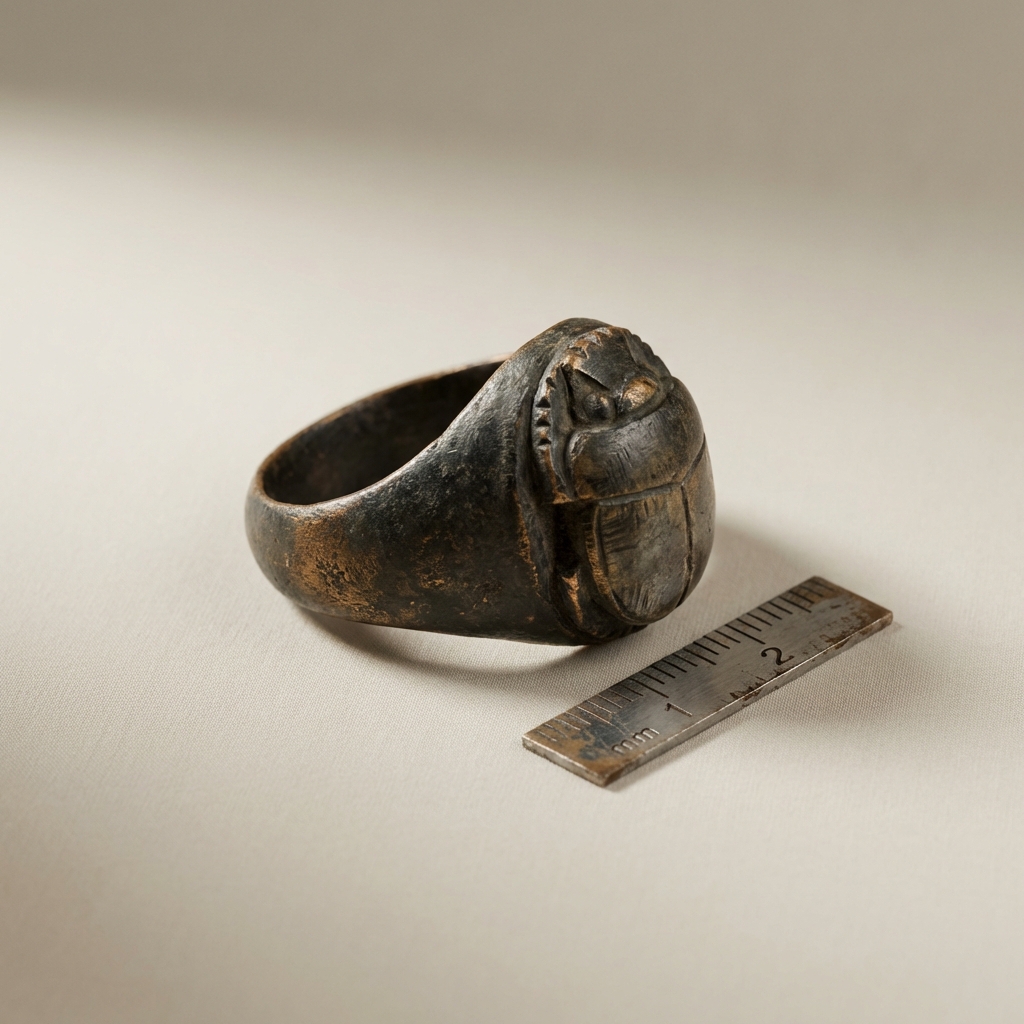
Request high-resolution images of the scarab's base, profile, mounting and any areas of wear or restoration, plus exact measurements and a clear view of the hoop or bezel so you can assess scale and setting details before purchase British Museum collection term page for scarabs and consult the rings collection for examples.
Ask targeted questions about material testing, what restoration work was done and whether the seller can supply provenance documentation or references to prior cataloguing; if answers are incomplete, consider seeking a specialist opinion Penn Museum overview of scarab seals and amulets.
Photos and measurements to request
Essential images include macro photos of the base, side profiles showing drill holes, the inside and outside of the mounting, and a scale reference; request measurements in millimetres and the ring's internal circumference or size for accurate fit assessment British Museum collection term page for scarabs.
Key questions to ask sellers
Key questions cover whether any adhesives or consolidants were used, whether material testing has been conducted, and whether there is a documented chain of custody or prior cataloguing that can be checked against institutional records Penn Museum overview of scarab seals and amulets.
Common buyer mistakes and how to avoid them
A frequent error is assuming that the scarab motif alone proves a pharaonic date; motif reuse across later regional periods means motif-only dating can be misleading without supporting material or provenance evidence Penn Museum overview of scarab seals and amulets. For practical notes on modern forgeries see Fake scarabs.
Another common issue is over-reliance on highly polished catalogue photography that conceals patina or mounts; ask for unedited close-ups and condition notes to evaluate whether images have been overly retouched Metropolitan Museum of Art scarab entry.
Assuming motif equals period
Because later craftsmen often copied or reused scarab imagery, verify dating with material analysis and comparative references rather than taking iconography alone as proof of an early date Scarab. In: UCLA Encyclopedia of Egyptology (Kathlyn M. Cooney), University of California, Los Angeles.
Over-reliance on attractive photographs
Insist on raw, high-resolution photos of diagnostic areas and request condition statements; if a seller cannot provide these, treat the listing with caution and consider a specialist report before purchase Metropolitan Museum of Art scarab entry.
Illustrative scenarios: reading three typical antique scarab ring listings
Scenario A: A compact, well-worn flat-back scarab with a clear carved device and a simple ancient hoop might be a Middle Kingdom seal reused as a ring; evidence points to an ancient sealing function when base carving matches documented seal impressions and patina appears consistent OIP 118. Scarabs, Scaraboids, Seals, and Seal Impressions from Medinet Habu, Institute for the Study of Ancient.
Scenario B: A scarab motif set in a highly polished modern bezel with machine-soldered joins and a glossy hardstone that lacks surface wear suggests a later-era motif in a remounted ring, which calls for caution and requests for material testing or documentation About us, International Association of Dealers in Ancient Art (see a 1stdibs listing) and compare with the ancient Roman rings collection.
Scenario C: An ambiguous listing with partial provenance, unclear images and mixed materials is a case for specialist input; provide high-resolution images, restoration notes and any provenance to a conservator or researcher to reduce uncertainty Metropolitan Museum of Art scarab entry.
Scenario A: likely Middle Kingdom seal reused as ring
Top evidence points: carved base matching seal impressions, wear consistent with age, and a simple ancient hoop; next steps include requesting close-up images of the base and any impressions for comparison with museum examples Scarab, National Museums Liverpool (World Museum).
Scenario B: later-era motif in a remounted ring
Top evidence points: modern mounting, lack of patina, and machining marks; next steps include asking for material testing and provenance statements to determine whether the scarab was repurposed About us, International Association of Dealers in Ancient Art.
Scenario C: ambiguous case needing specialist input
Top evidence points: incomplete documentation, mixed signals from material and mounting, and unclear toolmarks; next steps include seeking a conservator's condition report or a provenance researcher to review available records Metropolitan Museum of Art scarab entry.
Wearing a scarab ring today: symbolism, etiquette and meaning for collectors
Modern wearers often adopt historic symbolic readings as personal meanings without claiming to replicate original ancient intent, so describing what a scarab symbolised historically can enrich contemporary use without asserting a single authoritative message Encyclopaedia Britannica entry on the scarab.
When wearing an ancient ring, basic precautions include avoiding saltwater, heavy impact and rough manual tasks, and keeping documentation such as condition notes and provenance with the piece for future reference or study Penn Museum overview of scarab seals and amulets and see can you wear ancient rings.
Modern symbolic readings
Collectors may value the scarab for its long association with renewal and protection while also appreciating the personal resonance a historic object can acquire over time; use careful language when explaining provenance to others and note uncertainties where they exist Encyclopaedia Britannica entry on the scarab.
Care when wearing an artifact
Wear with caution, minimise exposure to chemicals and abrasion, and store documentation with the object; if routine maintenance is required consult a conservator rather than attempting amateur cleaning that could remove patina or diagnostic residues How to Care For Your Jewellery: The Ultimate Guide by the National Association.
When to seek specialist input: conservators, gem analysts and provenance researchers
Conservators can advise on safe cleaning, stabilisation and non-destructive analysis, while gem analysts and material specialists can help identify stone types and treatments; provide specialists with high-resolution photos and all available provenance documentation to speed assessment Archaeological materials, Icon, The Institute of Conservation (UK).
Non-destructive testing has limits: some material identifications or questions about drilling sequences may require invasive sampling to be definitive, so set realistic expectations and prefer reversible conservation steps when possible British Museum collection term page for scarabs.
Which expert for which question
A conservator is the right contact for stabilisation and cleaning questions, a gemologist or materials lab can advise on stone identification, and a provenance researcher can help trace collection histories and documentation Fitzwilliam Museum scarab collection notes.
What information to provide to a specialist
Supply high-resolution images of the base, side profiles, any inscriptions, restoration notes, and provenance statements; these items let specialists give a faster and more accurate assessment without unnecessary invasive testing Metropolitan Museum of Art scarab entry.
Summary: key takeaways about what wearing an antique scarab ring means and how to assess one
The scarab motif links historically to Khepri and ideas of regeneration, but a ring's meaning depends on type, material, mounting and documented context, so interpretive claims should rest on combined evidence rather than motif alone.
Before buying, prioritise clear photos, condition and restoration notes, material identification where available, and transparent provenance statements; request specialist input when documentation or imagery leave significant questions.
Further reading and references
Consult major collection pages for typology and comparison: the Metropolitan Museum of Art, the British Museum, the Ashmolean and specialist pages at the Penn Museum and the Fitzwilliam provide searchable images and cataloguing entries useful for close comparison Metropolitan Museum of Art scarab entry. Also consult the ancient Roman rings collection for related catalogue examples.
Use institutional collection pages to compare base motifs, material and mounting, and prefer examples with clear provenance or published catalogue entries when seeking confident parallels British Museum collection term page for scarabs.
Look for a carved base with an intentional device or hieroglyphs, and request close-up images or impressions; matching impressions in clay or catalogued parallels strengthen a sealing interpretation.
Good notes state what was stabilised or repaired, the materials or adhesives used, and what was left untouched so buyers can judge how intervention may have affected surface evidence.
Seek specialist input when provenance is incomplete, images are unclear, or toolmarks and mounting suggest possible recarving or remounting that affect attribution.
More from Aurora Antiqua
References
- OIP 118. Scarabs, Scaraboids, Seals, and Seal Impressions from Medinet Habu, Institute for the Study of Ancient
- Scarab. In: UCLA Encyclopedia of Egyptology (Kathlyn M. Cooney), University of California, Los Angeles
- Gemstones. In: UCLA Encyclopedia of Egyptology (James A. Harrell), University of California, Los Angeles
- scarabée ; amulette, Louvre site des collections, Musee du Louvre, Departement des Antiquites egyptiennes, Paris
- Scarab, National Museums Liverpool (World Museum)
- Archaeological materials, Icon, The Institute of Conservation (UK)
- Conserve O Gram 10/2: Caring For Silver And Copper Alloy Objects, National Park Service, US Department
- About us, International Association of Dealers in Ancient Art
- How to Care For Your Jewellery: The Ultimate Guide by the National Association
- Scarab ring, Wikipedia