


Looking for the real thing? Browse authenticated ancient rings, each piece one of one, individually authenticated, with documented provenance. For the background, see the guide to ancient jewelry.
The Eye of Horus: definition, functions and where it appears
The Eye of Horus, often called the wedjat, is a long established Egyptian symbol used for protection and restoration; in practice it appears on amulets, funerary equipment and a wide range of small artifacts that mark bodily wholeness and safeguarding in ritual contexts. Scholars and museum catalogs describe the symbol as connected to Horus and to ideas of healing and preservation in pharaonic religion, and these descriptions help explain the motif's persistence across periods and contexts Encyclopaedia Britannica entry on Horus. Fashion History Timeline on the eye of Horus.
In material culture the wedjat appears in varied forms, from inlaid beads and amuletic inlays to carved pendants and painted scenes in tombs; curators use object entries to note whether a piece was intended as personal protection, funerary provisioning or decorative insignia, and those notes are central to how historians read each object The Metropolitan Museum of Art collection entry on wedjat amulets.
Follow behind the scenes for provenance and condition context
At Aurora Antiqua we include condition notes and provenance context with pieces so collectors can evaluate how an object was used and documented.
Across pharaonic, Ptolemaic and later contexts the Eye of Horus continued to function as a visual shorthand for bodily repair and divine safeguarding; museums and long running catalog traditions trace both the symbol and its common uses over many centuries, which is why provenance and catalogue entries matter when assessing a piece. The British Museum collection term on the Eye of Horus
For readers interested in material specifics, examples of wedjat amulets include small faience and stone eyes set into bezels or incorporated into composite jewelry, and wear patterns on such items can show handling or suspension wear consistent with extended use. Condition notes and restoration entries in catalog records often describe whether an object was stabilized or left largely as found, which affects interpretation.
Why some sources compare Horus and Jesus: motifs, not identities
Popular comparisons between Horus and Jesus usually focus on a handful of shared motifs rather than on direct lines of descent or identity: commentators point to motif parallels such as certain birth story elements, motifs of healing or restoration, and protective imagery that can look superficially similar across cultures. These motif comparisons are visible in many summaries and lists that connect religious figures across traditions, but they amount to thematic echoes rather than evidence of identity or direct borrowing Jonathan Z. Smith's critique of comparative method.
No, current scholarship treats Horus and Jesus as distinct; motif parallels are not evidence of identity and should be evaluated within their separate historical contexts.
The core methodological problem is selective motif matching, which reads a few similar narrative or symbolic features as if they establish equivalence between very different religious agents and contexts. In technical terms this is a type of category error: motifs can travel, recur or be analogous without implying that two religious figures are the same person or that one directly inspired the other. Scholars caution that lists of parallels often omit differences in function, social role and theological framing that are crucial for historical claims.
To illustrate, the presence of a healing motif in an Egyptian myth and a healing story in a Judean context does not by itself demonstrate borrowing. Context, audience, and the institutional meanings of those narratives in their respective communities are essential to understanding what the motifs did in practice and how they were interpreted by contemporaries.
Historical Jesus scholarship places Jesus in a first century Jewish setting, engaged with the theological and social debates of his time; his role and reception are framed by first century Jewish practices, texts and social situations rather than by Egyptian deity cycles, which developed in different religious and political systems Stanford Encyclopedia of Philosophy overview of the historical Jesus.
That placement matters for comparative claims because social role and theological function shape why particular motifs gain prominence. Jesus appears in sources as a Jewish preacher and figure within the early messianic and interpretive currents of first century Palestine, while Horus and related Egyptian myths served other social and ritual roles in a very different religious ecology. Treating similar narrative elements as proof of identity ignores those contextual differences and overstates what motif similarity can establish a foundational methodological critique.

Scholars therefore urge caution: surface parallels can be illuminating for comparative study when placed in a careful historical framework, but they cannot substitute for evidence of transmission, shared institutions or direct historical contact that would support claims of identity between figures from distinct traditions.
Iconography and purpose: what eye of horus jewelry signified in antiquity
In antiquity the Eye of Horus was primarily amuletic in purpose, functioning to protect the wearer or to symbolize wholeness after injury or death; this amuletic role is consistently emphasized in museum descriptions and in scholarship that treats Egyptian material religion as a set of enacted protections and restorations rather than as direct doctrinal equivalents of later Christian vocabularies The Metropolitan Museum of Art catalog on wedjat amulets. See the Wikipedia overview.
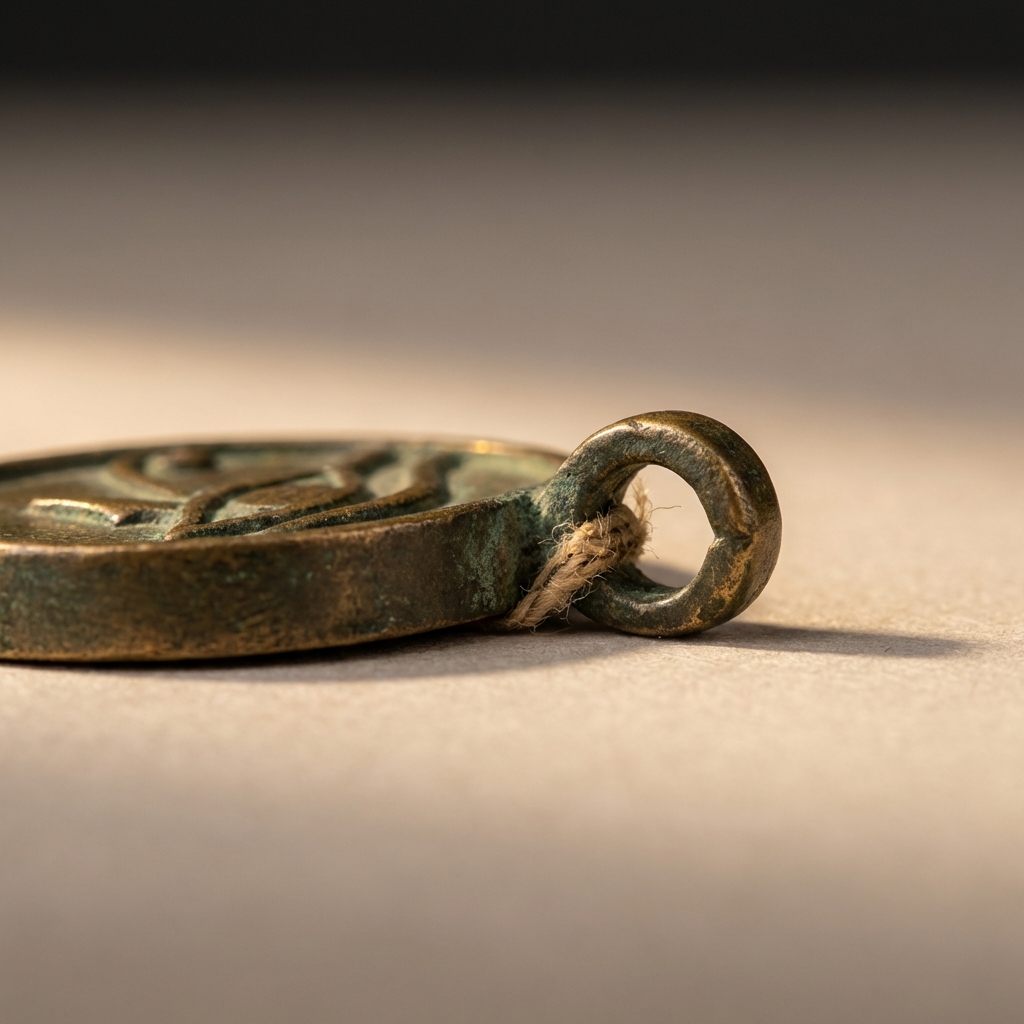
Materially, wedjat items appear in faience, stone, bronze and glass, and they are often small enough to be worn as pendants or attached to a ring or bracelet. Wear consistent with age, patina and the way bezels or suspension holes are finished are all clues curators record when describing an object. Such entries make clear whether a piece is best read as an amulet, a funerary inclusion or a decorative motif incorporated into another object The British Museum summary on the Eye of Horus.
quick cross check of museum records for a candidate piece
Use as a starting point when consulting online collections
The difference in symbolic grammar is important: the wedjat signaled bodily repair and divine protection, whereas Christian visual vocabularies later emphasized incarnational and sacramental symbols such as the cross or eucharistic emblems. Those different visual grammars shaped how people used and wore objects and how communities understood religious agency, so conflating the functions of a wedjat amulet and a Christian devotional image flattens distinct historical practices.
For collectors and readers interested in eye of horus jewelry specifically, looking at materials and wear patterns helps determine intended use. A small faience eye with a drilled suspension hole that shows string mark wear most likely functioned as a personal amulet, while an eye carved as part of a funerary inlay may primarily serve a symbolic role within burial assemblage descriptions. See our artifacts collection for comparable items.
How to evaluate eye of horus jewelry as a collector: provenance, condition and documentation
When assessing an item described as eye of horus jewelry, prioritize documented provenance or collection history, clear condition notes and detailed photographs. Provenance records and catalogue entries allow a buyer to understand an object's documented journey and whether it has been part of a museum or reputable collection, which matters more for scholarly and market assessment than any claim that links it to another religious figure The British Museum guidance on terminology and catalogue data.
A practical checklist for a responsible purchase should include: a clear provenance statement or collection history, high resolution images of both sides, condition notes mentioning stabilization or repairs, and any verification letters or curator correspondence where available. If these items are missing, ask the seller for more detail before proceeding or consult our questions and answers hub.

Restoration notes deserve careful reading. Stabilization that prevents further deterioration is often recorded and need not be an interpretive problem, but undocumented modern repairs or heavy retouching can change how an object should be presented and may complicate attribution. Where restoration is extensive, catalogue entries usually provide a clear description and date range for the intervention.
Equivalence claims linking a wedjat to Christian figures are not a substitute for this basic documentation. Treat sensational comparative language in listings as a red flag: proper scholarly evaluation depends on records, condition notes and institutionally verifiable history rather than on broad cross cultural assertions.
Common mistakes, red flags and interpretive pitfalls for readers and buyers
A frequent mistake in popular listings is to elevate motif parallels into claims of identity, for example by suggesting that similar motifs prove that one religious figure is the same as another. This is often a form of sensationalist comparison that ignores the methodological objections scholars have raised about such parallels Jonathan Z. Smith's methodological critique.
Red flags in provenance and condition reporting include vague or absent collection histories, blanket statements about age without supporting catalog entries, and images that hide critical details such as bezels or suspension holes. Also be wary of listings that claim dramatic connections to well known historical figures without citing verifiable documentation or institutional references.
Another pitfall is misreading restoration notes: sellers may describe stabilization as minimal when a closer inspection would show modern fills or recuts. Ask for conservation reports or clearer photographic detail, or contact us if any repair is described in vague terms, and be cautious when a piece's history depends chiefly on an unverifiable seller story.
Short case studies: reading three examples of Eye of Horus pieces
Case 1, a museum catalog example: a wedjat amulet documented in an institutional online collection shows a standard catalog entry with object id, material description, dating rationale and condition statement. Such entries let readers see how curators date and describe objects and why those fields are essential to confident interpretation An example catalog entry from The Metropolitan Museum of Art. Further scholarly discussion.
Case 2, a private listing example: a typical private sale listing might show attractive photography but omit a clear provenance line or restoration details. In those situations a buyer should ask for previous collection history, any export or import documentation, and high resolution images of edges and suspension points to check for modern work.
Case 3, restoration and interpretation: two pieces with similar form can be read differently when one has a curator's condition note stating early stabilization while the other shows signs of recent recutting. That difference in restoration history affects how a piece is framed for display and how confidently it can be attributed to a particular period or workshop.
Conclusion: how to wear, interpret and write about eye of horus jewelry responsibly
Current scholarship does not treat Horus and Jesus as the same figure; academic work sees motif similarities as limited and methodologically problematic when used to claim identity. For collectors and readers this distinction means that buying decisions should rest on documentation and condition rather than on broad comparative assertions Stanford Encyclopedia of Philosophy guidance on contextual historical method.
Practical priorities are simple: demand provenance, insist on full condition and restoration notes, and place any motif comparisons in their historical context. When sharing images or descriptions, be clear about whether a piece is an ancient amulet, a later reproduction, or a modern reinterpretation so that public interpretation remains accurate and respectful British Museum terminology on collection descriptions.
Respectful wearing is possible when collectors acknowledge multiple receptions of the symbol and are transparent about an object's history. Clear documentation, restrained language about identity claims, and attentiveness to provenance help preserve both the object's history and its meaning to diverse audiences.
Not in a direct theological sense; the Eye of Horus is an Egyptian amuletic motif with its own history, though later receptions can reframe symbols in new contexts.
Request clear provenance or collection history, high resolution images, detailed condition and restoration notes, and any available catalogue or verification letters.
Meanings vary; people wear the motif for historical interest, aesthetic reasons or personal belief, so transparency about origin helps avoid misinterpretation.
More from Aurora Antiqua
References
- Eye of Horus (Wedjat) Amulet, Egypt, Ptolemaic Period, Art Institute of Chicago
- Amulet with the wedjateye of the god Horus, Victoria and Albert Museum, London
- Bristol City Council : Museum Collections, Bristol Museums (Egyptology Collection)
- Artifacts: Amulets, Mummification, Online Exhibits, Spurlock Museum of World
- Amulette contre le mauvais oeil, Persée, Echos d'Orient, later Revue des etudes byzantines
- Emergency Red List of Egyptian Cultural Objects at Risk, International Council of Museums (ICOM), Paris
- Federal Register, U.S. Customs and Border Protection, Department of Homeland Security
- Auction Terminology, Christie's
- New Acquisitions of Archaeological Material and Works of Ancient Art, Association of Art Museum Directors (AAMD)
- eye of Horus, fashionhistory.fitnyc.edu