


Looking for the real thing? Browse genuine ancient rings for sale — each piece one-of-one, individually authenticated, with provenance.
Quick answer for buyers: Is eye of horus jewelry good or bad?
A concise verdict: eye of horus jewelry is neither categorically good nor bad; historically the wedjat functioned as a protective and restorative emblem, but modern meanings vary with context and provenance. In many cases the motif can be worn respectfully as a historical design, provided the buyer understands whether the object is an ancient amulet or a modern reproduction and accepts that historical protection is a cultural meaning rather than a literal guarantee.
The ancient association of the symbol with healing and wholeness is well established in Egyptological literature and museum catalogues, and those resources help explain why the motif appears so often in personal jewelry across periods Encyclopaedia Britannica entry on the Eye of Horus.

Aurora Antiqua presents curated ancient pieces with condition notes and provenance-style documentation to help buyers decide if a wearable antiquity fits their collecting goals. Visit the Aurora Antiqua homepage.
A short takeaway
Short takeaway: the symbol is historically protective and restorative in origin, but modern uses range from respectful reuse to purely commercial fashion; evaluate each item on its own documentation and condition notes.
How to read the rest of this article
This article walks through the symbol's ancient meanings, how museums document wedjat objects, the route from amulet to modern motif, controversies to be aware of, and practical checklists you can use when deciding whether to wear or buy eye of horus jewelry.
What the Eye of Horus originally meant in ancient Egypt
The core myth linking Horus to the wedjat centers on an injured eye that is later restored, and that restoration narrative underpins the symbol's association with healing and wholeness in ancient Egyptian religious texts and iconography. Egyptological summaries describe how the restored eye became a visual shorthand for protection and completeness in ritual contexts Oxford Research Encyclopedias entry on Horus.
In practice, the wedjat appears frequently in amulets and funerary equipment where protection and regeneration were emphasized for the living and the dead; museum catalogues and reference works document this persistent function across object types and periods, indicating the symbol's practical role in personal ritual and material culture Encyclopaedia Britannica entry on the Eye of Horus. See a museum example at the Cleveland Museum of Art Eye of Horus Amulet.
The myth: injured and restored eye
The narrative economy of the myth makes the restored eye a compact symbol for repair, recovery, and royal regeneration; ancient texts link the motif directly to ideas of healing rather than to generalized modern esoteric claims Oxford Research Encyclopedias entry on Horus.
Protection, healing, and wholeness in texts and iconography
Archaeological finds and iconographic studies show wedjat signs on amulets intended for personal wear and on objects associated with burial and renewal, which supports reading the motif primarily as a protective and restorative symbol in ancient practice Encyclopaedia Britannica entry on the Eye of Horus. For another museum example see the MFA collection entry Eye of Horus (wedjat) amulet.
How museums and catalogues document eye of horus jewelry and amulets
Museum collections and catalogues provide the most reliable, documented evidence for how the wedjat was used across time, and they record key fields such as dating, material, findspot when known, previous ownership, and condition notes that help researchers and buyers assess an object's history British Museum collection term for the wedjat.
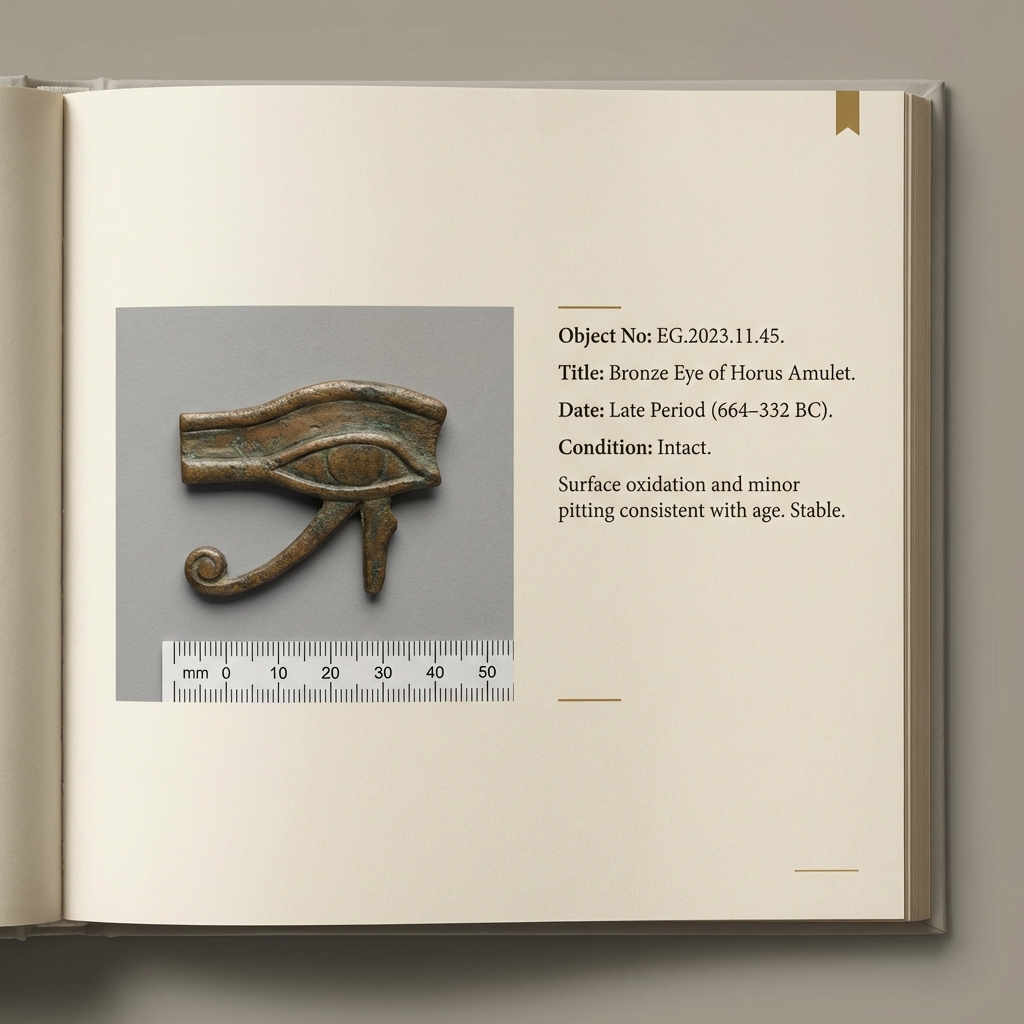
Typical catalogue entries include a short description, catalogue or accession number, dating or period estimate, material identification, measurements, provenance or collection history when available, and condition or restoration notes; these fields together form the baseline information you should expect to see when a seller claims an object is ancient Metropolitan Museum collection entry example.
compare catalogue fields when evaluating a listing
use side by side when comparing seller info to museum records
Primary object records in museum catalogues are more reliable than unverified online descriptions because they usually reflect curatorial review and provenance research; when a private seller provides the same fields with clear documentation, that parity improves confidence in a claim of antiquity.
Where to find reliable object records
Start with major public catalogues and searchable museum databases that include entry fields and photographs; these entries offer comparative examples of style, material, and documented provenance that can be used to test a seller's claim about a piece's period or function Encyclopaedia Britannica entry on the Eye of Horus.
What museum catalogue entries typically record
When you review an entry, confirm it lists measurement data, material, and any notes on prior ownership or condition; entries that lack those basics make it difficult to evaluate whether an item is an original antiquity or a modern reproduction Metropolitan Museum collection entry example. A related article on museum publication categories is available from the Art Institute of Chicago Cat. 93 Eye of Horus Amulets, Ptolemaic Period.
How the Eye of Horus became a modern jewelry motif
During the 20th century and continuing today, the wedjat migrated from archaeological contexts into fashion and popular jewelry, a process documented in contemporary cultural histories that show how ancient symbols are often adopted for aesthetic reasons and reinterpreted outside their original religious frameworks Smithsonian Magazine feature on ancient symbols in jewelry.
See behind the scenes on @auroraantiqua
For curated listings and context notes from a dealer who focuses on wearable history, see the shop's educational posts and documentation examples.
In many modern uses the symbol is divorced from its ritual background and presented as a protective charm or a striking motif; that does not make the object historically equivalent to an ancient amulet, so clarity in listing language is essential when sellers describe a piece as ancient or inspired by antiquity Smithsonian Magazine feature on ancient symbols in jewelry.
20th century popularization
Popular culture, film, and fashion helped normalize the image so designers could freely adapt it into pendants, earrings, and rings; the historical narrative often remains implicit in these translations, so consumers encounter the design more often as a visual shorthand than as a documented religious object Smithsonian Magazine feature on ancient symbols in jewelry.
Stripping religious context vs stylistic reuse
When saved and reproduced in modern metalwork or printed motifs, the wedjat frequently loses explicit connections to Egyptian ritual language; responsibly presented pieces will label such items clearly as reproductions or evocative designs rather than as artifacts with original function Encyclopaedia Britannica entry on the Eye of Horus. Browse related pieces in our ancient Roman rings collection ancient Roman rings collection.
Controversies and negative associations: conspiracy theories and misuses
Some contemporary narratives conflate the wedjat with the Western all eye symbolism and other esoteric signs, creating occasional suspicion or negative associations in media and public discourse; those conflations are modern reinterpretations rather than reflections of ancient Egyptian meaning BBC Culture feature on the history of eye symbols.
Media coverage of such conflations can amplify misperceptions by treating visually similar symbols as equivalent without attending to their separate histories and cultural meanings, so critical scrutiny of sources is important when such claims appear online BBC Culture feature on the history of eye symbols.
When you encounter online claims that link the wedjat to modern conspiracy narratives, check the primary object records and museum references rather than relying on impressionistic articles or social media posts Smithsonian Magazine feature on ancient symbols in jewelry.
How the Eye of Horus gets conflated with other 'eye' symbols
Visual similarity invites casual comparison, but the wedjat has a specific mythic and iconographic history that differs from the Western single eye motif used in other ideological contexts; distinguishing these histories helps avoid false equivalence and reduces unwarranted alarm when seeing the symbol in jewelry.
Media and public responses
Public reaction depends on the cultural setting: in some contexts the motif is read primarily as a decorative emblem, while in others it is reinterpreted through present-day belief systems or conspiracy framings; assessing each appearance against authoritative references reduces the chance of misunderstanding BBC Culture feature on the history of eye symbols.
Evaluating whether eye of horus jewelry is appropriate to wear or buy
Use a short decision checklist before buying: check provenance and documentation, review condition and restoration notes, consider cultural sensitivity, and reflect on your personal intent when wearing the motif. If the seller claims an object is ancient, demand catalogue-style fields to support that claim Encyclopaedia Britannica entry on the Eye of Horus.
Remember that historical protective meaning does not imply supernatural effect today; treat such claims as cultural interpretations and prioritize transparent documentation when assessing value or significance.
Decision criteria checklist
Checklist items to consider: clear provenance or collection history, precise dating or period estimate, detailed condition and restoration notes, high quality photographs showing wear consistent with age, and third party or institutional references where available Encyclopaedia Britannica entry on the Eye of Horus.
Situational considerations
If you plan to wear a piece in a professional or culturally sensitive setting, prefer reproductions or clearly documented originals accompanied by contextual explanations; casual aesthetic use is common, but transparency about origin respects both buyers and source cultures.
How to check provenance and authenticity for eye of horus jewelry
Ask sellers for documented provenance, prior collection history, original findspot if known, accession or catalogue references, and any third party reports; museum-style documentation makes a seller s claim about antiquity easier to evaluate Encyclopaedia Britannica entry on the Eye of Horus.
Request high resolution photographs that show details such as tool marks, surface patina, and repair or restoration areas; wear consistent with age is a useful indicator, but only when assessed against comparable museum objects and with appropriate expertise Metropolitan Museum collection entry example.
What to ask sellers
Sample questions to copy: Can you provide provenance or prior ownership records? Is there a condition report or restoration note? Were the photos taken of the actual object? Does the seller have an accession or catalogue number to share? These direct questions help move a listing from vague to verifiable.
Red flags and verification steps
Red flags include vague origin stories, no condition notes, stock images in place of real photos, and pressure tactics; verification steps include comparing seller information to museum records and, for high value items, seeking an independent specialist or conservator opinion Encyclopaedia Britannica entry on the Eye of Horus.
Practical buying guide: choosing responsibly when shopping for eye of horus jewelry
First decide whether you want an original ancient piece or a modern reproduction; for originals insist on written provenance and clear condition or restoration notes, and for reproductions expect clear labeling that identifies the piece as modern or inspired by antiquity Encyclopaedia Britannica entry on the Eye of Horus.
Maintain records of any purchase that claims antiquity, including screenshots of the listing, photos, the seller s condition notes, and any verification letters; those records are the practical equivalent of catalogue data for private buyers and collectors.
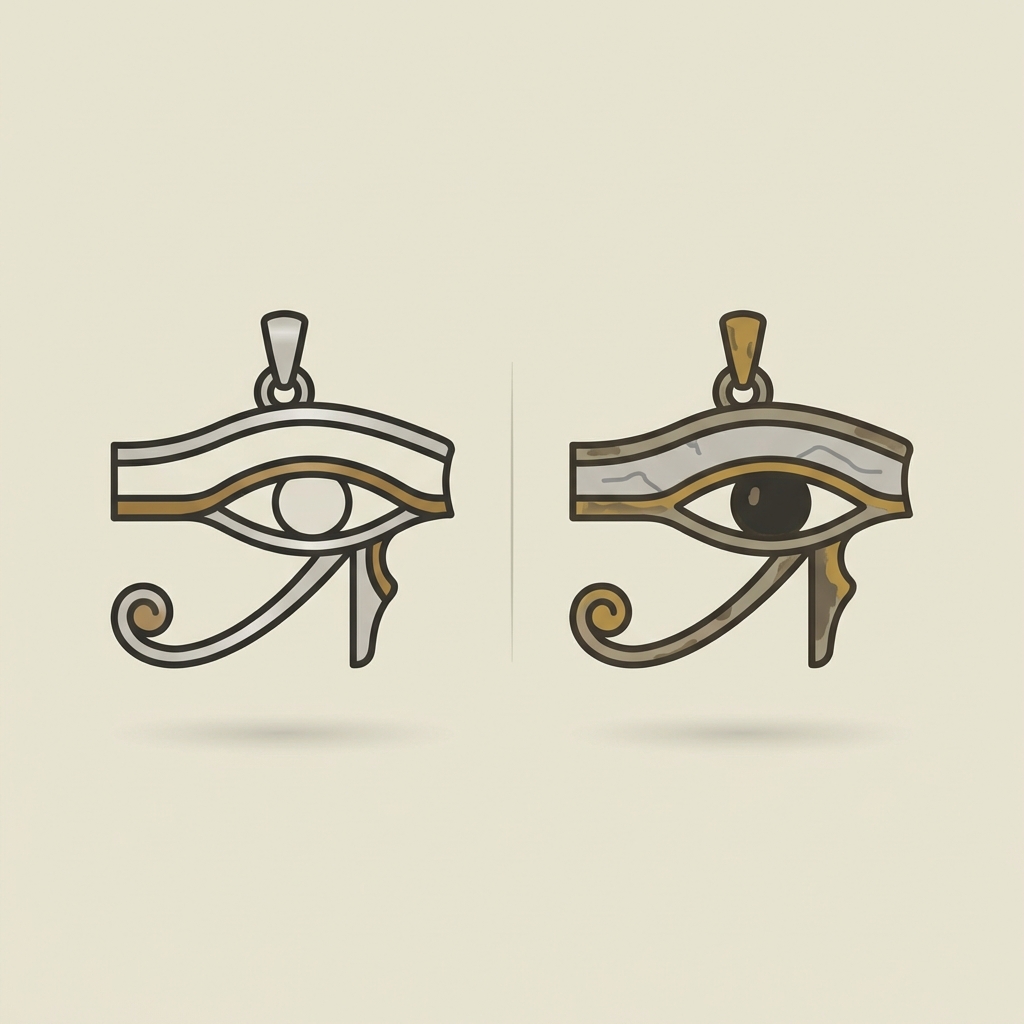
Buying ancient vs modern reproductions
Ancient originals should come with documented provenance, clear condition descriptions, and ideally references to prior collection history; modern reproductions should be labeled so and described by materials and maker, which avoids confusion and protects buyers from inadvertent acquisition of undocumented antiquities Metropolitan Museum collection entry example.
What documentation to demand and keep
Ask for condition and restoration notes, prior ownership or collection history, clear photographs, and any independent verification or lab reports; keep copies of all communications and images so you can compare them to museum examples or share them with a specialist if questions arise.
Common mistakes and pitfalls when interpreting eye of horus symbolism
A common error is to project modern spiritual or conspiratorial meanings onto the wedjat without consulting Egyptological or museum sources; doing so confuses historically grounded function with present day belief and can mislead buyers and viewers alike Smithsonian Magazine feature on ancient symbols in jewelry.
Marketplace pitfalls include mislabeling reproductions as ancient, ignoring condition notes, and conflating visually similar eye motifs from different cultures; quick checks such as asking for provenance and comparing photos to museum records help avoid these mistakes Metropolitan Museum collection entry example.
Over-reading modern spiritual claims
If a listing makes broad supernatural promises, treat those as seller interpretation rather than historical fact; the ancient association was cultural and ritual, so modern claims about protective power should be framed as contemporary belief rather than objective effect.
Mistaking stylistic reuse for ancient function
Remember that stylistic reuse is widespread and legitimate, but it is not the same as original ritual function; reputable sellers will clearly state whether an item is a reproduction or an antiquity and provide the supporting documentation for either claim.
Caring for and displaying eye of horus jewelry
For all jewelry, avoid harsh chemicals, store pieces separately, and document condition before and after any cleaning or conservation; this is especially important for antiquities where patina and fragile repairs may be significant to the object s integrity.
If a seller provides restoration notes, read them carefully to understand what was stabilized or repaired and how those interventions affect handling; for objects claiming antiquity, consult a conservator rather than attempting DIY repairs.
Basic conservation-minded care
Keep jewelry away from chlorinated water and household cleaners, use soft cloths for surface dusting, and choose padded storage that prevents abrasion; routine gentle care preserves both modern and ancient pieces.
Display and storage considerations
When displaying, use mounts that support the object without stressing soldered joints or thin sections, keep items out of direct sunlight for extended periods, and maintain humidity in a stable range to reduce material stress.
Ethical considerations and cultural respect when wearing the wedjat
Acknowledge the symbol s cultural origin when you wear or share images of an Eye of Horus piece, and avoid exploitative framing that erases context; clear labeling and respectful language help connect a motif to its history rather than treating it as a generic good-luck token Smithsonian Magazine feature on ancient symbols in jewelry.
When choosing between an original and a reproduction, prefer reproductions for casual fashion use or contexts where cultural sensitivity is a concern, and reserve originals for collectors who can document provenance and present contextual information responsibly.
Cultural origin and respectful display
Present the wedjat with a short context note if you share it online or in conversation, indicating the symbol s Egyptian origin and its broadly understood meaning of protection and restoration, without asserting supernatural powers.
When to choose reproduction vs original
Choose a modern reproduction for everyday wear when you want the design without the responsibility of conserving an antiquity, and opt for an original only when you can verify provenance and commit to appropriate care and documentation.
Practical examples and short case scenarios
Scenario 1, plausible purchase of a labeled ancient amulet: a seller lists a small bronze wedjat with a clear accession reference, detailed condition notes describing patina and an old repair, several high resolution photos, and a prior collection history that matches museum-style fields; in that case proceed by comparing the listing to museum entries and, if necessary, requesting an independent specialist opinion before finalizing the purchase Encyclopaedia Britannica entry on the Eye of Horus.
Scenario 2, when a modern pendant is the right choice: you want a daytime wearable piece with the wedjat motif for its aesthetic and historical resonance but not as an antiquity; choose a clearly labeled modern maker, check materials and maker notes, and expect a lower price and different care needs than for an original.
A plausible purchase of a labeled ancient amulet
Step-by-step checks: confirm accession or catalogue references, ask for prior ownership records, compare patina and wear to museum examples, and request an independent condition report for high value claims; walk away if core catalogue fields are missing.
When a modern pendant is the right choice
For reproductions check maker reputation, materials, and return policies; clear labeling saves confusion and preserves ethical sourcing by avoiding misrepresentation of modern work as an antiquity.
Summary and next steps for readers
Key takeaways: the wedjat, or Eye of Horus, is historically a protective and restorative symbol, while modern uses vary; buyers should assess provenance, condition notes, and clear documentation before purchasing or presenting a piece as ancient Encyclopaedia Britannica entry on the Eye of Horus.
Three immediate actions: check seller provenance fields against museum catalogue examples, require condition and restoration notes, and prefer transparent listings that label reproductions clearly; when in doubt consult museum records or a specialist.
Where to learn more and verify claims
Use museum databases and reputable encyclopedic entries to compare style and documentation, and keep copies of seller communication for future verification or specialist review Encyclopaedia Britannica entry on the Eye of Horus. You can also read related posts on our Roman Empire blog Roman Empire blog posts.
No. In ancient Egyptian context the wedjat was a protective and restorative emblem associated with healing and wholeness.
Ask for provenance, accession references, detailed condition and restoration notes, and high resolution photographs; compare these to museum catalogue entries and seek expert input for high value items.
It can be respectful if you acknowledge the symbol's Egyptian origin, avoid exploitative framing, and clearly label reproductions when appropriate.
References
- https://www.britannica.com/topic/Eye-of-Horus
- https://auroraantiqua.com/products/the-celestia
- https://auroraantiqua.com/
- https://oxfordre.com/religion/view/10.1093/acrefore/9780199340378.001.0001/acrefore-9780199340378-e-250
- https://www.clevelandart.org/art/1914.759
- https://collections.mfa.org/objects/164877
- https://www.britishmuseum.org/collection/term/wedjat-eye-of-horus
- https://www.metmuseum.org/art/collection/search?q=wedjat+eye+of+horus
- https://www.artic.edu/pdf/static/download-collection.publications.digital-publications-articles.show-172.pdf
- https://www.smithsonianmag.com/history/ancient-symbols-jewelry-eye-of-horus-2024-10/
- https://www.bbc.com/culture/article/20230912-history-of-the-eye-symbol
- https://auroraantiqua.com/collections/ancient-roman-rings
- https://auroraantiqua.com/blogs/questions-and-answers