


Looking for the real thing? Browse authenticated ancient rings, each piece one of one, individually authenticated, with documented provenance. For the background, see the guide to ancient jewelry.
Quick answer: how the Eye of Horus and the Eye of Ra differ in jewellery
The simplest distinction is that the Eye of Horus, or Wedjat, is most often read as a symbol of healing, restoration and a specialised fractional measurement tradition, while the Eye of Ra functions as a solar, often personified force linked to Ra and sometimes represented through powerful goddesses; both motifs appear in jewellery across long periods but the intended emphasis differs in context and imagery.
For collectors examining listings, the main practical takeaway is to rely on visual markers and contextual clues in descriptions and photos, and to request provenance or testing when attribution or dating matters.
Follow @auroraantiqua for condition notes and behind-the-scenes views
Sign up for condition-note alerts or the checklist to get notified when we publish detailed condition reports and high-resolution views of eye-motif pieces.
Below we expand these points, provide visual checks you can use with photos, and offer a buyer checklist so you can judge an eye-motif listing with more confidence.
What is the Eye of Horus (Wedjat)?
Mythic origin and symbolic associations (eye of horus jewelry)
The Eye of Horus, often called the Wedjat, comes from the Horus-Set myth in which Horus’s injured eye is healed, a story that underpins readings of the motif as connected to restoration and protection; this interpretive link is commonly cited in museum literature on amulets and iconography Encyclopaedia Britannica on Horus. A faience Wedjat example is available in online collections.
Beyond protection and healing, Egyptological scholarship has long associated the Wedjat with a specialized fractional measurement system, an analytical layer that can appear in descriptions of some amulets and texts; this association is part of how specialists interpret certain ritual and symbolic dimensions of the motif The Eye of Horus and the Ancient Egyptian Fraction System.
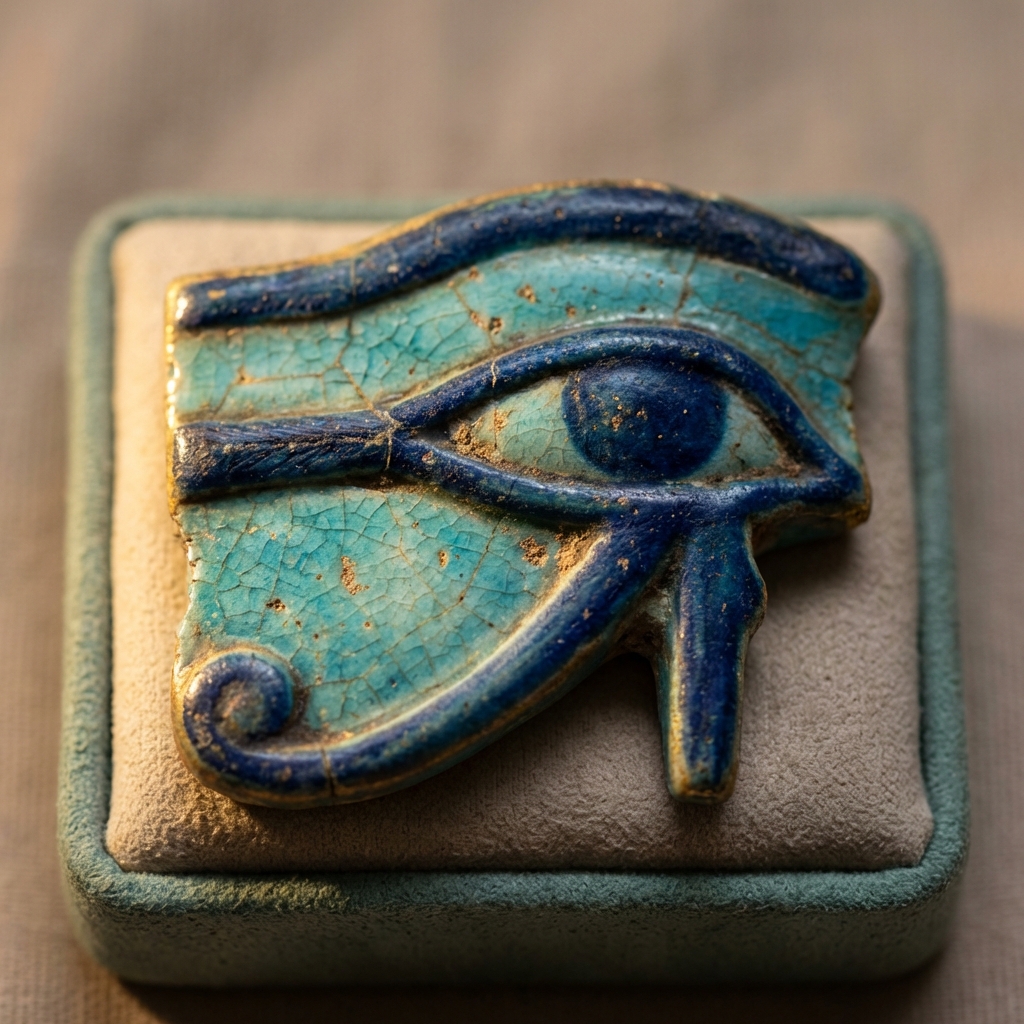
In material culture the Wedjat was produced in many formats that collectors encounter today: faience plaques and beads, carved stone and inlaid rings, and small metal amulets intended for wear or for inclusion in burial assemblages; museum catalogues document these production types and their long chronological range Met Museum amulets overview.
How the Wedjat is used in ancient Egyptian material culture
Wedjat imagery typically appears as a stylised human eye with a defined eyebrow and a curved lower line, features that recur across faience, stone and metal examples and that are useful visual markers when inspecting photos of rings or pendants British Museum collection summaries for Wedjat imagery. See a catalogued amulet at the Met Museum Wedjat-eye amulet.
When found in burial contexts the Wedjat often accompanies other protective amulets, a pattern that supports readings of the motif as intended to guard the living or the dead, though exact ritual functions can remain interpretive without published contextual evidence Met Museum amulets overview. See a British Museum object example that shows related openwork treatment British Museum object Y_EA29222.
What is the Eye of Ra and how does it appear in jewellery?
Conceptual link to Ra and attendant goddesses
The Eye of Ra is conceptually tied to the sun god Ra and is frequently personified or equated with powerful goddesses such as Sekhmet or Hathor, which shifts its emphasis from restoration to solar authority, protection and sometimes aggressive or wrathful action Encyclopaedia Britannica on Ra.
In jewellery the Eye of Ra can be signalled not only by the eye form but by accompanying solar or royal signs, or by inscriptions and attributes that link the motif to a named goddess; context therefore matters when a seller's label uses Ra language British Museum collection summaries for Wedjat imagery.
Start with clear photos of front, back and edges and look for visual markers (eyebrow and tear-line for Wedjat; sun-disk, uraeus or goddess attributes for Eye of Ra). Request provenance, restoration notes and any independent testing, and consult a specialist when inscriptions or unusual materials make attribution uncertain.
When assessing a piece ask whether the motif appears with a sun-disk, uraeus, royal regalia or references to a goddess, since those clues can indicate an Eye of Ra reading rather than a Wedjat reading Met Museum amulets overview.
For the Wedjat, look for the familiar stylised human-eye schematic: a defined eyebrow, a clear tear-line or curved lower stroke and proportions that match catalogued examples; these graphic elements recur in both small faience amulets and in intaglio rings Met Museum amulets overview.
Typical contexts where the Eye of Ra is invoked in objects
The Eye of Ra often functions in texts and images as an active agent of the sun, invoked for protection of the king or for destructive power directed against enemies; such roles mean that eye-motif jewellery associated with Ra can carry different symbolic overtones than Wedjat pieces Encyclopaedia Britannica on Ra.
Because both names and eye imagery appear in overlapping contexts, museum and market labels sometimes blur the distinction; careful reading of inscriptions, associated figures and museum catalogue notes helps disentangle the intended reference British Museum collection summaries for Wedjat imagery.
Visual markers: how to tell a Wedjat from an Eye of Ra on a ring or amulet
Key graphic elements to look for
For the Wedjat, look for the familiar stylised human-eye schematic: a defined eyebrow, a clear tear-line or curved lower stroke and proportions that match catalogued examples; these graphic elements recur in both small faience amulets and in intaglio rings Met Museum amulets overview.
For pieces read as the Eye of Ra, check for solar or royal markers such as sun-disks, uraeus serpents, or imagery of attendant goddesses; such additions can change the likely symbolic reading even when the basic eye form looks similar to a Wedjat Encyclopaedia Britannica on Ra.
Contextual clues in inscriptions and associated symbols
Inscriptions that name Ra or a goddess, or that include royal titulary, are strong contextual clues; when an inscription is visible in a photo it often clarifies the intended reference, though scripts can be worn and require specialist reading British Museum collection summaries for Wedjat imagery.
Remember that some objects mix attributes: an eye form may appear with both protective and solar markers, and in such cases attribution may remain interpretive without further documentation or published comparisons Met Museum amulets overview.
Materials, production and how pieces survive - what collectors should expect
Common materials and manufacturing techniques
Museum catalogues record a range of common materials for eye motifs: faience, carved stone, inlaid glass, gold, silver and bronze, and these materials appear in many wearable forms including beads, pendants and ring intaglios Met Museum amulets overview.
Production techniques vary by material: faience pieces are molded and fired, stone and gem intaglios were carved and sometimes inlaid, and metal eyes may be cast or repoussed; recognizing the technique from clear photos can help place a piece in a likely category British Museum collection summaries for Wedjat imagery.

Typical wear, repairs and conservation traces
Surviving eye-motif pieces commonly show age-consistent wear such as softened carving details, patina on metals, and sometimes inlay loss; museum condition notes often describe stabilizing repairs or conservation work that keep the object stable for display or wear British Museum collection summaries for Wedjat imagery.
Ask sellers for high-resolution views of edges, backs and any inlaid areas so you can judge join lines, retouching or later mounts; those photos are usually decisive for identifying replacements or modern interventions Penn Museum collecting guidance on Wadjet.
Iconography and symbolic meanings: healing, protection and solar power
How meanings overlap and diverge
Wedjat readings emphasize healing, restoration and protective measurement symbolism, while Eye of Ra readings foreground solar authority and a protective or sometimes wrathful agency attributed to attendant goddesses; both readings can coexist as interpretive possibilities for a single object Encyclopaedia Britannica on Horus.
In practice the same eye-form can serve protective functions in wearable and funerary contexts, but the implied emphasis-restorative versus solar/agentive-depends on associated signs and the object's archaeological or collection context Encyclopaedia Britannica on Ra.
How context shifts likely interpretation
When an eye amulet comes from a burial assemblage it is typically interpreted within funerary protective frameworks, whereas a royal or temple context that includes solar symbols may point toward an Eye of Ra association; catalogues and excavation notes are therefore useful for interpretation when available Met Museum amulets overview.
Because some museum labels and market descriptions use terms loosely, treat specific ritual functions as interpretive unless they are supported by published scholarship or scientific provenance evidence British Museum collection summaries for Wedjat imagery.
Dating, attribution and common ambiguities in labels
Limits of typology and labeling
Typological dating and workshop attribution are useful starting points but often remain interpretive in the absence of published comparisons or scientific testing; museum researchers caution that precise attributions require careful documentation The Eye of Horus and the Ancient Egyptian Fraction System.
Market and museum labels sometimes differ; a listing may call an object 'Horus-eye' while a curator assigns a different contextual reading, so collectors should expect some label ambiguity and look for supporting documentation British Museum collection summaries for Wedjat imagery.
Request provenance, photos and condition fields from a seller
Use when a listing lacks documentation
When to consider specialist analysis or scientific testing
Consider asking for independent material testing or specialist study when an object has unusual materials, ambiguous inscriptions, or a high asking price; such tests can strengthen dating and material identification though they are not always available for every listing Penn Museum collecting guidance on Wadjet.
Short of scientific reports, provenance documentation, prior ownership notes and published comparisons are the most reliable indicators a buyer can obtain from a seller to support an attribution Met Museum amulets overview.
Buying checklist for eye amulet and eye-motif jewellery
Essential documentation to request
Always request provenance documentation or collection history lines, clear condition and restoration notes, and high-resolution photographs that include front, back and edge views; sellers who provide those items make informed assessment possible Encyclopaedia Britannica on Horus.
If independent material testing or a conservator report exists, ask for the full documents or test results; when testing is absent, rely on detailed photos, transparent condition notes and provenance references instead Penn Museum collecting guidance on Wadjet.
Photo and description checklist
Good photos show scale, reverse views, mounting details and any visible inscriptions; include close-ups of inlay edges and any repair joins so you can judge later interventions and original technique British Museum collection summaries for Wedjat imagery.
Also ask sellers to state explicitly what was stabilized, repaired, or left untouched in a restoration; clear restoration notes reduce the chance of surprises after purchase Met Museum amulets overview.
Condition, restoration and what to inspect in photographs
Common restoration interventions and how they look
Typical interventions include stabilizing adhesives, later metal mounts or collars added to permit wear, and inlay replacements; museum conservation notes often describe these interventions and how they appear in close photography British Museum collection summaries for Wedjat imagery.
Conservation coatings can change surface sheen and color; ask whether conservator-grade materials were used and whether any coating was applied for display or wearability reasons Met Museum amulets overview.
Red flags versus normal age-related wear
Normal indicators of age include softened carving details, consistent patina on metal areas and minor surface abrasions; by contrast, sharp tool marks in modern styles, mismatched patina across adjoining elements, or crude inlay materials can suggest modern fabrication or heavy restoration Penn Museum collecting guidance on Wadjet.
When in doubt, request a conservator-provided condition statement or ask for additional high-resolution photos under raking light to reveal tool marks and join lines that are not visible in standard images British Museum collection summaries for Wedjat imagery.
Typical labeling and catalogue mistakes: how market labels can mislead
Common misleading phrases and how to read them
Sellers sometimes use 'Horus' and 'Ra' interchangeably or apply grand period labels without documentation; treat such shorthand as a prompt to ask follow-up questions rather than as proof of attribution The Eye of Horus and the Ancient Egyptian Fraction System.
Non-specific period attributions like 'ancient' or 'early' should be supported by provenance lines or specialist reports; if a listing lacks these, ask for more documentation and clearer photos before committing British Museum collection summaries for Wedjat imagery.
How to verify claims in a listing
Cross-check descriptive language with museum catalogue references and published scholarship where possible, and ask the seller for specific provenance points you can follow up on; transparent sellers will provide collection history and prior ownership notes when available Met Museum amulets overview.
If a claim seems unusually confident without documentation, treat it cautiously and consider a third-party specialist opinion for expensive or ambiguous pieces British Museum collection summaries for Wedjat imagery.
Practical examples and mini case studies
Compare three example descriptions and how to evaluate them
Example A: A listing calls a carved stone eye 'Horus-eye' with photos showing the classic stylised eyebrow and tear-line but no provenance; here the visual features point toward a Wedjat reading, but lack of provenance suggests asking for more history and high-resolution reverse views Met Museum amulets overview.
Example B: A gold pendant described as 'Eye of Ra' includes a small sun-disk motif in photos and a brief collector provenance; the added solar marker supports an Eye of Ra interpretation, and the provenance line improves confidence though specialist dating may still be useful Encyclopaedia Britannica on Ra.
Example C: A mixed-attribute ring shows the wedge-shaped eye form plus later inlay and a modern mount; the combination of later mounts and inlay replacement argues for careful condition questioning and possibly conservator evaluation before purchase British Museum collection summaries for Wedjat imagery.
What photographic details changed the likely reading
Close-up photos of the reverse can reveal ancient tool marks or modern filing; in two of the above hypothetical examples the reverse view clarified whether carving was ancient or modern, changing the likely attribution Penn Museum collecting guidance on Wadjet.
When photos are inconclusive, request a short video or angled lighting shots to show depth and shadow, which often reveal whether a detail is original or a later intervention British Museum collection summaries for Wedjat imagery.
How Aurora Antiqua presents eye-motif jewellery
What information we include with each piece
Aurora Antiqua acts as a curatorial reference and trust layer, presenting curated ancient rings and select small artifacts with condition notes, restoration and preservation notes, and provenance and documentation references to help buyers understand what they are purchasing in context British Museum collection summaries for Wedjat imagery.
We include editorial and historical content that explains iconography and likely contexts so collectors can evaluate symbolism and manufacturing techniques alongside photos and condition statements Met Museum amulets overview.
How to use those notes when evaluating an item
Use provenance lines and restoration notes to judge how much interpretive weight to place on a listing's attribution, and treat any missing documentation as a reason to request more information or a specialist opinion before purchase Penn Museum collecting guidance on Wadjet.
When Aurora Antiqua lists eye-motif items we aim to include clear photos of front, back and edges, and explicit notes about what was stabilized, repaired or left untouched so buyers have the information needed to decide responsibly Encyclopaedia Britannica on Horus.
Handle ancient pieces carefully, avoid harsh cleaning agents, and store items padded and away from rapid temperature or humidity changes to preserve patina and prevent stress to fragile inlays or mounting joins British Museum collection summaries for Wedjat imagery.
Care, display and legal considerations for ancient jewellery
Basic care and storage recommendations
Handle ancient pieces carefully, avoid harsh cleaning agents, and store items padded and away from rapid temperature or humidity changes to preserve patina and prevent stress to fragile inlays or mounting joins British Museum collection summaries for Wedjat imagery.
For display choose mounts that support the object without straining joins, and consult a conservator before wearing fragile items as jewelry; conservator advice can clarify safe handling and display options Penn Museum collecting guidance on Wadjet.
General legal and export/import considerations to check
Verify provenance paperwork and ask sellers for export or import documentation where relevant; laws differ by country and documentation helps ensure compliance and responsible collecting Met Museum amulets overview.
If legal questions arise consult a specialist in cultural property law; sellers and private buyers should avoid assuming legal clearance without seeing explicit paperwork or professional advice British Museum collection summaries for Wedjat imagery.
Conclusion: choosing between an Eye of Horus or Eye of Ra piece
Visually the Wedjat and the Eye of Ra overlap but tend to signal different emphases: Wedjat readings center on healing and restoration while Eye of Ra readings bring solar authority and goddess agency into focus; both appear widely in jewellery and amulets, so context and documentation guide final interpretation Met Museum amulets overview.
Before buying, follow the checklist above: request provenance, clear condition and restoration notes, and high-resolution views; accept ambiguity when documentation is thin, and seek specialist input for expensive or unusual pieces.
Look for the stylised eyebrow and tear-line for a Wedjat and for solar markers, goddess figures or inscriptions referencing Ra for an Eye of Ra; when in doubt request close photos and provenance or consult a specialist.
Faience is a common material for Wedjat amulets, but they were also made in stone, glass, gold and bronze; material descriptions and photos help identify technique and condition.
Restoration can change how safely a piece can be worn; ask for restoration notes and a conservator opinion for fragile mounts or repaired inlays before regular wear.
More from Aurora Antiqua
References
- Four Eyes of the God Horus (Wedjat) Amulet, inv. no, Art Institute of Chicago
- Eye of Horus (Wedjat) Amulet, Egypt, Ptolemaic Period, Art Institute of Chicago
- Bristol City Council : Museum Collections, Bristol Museums (Egyptology Collection)
- Amulet with the wedjateye of the god Horus, Victoria and Albert Museum, London
- Faience Technology. In: UCLA Encyclopedia of Egyptology (Paul T. Nicholson), University of California, Los
- Exploring the Composition of Egyptian Faience (Falcone, Aquilino, Stoppa), Minerals (MDPI)
- Artifacts: Amulets, Mummification, Online Exhibits, Spurlock Museum of World
- The Fitzwilliam Museum, Amulet: E.281.1896, University of Cambridge
- Federal Register, U.S. Customs and Border Protection, Department of Homeland Security
- Client Challenge, JSTOR