


Looking for the real thing? Browse genuine ancient artifacts for sale, each piece one of one, individually authenticated, with documented provenance. For the background, see the guide to ancient jewelry.
Why the ankh ring still matters today
The ankh ring remains a recognizable emblem because the ankh itself is an ancient Egyptian hieroglyph and amulet sign commonly translated as life or living, a consensus reflected in major museum and reference sources, so wearing an ankh motif carries a long visual lineage rather than a recent invention Encyclopaedia Britannica entry on the Ankh.
Approach such a purchase as both a styling decision and a conservation responsibility: verify size and bezel profile for comfort, obtain clear condition and provenance documentation, avoid abrasive cleaning, and consult a conservator for fragile or actively corroding pieces.
Scholars continue to discuss variations in ritual use and iconographic nuance, and that ongoing work tends to refine context rather than overturn the basic meaning; treating the symbol with cultural respect and consulting available documentation is a sound starting point for anyone considering an ankh as wearable heritage Metropolitan Museum of Art overview of the Ankh (see recent archaeology coverage An Afterlife So Perilous, You Needed a Guidebook - New York Times).
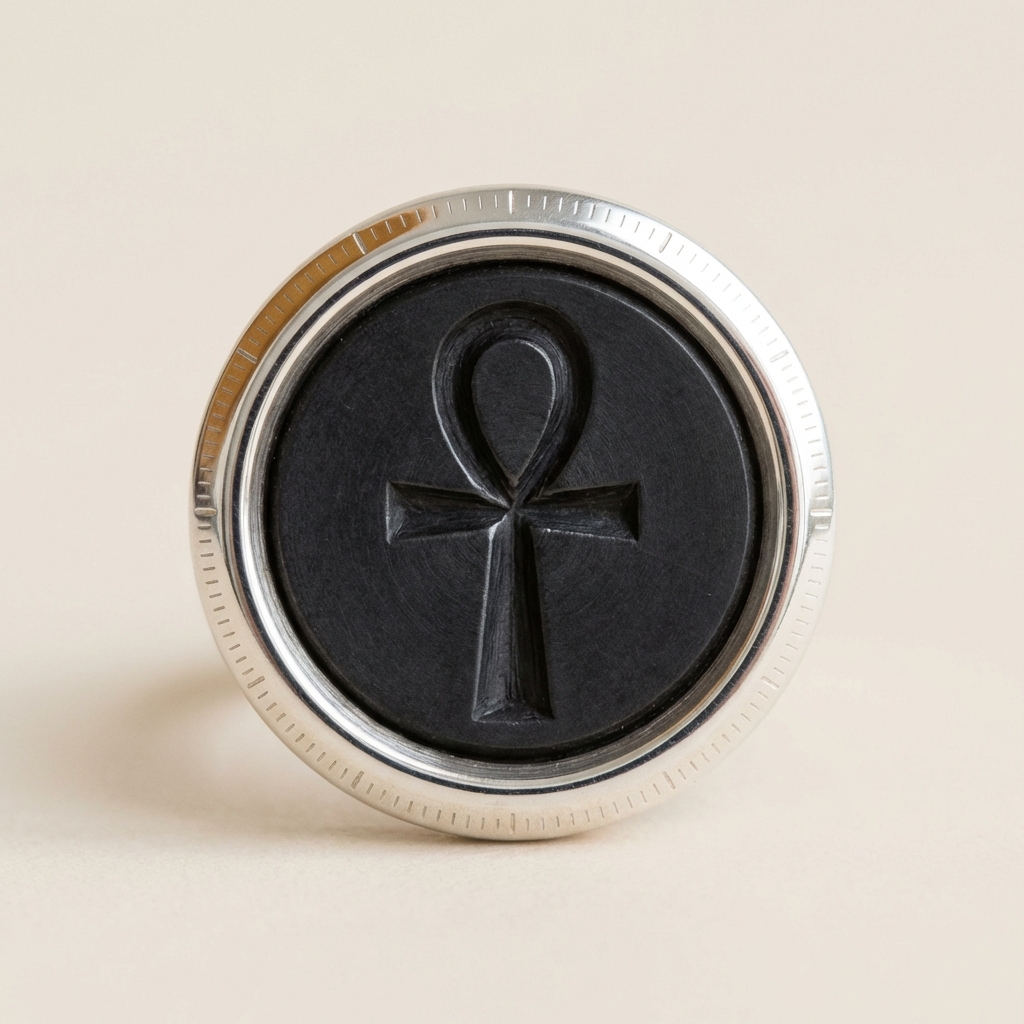
For collectors and history-minded buyers, an ankh as an element of an ancient ring is both a motif and an artifact, and appreciating its iconography alongside clear provenance and condition notes helps ensure the piece is worn and discussed responsibly. Learn more in our rings collection.
When assessing images or listing descriptions, pay attention to bezel depth, the visible edge finishing, and any note about a detached loop or stabilized repair; these details indicate how the material was treated and how careful you should be when wearing or storing the ring.
Quick primer: forms and materials of ankh rings in collections
Common materials: faience, stone, metal
Museum collections and auction records show ankh motifs made in faience, carved stone, and various metals; each material affects weight, fragility, and the kinds of mounts used, so examine photos and descriptions for material notes before deciding to wear a piece Encyclopaedia Britannica entry on the Ankh (see a detailed museum study at the Kelsey Museum Life, Death, and Afterlife in Ancient Egypt - University of Michigan).
Variations in proportion and suspension
Ankh motifs appear in different proportions and with different suspension methods: some are inset as intaglios in a bezel, others are low-relief plaques or full-loop pendants adapted to a ring setting, and these choices change how the motif sits on the finger and how likely it is to catch on clothing or pockets British Museum collection term for the Ankh.
When assessing images or listing descriptions, pay attention to bezel depth, the visible edge finishing, and any note about a detached loop or stabilized repair; these details indicate how the material was treated and how careful you should be when wearing or storing the ring.
How to choose where and how to wear an ankh ring
Finger choice and bezel size
Signet- or bezel-style ankh rings commonly work well on the index, middle, or ring fingers depending on bezel width and profile, so try to match bezel size with the finger surface you prefer and consider how the motif sits relative to knuckle movement British Museum collection guidance.
Choose a ring size that accounts for the bezel and any vertical ankh loop so the piece sits without catching; this may mean sizing up slightly when a high bezel or an upright loop would otherwise press or snag against adjacent fingers.
See behind the scenes on @auroraantiqua
Before you buy, ask the seller for clear condition notes and any provenance documentation so you can assess whether the piece is suited for regular wear or is better as occasional use or display.
Stacking and left versus right hand considerations
When stacking, pair an ankh with slim bands and neutral metals so the symbol remains legible and visually dominant; heavy or ornate companions can create competition that obscures the motif.
Decide whether to wear an ankh ring on the left or right hand based on comfort and context rather than symbolic claims; in many modern wardrobes the practical concerns of fit and snag risk outweigh handedness traditions.
CTA placement: a short call to action about provenance and documentation
What to request from sellers
Request condition notes, clear photographs from multiple angles, measurements, and any available collection history or verification letters so you can evaluate the listing in context.
Why documentation matters
Provenance helps illustrate a piece's collection history but does not by itself prove every detail of dating or material; when dating or material identification matters for your decision, ask about third-party testing or independent specialist reports British Museum guidance on collection terms.
How ankh motifs are mounted and why that affects comfort
Bezel-mounted intaglios versus applied plaques
Bezel-mounted intaglios typically have a lower profile than applied plaques, which can reduce snag risk; when a stone or intaglio sits flush within a bezel, the ring usually feels smoother against adjacent fingers and clothing Metropolitan Museum analysis of ankh forms.
Loop, suspension, and snag risk
Exposed loops or raised suspension elements increase the chance of catching; check photos for any visible loop and ask the seller about its stability and any restoration notes that describe how it was secured.
Evaluate bezel height and edge finishing in listing images: a high, sharply cut bezel can be uncomfortable and abrasive, whereas a lower, rounded bezel tends to be more wearable for daily use.
Product placement: presenting a curated ancient ankh ring with documentation
What to include in a listing
A responsible listing includes clear photos, accurate measurements, condition notes describing any corrosion or repairs, restoration notes that explain what was done and why, and any provenance references or collection history that the seller can supply British Museum collection guidance.
A specialist curator or seller, presented as a trust layer, can add editorial context about likely period, workshop attribution when known, and condition summaries; such contextual notes help a buyer judge whether a ring is wearable or better suited to display. See examples in the Ancient Roman rings collection.

When a seller mentions testing, verification letters, or third-party reports, request copies or summaries so you understand the basis for any material or dating claims before making a purchase decision.
Styling an ankh ring: pairing, metals, and avoiding visual competition
Minimal pairings that preserve the symbol
Pair an ankh with slim bands, neutral metals, or small geometric motifs to preserve legibility; minimal combinations ensure the ankh remains the focal motif rather than part of a crowded composition Metropolitan Museum context on iconography.
Cultural context and tasteful combinations
Keep cultural context in mind: wear the symbol respectfully and avoid settings or styling that strip it of documented meaning; when discussing a piece, reference provenance and condition notes to ground the conversation.
Patina and surface character can complement neutral metals; an aged surface often reads as part of an object's history, so choose accompanying pieces that do not obscure or clash with that visual language.
Tool placement: where to put a short practical tool or checklist
Quick wearable check for photos
Use a short, copyable checklist when inspecting listings: confirm clear focus, multiple angles, a scale reference, close-ups of the bezel and any loop, and a condition description that mentions any repairs or stabilization British Museum collection advice.
A short sizing and snag checklist
Verify inner diameter and shank width from measurements, compare bezel height to knuckle clearance, and imagine common tasks to judge snag risk; if in doubt, ask the seller for additional images or to confirm fit details.
Quick listing inspection checklist for ankh rings
Copy this before you ask for more images
Keep the checklist handy when you message sellers or when trying a ring on in person; it helps you stay objective and focused on fit, condition, and documentation rather than marketing language.
Caring for ankh rings: conservation basics for metal and stone
What to avoid: household cleaners and ultrasonic devices
Institutional conservation guidance advises against abrasive household cleaners and ultrasonic cleaning for archaeological metals and historic jewelry, because these treatments can remove patina and unstable surface layers and may accelerate corrosion Getty Conservation Institute guidance on metal. For advanced imaging and study methods see an X-ray tomography analysis X-ray Tomography Unveils the Construction Technique of ... - MDPI.
When to consult a conservator
For any ancient or fragile piece, consult a conservator before attempting restoration; conservators favor minimal, reversible treatments that stabilize corrosion rather than aggressive cleaning, and a specialist can recommend storage and handling appropriate to the material Smithsonian conservation guidance.
For daily care, store ankh rings in cushioned, low-humidity conditions and avoid wearing them during heavy manual tasks or around chemicals; these habits reduce physical and chemical stresses that can damage metals and stones.
Buying ankh rings as antiquities: provenance and documentation checklist
Essential provenance items to request
Ask for collection history, prior ownership notes, any verification letters, and a condition report so you can assess a listing with evidence rather than description alone; these items are central to understanding a piece's documented past British Museum on collection terms.
How to read provenance and collection history
Provenance can clarify previous ownership and exhibition history but does not automatically confirm scientific dating or material identification; when those details matter, seek independent reports or test summaries that accompany the provenance statements.
If provenance is incomplete, ask for more photos, precise measurements, and any conservation records; these practical steps help determine whether to pursue a purchase or seek specialist input first.
When to seek third-party testing and what it can show
Common tests and their limits
Typical analyses can suggest metal composition or gemstone identity and sometimes provide contextual data, but many tests carry costs or require sampling; weigh the expense against how important conclusive material identification is to your decision British Museum guidance.
Who can perform meaningful material and dating analyses
Specialist conservation labs and accredited analytical facilities can provide reports, and sellers who reference testing should make lab summaries or certificates available; remember that a lab report complements, rather than replaces, documentary provenance.
Restoration notes you will see in listings and what they mean
Stabilized, repaired, or left untouched explained
Common restoration language includes stabilized corrosion, which means corrosion was arrested to prevent further loss, and repaired, which indicates some mechanical or adhesive work was done; these phrases should come with descriptions or photos when offered in a listing Getty Conservation Institute on metal care.
How restoration affects handling and display
Repairs can make a ring safer to wear, but they also change how conservators recommend handling the piece; ask for pre- and post-restoration photos and for details on whether materials used in repair are reversible.
Common mistakes and cultural sensitivity when wearing an ankh ring
Avoiding visual appropriation
Context and provenance matter to avoid misusing cultural symbols; presenting ankh jewelry with documented context and respectful language reduces the risk of misinterpretation and places the motif within its historical framework Metropolitan Museum overview.
Mistakes that lead to damage or regret
Practical errors include wearing fragile pieces during manual work, exposing them to household chemicals, or assuming a piece is robust without checking restoration notes; these actions can cause irreversible damage and should be avoided.
When discussing or displaying an ankh ring, use measured, factual phrasing that references documentation and condition notes to keep the conversation grounded and informative.
Practical examples and scenarios: everyday wear, formal looks, and collection display
Scenario A: daily wear with protective practices
A low-profile faience ankh ring used occasionally can be worn if you avoid water, detergents, and heavy use; treat such pieces as delicate and plan to remove them for tasks that risk abrasion or impact Encyclopaedia Britannica on the Ankh. For further practical guidance on wearing ancient rings see our Q&A: Can you wear ancient rings?
Scenario B: special occasion styling
A bezel-mounted metal ankh can be stacked with slim bands for formal wear, keeping companions simple so the symbol remains legible and the overall composition stays balanced.
For fragile or heavily restored pieces, consider retiring them to a safe display with descriptive labels rather than exposing them to the risks of daily wear; secure storage and occasional professional conservation preserve condition.
A quick decision framework: should you buy this ankh ring?
Checklist: fit, documentation, condition, conservation needs
Ask whether photos are clear, measurements match your finger size, provenance references are supplied, and restoration notes are transparent; if key items are missing, request them before proceeding British Museum guidance.
Next steps after purchase
After purchase, prioritize secure storage, conservative handling, and consult a conservator if the ring shows active corrosion or instability; these steps help preserve the piece for future enjoyment or study.
Conclusion and further reading
Key takeaways
Wearing an ankh ring combines aesthetic choice with stewardship: choose the right fit and mounting, respect conservation guidance, and prioritize provenance and documentation when buying antiquities Encyclopaedia Britannica summary.
Where to learn more
Consult museum resources, conservation guidance, and independent specialists to deepen your understanding before you wear or acquire an ancient ankh ring; each piece is unique and merits careful consideration.
It depends on the material and condition; fragile or heavily restored pieces are usually better for occasional wear or display, while sturdy bezel-mounted metal rings may tolerate more regular use with precautions.
Request clear photos, measurements, condition and restoration notes, and any provenance or verification letters; ask for testing summaries if material identification matters.
No, avoid abrasive cleaners and ultrasonic devices; follow conservator guidance and favor minimal, reversible care.
More from Aurora Antiqua
References
- Amulet of an Ankh, inv. no. 1894.103, Art Institute of Chicago
- How to Care For Your Jewellery: The Ultimate Guide by the National Association
- Black Dermographism: An Uncommon Cause of Skin Discoloration, PMC, Indian Dermatology Online Journal, DOI
- Evaluation of a two rubber band technique for finger ring removal, PMC, Annals of the Royal College of Surgeons
- BS EN ISO 8653:2026, TC, BSI, British Standards Institution
- Archaeological materials, Icon, The Institute of Conservation (UK)
- Silver and plate, Icon, The Institute of Conservation (UK)
- Hallmarking Act 1973, UK Government, legislation.gov.uk (The National Archives)
- lsa.umich.edu