


Looking for the real thing? Browse our ancient artifact collection, each piece one of one, individually authenticated, with documented provenance. For the background, see the guide to ancient jewelry.
What is an egyptian ankh ring? Definition and historical context
An egyptian ankh ring refers to a ring that features the looped cross motif known from ancient Egyptian art and amuletic practice. The looped cross, commonly called the ankh, appears in temple reliefs, funerary scenes and personal jewellery and is most often associated in ancient sources with life and eternal life; museums and reference works use this association to explain the motif in artefacts and art.
On rings the ankh may appear as a small raised motif on a bezel, as part of an intaglio carving, or as a reduced amulet attached to a hoop. In many ancient examples the form is simplified to suit metalwork and small-scale carving, and wear consistent with age appears as softened details, a stable patina and occasional repairs recorded in condition notes.
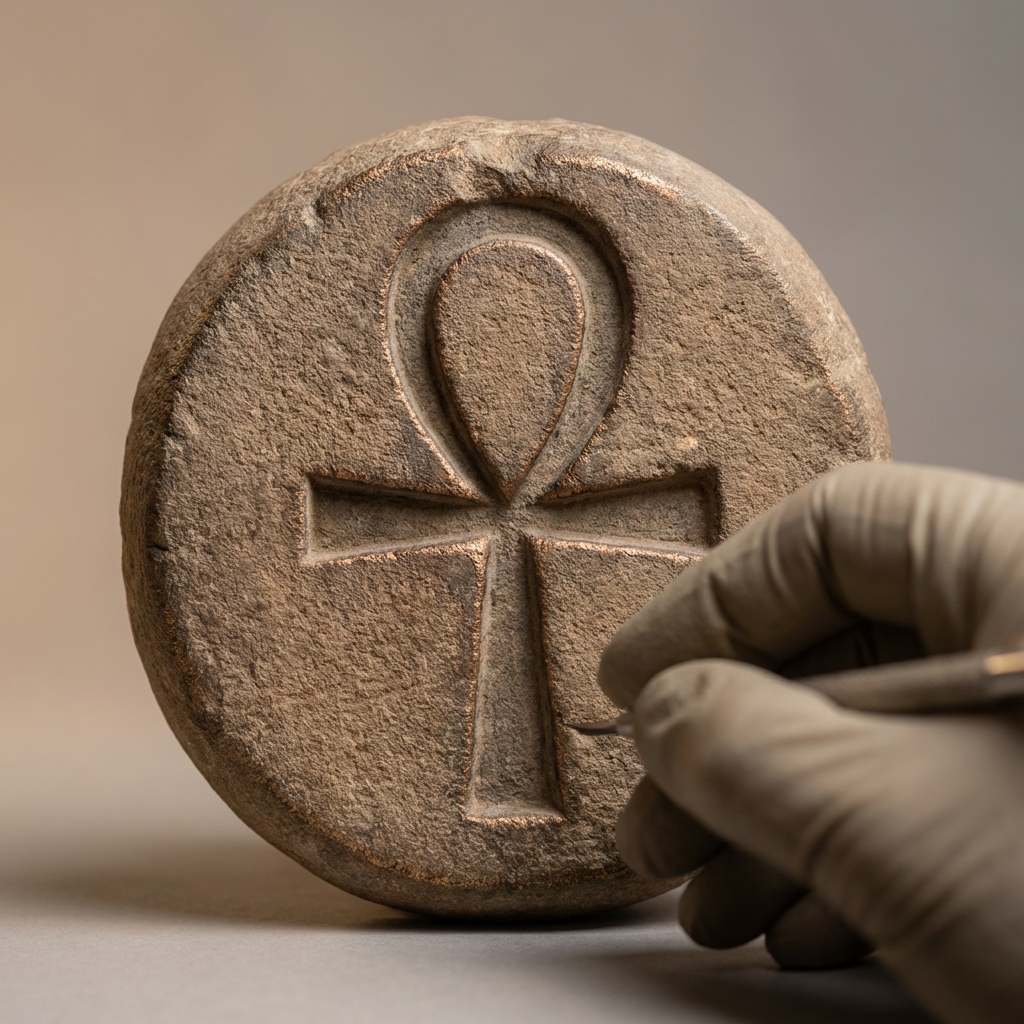
Typical materials for an ankh ring in antiquity include metals such as gold, silver and copper alloys, and occasional use of semi-precious stones that are carved as intaglio or set into a bezel. Descriptions of surviving examples often emphasise patina and joining marks as useful indicators of age, while clearly noting that visual inspection alone cannot prove dating without documentation or laboratory testing.
printable provenance and condition checklist for prospective buyers
Use with seller responses
The scholarly overview of the ankh helps explain why it appears on jewellery and amulets in both public and private contexts; for a focused discussion of the symbol and its appearances in art and artifacts see the Metropolitan Museum of Art overview of the ankh Metropolitan Museum of Art overview of the ankh. For a concise general summary see the Wikipedia entry on the ankh.
How the ankh’s meaning evolved: from ancient Egypt to later periods
In ancient Egyptian religion the ankh is principally a symbol of life and eternal life, and it frequently appears in funerary contexts and temple reliefs where deities hold or present the sign to humans or pharaohs. That primary association with life is the starting point for understanding how the motif functions on personal jewellery such as rings and amulets. Further popular overview is available at The Ankh Symbol: the Powerful Egyptian Symbol of Life.
From late antiquity into the Coptic period the shape was adopted and adapted in local Christian contexts, so the looped cross acquired additional associations for some communities and individuals in Egypt. Museums describe both continuity and reinterpretation across periods rather than a single fixed meaning, which helps explain why the motif can carry multiple layers of significance in later objects.
Cultural continuity and adaptation mean that a ring carrying the ankh motif might have been made for a range of reasons across time, from explicitly religious amuletic use to identification, decorative appropriation or local stylistic habit. When reading a single object it is therefore important to consider dating, find context and any condition or restoration notes that accompany the piece.
See behind the scenes on Instagram with @auroraantiqua
If you are assessing an ankh ring, look for clear provenance and condition notes, and consider whether the seller provides documentary context to explain the object's history.
The different lives of the motif are discussed in museum and academic summaries that trace both ancient uses and later Coptic adaptations; for a concise treatment of later religious and cultural shifts see the British Museum learning page on ancient Egyptian religion and funerary beliefs British Museum learning on ancient Egyptian religion and the Wolfson Gallery large-print guide from Durham University Wolfson Gallery of Ancient Egypt - Large Print Guide.
Can a non-religious person wear an egyptian ankh ring? Practical answer and nuance
Short answer: yes, a non-religious person can wear an egyptian ankh ring, but there are important qualifications about intent, context and respect. Wearing the motif as a piece of personal jewellery or interest in ancient culture is common, yet how it is presented and why it is worn can affect whether the choice is experienced as informed interest or as thoughtless commodification.
Modern uses of the ankh include fashion, popular culture and neo-spiritual movements, and these contemporary contexts sometimes separate the motif from its original religious associations. That separation means many wearers encounter the ankh first as a visual motif rather than as a religious sign, which can be acceptable when accompanied by knowledge or careful contextualisation.
Yes, but it is best done with informed intent: confirm provenance, acknowledge context, and present the piece as historical or aesthetic rather than a religious claim.
Deciding whether wearing feels appropriate benefits from a short reflective check: consider your reason for choosing the piece, whether you can speak to its provenance, and whether you would introduce it as a historical motif rather than claim religious meaning. This approach focuses on intent and avoids presenting the object in ways that could misrepresent source communities.
Public conversation about cultural appropriation emphasises intent, power dynamics and the risk of misrepresentation. If wearing a piece is part of a sincere interest in history, or a collector's appreciation of material culture, many observers will view that differently than casual commodification without context. For general guidance on how context and intent shape perceptions see a discussion on cultural symbol use from the Smithsonian Smithsonian Magazine on wearing cultural symbols
Ethical and legal considerations when buying or wearing an egyptian ankh ring
Before buying any purported antiquity, ask for provenance documentation, collection history and any verification letters the seller can provide. Professional guidance from museum and conservation bodies stresses that lawful acquisition and transparent documentation are key to displaying or owning antiquities responsibly.
International museum guidance such as the ICOM Code of Ethics highlights lawful acquisition, clear records and full disclosure of restoration and condition, and it is appropriate to request this information before purchase. If a seller cannot provide clear provenance or condition notes, that absence is a practical red flag.
For collectors and buyers who want to see how documentation is presented in a curated listing, Aurora Antiqua provides contextual notes, condition statements and provenance-style descriptions with many of its curated ancient rings; these notes aim to help readers understand what is known and where uncertainty remains. See our questions and answers blog for examples of how such notes are presented.

When legal questions arise about export, import or ownership, reputable sellers will either supply the paperwork or advise that an object lacks clear export documentation. Museum standards and national cultural property laws vary, so buyers should check relevant local regulations and the seller's documentation before purchasing or exporting objects.
For concrete steps to assess lawful acquisition, ask sellers for collection history, prior ownership notes, any export paperwork and clear condition or restoration notes; if these are absent or vague, consider declining the purchase or seeking third-party verification.
How to wear and present an ankh ring respectfully: practical guidelines
If you choose to wear an ankh ring, be ready to contextualise it when asked. Short explanatory phrases help: for example, you might say the ring is an ancient motif you appreciate for its historical meaning, or that it is a curated antiquity with documentation about its condition. This frames the wearer as informed rather than merely fashionable.
Consider settings where the symbol may carry sensitive meanings, and avoid prominent display in ceremonies or sacred spaces where local communities may view such use as inappropriate. Context matters: wearing a symbol in everyday life differs from wearing it in ritual situations linked to contemporary religious practice.
Practical language examples to accompany wearing include simple, factual statements about the ring's history and condition, such as noting that the motif is an ancient Egyptian symbol associated with life, and that your interest is historical or aesthetic in nature. Such framing reduces the risk of accidental misrepresentation.
These presentation steps align with broader advice on wearing cultural symbols respectfully: focus on intent, be open about provenance and avoid claiming meanings that belong to particular communities or practices. If someone expresses concern, listen and explain the reasons you chose the piece rather than dismissing the concern.
Buying and conservation checklist for collectors considering an egyptian ankh ring
Checklist item 1, Provenance: Request collection history, prior ownership notes and any verification documents that accompany the ring. Sellers who specialise in curated ancient rings often include provenance-style descriptions that help buyers assess credibility.
Checklist item 2, Condition notes: Ask for explicit condition statements and restoration notes that detail any stabilisation, repairs or areas left untreated. Transparent condition notes let buyers understand how much conservation was required and what materials survive.
Checklist item 3, Third-party verification: When available, request reports from independent experts or laboratory testing that support dating or material identification. Absent third-party checks, treat dating as provisional and rely more on documented collection history than on visual claims alone.
For conservation, genuine ancient jewellery should be treated conservatively: professional conservators recommend minimal, non-invasive cleaning and specialist assessment before any intervention. In contrast, modern reproductions can be cared for with common jewellery methods such as mild cleaning and appropriate storage; distinguishing originals from modern pieces is therefore important to know which care route to follow V&A guidance on caring for jewellery

Common mistakes and pitfalls when choosing or wearing an ankh ring
Mistake 1, assuming age without documentation: A frequent error is to accept broad dating claims without provenance or third-party verification. Visual signs may suggest age, but collection history and documentation remain the most reliable practical checks for buyers.
Mistake 2, improper cleaning: Home cleaning or abrasive methods can remove patina and damage fragile joins or inlaid stones. For genuine artefacts seek professional advice before treating metal or stone, as conservative approaches preserve evidence of age and use.
Mistake 3, treating the motif purely as a fashion token: Wearing culturally significant symbols without context can be experienced as commodification. The simple corrective is to accompany wearing with knowledge and a willingness to explain provenance and intent when appropriate.
These pitfalls are avoidable with careful questions, an insistence on clear condition notes, and a preference for professional conservation rather than DIY restoration when dealing with old metals and stones.
Scenarios and final recommendations for the thoughtful wearer
Scenario 1, The collector: A collector focused on one of a kind pieces will prioritise provenance ancient jewelry, clear restoration notes and third-party verification before purchase. For such buyers, the ankh ring may be part of a curated collection of ancient rings and is displayed with documentation.
Scenario 2, The fashion wearer: Someone drawn to the motif for aesthetic reasons should consider choosing a modern reproduction or a well-documented piece and be ready to explain their interest as historical or stylistic rather than religious. This reduces risks of misinterpretation and supports wearing ancient motifs respectfully.
Scenario 3, The cultural participant: If an individual uses the ankh within a religious or neo-spiritual practice, they should be aware of the symbol's layered meanings and, where relevant, seek guidance from communities that use the motif in living traditions. In such a case provenance and respectful engagement with context are especially important.
Final checklist: confirm provenance, request condition and restoration notes, prefer professional conservation for originals, choose reproductions for casual fashion, and explain your interest when asked. These steps help maintain ethical and legal standards while allowing interested people to wear the motif thoughtfully.
Yes. A non-religious person can wear an egyptian ankh ring, provided they consider intent, context and provenance, and present the piece knowledgeably rather than as a religious claim.
Request provenance or collection history, clear condition and restoration notes, and any third-party verification or export documentation. If these are absent, treat the dating as provisional.
Follow professional conservation advice: avoid abrasive cleaning, seek specialist assessment for metal or stone issues, and store the piece in stable conditions to protect patina and joins.
More from Aurora Antiqua
References
- Amulet of an Ankh, inv. no. 1894.103, Art Institute of Chicago
- Faience Technology. In: UCLA Encyclopedia of Egyptology (Paul T. Nicholson), University of California, Los
- Emergency Red List of Egyptian Cultural Objects at Risk, International Council of Museums (ICOM), Paris
- Federal Register, U.S. Customs and Border Protection, Department of Homeland Security
- 1995 Convention, UNIDROIT, International Institute for the Unification of Private Law, Rome
- Stolen Works of Art Database, INTERPOL
- Silver and plate, Icon, The Institute of Conservation (UK)
- How to Care For Your Jewellery: The Ultimate Guide by the National Association
- Ankh, Wikipedia
- durham.ac.uk