


Looking for the real thing? Browse authenticated Ancient Roman rings, each piece one of one, individually authenticated, with documented provenance. For the background, see the guide to Roman jewelry.
Quick answer: Did Romans wear rings on a specific finger?
Short summary of the main conclusion
In brief, Romans wear rings on several fingers rather than a single prescribed digit; museum catalogues and collection studies show that the index, middle and ring fingers were commonly used depending on the ring's function and period. This variability means that a signet, a decorative hoop and a betrothal ring often have different physical clues to original placement, so attributing a single "Roman ring finger" is not supported by the object evidence alone. For an overview of how collections present these patterns, see the Metropolitan Museum of Art notes on Roman jewelry Metropolitan Museum of Art notes and the Getty Museum catalogue Ancient gems and finger rings - Getty Museum.
Why the question matters for collectors
Collectors and buyers should care about likely finger placement because bezel form, band profile and wear consistent with repeated contact can affect how a ring looks on the hand and how a conservator reads its history; these details appear in museum condition and conservation notes and they inform sensible expectations when purchasing an antiquity. When a listing or label connects ring form to handling or sealing use it usually reflects assessment of wear and bezel geometry recorded by curators. See our rings collection for examples of catalogued forms.
Romans wear rings
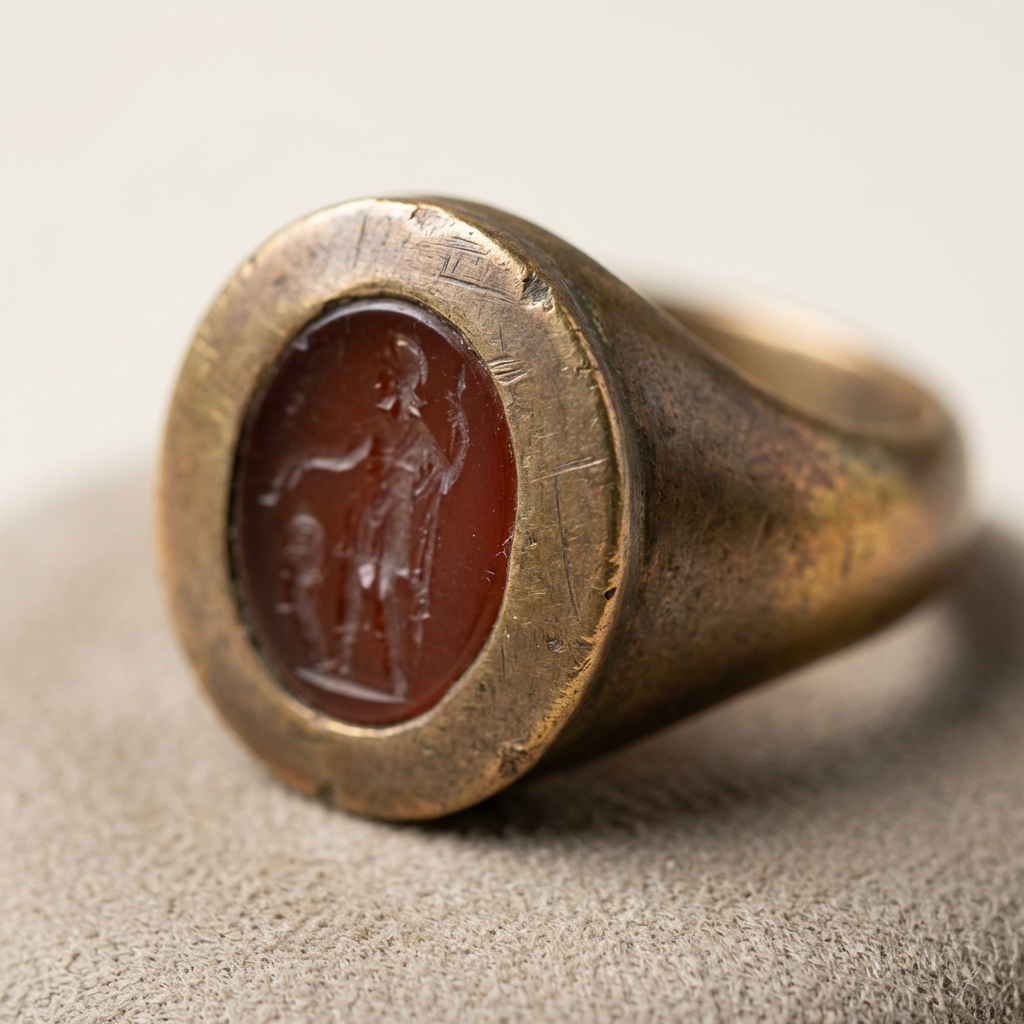
Understanding that Romans wear rings on different fingers helps avoid modern projection of wedding customs and guides better questions to ask of sellers and catalogues.
What the archaeological and textual evidence shows
Museum collection patterns and catalog notes
Museum catalogues and collection essays show repeated patterns: intaglio and signet rings, flat-bezel rings and certain band profiles appear in contexts and labels that link them to index, middle or third digit use at different times in the Republic and Imperial periods. Curatorial descriptions often point to form and wear as the primary evidence for likely placement, so museum essays remain a central starting point for interpretation, as summarized in British Museum catalogue notes British Museum catalogue.

Finds databases and regional recording
Finds recorded through national schemes and local recording projects add important regional and chronological nuance: portable finds data show variation in the types and frequencies of Roman rings by province and deposition context, underlining that a ring found in one area need not reflect practice everywhere; for searchable examples, see the Portable Antiquities Scheme records Portable Antiquities Scheme records.
Romans wore rings on the index, middle and ring fingers depending on function, period and local custom; identifying original placement relies on bezel form, band profile, patina and provenance rather than a single universal rule.
Ancient texts on betrothal and rings
Literary and epigraphic sources record betrothal gifts and named ring types, such as the anulus pronubus and anulus aureus, but they rarely fix a single finger for all contexts; texts can describe social practice or law without providing the kind of habitual-wear detail that physical traces on rings supply, as discussed in translated passages of classical texts Perseus Digital Library passages. For catalogues of historical rings see the Marshall finger rings catalogue Catalogue of the finger rings.
How ring function influenced finger choice: signet, decorative and matrimonial rings
Signet and intaglio rings and sealing use
Signet and intaglio rings are functional objects used for sealing and identification, and their bezel geometry and flat-shouldered settings often indicate handling that is consistent with wear on the index or middle finger. Where conservators note flattened bezels or reversal of an intaglio impression these traces are interpreted as functional use in sealing, not merely ornament; museum practice and object studies discuss these diagnostic features in relation to use Metropolitan Museum of Art notes and related Met publications Ten Rings from the Collection of J. Pierpont Morgan.
Decorative rings and daily wear
Decorative rings, including plain hoops and gem-set rings, were frequently worn for appearance rather than sealing and may show different contact wear; a rounded band profile and localized patina can indicate habitual wear on a finger that received less handling, making the middle or ring finger plausible for many ornamental pieces.
Wedding and betrothal rings in texts and practice
Ancient sources name rings used in betrothal ceremonies but do not universally prescribe a single finger for matrimonial rings, so regional custom and social class can affect placement; that uncertainty is why textual evidence is best read alongside object wear and find context when assessing claims about a "wedding ring" finger Perseus Digital Library passages.
Practical identification tips: reading bezels, bands, patina and wear
Bezel form and flat shoulders as clues
Bezel type is one of the clearest signals: an intaglio set in a low, flat-bezel mount with extended shoulders is more likely to have been used for sealing, which in turn points toward index or middle finger placement in many catalogued examples; conservation literature and museum labels outline how bezel geometry maps to function and handling Ashmolean Museum conservation notes.
Two step check to assess likely finger placement
Check bezel then check band and wear
Band profile and contact wear
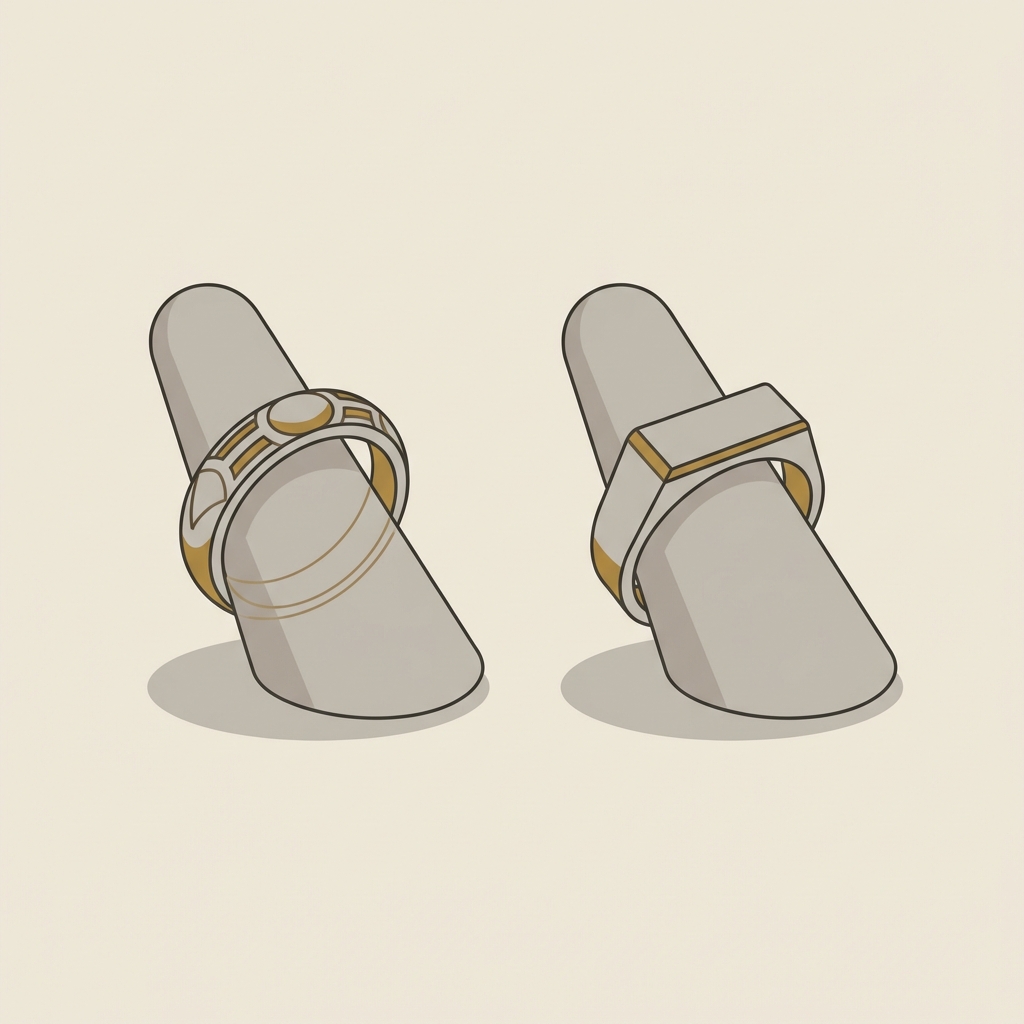
Band shape matters: flat or squared bands that show planar wear at the shoulders often indicate repeated contact with surfaces during handling, while rounded bands tend to show distributed smoothing consistent with less active use; reading these profiles alongside recorded patina helps avoid misattributing a ceremonial ring as a signet. For practical reference on reading intaglio and band wear see museum conservation guidance Ashmolean Museum conservation notes.
Using museum condition and conservation notes
Always consult condition and conservation notes where available. These reports record repairs, stabilisation, and the original state of patina and wear that underpin attributions of finger use; curatorial notes can identify whether observed wear is original or the result of later restoration, which is essential for sensible interpretation E.C.C.O. Professional Guidelines (II): Code of Ethics, European Confederation of Conservator-Restorers'.
How to read provenance, documentation and condition notes
What provenance entries typically record
Provenance entries ordinarily list collection history, prior ownership and any available verification letters; these elements help weigh a ring's documented chain and provide context for likely use, but they rarely substitute for physical wear evidence. When a listing includes detailed collection history it increases the interpretive options for placement and function, although provenance alone does not prove original finger choice British Museum catalogue.
How restoration and preservation notes affect reading wear
Conservation work can alter or obscure original wear patterns: stabilisation, re-solidifying pinched bezels or filling losses can change how contact wear appears, so restoration notes must be read to distinguish treatment effects from ancient use; museum conservation guidelines explain common interventions and their interpretive consequences Leitfaden Standards Bewahren, Deutscher Museumsbund e.V.
Why local and chronological context changes interpretation
Regional and chronological variation matters: finds reported by local recording schemes and regional reports show shifts in popular ring forms over time and between provinces, so a ring's likely finger placement can change with its archaeological context; consult regional syntheses and find reports to refine attributions Internet Archaeol. 40. Atkinson and Preston. Objects of personal adornment, Internet Archaeology, Council.
Buying checklist for collectors: what to prioritise when a listing says Roman ring
Photos, measurements and visible wear
Ask for clear, high-resolution photos showing bezel, shoulders, band profile and both lateral and frontal views, and request a scale or ruler in at least one image; visible contact wear, the edge of an intaglio and patina distribution can all be assessed from good images and help narrow likely finger placement.
Documentation to request and read
Request provenance documentation, condition notes and any conservation reports; these documents explain prior ownership and treatments and are essential for judging whether observed wear reflects ancient handling or modern intervention, so treat them as part of the primary evidence for function and placement British Museum catalogue. For further discussion see our Q and A what finger did Romans wear rings on.

Restoration disclosures and condition expectations
Look for explicit restoration disclosures and ask whether stabilisation was performed; descriptions that detail what was stabilised, repaired or left untouched help buyers weigh how much the ring's surface reflects ancient use versus later treatment, which directly affects judgments about likely finger placement E.C.C.O. Professional Guidelines (II): Code of Ethics, European Confederation of Conservator-Restorers'.
Common mistakes and how to avoid them
Assuming modern finger meanings apply
A common error is projecting modern left-right wedding customs onto Roman practice; evidence indicates Roman placements did not map neatly onto contemporary conventions, so avoid assuming a single "ring finger" meaning without object-based support British Museum catalogue.
Overreading single find reports
Do not generalise from an isolated find or catalogue entry: single examples can mislead if taken as typical, which is why comparative samples from collections and recording schemes give a more reliable picture of variation across time and place; portable finds collections and regional reports help provide that comparative framework Portable Antiquities Scheme records.
Ignoring restoration effects
Failing to account for conservation interventions can lead to false attributions: if a bezel has been reshaped or a band consolidated, wear traces may be obscured or altered, so always read restoration notes in tandem with photos and condition reports Leitfaden Standards Bewahren, Deutscher Museumsbund e.V.
Short case studies and final takeaways
Case study 1: A Roman intaglio ring with a low, flat bezel and planar shoulder wear recorded in a museum label is plausibly a seal ring intended for index or middle finger use; that attribution relies on the bezel geometry and recorded contact wear rather than a textual claim alone, illustrating how object form drives interpretation in collection entries Metropolitan Museum of Art notes.
Case study 2: A decorative gem-set hoop with a rounded band and even patina across the hoop is more likely to have been worn as personal ornament on the middle or ring finger; without sealing-related wear the ornamental interpretation is stronger, and regional find reports can help confirm common practice for that period and area Portable Antiquities Scheme records.
See curated pieces with condition notes on Aurora Antiqua
Aurora Antiqua provides detailed condition notes and contextual descriptions to help collectors evaluate likely function and placement when considering an ancient ring.
Recap checklist: examine bezel form, check band profile and contact wear, request provenance and conservation reports, and compare the piece to museum labels and regional find reports before concluding a likely finger placement.
Next steps for collectors: combine museum labels, find reports and primary texts when possible, and prioritise pieces with clear condition notes and transparent restoration disclosures to make an evidence-based assessment of Roman ring placement. See related items in our Ancient Roman Rings collection Ancient Roman Rings.
No. Ancient sources mention matrimonial rings but do not prescribe a universal left-hand practice, and archaeological evidence shows regional and chronological variation.
Yes, bezel geometry, band profile and contact wear can indicate likely placement, but these clues should be read alongside conservation reports and provenance.
Request clear photos showing bezel and band, provenance documentation, and any conservation or condition notes that describe repairs or stabilisation.
Browse the Aurora Antiqua catalogue
Every piece is independently identified, dated, and documented. Shipped insured from Belgium with DHL Express, free within the EU.
More from Aurora Antiqua
References
- Pliny the Elder, The Natural History, BOOK XXXIII, Perseus Digital Library, Tufts University (edition Bostock)
- Aulus Gellius, Attic Nights, Book X, LacusCurtius, Bill Thayer, University of Chicago (Loeb Classical Library edition)
- Ring, Victoria and Albert Museum, London
- Roman gold finger ring with intaglio, Collections Online, Amgueddfa Cymru, Museum Wales
- Thumb Ring, The Cleveland Museum of Art
- Emilie Riha, Der römische Schmuck aus Augst und Kaiseraugst (Roman jewelry from Augst and Kaiseraugst), Römermuseum Augst
- Internet Archaeol. 40. Atkinson and Preston. Objects of personal adornment, Internet Archaeology, Council
- E.C.C.O. Professional Guidelines (II): Code of Ethics, European Confederation of Conservator-Restorers'
- Leitfaden Standards Bewahren, Deutscher Museumsbund e.V
From Aurora Antiqua
We sell authenticated ancient & medieval pieces, each individually examined before listing and backed by a Lifetime Authenticity Guarantee. One of a kind, sold once, never reproduced.
Browse Ancient Roman Rings →